Mass Shootings in the 21st Century: An Examination through the Lens of the Interpersonal Psychological Theory of Suicide

SHARE THIS ARTICLE

Mass Shootings in the 21st Century: An Examination through the Lens of the Interpersonal Psychological Theory of Suicide

Tyler Hendley,1 Email the Corresponding Author Nicholas Deas,2 Sophie Finnell,3 and Robin Kowalski3


1 Department of Psychology, Louisiana State University
2 Department of Computer Science, Columbia University
3 Department of Psychology, Clemson University

Article History: Received September 27, 2024 | Accepted December 18, 2024 | Published Online January 21, 2025

ABSTRACT

Suicide-related thoughts and behaviors (SRTBs) have become identified as common antecedent experiences of mass shooters prior to and during their shootings. To better support and inform efforts of such upstream prevention and intervention efforts of mass violence, this study aimed to provide an exploratory descriptive perspective of the interpersonal experiences of mass shooters who survived and those who died on the scene (i.e., died by self-inflicted suicide, or died by police intervention) using the interpersonal psychological theory of suicide (IPTS) as a theoretical framework. Through an open-source data collection method, researchers gathered data related to the interpersonal constructs of thwarted belongingness, perceived burdensomeness, and a capability for suicide, for N = 112 mass shooters that perpetrated their crime in the 21st century. Interpersonal constructs were observed as similar across both on-scene outcomes. The interpersonal constructs of thwarted belongingness and a capability for suicide were evidenced in a majority shooters across outcomes. These results offer initial exploratory evidence that most mass shootings may, at their core, be influenced to some extent by SRTBs as described by the IPTS. By addressing mass shootings through such a point-of-view, prevention and intervention efforts may benefit from alignment with those proven efficacious for SRTBs.

KEYWORDS
mass shootings, suicide, interpersonal risk, thwarted belongingness, perceived burdensomeness

Acts of firearm violence pose serious threats to public safety in the United States (US). The Centers for Disease Control and Prevention (CDC) reported over 220,000 firearm-related deaths on American soil from 2018 to 2022 (CDC, 2023). Of these deaths, 61% have been linked to deaths by suicide and 36% were the result of homicide (CDC, 2023). Amongst deaths that were a result of homicide in the US, less than 1% were a consequence of a mass shooting (Peterson & Densley, 2023). While statistically rare, the effects of firearm violence on victims, families, communities, and society should not be understated (Lowe & Galea, 2017).

According to the Congressional Research Service, and, as followed by this study, mass shootings result in four or more deaths by firearm (not including the shooter), a death in a public location or locations in close geographical proximity (e.g., a school, workplace, restaurant, shopping center), and must not be related to other criminal activity or commonplace circumstance (e.g. gang activity, armed robbery, family violence; Krouse & Richardson, 2015; see also Peterson & Densley, 2019; 2023). It should be noted that, although this study followed the Congressional Research Service’s (Krouse & Richardson, 2015) definition of mass shootings, there is no universally agreed upon definition for this phenomenon, which can result in discrepancies of qualifications and frequency measurements for such shootings (Booty et al., 2019).

These types of shootings have plagued the US for decades and are becoming both more frequent and deadlier (Peterson & Densley, 2023). According to The Violence Project Database of Mass Shootings (Violence Project; Peterson & Densley, 2023), more than half of the deadliest 35 shootings over the past 100 years have occurred since 2010, with the single-most deadly taking place in 2017 at the Route 91 Harvest Music Festival in Las Vegas, Nevada.1 As seen in many mass shootings, the Las Vegas shooting resulted in the death of the perpetrator at the scene of the shooting (Shultz et al., 2017). Since 1966, 57% of mass shooters have died on the scene of their killing (Peterson & Densley, 2023). Additionally, 72% of mass shooters had expressed some degree of suicidal ideation prior to or during the shooting, and 38% died by suicide during the shooting (Peterson & Densley, 2023; Shahid & Duzor, 2021). Shooters who died on the scene of the crime, but not by suicide, perished at the hands of intervention by an external force (e.g., law enforcement). Within this category of shooter mortality, the phenomenon known as suicide-by-police may act as a driving factor (Lankford, 2015), with up to 10% of mass shooters creating a suicide-by-police situation (Lankford, 2015).

Suicide, in a general sense, is a highly complex, multi-faceted human phenomenon (de Beurs et al., 2021; Orsolini et al., 2020) that has yet to be fully understood. Many current theorists believe that the phenomenon is a result of an interplay of psychological, biological, and social risk/protective factors (de Beurs et al., 2021; Orsolini et al., 2020). Among these theories is Thomas Joiner’s (2005) interpersonal psychological theory of suicide (IPTS). According to Joiner’s (2005) IPTS, the desire to die by suicide (i.e., suicidal ideation) is a result of the simultaneous interpersonal experience of thwarted belongingness (TB) and perceived burdensomeness (PB). This theory further posits that, to transition from suicidal ideation to suicidal behavior, the individual must possess a capability to enact lethal self-injury (Joiner, 2005). This transition of ideation to behavior has led to the IPTS being considered “the first in line of ‘next generation’ theories of suicide” due to its consideration of suicidal ideation and suicidal behavior as two distinct processes (Klonsky et al., 2018, p. 38). The IPTS differs from other theories of suicide who treat ideation and behavior as two distinct processes (e.g., integrated motivational-volitional theory, three-step theory; Klonsky & May, 2015; O’connor, 2011) however, as it proposes that one must overcome the innate fear of death to transition from ideation to behavior (Klonsky et al., 2018).

It should be noted that, at the time of this study, modifications to the IPTS have been proposed. Most notably, Van Orden and colleagues (2010) theorize that suicidal ideation is the result of an intractable sense of hopelessness about one’s interpersonal states of TB and PB (see also Joiner et al., 2021). Research has shown both hopelessness and suicidal ideation to be higher among individuals labeled with a mental illness (e.g., major depressive disorder, psychosis, anxiety disorders; Oexle et al., 2017). Such individuals subsequently have shown to be at higher risk for suicide-related behaviors (Brådvik, 2018). Since the present study is one of the first to examine suicidality among mass shooters, the researchers decided to focus on the original core components of the IPTS (i.e., hopelessness was not included in the current study; Joiner, 2005). However, in light of research since the inception of the theory, the researchers also recognize both the interpersonal and intrapersonal factors that contribute to suicidal ideation and suicide attempts. Specifically, thwarted belonging is more interpersonal in nature compared to perceived burdensomeness which reflects intrapersonal perceptions and concerns. Additionally, compared to its original formulation as a purely acquired state, the capability for suicide may also stem from dispositional variables (Bayliss et al., 2022).

As described by Baumeister and Leary (1995), the need to belong is a fundamental human motivation that drives individuals to maintain relationships with peers. If this need to belong is threatened, and one does not feel they belong to a community, even if they try to connect, there may be an increased risk of psychological and physical consequences, including suicidal ideation (Joiner, 2005). Additionally, research indicates that feelings of TB can be exacerbated by interpersonal risk factors such as bullying victimization (Gunn & Goldstein, 2017), long-term rejection (e.g., Hill et al., 2017), short-term rejection (e.g., romantic dissolution; Love et al., 2018), and other negative life events (see Glenn et al., 2022). Similarly, if an individual feels they are a burden to others, it may lead to thoughts that peers, family, or society would be better off without them (Joiner, 2005; see also Van Orden et al., 2006).

The capability for suicide is due, in part, to the habituation or desensitization to the fear of death which can occur through both physical and psychological means (Joiner, 2005). Additionally, an individual must have access to means (e.g. firearm, knife, excessive amounts of medication) for a lethal or near-lethal suicide attempt to occur (Joiner, 2005).2 Physical desensitization is mostly due to an increase in physical pain tolerance, whereas psychological desensitization is said to be a result of one’s lowered fear of death and pain (Joiner, 2005). The capability to enact lethal self-injury through physical means can be heightened through various ways such as nonsuicidal self-injury (Joiner, 2005; Whitlock et al., 2013), prior injury (e.g. broken bone, concussion; Fralick et al., 2019), being a victim of assault (Sutherland et al., 2002; Tomasula et al., 2012), and even donning tattoos and piercings (Blay et al., 2023; Solís-Bravo et al., 2019). Additionally, individuals may psychologically increase the capability for suicide through means such as mentally rehearsing or preparing for their suicide attempt (George et al., 2016), viewing social media content/videos of suicide or lethal injury (Kocakaya & Arslan, 2023), or working in professions that involve violence and/or mortality (e.g. military, emergency medicine doctors; Bartram & Baldwin, 2010; Joiner, 2005).

The elements of TB, PB, and the capability for suicide map onto variables found in previous research examining the behaviors and experiences of individuals criminally involved in school and mass shootings. Leary et al. (2003) found five antecedent conditions common to many K-12 school shootings: a long-term history of rejection, an acute rejection experience, a fascination (i.e., a preoccupation of out proportion compared to the general population) with firearms, a fascination with death/violence, and a history of psychological problems. More recently, Kowalski et al. (2021) examined the degree to which these same variables were related to K-12 as well as mass shootings that had occurred since the Leary et al. (2003) study. Among K-12 shooters included in their study, 63% had experienced acute and/or long-term rejection. Among mass shooters, 20% had experienced a long-term history of rejection, with 53% reporting an acute rejection experience (see Kowalski et al., 2021). According to Chinazzo et al. (2023), such experiences of rejection can lead to negative outcomes such as suicidal ideation or suicide attempts. In addition, 35% of K-12 shooters and 61% of mass shooters demonstrated a fascination with violence, often prior mass shootings (e.g., researching and idealizing the Columbine High School shooting). Almost a fifth (17.5%) displayed a fascination with firearms, often acquiring them from family members (see Kowalski et al., 2021). Immersing themselves in prior shootings or other forms of violence and frequently having ready access to firearms feeds into a capability for suicide.

Purpose of the Research

Results, such as these from Kowalski and colleagues (2021), indicate that the interpersonal risk factors that drive suicidal ideation and suicide attempts, may also play a role in driving acts of mass murder. As SRTBs have become identified as common antecedent experiences of mass shooters prior to and during their shootings (see Joiner, 2024), researchers have called for further research into the relationship of the two distinct yet possibly related phenomena (Hagan et al., 2015; Lankford, 2015). With those perpetrating a mass shooting and simultaneously experiencing SRTBs only composing a statistically rare proportion of all individuals who experience SRTBs, it’s important to attempt to understand what may lead one to act on lethal urges toward others, and possibly themselves, rather than only themselves. This said, straying away from reactive measures (e.g., metal detectors in schools, excessive law enforcement presence), researchers believe that interventions directed towards upstream targets (i.e., SRTBs) may be beneficial in the prevention of mass violence (Hagan et al., 2015; Langman, 2017).

To better support and inform efforts of such upstream prevention and intervention efforts of mass violence, this study presents an exploratory descriptive perspective of the interpersonal experiences of mass shooters who survived and those who died on the scene (i.e., died by self- inflicted suicide, or died by police intervention) using Joiner’s (2005) IPTS as a theoretical framework. The IPTS was chosen as the framework for this study for several reasons. First, and most importantly, the IPTS is a leading theory for why individuals die by suicide, and due to the large percentage of mass shooters experiencing suicidal thought and behaviors, prior to or during the shooting (Lankford et al., 2021), the researchers felt it was important to utilize a well-studied and supported theory of suicide for this study’s framework. Secondly, it considers both interpersonal and intrapersonal factors as risk factors for suicidal ideation and behavior, a common finding of antecedent thoughts and behavior also seen in mass shooters (Lankford et al., 2021). Finally, a major component of the IPTS is the capability for suicide, which the authors believed may also be a factor in mass shooters’ ability to overcome the innate fear of ending one’s life (i.e., mass shooters may also experience aversive, traumatic, or painful events that lead to the capability of not only suicide, but lethal behaviors directed at others). Toward this end, the researchers used an open-source data collection method with hopes of better understanding antecedent behaviors and interpersonal experiences of mass shooters.

To paint a clearer picture of the interpersonal risk factors that may have impacted SRTBs, as well as the decision of the individuals to perpetrate the mass shooting, two research questions are proposed:

RQ1: Are there similarities in antecedent IPTS components (i.e., TB, PB, capability for suicide) experienced by mass shooters who live versus die at the scene of their crime?

RQ2: Do mass shooters have experiences of perceived burdensomeness, thwarted belongingness, and a capability to enact lethal self-injury prior to their shooting?

Method

Study Population

Focusing on the 21st century, a total of 112 individuals who perpetrated a mass shooting between January 9, 2001, and May 6, 2023, were included in the study.3 Mass shooters were identified by referencing The Violence Project Database of Mass Shootings, Version 7.0 (Peterson & Densley, 2023), which stores data of mass shooters (in accordance with the Congressional Research Service’s (Krouse & Richardson, 2015) definition of a mass shooter) from 1966 to present. Of the examined mass shooters, 95% (n = 106) were assigned male at birth. Racial and ethnic makeups of the shooters included 49% (n = 55) White, 20% (n = 22) Black, 9% (n = 10) Latinx, 8% (n = 9) Asian, 8% (n = 9) Middle Eastern, and 6% (n = 7) other. The average age of mass shooters was 34 years old with 47% (n = 53) of shooters falling between the ages of 15- and 30-years-olds, 38% (n = 43) between 31- and 50-years-old, and 14% (n = 16) 51-years-old or older. It should be noted that following in line with recommendations from organizations such as No Notoriety (n.d.) and ALERRT (n.d.), no shooters will be named in this manuscript or its data. A full list of shootings included in this study can be found in the appendix.

Measures

Demographics

Demographic information for mass shooters was informed via The Violence Project Database of Mass Shootings, Version 7.0 (Peterson & Densley, 2023). Demographic variables included location and date of the shooting, race/ethnicity, age, and sex.

Thwarted Belongingness (TB)

Experiences of TB were measured through evidence of the presence of three interpersonal risk factors which may have affected one’s sense of belonging: a history of bullying victimization (i.e., bullied), an acute short-term rejection experience, and/or a history of long-term rejection. Risk factors were coded as present if evidence for their presence were found within the sources. Risk factors were not coded for their absence, as it is not possible to truly confirm the total absence of such experiences. Individuals experiencing at least one TB risk factor were coded as showing evidence for some degree of TB prior to their shooting. Bullying victimization data was gathered from The Violence Project Database of Mass Shootings, Version 7.0 (Peterson & Densley, 2023) and included evidence of the shooter being a victim of bullying to at least some extent in any setting (e.g., school, workplace). Detailed descriptions of all other risk factors for this construct can be found in Table 1.

                         (Click table to enlarge)

Perceived Burdensomeness (PB)

Experiences of PB were measured through evidence of the presence of the shooter reporting feelings of being a burden to society and/or friends/family. Risk factors were coded as present if evidence for their presence were found within the sources. Risk factors were not coded for their absence, as it is not possible to truly confirm the total absence of such experiences. Individuals experiencing at least one PB risk factor were coded as showing evidence for some degree of PB prior to their shooting. Detailed descriptions of both risk factors for this construct can be found in Table 1.

Capability for Suicide

Experiences potentially increasing one’s capability for suicide were measured through evidence of the presence of two physical and six psychological risk factors that may had desensitized one to the act of lethal self-injury. Psychological risk factors included: passive (i.e., witnessing death as a bystander) and/or active (i.e., witnessing death as a perpetrator of homicide) exposure to death, fascination with death and/or violence, fascination with guns and weapons, and traumatic events that did not result in physical pain (e.g., witnessing abuse). Physical risk factors included: exposure to physical pain (chronic or acute), traumatic event(s) that resulted in physical pain, and body enhancements (e.g., piercings or tattoos; may also be referred to as “body modifications”). It should be noted that these are solely risk factors for SRTBs and do not necessarily indicate that an individual will perpetrate a mass shooting if they, for example, don tattoos. However, the exposure to pain, such as tattoos and piercings, may act as a form of non-suicidal self-injury and have been positively linked with SRTBs (Blay et al., 2023). Risk factors were coded as present if evidence for their presence were found within the sources. Risk factors were not coded for their absence, as it is not possible to truly confirm the total absence of such experiences. Individuals experiencing at least one capability for suicide risk factor were coded as showing evidence for some degree of capability for suicide prior to their shooting. Detailed descriptions of each risk factor for this construct can be found in Table 1.

Procedures

Theoretical Framework

To examine antecedent risk factors of mass shooters, Joiner’s IPTS (2005) was selected as a theoretical framework utilizing TB, PB, and capability as constructs to guide the coding process. Due to the complex nature of such thoughts and behaviors (see de Beurs et al., 2021), and past research of mass violence and suicide (see Kowalski et al., 2021; Peterson & Densley, 2023), it was decided that these risk factors and constructs may give the greatest insight into precedent influences of the two phenomena.

Sources

Sources for coding the shootings consisted of primary sources (e.g., manifestos, journals, personal blogs), secondary sources (e.g., local news articles, police reports, court rulings), and community sources (e.g., Federal Bureau of Investigation (FBI) reports). To reduce chances of source selection bias, each of four raters were randomly assigned 28 shootings in which the rater selected five sources for each shooting. This procedure also falls in line with Booty et al.’s (2019) recommendation of corroborating evidence of each mass shooting with multiple sources to help mitigate concerns with the use of multiple definitions of the

phenomenon. Additionally, the use of multiple sources, and a variety of types of sources, assisted in corroborating evidence found for individual variables. A total of 559 sources were used in the coding process.4 The sources, when possible, for each shooting were bipartisan to reduce news source bias. To increase reliability across raters, only the five selected sources were utilized during the rating process for any given shooting.

Risk Factors

To quantify the evidence found in support of the presence TB, PB, and/or a capability for suicide for shooters, a set of risk factors were developed for each interpersonal construct that represented the IPTS (Joiner, 2005; see Table 1). For example, if a mass shooter had experienced bullying victimization, this would constitute evidence of the presence of some degree of TB for that shooter. As there is no known empirical evidence supporting the use of IPTS risk factors for the quantification of individual risk level (e.g., experiencing three TB risk factors constituting a different level of suicide risk compared to experiencing two TB risk factors), this study considered an individual experiencing any number of IPTS risk factors as experiencing that specific overarching construct to some degree. This scheme was followed for PB and capability for suicide risk factors as well. All risk factors considered for each construct, along with coding definitions, can be found in Table 1. Additionally, all risk factors have shown empirical support as being related to the construct of interest.

Coding

Preceding the coding process, shooters were randomly divided and assigned to four raters. Using an open-source data collection method, mass shootings were coded by four raters for evidence suggesting the presence of PB, TB, and capability for suicide for n = 112 mass shooters. All shooters were coded by two raters such that each unique pair of raters shared an equal number of shooters (n = 18 or n = 19 each among 6 pairs). To assist with uniformity and accuracy during the coding process, a codebook was developed and adhered to by each rater. Utilizing previous literature (e.g., Hill et al., 2017; Joiner, 2005; Solis-Bravo et al., 2019; Tomasula et al., 2012), the codebook consisted of risk factors developed for each of the IPTS’ three constructs (i.e., TB, PB, and capability for suicide). Risk factors were coded present if evidence of its presence was determined within the sources by raters. If the risk factor of interest was not identified within the sources, that variable was considered lacking evidence for by the raters. When a risk factor was lacking evidence for its presence, this was only indicative of it not being cited within the sources and did not deem it confirmatory of its absence.

Outcome

Throughout analyses, whether a shooter dies at the scene of the shooting is considered as the outcome or response variable. These codes are drawn from the “On Scene Outcome” variable from The Violence Project Database of Mass Shootings, Version 7.0 (Peterson & Densley, 2023), considering both “Killed Self” and “Killed on Scene” collectively as “Died on Scene” values.

Interrater Agreeability and Discrepancy Resolution

Using Cohen’s Kappa (Cohen, 1960), interrater agreeability across all variables among the four raters was calculated to assess overall variability across the raters’ interpretation of (1) the codebook criteria and (2) the selected open sources. Most variables fell at, or above, 𝜿 = .75, indicating relatively strong agreement across raters. One variable, fascination with death, had a weaker level of agreement (𝜿 = .54) due to raters’ individual perceptions of unique characteristics associated with some shooters (e.g., shooters who had become radicalized by terrorist organizations were coded by some raters as having a fascination with death, while other raters did not code this as a fascination). Any variable with a disagreement between raters was critically examined by all four raters. Following examination, a discussion was held for each discrepancy and, with reference to the codebook, a decision was made by the majority to mark the variable as either possessing evidence indicating its presence within the source or not possessing sufficient evidence to support its presence in the sources.

Analytical Strategy

Risk Factors and Shooting Outcomes

Research Question 1 asks whether there are similarities in antecedent IPTS components experienced by mass shooters who survive and die at the scene of their crime. Toward investigating this question, the proportions of shooters evidenced by indicating experiencing the IPTS components to some degree were assessed among shooters that died at the scene and survived the shooting. Additionally, similar analytic strategies were utilized to investigate similarities between the two groups for each individual IPTS risk factor. Plots developed in analysis separate Self-Perpetrated Suicide and Died by Police in the Died on Scene group, but proportions are reported for the Survived group as a whole.

Finally, the overlap between the presence of IPTS components, interpersonal risk factors, and outcome variables, are assessed. Correlations were measured using the Jaccard similarity coefficient as all variables are dichotomous (e.g., there was evidence that indicated the presence of a variable or there was no evidence that indicated the presence of a variable).

Risk Factors in Shootings

Following these analyses, Research Question 2 asks whether mass shooters have experiences of PB, TB, and a capability to enact lethal self-injury prior to their shooting. The proportions of each IPTS component and individual risk factors evidenced as present within the open sources for mass shooters were calculated among the full set of shootings in the database.

Results

Risk Factors Differences in Shooting Outcomes

To investigate Research Question 1, whether there are similarities in the prevalence of IPTS components between shooters that died on the scene and those that survived, Figure 1 shows the proportion of shooters for which evidence of each component was identified. Evidence of TB was indicated as the most commonly mentioned antecedent experience of mass shooters within the IPTS constructs for both outcomes, died on the scene (85.5%) and survived the shooting (94.3%). Evidence for a capability for suicide was indicated as the second most common IPTS antecedent experience of mass shooters for both those that died on scene (75.4%) and survived (71.4%). Finally, PB was the IPTS construct in which the least amount of evidence was found across both outcomes, died on the scene (5.8%) and survived (5.7%).

                         (Click figure to enlarge)

Similar to Figure 1, Figure 2 shows the proportion of shooters for which evidence of each interpersonal risk factor was identified between those that died on the scene and those that did not. As in Figure 1, proportions of the PB risk factors between the two groups were similar: 1.5% and 5.8% among those that died on the scene and 2.9% and 5.7% among those that did not for PB (Society) and PB (Family/Friends) respectively. Regarding TB, evidence of Short-Term Rejection and Long-Term rejection were the most commonly found antecedent experiences for both shooting outcomes, died on scene (78.3% and 44.9%, respectively) and survived (74.3% and 62.9%, respectively). Finally, for the capability for suicide risk factors, the group that died on the scene presented a higher proportion of evidence of Active Exposure to Death (5.8% vs. 2.9%), Passive Exposure to Death (20.3% vs. 14.3%), Body Enhancements (10.1% vs. 0%), Fascination with Death (30.4% vs. 22.9%), and Adult Trauma (5.8% vs. 2.9%) than among those that did not. Childhood Trauma is the sole capability for suicide factor that was evidenced as more prevalent among those that survived the shooting (37.1% vs. 31.9%).

                         (Click figure to enlarge)

Finally, Figure 3 shows the Jaccard Similarity Indices between the outcome variables and both the IPTS components and risk factors. Considering whether the shooter died by self-perpetrated suicide or died on the scene, while evidence of TB (J = 0.38 and J = 0.22, respectively) and a capability for suicide (J = 0.34 and
J = 0.25) sufficiently overlapped, PB was greatly different (J = 0.09 and J = 0.00). Among TB factors, Short-Term Rejection was most similar (J = 0.40 and J = 0.21) followed by Long-Term Rejection (J = 0.25 and J = 0.17). Finally, each capability for suicide factor alone was dissimilar with whether the shooter died at the scene or not, with Fascination with Firearms (J = 0.27 and J = 0.14) and Fascination with Death (J = 0.22 and J = 0.16) being the least dissimilar.

                         (Click figure to enlarge)

IPTS Risk Factors in Shooters

Toward answering Research Question 2, whether mass shooters have experiences of PB, TB, and a capability for suicide prior to their shooting, Figure 4 shows the overall prevalence of shooter outcomes, the IPTS components, and risk factors among all shooters. First, while a minority of shooters died by taking their own lives (39.4%), a majority died on the scene (66.4%). This discrepancy is accounted for by those who died by police intervention (25.0%). Among the IPTS components, PB (5.8%) was rarely evident among shooters, while evidence of TB (88.5%) and a capability for suicide (74.0%) was found in a majority of shooters. Additionally, most single risk factors were present in less than 50% of shooters, with the exception of the proportion of Long-Term Rejection (51.0%) and Short-Term Rejection (76.9%).

                         (Click table to enlarge)

Discussion

The current study intended to provide an exploratory descriptive analysis of antecedent interpersonal experiences and risk factors among mass shooters who died on the scene, and those who survived their shooting. Results aimed to provide possible insight into potential upstream targets (i.e., interpersonal processes and behaviors that occur before the act of violence) for the prevention of mass shootings. While the current study only focuses on a subset of mass shootings (i.e., only shootings in the 21st century), the researchers hope that this work will assist in developing the groundwork for future studies assessing the potential impact of SRTBs on the perpetration of mass shootings.

Addressing Research Question 1, across both groups of shooters, those who died on the scene and those who survived, TB was present in at least 80% of each group. PB, on the other hand, was present in just over 5% of shooters. The failure to find much evidence of PB should not be taken as an indication that mass shooters do not feel that they are a burden to society or to family and friends. It may simply be an artifact of the modality by which information for the current study was collected. Specifically, unless there was a direct quote in a manifesto left by a shooter, no evidence of PB was observed. Because it is the shooters’ self-perception that they are a burden (and not necessarily others’), it may be more likely to not see this variable as much as TB which can be observed by outsiders (e.g. if someone’s a loner, this will be obvious to peers/family). This is consistent with prior research examining the presence of PB and TB in suicide notes. Gunn et al. (2012) found that only 10.3% of suicide notes showed indications of PB, with 30.7% indicating TB. Lester and Gunn (2012) later examined a larger sample and found an even larger difference in the proportions,15.5% and 42.5% respectively.

The prevalence of TB among both shooters who died at the scene and those who did not highlights the importance of people’s need to belong (Baumeister & Leary, 1995). People who feel rejected have low relational value (Kowalski & Leary, 2024; Leary, 2001). As noted by Kowalski and Leary (2024, p. 241), “a good deal of aggression and violence is perpetrated by people who feel that other people inadequately value having relationships with them. In such cases, the perpetrator feels rejected, is invariably hurt and angry, and behaves aggressively.”

The higher proportion of TB evidence among shooters who survived compared to those who died on the scene was surprising. This may reflect the shooter’s motivation. Those who survived and felt that others had rejected them may have been motivated to hurt and kill as many others as they could, excluding the self. Their resentment may be other- rather than self-directed. Shooters who died on the scene, alternatively, may have had more self-hatred that better allowed them to overcome the motive for self-preservation (Lankford, 2015).

An examination of IPTS risk factors demonstrated a higher proportion of short-term rejection in shooters who died on the scene compared to those who didn’t. However, a higher proportion of long-term rejection was observed in shooters who survived than shooters who died on the scene. People who have a history of rejection may desire to enact violence to cause pain to those who have hurt them out of spite, as opposed to self-inflicted harm (Leary, 2015). It is also possible that people who have a long-term history with rejection may have developed a sense of resilience that helps maintain the desire for self-preservation in the face of adversity. Additionally, Joiner (2014) highlights the premeditation that accompanies murder-suicides. Thus, what may seem like the proverbial straw that broke the camel’s back may instead create a situation where the perversion of an interpersonal virtue can occur (Joiner, 2014).

The proportion of shooters for which evidence for a capability for suicide was present was similar across both groups, those who died at the scene and those who did not. However, individual risk factors for a capability for suicide did show some differences. Specifically, shooters who died at the scene had higher proportions of active and passive exposure to death, adult trauma, and body enhancements. This falls in line with previous research, such as Pirelli and Jeglic’s (2009), which found those who had been exposed to a death by suicide or acute disease were more likely to have reported a suicide attempt compared to those who had not experienced a similar death exposure. In particular, the active and passive exposure to death may have made death seem less foreboding and, perhaps, a welcome respite from the pain and trauma of life.

The Jaccard Similarity Indices allowed a direct comparison between shooters who died by suicide versus those who died on the scene either through self-inflicted suicide, suicide by police, or by being shot by another individual other than a police. Similarity indices for TB and a capability for suicide were high for the two variables. They were much lower, however, for PB. IPTS risk factors for TB showed strong similarity for short-term rejection followed by long-term rejection.

Regarding Research Question 2, the presence of TB and a capability for suicide in a majority of the shooters indicate that interpersonal constructs evidenced in mass shooters overlap with those of suicidal individuals in accordance with the IPTS. Regardless of the outcome of the shooting, TB was the most represented of the IPTS components, present to some degree in almost 90% of the shooters. While not as prominent, some degree of a capability for suicide was evident in over 75% of shooters, indicating that almost three-fourths of all shooters had experienced physical or psychological events that may have lowered their fear of death, and therefore, enhanced their ability to overcome the instinctual human behavior for self- preservation.

Within the TB construct, short- and long-term rejection constituted the most prominent IPTS risk factors, with some form of short-term rejection present in almost 80% of all mass shooters. This presence of short-term rejection as an antecedent experience in a majority of shooters may indicate a lack of proficiency in individual coping and crisis response skills (i.e., managing emotions and behaviors in events that may evoke heightened arousal). While many individuals are fired from their profession or broken up with by a romantic partner, only a statistically rare few go on to perpetrate a mass shooting. Additionally, with at least 40% of all shooters expressing a fascination with firearms, and all having access to firearms, this may indicate a missed opportunity for intervention, such as means safety. As a crucial piece of suicide safety planning interventions (see Stanley & Brown, 2012), means safety seeks to remove or limit one’s access to lethal means (e.g., firearms) before and/or during times of crises. Restricting (e.g., safe storage, universal background checks) and/or removing one’s access to lethal means has proven effective for suicide intervention (Jin et al., 2016), which yields promise for translating such an intervention to individuals deemed at risk of perpetrating a mass shooting.

Limitations and Future Research

As an exploratory descriptive analysis, the results of the current study should be interpreted with caution. First, the sample size is limited due to the rarity of occurrence of mass shootings. Second, as noted, PB was not often evidenced if the shooter did not express it prior to their shooting. It may be important to gain insight into the absence of PB in online sources that detail shooters’ antecedent thoughts and behaviors. Additionally, if a shooting was perpetrated as a result of radicalization, it may be difficult to find evidence of TB as these individuals may have swung the pendulum of belonging to an excessive amount rather than thwarted (see Joiner, 2024). Third, beyond manifestos that only a few shooters left behind, it is impossible to discern the true motives and feelings of shooters who died on the scene as truly suicidal. Thus, understanding the true impact of individual risk factors on particular shooters is difficult. Fourth, the study gathered information from open sources such as media reports and the Violence Project Database (Peterson & Densley, 2019). Media report snapshots of information that may be true in the moment until disconfirming information is later revealed in which case a story may or may not be updated. In addition, public records for juveniles are limited, which affects the nature of data accessibility. Other databases for mass shootings exist that differ slightly in the shootings reported along with other characteristics. Depending on the database used, slightly different results may emerge. Finally, this study did not code for the absence of variables, only for the evidenced presence of an interpersonal variable. This method does not allow for definite absences of variables, which may result in missing data not found within the included sources. Future research should continue to allocate efforts to better understanding the impact of suicidal ideation on perpetrating mass shootings. Additionally, future research should consider utilizing a case study research method to counter the small sample size of perpetrators and to possibly allow for a better understanding of varying risk factor experiences that may occur between persons.

Conclusion

Results support previous theory (Joiner, 2024) that components of the IPTS would likely be evidenced in antecedent behaviors and experiences (i.e., before the shooting) of most mass shooters. Though PB was not observed to the extent of TB and capability for suicide throughout the coding process, it is most likely the case that this construct would present greater through self-reports. These results offer initial exploratory evidence that most mass shootings may, at their core, be influenced to some extent by SRTBs as described by the IPTS. By addressing mass shootings through such a point-of-view, prevention and intervention efforts may benefit from alignment with those proven efficacious for SRTBs. Such efforts may include restricting and/or removing access to means (Sarchiapone et al., 2011; Wintemute et al., 2019), safety planning (see Stanley & Brown, 2012), and psychoeducation regarding crisis response skills (e.g., distress tolerance skills; see Linehan, 2014). By confronting perceived threats with upstream preventative measures, rather than reactive, the researchers believe that the frequency of mass shootings could be reduced.

NOTES

  1. These statistics should be interpreted through the lens of firearm technology and social context. Firearm technology has advanced markedly in recent years. Additionally, prior to the digital age, records were insufficient regarding incidents of mass violence and often did not include shooting massacres of people groups with limited rights, such as Native Americans.
  2. It is assumed in this study that all mass shooters had access to lethal means due to the use of a firearm in their shooting.
  3. While there may have been more recent mass shootings that fell between May 6, 2023, and the submission of this paper, a cutoff date had to be established for coding and data analysis purposes.
  4. It should be noted that the shooting which took place in Rifle, CO, only had four sources listed due its lack of news sources accessible to the raters.


ARTICLE APPENDIX
An appendix to the article containing the study’s case list is available below.

(Click table image to enlarge)

DISCLOSURE STATEMENT
No potential conflicts of interest were reported by the authors.

DATA AVAILABILITY
The data that support the findings of this study are available from the corresponding author, Tyler Hendley, upon reasonable request.


REFERENCES

ALERRT. (n.d). Don’t name them. https://www.dontnamethem.org/

Bartram, D. J., & Baldwin, D. S. (2010). Veterinary surgeons and suicide: A structured review of possible influences on increased risk. Veterinary Record, 166(13), 388-397. https://doi.org/10.1136/vr.b4794

Baumeister, R. F., & Leary, M. R. (1995). The need to belong: Desire for interpersonal attachments as a fundamental human motivation. Psychological Bulletin, 117(3), 497. https://doi.org/10.1037/0033-2909.117.3.497

Bayliss, L. T., Christensen, S., Lamont-Mills, A., & du Plessis, C. (2022). Suicide capability within the ideation-to-action framework: A systematic scoping review. PloS One, 17(10), e0276070. https://doi.org/10.1371/journal.pone.0276070

Blay, M., Hasler, R., Nicastro, R., Pham, E., Weibel, S., Debbané, M., & Perroud, N. (2023). Body modifications in borderline personality disorder patients: prevalence rates, link with non-suicidal self-injury, and related psychopathology. Borderline Personality Disorder and Emotion Dysregulation, 10(1), 7. https://doi.org/10.1186/s40479-023-00213-4

Booty, M., O’Dwyer, J., Webster, D., McCourt, A., & Crifasi, C. (2019). Describing a “mass shooting”: The role of databases in understanding burden. Injury Epidemiology, 6, 47. https://doi.org/10.1186/s40621-019-0226-7

Brådvik, L. (2018). Suicide risk and mental disorders. International Journal of Environmental Research and Public Health, 15(9), 2028. https://doi.org/10.3390/ijerph15092028

Centers for Disease Control and Prevention. (2023). Web-based Injury Statistics Query and Reporting System. https://wisqars.cdc.gov/data/explore-data/home

Chinazzo, Í. R., Fontanari, A. M. V., Costa, A. B., & Lobato, M. I. R. (2023). Factors associated with suicidal ideation and suicide attempt in Brazilian transgender youth. International Journal of Environmental Research and Public Health, 20(4), 3215. https://doi.org/10.3390/ijerph20043215

Cohen, J. (1960). A coefficient of agreement for nominal scales. Educational and Psychological Measurement, 20(1), 37-46. https://doi.org/10.1177/001316446002000104

de Beurs, D., Bockting, C., Kerkhof, A., Scheepers, F., O’Connor, R., Penninx, B., & van de Leemput, I. (2021). A network perspective on suicidal behavior: Understanding suicidality as a complex system. Suicide and Life‐Threatening Behavior, 51(1), 115-126. https://doi.org/10.1111/sltb.12676

Fralick, M., Sy, E., Hassan, A., Burke, M. J., Mostofsky, E., & Karsies, T. (2019). Association of concussion with the risk of suicide: A systematic review and meta-analysis. JAMA Neurology, 76(2), 144-151. https://doi.org10.1001/jamaneurol.2018.3487

George, S. E., Page, A. C., Hooke, G. R., & Stritzke, W. G. (2016). Multifacet assessment of capability for suicide: Development and prospective validation of the Acquired Capability With Rehearsal for Suicide Scale. Psychological Assessment, 28(11), 1452-1464. https://doi.org/10.1037/pas0000276

Glenn, C. R., Kleiman, E. M., Kandlur, R., Esposito, E. C., & Liu, R. T. (2022). Thwarted belongingness mediates interpersonal stress and suicidal thoughts: An intensive longitudinal study with high-risk adolescents. Journal of Clinical Child & Adolescent Psychology, 51(3), 295-311. https://doi.org/10.1080/15374416.2021.1969654

Gunn, J. F., & Goldstein, S. E. (2017). Bullying and suicidal behavior during adolescence: A developmental perspective. Adolescent Research Review, 2(2), 77-97. https://doi.org/10.1007/s40894-016-0038-8

Gunn, J. F. III, Lester, D., Haines, J., & Williams, C. L. (2012). Thwarted belongingness and perceived burdensomeness in suicide notes. Crisis: The Journal of Crisis Intervention and Suicide Prevention, 33(3), 178-181. https://doi.org/10.1027/0227-5910/a000123

Hagan, C. R., Podlogar, M. C., & Joiner, T. E. (2015). Murder-suicide: Bridging the gap between mass murder, amok, and suicide. Journal of Aggression, Conflict and Peace Research, 7(3), 179-186. http://dx.doi.org/10.1108/JACPR-07-2014-0132

Hill, R. M., Rooney, E. E., Mooney, M. A., & Kaplow, J. B. (2017). Links between social support, thwarted belongingness, and suicide ideation among lesbian, gay, and bisexual college students. Journal of Family Strengths, 17(2), 6. https://doi.org/10.58464/2168-670X.1350

Jin, H. M., Khazem, L. R., & Anestis, M. D. (2016). Recent advances in means safety as a suicide prevention strategy. Current Psychiatry Reports, 18, 96. https://doi.org/10.1007/s11920-016-0731-0

Joiner, T. (2014). The perversion of virtue: Understanding murder-suicide. Oxford University Press.

Joiner, T. (2024). The varieties of suicidal experience: A new theory of suicidal violence. New York University Press.

Joiner, T. E. (2005). Why people die by suicide. Harvard University Press.

Joiner, T. E., Jeon, M. E., Lieberman, A., Janakiraman, R., Duffy, M. E., Gai, A. R., & Dougherty, S. P. (2021). On prediction, refutation, and explanatory reach: A consideration of the interpersonal theory of suicidal behavior. Preventive Medicine, 152, 106453. https://doi.org/10.1016/j.ypmed.2021.106453

Klonsky, E. D., & May, A. M. (2015). The three-step theory (3ST): A new theory of suicide rooted in the “ideation-to-action” framework. International Journal of Cognitive Therapy, 8(2), 114-129. https://doi.org/10.1521/ijct.2015.8.2.114

Klonsky, E. D., Saffer, B. Y., & Bryan, C. J. (2018). Ideation-to-action theories of suicide: A conceptual and empirical update. Current Opinion in Psychology, 22, 38-43. https://doi.org/10.1016/j.copsyc.2017.07.020

Kocakaya, H., & Arslan, K. (2023). The importance of social media use and interpersonal factors in suicidal ideas. Journal of Medicine and Palliative Care, 4(5), 444-450. https://doi.org/10.47582/jompac.1347537

Kowalski, R. M., & Leary, M. R. (2024). Rejection and serious aggression: Hurt people hurt people. In M. Pfundmair, A. H. Hales, & K. D. Williams (Eds.), Exclusion and extremism: A psychological perspective (pp. 239-262). Cambridge.

Kowalski, R.M., Leary, M., Hendley, T., Rubley, K., Chapman, C., Chitty, H., Carroll, H., Cook, A., Richardson, E., Robbins, C., Wells, S., Bourque, L., Oakley, R., Bednar, H., Jones, R., Tolleson, K., Fisher, K., Graham, R., Scarborough, M., Anne Welsh, S., Longacre, M. & Longacre, M. (2021) K-12, college/university, and mass shootings: Similarities and differences. The Journal of Social Psychology, 161(6), 753-778. https://doi.org/10.1080/00224545.2021.1900047

Krouse, W. J., & Richardson, D. J. (2015). Mass murder with firearms: Incidents and victims, 1999-2013. Washington, D.C.: Congressional Research Service. http://sgp.fas.org/crs/misc/R44126.pdf

Langman, P. (2017). A bio-psycho-social model of school shooters. Journal of Campus Behavioral Intervention, 5. https://www.researchgate.net/profile/Jonathan-Silk-2/publication/321181410_Redesigning_Care_Using_Design_Thinking_to_Restructure_the_Care_Team/links/5a139d75aca27217b5a3016a/Redesigning-Care-Using-Design-Thinking-to-Restructure-the-Care-Team.pdf#page%3D31

Lankford, A. (2015). Mass shooters in the USA, 1966–2010: Differences between attackers who live and die. Justice Quarterly, 32(2), 360-379. https://doi.org/10.1080/07418825.2013.806675

Lankford, A., Silver, J., & Cox, J. (2021). An epidemiological analysis of public mass shooters and active shooters: Quantifying key differences between perpetrators and the general population, homicide offenders, and people who die by suicide. Journal of Threat Assessment and Management, 8(4), 125-144. https://doi.org/10.1037/tam0000166

Leary, M. R. (2001). Toward a conceptualization of interpersonal rejection. In M. R. Leary (Ed.), Interpersonal rejection (pp. 3-20). Oxford University Press.

Leary, M. R. (2015). Emotional responses to interpersonal rejection. Dialogues in Clinical Neuroscience, 17(4), 435-441. https://doi.org/10.31887/DCNS.2015.17.4/mleary

Leary, M. R., Kowalski, R. M., Smith, L., & Phillips, S. (2003). Teasing, rejection, and violence: Case studies of the school shootings. Aggressive Behavior: Official Journal of the International Society for Research on Aggression29(3), 202-214. https://doi.org/10.1002/ab.10061

Lester, D., & Gunn, J. F. III. (2012). Perceived burdensomeness and thwarted belonging: An investigation of the interpersonal theory of suicide. Clinical Neuropsychiatry: Journal of Treatment Evaluation, 9(6), 221-224.

Linehan, M. (2014). DBT? Skills training manual. Guilford Publications.

Love, H. A., Durtschi, J. A., Ruhlmann, L. M., & Nelson Goff, B. S. (2018). Army soldiers and suicidal thoughts: The impact of negative relationship dynamics moderated by the dissolution of romantic relationships. Journal of Marital and Family Therapy, 44(2), 265-276. https://doi.org/10.1111/jmft.12252

Lowe, S. R., & Galea, S. (2017). The mental health consequences of mass shootings. Trauma, Violence, & Abuse, 18(1), 62-82. https://doi.org/10.1177/1524838015591572

No Notoriety. (n.d.). No Notoriety. https://nonotoriety.com/

O’connor, R. C. (2011). Towards an integrated motivational–volitional model of suicidal behaviour. In R. C. O’connor, S. Platt, & J. Gordon (Eds.), International handbook of suicide prevention: Research, policy and practice (pp. 181-198). John Wiley & Sons, Ltd.

Oexle, N., Ajdacic-Gross, V., Kilian, R., Müller, M., Rodgers, S., Xu, Z., Rössler, W., & Rüsch, N. (2017). Mental illness stigma, secrecy and suicidal ideation. Epidemiology and Psychiatric Sciences26(1), 53-60. https://doi.org/10.1017/S2045796015001018

Orsolini, L., Latini, R., Pompili, M., Serafini, G., Volpe, U., Vellante, F., Fornaro, M., Valchera, A., Tomasetti, C., Fraticelli, S., Alessandrini, M., La Rovere, R., Trotta, S., Martinotta, G., Di Giannantonio, M., & De Berardis, D. (2020). Understanding the complex of suicide in depression: From research to clinics. Psychiatry Investigation, 17(3), 207-221. https://doi.org/10.30773/pi.2019.0171

Peterson, J., & Densley, J. (2019). The Violence Project database of mass shootings in the United States, 1966-2019. https://www.theviolenceproject.org/wp-content/uploads/2019/11/TVP-Mass-Shooter-Database-Report-Final-compressed.pdf

Peterson, J., & Densley, J. (2023). The Violence Project database of mass shootings in the United States. Version 7.0. https://www.theviolenceproject.org/  

Pirelli, G., & Jeglic, E. L. (2009). The influence of death exposure on suicidal thoughts and behaviors. Archives of Suicide Research, 13(2), 136-146. https://doi.org/10.1080/13811110902835064

Sanders, K., Chermak, S. M., Freilich, J. D., & Klein, B. R. (2024). School shootings and suicide: A comparison of school shooters who die by suicide and non-suicide school shooters. Crime & Delinquency. https://doi.org/10.1177/00111287241268387

Sarchiapone, M., Mandelli, L., Iosue, M., Andrisano, C., & Roy, A. (2011). Controlling access to suicide means. International Journal of Environmental Research and Public Health, 8(12), 4550-4562. https://doi.org/10.3390/ijerph8124550

Shahid, S., & Duzor, M. (2021, June 1). History of mass shooters. Voice of America. https://projects.voanews.com/mass-shootings/

Shultz, J. M., Thoresen, S., & Galea, S. (2017). The Las Vegas shootings—underscoring key features of the firearm epidemic. The Journal of the American Medical Association, 318(18), 1753-1754. https://doi.org/10.1001/jama.2017.16420

Solís-Bravo, M. A., Flores-Rodríguez, Y., Tapia-Guillen, L. G., Gatica-Hernández, A., Guzmán- Reséndiz, M., Salinas-Torres, L. A., Vargas-Rizo, T. L., & Albores-Gallo, L. (2019). Are tattoos an indicator of severity of non-suicidal self-injury behavior in adolescents? Psychiatry Investigation, 16(7), 504. https://doi.org/10.30773/pi.2019.03.06

Stanley, B., & Brown, G. K. (2012). Safety planning intervention: A brief intervention to mitigate suicide risk. Cognitive and Behavioral Practice, 19(2), 256-264. https://doi.org/10.1016/j.cbpra.2011.01.001

Sutherland, C. A., Bybee, D. I., & Sullivan, C. M. (2002). Beyond bruises and broken bones: The joint effects of stress and injuries on battered women’s health. American Journal of Community Psychology, 30(5), 609-636. https://doi.org/10.1023/A:1016317130710

Tomasula, J. L., Anderson, L. M., Littleton, H. L., & Riley-Tillman, T. C. (2012). The association between sexual assault and suicidal activity in a national sample. School Psychology Quarterly, 27(2), 109-119. https://doi.org/10.1037/a0029162

Van Orden, K. A., Lynam, M. E., Hollar, D., & Joiner, T. E. (2006). Perceived burdensomeness as an indicator of suicidal symptoms. Cognitive Therapy and Research, 30(4), 457-467. https://doi.org/10.1007/s10608-006-9057-2

Van Orden, K. A., Witte, T. K., Cukrowicz, K. C., Braithwaite, S. R., Selby, E. A., & Joiner, T. E. (2010). The interpersonal theory of suicide. Psychological Review, 117(2), 575-600. https://doi.org/10.1037/a0018697

Whitlock, J., Muehlenkamp, J., Eckenrode, J., Purington, A., Abrams, G. B., Barreira, P., & Kress, V. (2013). Nonsuicidal self-injury as a gateway to suicide in young adults. Journal of Adolescent Health, 52(4), 486-492. https://doi.org/10.1016/j.jadohealth.2012.09.010

Wintemute, G. J., Pear, V. A., Schleimer, J. P., Pallin, R., Sohl, S., Kravitz-Wirtz, N., & Tomsich, E. A. (2019). Extreme risk protection orders intended to prevent mass shootings: A case series. Annals of Internal Medicine, 171(9), 655-658. https://doi.org/10.7326/m19-2162


About the Authors

Tyler Hendley is a second-year clinical psychology Ph.D. student at Louisiana State University. His research interests include suicide intervention and prevention efforts in child and adolescent populations, examining interpersonal processes as they relate to suicide-related thoughts and behaviors, and firearm violence on a mass and individual level.

Nicholas Deas is a Ph.D. candidate in the Natural Language Text Processing Lab at Columbia University. He conducts research at the intersection of Natural Language Processing and the social sciences, focusing on reasoning about and modeling attitudes and identity with language models.

Sophie Finnell is a graduate of Clemson University beginning her career in the field of social work and community-centered care. While at Clemson, Sophie worked with a team of student Senators to establish the first LGBTQIA+ Living-Learning residential Community in the state of South Carolina. In addition to advocating for the LGBTQ+ community, Sophie is also passionate about women’s empowerment, mental health, self-love and acceptance, and the power of empathy in the fight for social justice. She is currently working towards a Masters of Social Work at the University of South Carolina.

Robin Kowalski is a Centennial professor of psychology at Clemson University. She obtained her Ph.D. in social psychology from the University of North Carolina at Greensboro. Her research interests focus primarily on aversive interpersonal behaviors, most notably complaining, teasing and bullying, with a particular focus on cyberbullying.

CITATION (APA 7th Edition)
Hendley, T., Deas, N., Finnell, S., & Kowalski, R. (2025). Mass shootings in the 21st century: An examination through the lens of the interpersonal psychological theory of suicide. Journal of Mass Violence Research. https://doi.org/10.53076/JMVR40414

Download an infographic summarizing the main takeaways of this article.
Available Formats: PDF  |  PNG

Partisan Media Bias in the Framing of the Parkland School Shooting and the March For Our Lives Movement

SHARE THIS ARTICLE

Partisan Media Bias in the Framing of the Parkland School Shooting and the March For Our Lives Movement

Mila Seppälä Email the Corresponding Author
University of Turku (Finland), John Morton Center for North American Studies and Department of Philosophy, Contemporary History and Political Science

Article History: Received October 13, 2023 | Accepted August 14, 2024 | Published Online September 24, 2024

ABSTRACT

This study examines the role of partisan media bias in the reporting of the Marjory Stoneman Douglas High School shooting in Parkland, Florida on February 14, 2018, and on the March For Our Lives gun control protests that followed the shooting. This study posits partisan media bias at the center of the Parkland shooting. It asks how partisan bias affected the way the media constructed narratives about the shooting and the youth activists who mobilized because of their experiences of victimization. The results show that the national media’s framing of the Parkland advocates and the tragedy itself depended on their partisan orientations. Additionally, the results indicate that there are meaningful differences in the reporting that advocates can strategically use to gain positive coverage from news media.

KEYWORDS
mass shootings, partisan media bias, gun control, media framing, Parkland

The shooting at the Marjory Stoneman Douglas High School in Parkland, Florida on February 14, 2018, sparked a nationwide student-led social movement that demanded more gun control1 measures from political leaders. The March For Our Lives (MFOL) demonstration in Washington, D.C. grew into one of the largest protests in the United States, with over 800 sibling events nationwide. Elected officials, the media, and the public praised the young Parkland students for their activism. The activists also had a significant impact in building both public and elite consensus on the issue of gun control. The Republican-led Florida Legislature passed the Marjory Stoneman Douglas High School Public Safety Act less than a month after the shooting, which tightened gun control measures in Florida. In addition, while the student-led nonprofit organization March For Our Lives was unable to convince the Trump administration to support legislative changes on a federal level, their policy suggestions were embraced by the presidential campaign of Joe Biden in 2020. This study explores the impact of the Parkland students’ activism by examining the narratives that were told about them in national news media together with narratives about guns and gun control. In particular, this study seeks to understand how narratives about guns are constructed in mass shooting reporting by an increasingly partisan news media and the opportunities activists might have in communicating their message within that landscape.

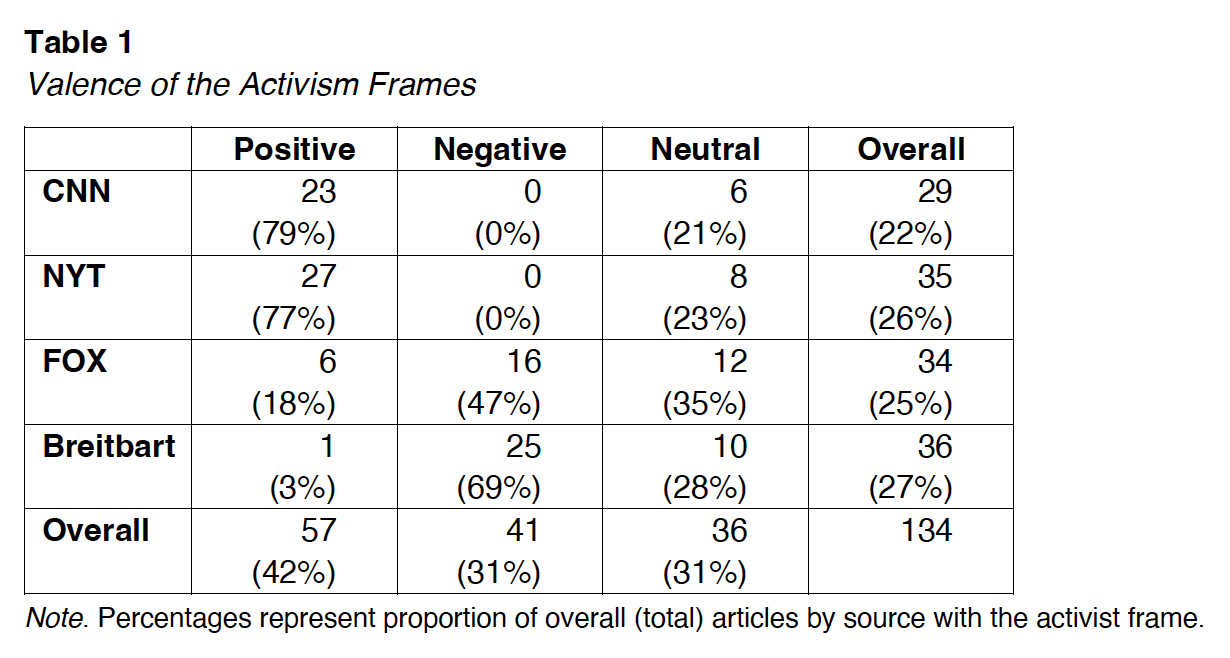
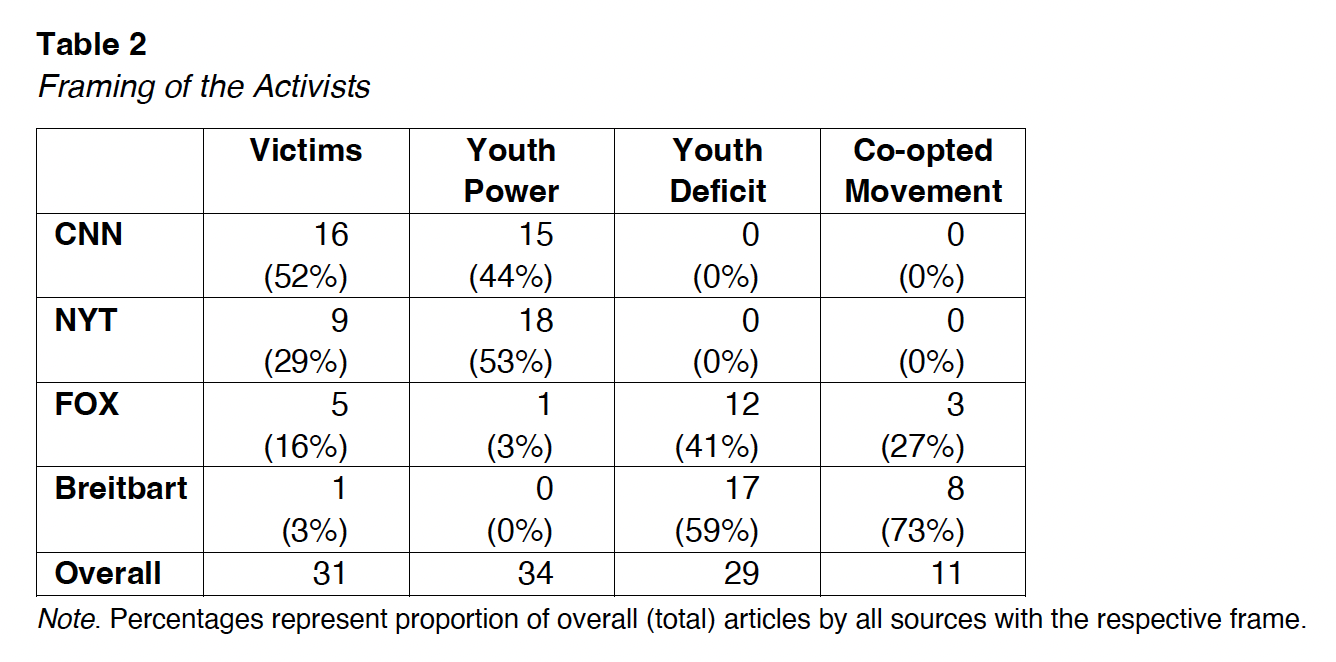
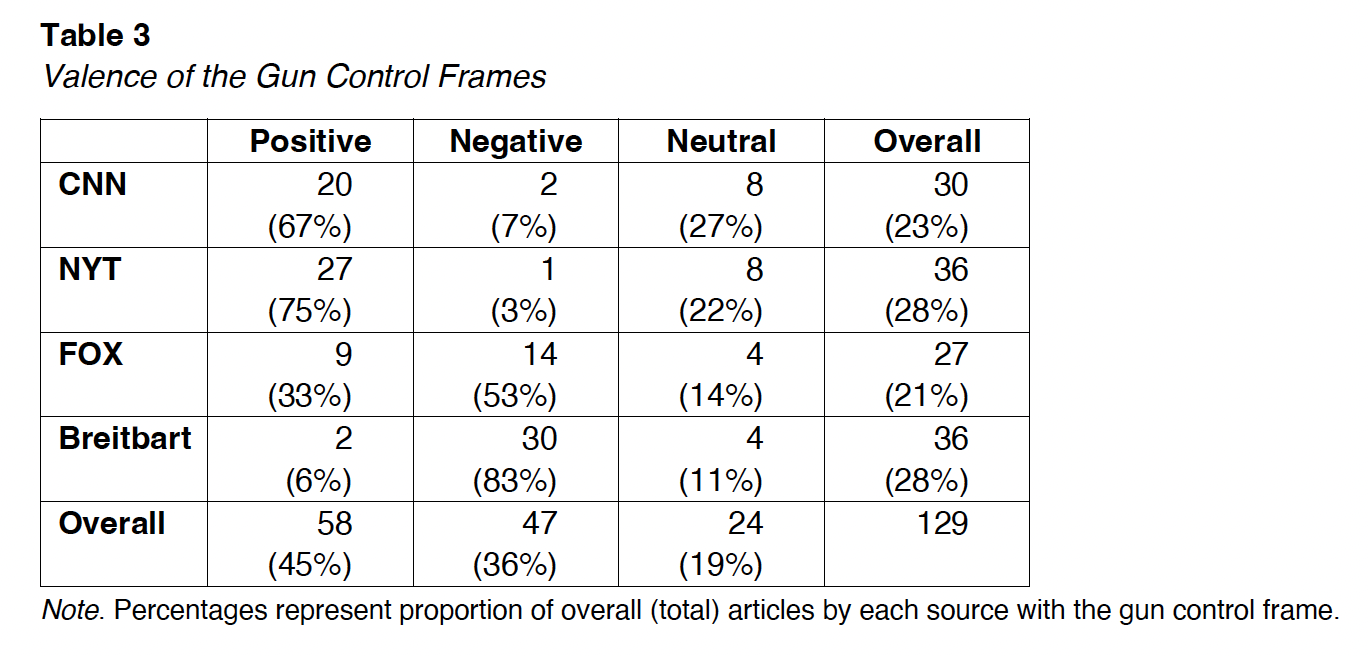
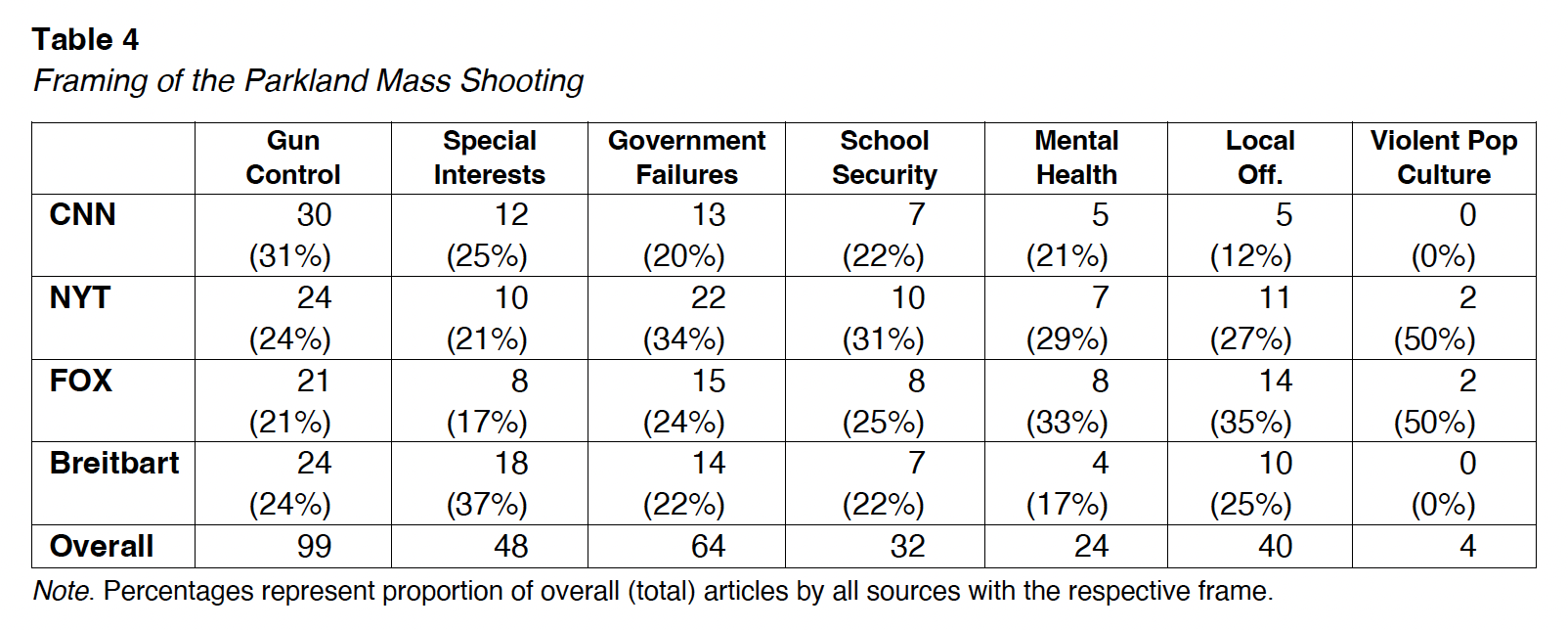
The data for this study was collected from four national news media sources, The New York Times, CNN, Fox News, and Breitbart to answer two research questions: 1) How did major news outlets frame the survivors-turned-advocates for gun control and 2) how did major news outlets frame the topic of mass shootings in the aftermath of the Parkland shooting? The analysis relied both on deductive and inductive content analysis (Bryant & Charmaz, 2019; Kuckartz, 2014; Morse et al., 2021; Schreier, 2012), while drawing on studies on media framing of youth political participation (Gordon, 2009; Thurlow, 2007; Wyn, 2005), mass shootings in general (Lawrence & Birkland, 2004; McCluskey, 2017; Muschert & Carr, 2006), and the Parkland shooting in particular (Holody & Shaughnessy, 2020; LaRose et al., 2021; Rohlinger et al., 2022). The findings were considered within the framework of partisan media bias (Levendusky, 2013a; Mutz, 2006; Shultziner & Stukalin, 2020, 2021) to untangle the choice of frames each news outlet was contending with from the very beginning of the shooting.

The way partisanship affects mass shooting reporting by the media has been researched to some degree (McCluskey, 2017; Muschert, 2007). However, besides the study by Holody and Shaughnessy (2020), the role of partisan media bias has been absent from the studies examining the reporting on the Parkland shooting. Arguably, the Parkland shooting presents a unique case to study due to the emergence of a strong national student movement that made explicit political claims about the shooting, inclining the news media towards a particularly partisan framing in its reporting. Researching the effects of partisan media bias on mass shooting coverage is crucial, especially as highly publicized, high-fatality shootings are becoming more frequent (Valeeva et al., 2022). At the same time, the media landscape is increasingly fragmented and partisan (Hollander, 2008; Mutz, 2006; Stroud, 2010). In addition, this study contributes to the scholarship on media representations of social movements and protests by considering the interaction between the protest paradigm and partisan media bias. The traditional protest paradigm dictates that media representations of social movements are mainly negative and sensational (McCurdy, 2012; McLeod, 2000). However, recent studies have found that if the ideological leanings of the newspaper align with the movement, the protest paradigm is less consequential (Chuang & Tyler, 2023; Kananovich, 2022). The case of the MFOL movement offers a new perspective on a student-led protest, which was highly critical of both parties in the divided government but took a partisan stance on a contentious political issue.

The Parkland students’ social media activism has gained considerable research attention (Austin et al., 2020; Cheas et al., 2020; Jenkins & Lopez, 2018; Zoller & Casteel, 2021), but little consideration has been given to how the national news media participated in either promoting their message or discrediting it. By examining how prominent news outlets represented the activists themselves and their diagnosis of the issue and its solutions, inferences can be drawn about the frames different media outlets are willing to adopt and how advocates can strategically exploit partisan media bias. In addition to studying how partisan media bias influences the framing of mass shootings, the study’s findings clarify the opportunities and challenges that partisan media poses to advocacy groups.

Literature Review

Gun Control as an Issue

Gun violence is a unique epidemic in the United States (American Public Health Association, 2022). On one hand, studies consistently show that there is a correlation between gun ownership and gun-related deaths (Leach-Kemon & Sirull, 2023; Miller et al., 2022; Studdert et al., 2022; Wallace et al., 2021). On the other hand, gun culture is steeped with historical ideas about what it means to be “American,” notions that are intertwined with individualism and the fundamental rights of citizens to be free from overreaches by the government inscribed into the Constitution. In the U.S. context, gun control is difficult as a social regulatory issue that is passively supported by the majority of the public (Gallup, 2022) but singularly opposed by an active minority (the gun control paradox, see Cook & Goss, 2014; Goss, 2006). Furthermore, the 400 million guns in circulation (Small Arms Survey, 2017) can make the problem seem insurmountable. These factors have contributed to the fact that it was only after the 2012 Sandy Hook Elementary School shooting that a nationwide grassroots movement mobilized around the issue of gun control in a comprehensive way (Cook & Goss, 2014). Sustained advocacy work has only recently led to significant action by state and federal legislatures to address the problem, even though mass shootings are a constant reason for public outrage, and communities, often poor and of color, are being ravaged by everyday gun violence (Kravitz-Wirtz et al., 2022).

Partisan Media Bias and Covering Protest

Gun control messaging in the United States happens in a media landscape that is especially fragmented and politically polarized (Starr, 2012; Steppat et al., 2022; Stroud, 2011). Partisan media has been widely studied and debated. There is significant disagreement whether news media is traditionally more liberal (Groseclose, 2011) or conservative (McChesney, 2003), how much partisan preferences influence the public’s choice of news outlets (Dvir-Gvirsman, 2017; Nelson & Webster, 2017; Weeks et al., 2016), or how much media exacerbate partisan polarization of the public (Levendusky, 2013a, 2013b; Stroud 2010; Suhay et al., 2018). However, it seems clear that news media is increasingly being influenced by partisan considerations from the top of the organizational structure to the individual choices journalists make (Mutz, 2006; Shultziner & Stukalin, 2020, 2021). Partisanship does not affect every news outlet the same way, but it can influence what news gets reported, what becomes salient, and what frames are used (Shultziner & Stukalin, 2021).

When reporting on social movements and protests, the protest paradigm can complicate the logic of partisan bias. Gitlin (1980) argued that the media has a vested interest in upholding the status quo to protect its place in the power structure, and as such will not contradict the fundamental organizing principles of society. For example, when news media reports the actions of a movement protesting against its government, they reproduce social conflict “in terms derived from the dominant ideology” (Gitlin, 1980, p. 270). Indeed, scholars have found that news media’s reports of social movements often marginalize protestors, especially those of color (Harlow et al., 2017; Ismail et al., 2019; Mills, 2017), delegitimize movement claims (Ashley & Olson, 1998; Xu, 2013), emphasize individuals over the collective (Gitlin, 1980), and sensationalize violence (Brown, 2021). When the protestors are young, as was in the case of Parkland, negative tropes about youth political participation can also be employed. Young people can be seen as still “citizens in the making” who need to be taught how to “correctly” engage in politics by the adults in their lives such as their parents and teachers (Collin, 2015; Earl et al., 2017). These understandings of youth political participation can lead to media coverage that frames student activists in an infantilized manner, depoliticizing their message, or suggests that the students are being manipulated by radicalized adults (Gordon, 2009; Thurlow, 2007). Moreover, not only is youth activism sometimes seen as lacking in adult guidance, but it can also be likened to youth delinquency that is troubling and destabilizing for society (Wyn, 2005).

However, most recent studies have found that the protest paradigm misses some nuances in analyses of media coverage. Media can also portray protestors sympathetically by amplifying diverse social media voices (Elmasry & el-Nawawy, 2016) and legitimizing the claims of protestors (Li et al., 2023; Trivundža & Brlek, 2017). This is especially true if the protestors challenging the state are ideologically aligned with the partisan leanings of the news outlets (Chuang & Tyler, 2023; Kananovich, 2022; Kim & Shahin, 2019). In cases of student movements, sympathetically predisposed media coverage can also rely on positive conceptualizations of youth activism, where their participation is seen as different rather than lacking in adult guidance (Collin, 2015). These types of understandings can be tied to a notion that young people are capable of bringing about change in the world and as such become the sites where adults may project all their hopes and dreams of socioeconomic transformation (Wyn, 2005).

Framing of Mass Shootings

Gun control often gets attention in news media after a mass shooting. Scholars have extensively studied media framing of mass shootings since the Columbine shooting of 1999. Studies of mass shooting reporting have employed framing analysis from diverse perspectives. For example, Lawrence and Birkland (2004) analyzed issue-defining frames, while Holody and Daniel (2016) and Muschert and Carr (2006) considered frame salience by studying which frame was given the most attention, based on factors such as repetition or headlines. Holody and Shaughnessy (2020) examined frame valence by analyzing whether frames emphasized positive or negative qualities of the subject matter. In Columbine, the most prevalent media frames were gun control, mental illness, and violent popular culture (Lawrence & Birkland, 2004; Muschert, 2007). Mass shootings were framed through moral panics, which were particularly popular in news media discourse at the turn of the 20thcentury. The perceived rise in crime was seen as connected to young people confusing fantasy with reality and being corrupted and desensitized to violence due to TV shows and video games (Glassner, 1999). Such narratives permeated the Columbine reporting too, which played its part in popularizing the “tough on crime” policy positions that followed (Altheide, 2009; Madfis, 2016; Morrow et al., 2016).

The frames in later shootings have remained largely the same with the three key narrators offered as the most prevalent explanation to the question of why such massacres happen (Schildkraut & Muschert, 2013). Especially in the beginning of the news cycle, focus is given to the particulars of the perpetrator, their mental health, and race if it is something other than white (Holody et al., 2012). Attention is given to how culpable other actors are in the shooting, including law enforcement, the school, and the family of the perpetrator (McCluskey, 2017; Muschert, 2007). After the Aurora, Colorado theater and Sandy Hook Elementary School shootings in 2012, there was a widespread media shift to focus on the victims rather than the perpetrator (Holody & Daniel, 2016; Schildkraut & Muschert, 2014). Studies have also found evidence that the violent popular culture frame is becoming less relevant, while ideologically motivated, terrorism-related shootings are increasingly receiving intense attention in media coverage (Silva, 2020; Silva & Capellan, 2018, 2019).

The Parkland shooting has been the subject of multiple studies. Rohlinger et al. (2022) examined claims made for gun control and gun rights after the Parkland shooting in both national and local news and found that political actors in Florida were able to amplify a unified gun control message, while gun rights groups promoted multiple competing frames to their detriment. LaRose et al. (2021) studied how media framing of the Parkland shooting changed across time and place and discovered that while the framing remained largely the same as in previous shootings, there was a particular emphasis on school security. Holody and Shaughnessy (2020) identified in their study of media frames used in national and local coverage of the Parkland shooting that gun control was the most salient frame. They concluded that the MFOL activists recognized how previously established mass shooting frames, such as mental illness and popular culture, were distractions that disrupted the gun control conversation they wished to promote (Holody & Shaughnessy, 2020). Studies on media framing of school shootings have shown that news outlets rely on well-established scripts when reporting on such tragedies. Furthermore, the studies on Parkland in particular have shown largely the same trends, with the exception of the student activists who managed to draw more focused attention to gun control. This study continues and expands this literature by considering how partisan media bias affected these narrative choices and the opportunities and challenges the activists had in this landscape. 

The Current Study

To examine partisan bias in the reporting of the Parkland school shooting and to understand how the activists and their advocacy work were represented by news media, this study posits two main research questions:

RQ1: How did major news outlets frame the survivors-turned-advocates for gun control?

RQ2: How did major news outlets frame the topic of mass shootings in the aftermath of the Parkland shooting?

Within the framework of partisan media bias and the protest paradigm, this study predicts that left-leaning news outlets (The New York Times and CNN) will frame the gun control advocates positively, while right-leaning news outlets (Fox News and Breitbart) will frame the movement negatively. Furthermore, the study predicts that partisan dynamics will also influence coverage about the shooting itself. Gun control as a solution to gun violence has been a dividing issue between the parties ever since the 1960s (Cook & Goss, 2014). Most recently, Democrats in Congress have almost unanimously supported gun control, while Republicans have remained unified in their support for gun rights (Kurtzleben, 2018). The study expects that established frames found in previous studies will be used to frame the shooting. In addition, the frames discovered in the three Parkland studies provide insights into how gun control was countered (Holody & Shaughnessy, 2020; LaRose et al., 2021; Rohlinger et al., 2022). The analysis is therefore conducted by testing two overarching hypotheses with two sub-hypotheses.

H1: The framing of the media coverage about the Parkland survivors and gun control advocates will align with the partisan leanings of the news outlet.

H1a: Fox News and Breitbart will convey a message that the survivors are uninformed and victims of liberal indoctrinations.

H1b: CNN and The New York Times will convey a message that the survivors have the power to effect change.

H2: The media framing of mass shootings will align with the partisan leanings of the news outlets.

H2a: Fox News and Breitbart will frame mass shootings as an issue of lack of school security, mental illness, and violent popular culture.

H2b: CNN and The New York Times will frame mass shootings as an issue of lack of gun control.

Method

Data Collection

The articles were collected from the websites of four national news media outlets, which were chosen because of their significant readership and to represent the partisan bias evident in U.S. media. Metrics from Comscore were used to assess the most-read national news outlets.2 In January 2020, CNN was reported to be the most popular online news media platform with the most unique visitors (148 million), while The New York Times had 109 million visitors (CNN Pressroom, 2020). Fox News had 114 million unique visitors on its website in January 2020 (CNN Pressroom, 2020). Breitbart is a less consumed news source among the wider population with 5.2 million unique visitors in February 2019 (The Righting, 2019).

How to consider partisan bias in the selection of the news sources was more complex. For comparison’s sake, the ideal scenario would include a right-wing news source that is three standard deviations to the right of center on the ideological spectrum and a left-wing news source that is three standard deviations to the left of center. Unfortunately, such precise quantitative measures of news source ideology do not exist, and more crude measures have been heavily criticized (Benjes-Small & Elwood, 2021; Mahadevan, 2023). In fact, studies of right-wing media in the U.S. find that there is no comparable media ecosystem on the left (Benkler et al., 2018).

Another option was to consider the partisan identification of the audiences reading the news outlets. Pew Research Center finds that 93% of those adults who named Fox News as their main source of political news identified as Republicans, while 91% of those respondents who named The New York Times and 79% of those who named CNN identified as Democrats (Grieco, 2020). Less than 2% of the respondents mentioned other right-leaning news sources. Notably, audiences identifying as Republicans tend to cluster around Fox News, while Democratic audiences are split among a wider array of media sources (Grieco, 2020). For this case study, Breitbart was chosen due to its unique position as a popular platform among the voices in the constellation of right-wing actors who promote so-called anti-woke, anti-liberal, anti-elite positions that are often rooted in ideas of white supremacy and misogyny (Benkler et al., 2018; Hawley, 2017). Overall, the aim was not to make definite statements about the level of partisan biases present but to account for some of the different narratives that exist both in left-wing and right-wing media. Importantly, including additional sources would not change the current interpretation of the news media analyzed here.  

The data sample was collected by searching for the phrases “Parkland school shooting” and “March For Our Lives” beginning from the shooting on February 14, 2018, and ending on February 28, 2019, with the last year mark story. This search produced 236 articles. When attempting to collect new data at a later period, two issues arose. First, some news stories were never long-term archived. Second, some news stories were actively removed from the websites. Therefore, comparability issues would exist if new data were collected at a different period, even if looking in archives. The data was further narrowed to articles with mentions of the Parkland students as well as to articles that comment on the issue of mass shootings. This search produced a final dataset of 200 articles, excluding episodic articles. The articles were divided fairly evenly, with 42 articles collected from CNN, 48 from The New York Times, 59 from Fox News, and 51 from Breitbart.  

Coding Process and Data Analysis

Emergent themes from the data were coded using the NVivo qualitative analysis tool, which allows systematic coding according to themes, sentiments, relationships, and the exploration of linkages between the three. Drawing on previous studies on media framing of both youth activism and mass shootings and in particular the Parkland shooting, both deductive and inductive content analysis (Bryant & Charmaz, 2019; Kuckartz, 2014; Morse et al., 2021; Schreier, 2012) were used to generate categories of frames found in the data. News articles describing either the Parkland advocates or the issue of mass shootings were considered to contain a frame if it promoted “a particular problem definition, causal interpretation, moral evaluation, and/or treatment recommendation” (Entman, 1993, p. 52). The sections within an article coded for particular frames ranged from a phrase to multiple paragraphs in length. This analysis meant coded sections could contain multiple, co-occurring, and overlapping frames.

In the first phase, the data was carefully read and coded according to all the themes found in the text. From the initial codes, main framing categories were developed by combining inductive and deductive content analysis that relied on theoretical frameworks. To answer the first research question, how the news outlets framed the activists, four main categories were identified drawing on the emergent themes arising from the text and theories of media representation of youth political participation and the protest paradigm:

  1. Victims: framing the activists through their experiences of victimization
  2. Youth power: framing the activists as smart/capable/strong and/or their activism as something useful/impactful/desirable
  3. Youth deficit: framing the activists as naïve/stupid/uneducated/gullible and/or their activism as something unhelpful/bad/harmful
  4. Co-opted movement: framing the activism as deceitful/taken over by adults

To answer the second research question, how the news outlets framed the topic of mass shootings, seven main categories were identified drawing on the inductive content analysis and theories of mass shooting framing:

  1. Gun control: access to guns as the cause/gun control as the solution
  2. Special interest groups: gun lobby/political groups as the cause/obstructing the solution
  3. Government failures: lack of action/action by government agencies the cause/solution
  4. School security: lack/more school security the cause/solution (security officers, security tools, arming teachers)
  5. Mental health: mental illness the cause/improving mental health the solution
  6. Local officials: actions of local officials the cause/solution (police department, school board, teachers, superintended)
  7. Violent popular culture: violence in video games/TV shows/movies the cause/restricting consumption the solution

In addition, following the definition by Holody and Shaughnessy (2020), frame valence was considered to provide more information about how the news outlets represented gun control activism and the topic of guns. If the framing of an article was positive towards the MFOL activists or presented gun control as the solution to stopping mass shootings, it was considered positive. If the framing of the article was negative towards the advocates or delegitimized gun control as a solution, it was coded negative. In the presence of both perspectives, the salience of the frames was considered by analyzing whether one frame was used multiple times or presented in the headline, abstract, or beginning of the article. Cases where activism and/or gun control were present without any commentary, quotes, or details into the content of the suggestions were considered neutral.

The codebook drafted for the second phase included criteria for coding the articles into the four categories identified for the framing of the MFOL activists and the seven categories identified for the framing of the shooting. In addition, the instructions included guidelines for coding the valence of the articles, when activist frames and gun control frames were present. To check the quality of the coding process, intercoder reliability was tested on a 10% random sub-sample of the articles. The author and a researcher outside of the study coded the articles with the codebook using the NVivo software. The guidelines in the codebook were discussed and clarified before coding. Agreement between the coders in the test sample was 95%.Disagreements were resolved in a feedback session and the guidelines were revised accordingly. The rest of the articles were coded again by the author.

After the coding process, descriptive tables were created to offer an overall summary of the data analysis. The tables describe the number of articles coded for specific frames as well as the valence of the articles in each news source with MFOL activist frames and gun control frames. Comparisons between the number of frames and the valence of the frames were made to test the hypotheses that the framing of activism and the shooting aligned with the partisan leanings of the news sources. In addition, qualitative content analysis (Bryant & Charmaz, 2019; Kuckartz, 2014; Morse et al., 2021; Schreier, 2012) was used to consider how each news source employed and combined particular frames to present an overarching narrative about the Parkland school shooting and the activism that followed it.

Results

Framing of the Activists

The activist frame was the only frame that was consistently and prominently featured in all four news outlets from the very beginning of the shooting in February to the end of the year mark. The New York Times and CNN’s portrayal of the MFOL activists were overwhelmingly positive. In The New York Times, 77% of the articles that used activism frames used them positively while in CNN, 79% of the articles with activism frames were positive. CNN focused heavily on the activists immediately after the shooting, while The New York Times shifted their attention to the activism primarily in March, when the March For Our Lives protest was organized. In contrast to the more left-leaning news outlets, Fox News and Breitbart in particular overwhelmingly framed the activists negatively. In Fox News, 47% of the articles with activism frames were negative toward the activists (35% of them were neutral). In Breitbart, 69% of the articles with activism frames were negative. Breitbart,out of all the outlets, right from the beginning, was much more focused on the activism than the shooting itself—it was the only outlet that had more articles about the shooting in March than in February when it occurred. Where the other outlets for example featured the gun control frame from the beginning until the end, the focus of Breitbart remained on the activists and the political figures Breitbart drew into its narrative. None of the articles on CNN and The New York Times that had activist frames were negative. Overall, the findings confirm that the framing of the coverage that the news outlets provided about the Parkland survivors-turned-gun control advocates aligned with their partisan orientations (Table 1).

                         (Click table to enlarge)

However, there are significant discrepancies in how the different media outlets framed the narratives of the MFOL activists that need to be considered further (Table 2). The specific frames each news source chose illustrated the type of narratives they told and the different ways the partisan leanings materialized.

                         (Click table to enlarge)

From Victimization to Activism and the Power of Youth Political Participation

As survivors of a mass shooting, the Parkland students were given space to express their views in all the media under study, but CNN and The New York Times connected those aspects positively to their activism. CNN in particular framed the activists first and foremost through their experiences of victimization. Fifty-two percent of all the activism frames that represented the MFOL advocates primarily as victims appeared on CNN (see “victims” in Table 2). These articles approached the narrative through the everyday consequences a shooting leaves in a person’s life and how activism can be used to heal from that experience. Activism as a response to trauma and turning “pain into change” (Ryan, 2018) was an explicit structure CNN used multiple times (see Appendix A1).

In contrast, The New York Times featured 53% of all the youth power frames in the data. These frames focused on the power of youth activism, particularly what set them apart from those that came before them (see “youth power” in Table 2). One of the main claims made by the Parkland students, who would later organize the MFOL marches, was that gun violence is more of an intergenerational issue than a partisan one. The activists continuously juxtaposed the “adults” who have been incapable of solving the continued epidemic of gun violence and the “kids” who have been left to suffer the consequences in a way that has come to define them as “the mass shooting generation” (Burch et al., 2018). Instead of relying solely on their authority over the issue through their experiences of victimization, they emphasized their own power to affect change: “The adults who ‘have the responsibility to take care of these things’ have failed, he said. ‘It’s our generation’s responsibility’” (Turkewitz & Yee, 2018). The New York Times represented the MFOL movement in ways that set them apart in a positive manner from political decision-makers. In their narrative, young age offered a unique perspective that could have a transformative effect:

Even after a year of near continuous protesting — for women, for the environment, for immigrants and more — the emergence of people not even old enough to drive as a political force has been particularly arresting, unsettling a gun control debate that had seemed impervious to other factors. (Yee & Blinder, 2018)

The students were described as being unsullied by cynicism and traditional politics. Although inexperienced in politics, they were seen as eloquent and savvy enough to be capable of inspiring societal change (see Appendix A2).

Naïve Youth Running a Co-opted Movement

Fox News and Breitbart focused on employing the tactics of negative media coverage of youth activism, where young people were represented as not as capable of participating in civic action due to their lack of experience and knowledge (see “youth deficit” in Table 2). Forty-one percent of these types of frames appeared in Fox News, where patronizing language was used to frame the youth activists advocating for gun reform, describing them as being well-meaning but naïve and ignorant of the realities of the real world (see Appendix A3). The rest of the 59% of the articles were found in Breitbart, where the language used was even more hostile towards the students, and tropes about youth delinquency were employed. The radicalized leftist adult was seen as responsible for the brainwashed, misbehaving youth (see “co-opted movement” in Table 2). Breitbartdevoted significant attention to stories that suggested that the entire movement had been co-opted by liberal elites, claiming that “the rally first planned by high school students was quickly hijacked by the left and gun control groups, transforming it into a turn out-the-liberal-vote event” (Starr, 2018a). In Breitbart, very little explicit exposition was needed to mark MFOL as an illegitimate, adult-led movement. Michael Bloomberg and George Soros, two billionaires who have donated money to Democratic campaigns and gun control activism, were frequently mentioned with the presumption that readers would know who they were and what their association implied. The narrative of corrupt liberal elites working behind the scenes and deceiving the public to advance their own agenda was told with cues that readers who already share this worldview know to look for. 73% of the articles where the co-opted movement frame was used appeared in Breitbart, but the remaining 27% of the cases were found in Fox News (see examples in Appendix A4).

However, the negative narrative Fox News and Breitbart constructed about the MFOL activists seemed to be more motivated by partisanship and a distaste for the policies the youth were advocating for than disbelief in youth activism in general. In 27% of the negative articles about the young gun control activists, Fox News and Breitbart contrast them specifically to the few students who were vocal advocates of gun rights. Not only was the participation of these students seen as desirable, but they were also framed as heroes whose fight with their liberal classmates, the media, and the Democrats was admirable and courageous: “Being a hero of the right isn’t easy. Especially for a 16-year-old who opposes the majority of his classmates’ calls for more restrictive gun laws” (Flood, 2018).

Framing of Mass Shootings

The central claim the youth activists made was that guns were the main cause of the shooting and that the best way to prevent one in the future was to implement more gun control measures. Gun control has consistently been part of mass shooting reporting, but it was particularly prominent in the Parkland coverage due to the considerable role of the activists. As with the framing of the activists themselves, the framing of the shooting aligned with the partisan leanings of the news outlets (Table 3). Seventy-five percent of the articles that had the gun control frame were positive in The New York Times, while the same was true for 67% of the articles on CNN. Both left-leaning sources reaffirmed the claim that guns are the cause of mass shootings. Fox News framed gun control negatively in 53% of the articles that discussed the issue, while Breitbart delegitimized gun control as a solution in 83% of the articles.

                         (Click table to enlarge)

Exploring the frames used to define mass shootings revealed how the partisan leanings of the news outlets influenced the vastly different stories they told about the tragedy in Parkland (Table 4). The New York Times and CNN framed the lack of gun control as the main issue, focusing on government failures and the influence of special interest groups that lobby for gun rights such as the National Rifle Association (NRA) as the reason for that oversight. Fox News and Breitbart used other common mass shooting frames to counter gun control as a solution, primarily focusing on the failures of local officials as the reason for the shooting and promoting school security and arming teachers as a solution. Contrary to expectations, violent popular culture was not a prominent part of the reporting by any of the news outlets.

                         (Click table to enlarge)

Gun Control, Government Failures, and Special Interest Groups

Regardless of the political biases of the news media or the valence of the frame, each news source used the gun control frame the most often with cases found in 99 articles overall. On CNN, gun control appeared the most (31%), while on Fox News, it appeared the least (21%). All outlets, with the exception of Breitbart, also consistently featured gun control from the beginning until the end of the year mark. Both CNN and The New York Times amplified the gun control frame by writing stories about the specific policy proposals the activists were advocating for and by offering contextual information that reinforced their claims. CNN had links to the MFOL website and introduced their primary demands (banning assault weapons and high-capacity magazines, restricting ammunition sales, and closing loopholes to background checks). The New York Times wrote about the type of assault weapons used in other mass shootings to support the assault weapons ban advocated by the MFOL activists (see Appendix B1). Fox News and Breitbart framed gun control as a vague and ineffective policy at best and government infringement at worst (see Appendix B1). They explicitly criticized policy proposals that targeted specific types of guns or their features. Fox News saw no practical difference between an AR-15 rifle and a game-hunting rifle (Lott, 2018b), while Breitbarttook the argument even further claiming that a ban on any part of the weapon would lead to the banning of guns altogether (Hawkins, 2018a). In the two Breitbart articles where gun control was framed positively, Breitbart reproduced mainstream media articles quoting speeches of Democratic politicians notorious in right-wing spaces such as Hillary Clinton. This is a common tactic in right-wing alternative media where mainstream media is used as a reference to recontextualize information within their own news content and ideological agenda (Haanshuus & Ihlebæk, 2021; Mayerhöffer & Heft, 2021). No explicit negative framing was present, but within the context of the overarching narrative Breitbart has been producing about corrupt liberal elites, it was precisely the positive framing of gun control through Hillary Clinton that made the policy itself suspect.

Government failures was the second most used frame in the data, appearing in 64 articles overall. Twenty percent of the government failures frame were in CNN, which used the framing of the activists who presented the problem as intergenerational rather than partisan and reproduced their advocacy for bipartisan solutions. While The New York Times also reaffirmed the intergenerational nature of the issue, the stories also elaborated on the resistance from the Republican Party and the Trump administration to enact policy (see Appendix B3). In contrast to the other outlets that focused on government failures from the beginning until the summer, The New York Times also featured the frame for the whole duration of the one-year reporting. This focus was apparent in the number of times the frame was used as well. With 34% of the cases, government failures appeared most often in The New York Times. Both Fox News and Breitbart also used the government failures frame but with a different focus. Breitbart, with 22% of all the articles that used the frame, and Fox News with 24%, mainly described gun violence as the result of bad liberal policies. These policies enacted by various actors, such as the Obama administration and Democrats in Congress, left people unsafe and vulnerable (see Appendix B3). However, for both Fox News and Breitbart, government failures also implicated mistakes made by the FBI, particularly its failure to respond to a tip it had received about the threats the perpetrator was spreading online:

In January, the FBI had the dots connected for them by a tipster who told them all about Cruz, his fascination with firearms, and his desire to kill people — and they did absolutely nothing. This what you call a catastrophic failure of law enforcement. This is also a situation where everyday citizens did exactly what they were supposed to — they saw something and then they said something — but in an ocean of red flags, the government still failed at its primary function — to protect us. (Nolte, 2018a)

The activists highlighted the role the NRA has played in preventing the passing of gun control legislation and both The New York Times and CNN contextualized this in their reporting (see Appendix B2). The New York Times, which showed the most diversity on the framing choices out of all the news outlets, used the special interest group frame in 10 articles (21% of the cases). It was the only one to feature the frame across the yearlong reporting. On Fox News, where the frame appeared the least (17%), the NRA was only used when the speeches of the youth were reproduced and only once was blaming the NRA portrayed as a negative position to hold (see Appendix A4). NRA was defended vigorously on Breitbart. However, most of the time, when they mentioned special interest groups they were talking about entirely different organizations. In clear contrast to the other three news media outlets, Breitbart spent considerable time negatively framing the connections of the youth activists to adult-led gun control groups and used those connections as proof of the fraudulent nature of gun control as a solution (see Appendix B2). Left-wing media was accused of backing those organizations and assigned blame for mass shootings due to their refusal to enforce accountability on the real enablers and perpetrators (see Appendix B2). Breitbart’s unique focus was also reflected in the fact that Breitbart had the highest number of articles that used the special interest frame (37%).

School Security, Mental Health, and Failures by Local Officials

Three frames—school security, mental health, and local officials—were used by all the news outlets but Fox News and Breitbart explicitly positioned them to be either the cause or the solution to mass shootings instead of gun control. School security was a particularly useful example when considering the effect partisan media bias had on the reporting. For The New York Times, which used the frame the most with 10 articles (31% of the cases) and for CNN, which had it in seven articles (22%), school security meant different security enforcement tools such as metal detectors, armed law enforcement, and clear backpacks that could serve as additional measures to gun control. For Fox News, which used the frame in eight articles (25%), school security could mean those things, not as an addition but as an alternative to gun control. However, in most cases, school security meant arming teachers. For Breitbart, which used the frame as often as CNN, security and broadening the purview of gun rights to include schools and teachers was ubiquitous (see Appendix B4). Importantly, the school security frame had the most lasting power in comparison to all the counter-frames found in the reporting of all the news outlets. It was the only frame in addition to activist and gun control frames that was featured in all the news outlets from the beginning until the end of the year mark.

The mental health frame was the least prevalent out of the three that were used to counter gun control with appearances only in 24 articles across all the news sources. Mental health was featured in all the outlets only in the beginning of the reporting in February and March. While the activists who paid less attention to the topic may have influenced the lack of mental health framing, the school security (32 articles overall), and local officials frame (40 articles overall) were more prominent in countering the gun control message. As a solution, addressing mental health concerns through increased funding or in other undefined ways was mostly a promise made by lawmakers or the few prominent voices emerging out of Parkland that were self-proclaimed defenders of the Second Amendment (see Appendix B5). Breitbart in the four articles that featured the mental health frame did not dedicate any time on how it could be part of the solution and instead, only lamented on the mental illnesses of the perpetrator.

Local officials such as law enforcement and the school board were also blamed for the Parkland tragedy particularly in the beginning of the reporting. All four news outlets covered stories criticizing the police officers who had refused to enter the building during the shooting and questioned how the perpetrator had obtained a gun, given his previous run-ins with the local police department (see Appendix B6). Likewise, the news outlets reported on the troubling behavior that went ignored by the school officials, which was enough for the two parents of Parkland victims to run for the district school board (see Appendix B6). Fox News focused the most on the failures of local officials (35%), but Breitbart explicitly used those failures as proof of the need for strong gun rights so that citizens could be armed to defend themselves: “The only lesson a rational person can take away from the Parkland school massacre, is this: federal and local law enforcement is either too corrupt, inept, or hamstrung, to protect our children. Therefore, we must protect ourselves” (Nolte, 2018b). A surprising element emerging from this analysis is that unlike hypothesized, the frame of violent popular culture often found in other shootings was not relevant here. There was no mention of it in the reporting of Breitbart or CNN, and on Fox News and The New York Times, the frame appears only twice—both in February and in March about a video game that allowed players to act out school shootings. It could be that the particulars of the Parkland shooting made the violent popular culture frame less relevant. For example, the glaring mistakes by the local officials made them easy to blame for the shooting, which meant less focus was paid to other potential causes.

Discussion

The activists were prominently and consistently featured in all the outlets for the entirety of the period under study here, from the beginning of the shooting on February 14, 2018, until February 28, 2019. The fact that there is reporting about the MFOL activists throughout the year shows that their activism impacted the duration of the reporting on the Parkland shooting, which was far longer than the one month that is typical for mass shootings. This finding is in line with studies such as by Holody and Shaughnessy (2020). In addition, like Holody and Shaughnessy (2020) and LaRose et al. (2021), this study mirrored the results of other studies that found that mass shooting reporting after Columbine has stayed largely the same and that gun control continues to be the most prominent frame to be used in such media coverage. However, the effects of partisan bias on mass shooting media coverage have not been systematically explored before. Thus, this study asked how major news outlets framed the Parkland shooting and the gun control movement March For Our Lives that followed it.

First, it was hypothesized that framing of the media coverage about the Parkland survivors and gun control advocates would align with the partisan leanings of the news outlets. The findings illustrate that negative and positive framing of the activism was dependent on the partisan leanings of the news outlets. CNN and The New York Times conveyed a message that the survivors could effect change by advocating for gun control policies. They framed the young age of the activists as precisely the reason why they should be listened to, seeing them as different rather than lacking in adult guidance and in that difference holding the key to breaking the pattern of inaction in federal gun control legislation. In clear contrast to the traditional protest paradigm and building on the findings of recent research such as Chuang and Tyler (2023), Kananovich (2022), and Kim and Shahin (2019), this study provides firm evidence that when the partisan positions of the activists align with the newspapers the coverage is sympathetic and message-affirming. In the case of Parkland, where the activists were particularly young, the media coverage took advantage of tropes that emphasized the positive aspects of youth political participation and the transformational power generational shift could bring (Collin, 2015; Wyn, 2005).

Fox News and Breitbart conveyed a message that the MFOL activists were uninformed and victims of liberal indoctrinations.Employing the trope of “citizens in the making” (Collin, 2015), they framed the MFOL youth as naïve, incapable of comprehending the effects of the policy positions they were advocating for and lacking in skills to participate in politics without adult guidance. More in line with the traditional protest paradigm, their claims were delegitimized, they were infantilized and accused of being manipulated and radicalized by adults with a nefarious agenda. Yet, in conservative youth, the conservative media outlets found the same hope for their future that CNN and The New York Times found in the MFOL movement. The MFOL advocates were disparaged to discredit their claims about gun control.     Secondly, it was hypothesized that media framing of mass shootings would align with the partisan leanings of the news outlets. The findings illustrate that the different causes and solutions offered to mass shootings were dependent on the partisan leanings of the news outlets. CNN and The New York Times conveyed a message that guns and lack of gun control are the most immediate causes of mass shootings. Frames such as government failures and special interest groups were used to support that main frame by offering reasons for how and why inaction on policies restricting access has led to the current situation. In contrast, Fox News and Breitbartconveyed a message that mass shootings happen not because of easy access to guns but because of lack of security and armed staff as well as poor law enforcement responses and school policies. However, unlike in previous shootings and hypothesized, mental health was not a significant frame used to explain mass shootings. Violent popular culture was even less relevant.

Instead, Fox News and Breitbart countered gun control by prominently featuring frames such as government failures and special interest groups. However, in their narratives, these referred to the failures of lenient liberal policies, politically compromised FBI, and incompetent local officials. Their mistakes were proof of the inability of government, local or federal, to keep its citizens safe and inevitably, proof of how government regulation policies such as gun control could not work. They sought alternative solutions to mass shootings by keeping schools secure with tools such as metal detectors and by arming school officials. The importance of school security as a solution, compared to mental health or attempting to restrict access to violent popular culture, is central to the findings of this study. It is in line with studies such as McCluskey (2017) that found that Republican states often framed school shootings through the school security frame and LaRose et al. (2021) that found school security was particularly emphasized in the Parkland case. Silva (2020) and Silva and Capellan (2018, 2019) also found that ideology and terrorism-related frames seem to be replacing the violent popular culture frame. Building on this research, this study argues that the importance of mental health and violent popular culture as frames used in mass shooting reporting are waning. Concurrently, school security is being developed as a prominent counter frame to gun control. It could be that the particulars of the Parkland shooting drove these framing choices. It may also be that frames like arming teachers, which directly oppose gun control, may become increasingly appealing as right-leaning outlets prioritize “culture war” issues.

 Limitations

The data selection process of this study brought with it some limitations. The findings could have been more conclusive and shown greater variety if the study had included more news sources from a broader ideological spectrum such as Mother Jonesor the New York Post. In addition, the data did not include any local newspapers. While Holody and Shaughnessy (2020) did not find differences in the frames that community newspapers and national newspapers used, the importance of partisan media bias on local news reporting, especially in the case of mass shootings, should be further explored. Finally, partisan alignment impacts the way news media interacts with the messaging by activists, which in turn gives advocates more opportunities to influence the media framing of their issues. While those opportunities are considered in this study, more research is still needed to understand how media framing and partisan bias affect the messaging of activists. It seems clear that the MFOL activists were aware of how media framing tactics could serve as a distraction from the gun control conversation. How much that awareness affected their messaging strategies is less clear. Due to the data selection, this study can only offer findings from the way the media framed the issue and the activists.

Policy and Research Implications

The present study aimed to further the research on mass shooting reporting and the partisan media biases that influence it, particularly as mass shootings have become a prominent site for political activism. The frames used in the coverage of Parkland were not new but there were qualitative differences in how each news outlet used them. Researchers and advocates alike should understand what purpose each frame serves in media narratives. Partisan bias is not the only factor that affects journalistic choices. However, an issue that has become as polarized as guns in the United States is increasingly susceptible to such influences. Mass shootings are at the center of a policy fight that is not only deeply ingrained into partisanship but has direct, devastating, real-life consequences. Mass shootings do not happen nearly as often as gun suicides or everyday gun violence that are destroying particularly impoverished communities. Yet, mass shooting reporting is still one of the most effective ways advocates can get attention to their messaging, even or especially in the current fragmented media landscape. This study showed that positive media coverage is possible when the policy positions of advocates and protestors align with the media outlet’s partisan leanings. CNN and The New York Times consistently reaffirmed both the policy of gun control and the credibility of its advocates.

 Breitbart was unlikely to positively frame the MFOL advocates or their solutions once gun control became their primary policy goal. Fox News was inclined to positively frame solutions that targeted school security or mental health, but this came at the expense of gun control policies. Advocates should be more conscious of the overarching stories offered by different media to understand how their claims can be aligned with those stories. The results are not surprising, but they do offer nuance to the discussion about mass shooting framing and the importance of partisan media bias. Left-leaning narratives have consolidated around gun control. Future research should keep exploring how frames such as school security are being developed, employed, and consolidated as counter to gun control. Whether these trends affect local reporting should also be investigated. There the opportunities for advocates could be more favorable. 

NOTES

  1. Gun control is used throughout the article because it describes the advocated policy, and the media sources analyzed in the study use it widely. However, recently activists themselves have shifted from talking about gun control to gun violence prevention to better describe the scale of the problem and the solutions.
  2. Information about unique visitors is available through the reporting of news sources that pay companies such as Comscore to release the data. In February 2020, CNN pressroom offered comparative results about the largest news sources including CNN, Fox News and The New York Times but had no such reporting on Breitbart. The closest comparable time frame could be found in the reporting of The Righting in January 2019, which also uses Comscore data.


ARTICLE APPENDIX
Download the appendix to the article by clicking on the icon below. (This will open in a new tab, so be sure your pop-up blocker is disabled.)


DISCLOSURE STATEMENT
No potential conflicts of interest were reported by the authors.

FUNDING STATEMENT
This work was supported by the Helsingin Sanomat Foundation.

REFERENCES

Altheide, D. L. (2009). Moral panic: From sociological concept to public discourse. Crime, Media, Culture, 5(1), 79-99. https://doi.org/10.1177/1741659008102063

American Public Health Association. (2022). Gun violence. https://www.apha.org/topics-and-issues/gun-violence

Andone, D. (2018a, February 18). Student journalist interviewed classmates as shooter walked Parkland school halls. CNN. https://edition.cnn.com/2018/02/17/us/david-hogg-profile-florida-shooting/index.html

Andone, D. (2018b, March 23). What you should know about the March for Our Lives. CNN. https://edition.cnn.com/2018/03/21/us/march-for-our-lives-explainer/index.html

Ashley, L., & Olson, B. (1998). Constructing reality: Print media’s framing of the women’s movement. Journalism & Mass Communication Quarterly, 75(2), 263-277. https://doi.org/10.1177/107769909807500203

Austin, L., Guidry, J., & Meyer, M. (2020). Gun violence on Instagram and Twitter: Examining social media advocacy in the wake of the Parkland school shooting. Journal of Public Interest Communications, 4(1), 4-36. https://doi.org/10.32473/jpic.v4.i1.p4

Baker, P., & Shear, M. (2018, February 22). Another shooting, another gun debate. Will the outcome be the same? The New York Times. https://www.nytimes.com/2018/02/22/us/politics/school-shooting-gun-debate.html

Benjes-Small, C., & Elwood, N. (2021, February 23). Complex or clickbait?: The problematic Media Bias Chart. ACRLog. https://acrlog.org/2021/02/23/complex-or-clickbait-the-problematic-media-bias-chart/

Benkler, Y., Faris, R., & Roberts, H. (2018). Network propaganda: Manipulation, disinformation, and radicalization in American politics. Oxford University Press.

Berry, S. (2018a, March 13). Teachers unions support student walkouts as ‘protest to change gun laws’. Breitbart. https://www.breitbart.com/politics/2018/03/13/teachers-unions-support-student-walkouts-as-protest-to-change-gun-laws/

Berry, S. (2018b, March 24). Broward superintendent: Keep focus on gun control, not ‘fake news’ on Obama policy to end ‘school to prison pipeline’. Breitbart. https://www.breitbart.com/politics/2018/03/24/broward-superintendent-keep-focus-on-gun-control-not-obama-policy-to-end-school-to-prison-pipeline/

Brown, D. K. (2021). Police violence and protests: Digital media maintenance of racism, protest repression, and the status quo. Journal of Broadcasting & Electronic Media, 65(1), 157-176. https://doi.org/10.1080/08838151.2021.1897821

Bryant, A., & Charmaz, K. (Eds.). (2019). The SAGE handbook of current developments in grounded theory. SAGE Publications Ltd. https://doi.org/10.4135/9781526485656

Burch, A., Mazzei, P., & Healy, J. (2018, February 16). A ‘Mass Shooting Generation’ cries out for change. The New York Times. https://www.nytimes.com/2018/02/16/us/columbine-mass-shootings.html

Cheas, K., Kannisto, M., & Juvonen, N. (2020). #MarchForOurLives: Tweeted teen voices in online news. International Symposium on Online Journalism, 10(1), 61-83. https://isoj.org/research/marchforourlives-tweeted-teen-voices-in-online-news/

Chuang, A., & Tyler, A. (2023). An obscured view of “both sides”: Default whiteness and the protest paradigm in television news coverage of the Charlottesville “Unite the Right” rally. Journalism & Mass Communication Quarterly, 100(3), 668-691. https://doi.org/10.1177/10776990221146519

CNN Pressroom. (2020, February 19). CNN digital breaks all records: Largest digital audience in history in January 2020. https://CNNpressroom.blogs.CNN.com/2020/02/19/CNN-digital-breaks-all-records-largest-digital-audience-in-history-in-january-2020/

Collin, P. (2015). Young citizens and political participation in a digital society: Addressing the democratic disconnect. Palgrave Macmillan.

Cook, P., & Goss, K. (2014). The gun debate: What everyone needs to know. Oxford University Press.

Dvir-Gvirsman, S. (2017). Media audience homophily: Partisan websites, audience identity, and polarization processes. New Media & Society, 19(7), 1072-1091. https://doi.org/10.1177/1461444815625945

Earl, J., Maher, T., & Elliott, T. (2017). Youth, activism, and social movements. Sociology Compass, 11(4), 1-14. https://doi.org/10.1111/soc4.12465

Egan, T. (2018, February 15). The bad parent caucus. The New York Times. https://www.nytimes.com/2018/02/15/opinion/florida-school-shooting-guns.html

Elmasry, M., & el-Nawawy, M. (2016). Do Black Lives Matter?: A content analysis of New York Times and St. Louis Post-Dispatch coverage of Michael Brown protests. Journalism Practice, 11(7), 857-875. https://doi.org/10.1080/17512786.2016.1208058

Entman, R. M. (1993). Framing: Toward clarification of a fractured paradigm. Journal of Communication, 43(4), 51-58. https://doi.org/10.1111/j.1460-2466.1993.tb01304.x

Farber, M. (2018, February 28). Florida school shooting timeline. Fox News. https://www.foxnews.com/us/florida-school-shooting-timeline

Flood, B. (2018, July 28). Parkland shooting survivor Kyle Kashuv emerges as conservative role model, Second Amendment champion. Fox News. https://www.foxnews.com/politics/parkland-shooting-survivor-kyle-kashuv-emerges-as-conservative-role-model-second-amendment-champion

Fox News. (2018a, February 27). Fox News first: School shooting survivor refuses to stick to CNN ‘script’; Trump to speak at CPAC. https://www.foxnews.com/us/fox-news-first-school-shooting-survivor-refuses-to-stick-to-cnn-script-trump-to-speak-at-cpac

Fox News. (2018b, March 27). Ingraham on March for Our Lives: ‘Political theater lacking in substance’. https://web.archive.org/web/*/http://insider.foxnews.com/2018/03/27/laura-ingraham-march-our-lives-political-theater-lacking-substance

Francis, M. (Host). (2018, May 18). Father of Parkland victim angry after Santa Fe shooting [Television talk program transcript]. In The Story. Fox News. https://www.foxnews.com/transcript/father-of-parkland-victim-angry-after-santa-fe-shooting

Gallup. (2022). Guns. https://news.gallup.com/poll/1645/guns.aspx

Gitlin, T. (1980). The whole world is watching: Mass media in the making and unmaking of the New Left. University of California Press.

Glassner, B. (1999). The culture of fear: Why Americans are afraid of the wrong things. Basic Books.

Gordon, H.R. (2009). We fight to win: Inequality and the politics of youth activism. Rutgers University Press.

Goss, K. (2006). Disarmed: The missing movement for gun control in America. Princeton University Press.

Grieco, E. (2020, April 11). Americans’ main sources for political news vary by party and age. Pew Research Center. https://www.pewresearch.org/short-reads/2020/04/01/americans-main-sources-for-political-news-vary-by-party-and-age/

Grinberg, E. (2018, February 28). They survived a school shooting. Now, activism feels more urgent than classes. CNN. https://edition.cnn.com/2018/02/26/us/florida-parkland-students/index.html

Grinberg, E. (2019, February 14). Parkland students, parents and teachers are still grieving. These are their stories. CNN. https://edition.cnn.com/2019/02/14/us/parkland-anniversary-reflections/index.html

Grinberg, E., Gallagher, D., & Edwards, M. (2018, February 28). His daughter died in the Parkland shooting. Today, his son went back to school. CNN. https://edition.cnn.com/2018/02/28/us/florida-school-shooting/index.html

Groseclose, T. (2011). Left turn: How liberal media bias distorts the American mind. St. Martin’s Press.

Haanshuus, B. P., & Ihlebæk, K. A. (2021). Recontextualising the news: How antisemitic discourses are constructed in extreme far-right alternative media. Nordicom Review, 42(1), 37-50. https://doi.org/10.2478/nor-2021-0005

Hanna, J. (2018, February 28). This wounded Parkland student won’t return to her high school. But she’ll still get her diploma. CNN. https://edition.cnn.com/2018/02/28/us/parkland-survivor-samantha-fuentes/index.html

Harlow, S., Salaverría, R., Kilgo, D., & García‐Perdomo, V. (2017). Protest paradigm in multimedia: Social media sharing of coverage about the crime of Ayotzinapa, Mexico. Journal of Communication, 67(3), 328-349. https://doi.org/10.1111/jcom.12296

Hawkins, A. (2018a, March 26). Parkland survivor: ‘When they give us that inch, that bump stock ban, we will take a mile’. Breitbart. https://www.breitbart.com/politics/2018/03/26/parkland-survivor-give-us-inch-bump-stock-ban-will-take-mile/

Hawkins, A. (2018b, March 26). Eagles of Death Metal’s Jesse Hughes: ‘Disgusting’ student gun control marchers ‘insult memory of those killed’. Breitbart. https://www.breitbart.com/entertainment/2018/03/26/eagles-of-death-metals-jesse-hughes-gun-control-marchers-insult-memory-of-those-killed/

Hawkins, A. (2018c, November 21). Sheriff investigating Parkland shooting: Teachers must be armed to stop attacks. Breitbart. https://www.breitbart.com/politics/2018/11/21/sheriff-investigating-parkland-shooting-teachers-must-be-armed-to-stop-attacks/

Hayward, J. (2018, April 27). Rabbi Shmuley Boteach: Using ‘Never Again’ to promote gun control is inappropriate. Breitbart. https://www.breitbart.com/radio/2018/04/27/rabbi-shmuley-boteach-never-again-gun-control-inappropriate/

Hawley, G. (2017). Making sense of the Alt-Right. Columbia University Press.

Hollander, B. A. (2008). Tuning out or tuning elsewhere? Partisanship, polarization, and media migration from 1998 to 2006. Journalism & Mass Communication Quarterly, 85(1), 23-40. https://doi.org/10.1177/107769900808500103

Holody, K., & Daniel, E. (2016). Attributes and frames of the Aurora shootings: National and local news coverage differences. Journalism Practice, 11(1), 80-100. https://doi.org/10.1080/17512786.2015.1121786

Holody, K., Park, S., & Zhang, X. (2012). Racialization of the Virginia Tech shootings: A comparison of local and national newspapers. Journalism Studies, 14(4), 568-583. https://doi.org/10.1080/1461670X.2012.726499

Holody, K., & Shaughnessy, B. (2020). NEVERAGAIN: Framing in community and national news coverage of the Parkland mass shootings. Journalism Practice, 16(4), 637-659. https://doi.org/10.1080/17512786.2020.1816857

Ingraham, L. (Host). (2018, February 21). Student: Conservative side of youth movement is ignored [Television talk program transcript]. In The Ingraham Angle. Fox News. https://www.foxnews.com/transcript/student-conservative-side-of-youth-movement-is-ignored

Ismail, A., Torosyan, G., & Tully, M. (2019). Social media, legacy media, and gatekeeping: The protest paradigm in news of Ferguson and Charlottesville. The Communication Review, 22(3), 169-195. https://doi.org/10.1080/10714421.2019.1651153

Jenkins, H., & Lopez, R. (2018). On Emma González’s jacket and other media: The participatory politics of the #NeverAgain movement. The Brown Journal of World Affairs, 25(1), 117-134. https://bjwa.brown.edu/25-1/on-emma-gonzalezs-jacket-and-other-media-the-participatory-politics-of-the-neveragain-movement/

Kananovich, V. (2022). From “angry mobs” to “citizens in anguish”: The malleability of the protest paradigm in the international news coverage of the 2021 US capitol attack. American Behavioral Scientist. https://doi.org/10.1177/00027642221118265

Karimi, F., & Yan, H. (2018, March 14). What’s changed one month after the Parkland shooting. CNN. https://edition.cnn.com/2018/03/14/us/parkland-school-shooting-a-month-later/index.html

Kim, K., & Shahin, S. (2019). Ideological parallelism: toward a transnational understanding of the protest paradigm. Social Movement Studies, 19(4), 391-407. https://doi.org/10.1080/14742837.2019.1681956

Kramer, M., & Harlan, J. (2019, February 13). Parkland shooting: Where gun control and school safety stand today. The New York Times. https://www.nytimes.com/2019/02/13/us/school-shootings-parkland.html

Kravitz-Wirtz, N., Bruns, A., Aubel, A. J., Zhang, X., & Buggs, S. (2022). Inequities in community exposure to deadly gun violence by race/ethnicity, poverty, and neighborhood disadvantage among youth in large US cities. Journal of Urban Health, 99, 610-625. https://doi.org/10.1007/s11524-022-00656-0

Kuckartz, U. (2014). Qualitative text analysis: A guide to methods, practice and using software. SAGE Publications Ltd.

Kurtzleben, D. (2018, February 19). How have your members of Congress voted on gun bills? NPR. https://www.npr.org/2018/02/19/566731477/chart-how-have-your-members-of-congress-voted-on-gun-bills

LaRose, J., Torres, J., & Barton, M. (2021). Changing media framings of school shootings: A case study of the Parkland school shooting. Journal of Mass Violence Research, 1(1), 44-61. https://doi.org/10.53076/JMVR11874

Lawrence, R., & Birkland, T. (2004). Guns, Hollywood, and criminal justice: Defining the school shootings problem across public arenas. Social Science Quarterly, 85(5), 1193-1207. https://doi.org/10.1111/j.0038-4941.2004.00271.x

Leach-Kemon, K., & Sirull, R. (2023, October 31). On gun violence, the United States is an outlier. The Institute for Health Metrics and Evaluation. https://www.healthdata.org/acting-data/gun-violence-united-states-outlier

Levendusky, M. (2013a). How partisan media polarize America. The University of Chicago Press.

Levendusky, M. (2013b). Why do partisan media polarize viewers? American Journal of Political Science, 57(3), 611-623. https://doi.org/10.1111/ajps.12008

Li, Y., Cassard, M., & Holmes, B. (2023). Does violent protest receive negative coverage? Media framing of Hong Kong Anti-Extradition Bill Movement and French Yellow Vest Movement. International Journal of Sociology, 53(3), 205-227. https://doi.org/10.1080/00207659.2023.2202992

Lieu, A. (2018, August 5). School district bungled Parkland suspect’s request for therapeutic services: report. Fox News. https://www.foxnews.com/us/school-district-bungled-parkland-suspects-request-for-therapeutic-services-report

Lott, J. (2018a, February 16). Florida shooting: Gun control advocates rush to distort the truth about what happened in Parkland. Fox News. https://www.foxnews.com/opinion/florida-shooting-gun-control-advocates-rush-to-distort-the-truth-about-what-happened-in-parkland

Lott, J. (2018b, March 24). March for Our Lives: Gun control ideas sound good, but are deeply flawed and won’t save lives. Fox News. https://www.foxnews.com/opinion/march-for-our-lives-gun-control-ideas-sound-good-but-are-deeply-flawed-and-wont-save-lives

Madfis, E. (2016). “It’s better to overreact”: School officials’ fear and perceived risk of rampage attacks and the criminalization of American public schools. Critical Criminology (Richmond, B.C.), 24(1), 39-55. https://doi.org/10.1007/s10612-015-9297-0.

Mahadevan, A. (2023, August 18). A media bias chart update puts The New York Times in a peculiar position. Poynter. https://www.poynter.org/commentary/2023/why-climate-experts-are-criticizing-a-hawaii-headline-from-abc-news/#chart

Mayerhöffer, E., & Heft, A. (2021). Between journalistic and movement logic: Disentangling referencing practices of right-wing alternative online news media. Digital Journalism, 10(8), 1409-1430. https://doi.org/10.1080/21670811.2021.1974915

Mazzei, P. (2018a, May 15). Parkland parents run for school board, saying district let gunman ‘slip through the cracks’. The New York Times. https://www.nytimes.com/2018/05/15/us/parkland-parents-school-board.html

Mazzei, P. (2018b, December 12). Slow police response and chaos contributed to Parkland massacre, report finds. The New York Times. https://www.nytimes.com/2018/12/12/us/parkland-shooting-florida-commission-report.html

McChesney, R. (2003). The Problem of journalism: A political economic contribution to an explanation of the crisis in contemporary US journalism. Journalism Studies, 4(3), 299-329. https://doi.org/10.1080/14616700306492

McCluskey, M. (2017). News framing of school shootings: Journalism and American social problems. Lexington Books.

McCurdy, P. (2012). Social movements, protest, and mainstream media. Sociology Compass, 6(3), 244-255. https://doi.org/10.1111/j.1751-9020.2011.00448.x

McLeod, D. (2000). The protest paradigm and news coverage of the ‘Right to Party’ movement. In D. Schultz (Ed.), It’s show time!: Media politics and popular culture (pp. 29-49). Peter Lang Publishing.

Miller, M., Zhang, Y., Prince, L., Swanson, S. A., Wintemute, G. J., Holsinger, E. E., & Studdert, D. M. (2022). Suicide deaths among women in California living with handgun owners vs those living with other adults in handgun-free homes, 2004-2016. JAMA Psychiatry,79(6), 582-588. https://doi.org/10.1001/jamapsychiatry.2022.0793

Mills, C. E. (2017). Framing Ferguson: Fox News and the construction of US racism. Race & Class, 58(4), 39-56. https://doi.org/10.1177/0306396816685030

Morrow, W. J., Vickovic, S. G., Dario, L. M., & Fradella, H. F. (2016). Assessing the influence of the Columbine shooting on federal sentencing outcomes. Criminal Justice Studies, 29(4), 378-396. https://doi.org/10.1080/1478601X.2016.1238826

Morse, J. M., Bowers, B. J., Charmaz, K., Clarke, A. E., Corbin, J., Porr, C. J., & Stern, P. N. (2021). Developing grounded theory: The second generation revisited. Routledge.

Muschert, G. (2007). The Columbine victims and the myth of the juvenile superpredator. Youth Violence and Juvenile Justice, 5(4), 351-366. https://doi.org/10.1177/1541204006296173

Muschert, G., & Carr, D. (2006). Media salience and frame changing across events: Coverage of nine school shootings, 1997-2001. Journalism & Mass Communication Quarterly, 83(4), 747-766. https://doi.org/10.1177/107769900608300402

Mutz, D. (2006). How the mass media divide us. In P. Nivola, & D. Brady (Eds.), Red and blue nation? Characteristics and causes of America’s polarized politics (pp. 223-248). Brookings Institution Press.

Nelson, J., & Webster, J. (2017). The myth of partisan selective exposure: A portrait of the online political news audience. Social Media + Society, 3(3), 1-13. https://doi.org/10.1177/2056305117729314

Nolte, J. (2018a, February 16). Nolte: Catastrophic law enforcement failures abound as MSM target NRA for Parkland school massacre. Breitbart. https://www.breitbart.com/the-media/2018/02/16/nolte-catastrophic-law-enforcement-failures-abound-msm-target-nra-parkland-school-massacre/

Nolte, J. (2018b, February 20). Nolte: The Government failed, no one was armed, 17 innocents died. Breitbart. https://www.breitbart.com/politics/2018/02/20/nolte-government-failed-no-one-armed-children-died/

Parke, C. (2018, March 9). Parkland survivor Kyle Kashuv on meeting Trump, his app to prevent another school shooting. Fox News. https://www.foxnews.com/us/parkland-survivor-kyle-kashuv-on-meeting-trump-his-app-to-prevent-another-school-shooting

Poniewozik, J. (2018, February 22). Critic’s Notebook: A day of raw mourning and rare accountability on TV. The New York Times. https://www.nytimes.com/2018/02/22/arts/television/school-shooting-town-hall-cnn.html

The Righting. (2019, February 19). Breitbart slump deepens as traffic plunges for 6th consecutive month. https://www.therighting.com/february-2019-breitbart-traffic-slump-deepens

Rogers, K. (2018, February 15). After Florida shooting, Trump focuses on mental health over guns. The New York Times. https://www.nytimes.com/2018/02/15/us/politics/trump-florida-shooting-guns.html

Rohlinger, D., Allen, W., & DeLucchi, C. (2022). Framing dynamics and claimsmaking after the Parkland shooting. Information, Communication & Society, 25(5), 690-706. https://doi.org/10.1080/1369118X.2021.2021271

Ryan, J. (2018, March 23). The Parkland diaries: Cell phone portraits of life after the Florida shooting. CNN. https://edition.cnn.com/2018/03/23/us/parkland-diaries-high-school-shooting-cnntv/index.html

Schildkraut, J., & Muschert, G. (2013). Violent media, guns, and mental illness: The three ring circus of causal factors for school massacres, as related in media discourse. Fast Capitalism, 10(1), 159-173. https://doi.org/10.32855/fcapital.201301.015

Schildkraut, J., & Muschert, G. (2014). Media salience and the framing of mass murder in schools: A comparison of the Columbine and Sandy Hook massacres. Homicide Studies, 18(1), 23-43. https://doi.org/10.1177/1088767913511458

Schreier, M. (2012). Qualitative content analysis in practice. SAGE Publications Ltd.

Shultziner, D., & Stukalin, Y. (2020). Politicizing what’s news: How partisan media bias occurs in news production. Mass Communication & Society, 24(3), 372-393. https://doi.org/10.1080/15205436.2020.1812083

Shultziner, D., & Stukalin, Y. (2021). Distorting the news? The mechanisms of partisan media bias and its effects on news production. Political Behavior, 43(1), 201-222. https://doi.org/10.1007/s11109-019-09551-y

Silva, J. R. (2020). The news media’s framing of mass shootings: Gun access, mental illness, violent entertainment, and terrorism. Criminology, Criminal Justice, Law & Society, 21(2), 76-98. https://ccjls.scholasticahq.com/article/14176-the-news-media-s-framing-of-mass-shootings-gun-access-mental-illness-violent-entertainment-and-terrorism

Silva, J. R., & Capellan, J. A. (2018). The media’s coverage of mass public shootings in America: Fifty years of newsworthiness. International Journal of Comparative and Applied Criminal Justice, 43(1), 77-97. https://doi.org/10.1080/01924036.2018.1437458

Silva, J. R., & Capellan, J. A. (2019). A comparative analysis of media coverage of mass public shootings: Examining rampage, disgruntled employee, school, and lone-wolf terrorist shootings in the United States. Criminal Justice Policy Review, 30(9), 1312-1341. https://doi.org/10.1177/0887403418786556

Small Arms Survey. (2017). Infographics on global firearms holdings. https://www.smallarmssurvey.org/sites/default/files/resources/SAS-Infographics-global-firearms-holdings.pdf

Starnes, T. (2018, February 20). CNN, MSNBC using Florida teens as anti-Trump propaganda pawns. Fox News. https://www.foxnews.com/opinion/cnn-msnbc-using-florida-teens-as-anti-trump-propaganda-pawns

Starr, P. (2012). An unexpected crisis: The news media in postindustrial democracies. The International Journal of Press/politics, 17(2), 234-242. http://dx.doi.org/10.1177/1940161211434422

Starr, P. (2018a, March 28). Obama on March for Our Lives: ‘All because of the courage and the effort of a handful of 15- and 16-year-olds’.Breitbart. https://www.breitbart.com/politics/2018/03/28/obama-march-lives-courage-effort-handful-15-16-year-olds/

Starr, P. (2018b, April 20). ‘No amendment is absolute’: D.C. student school walkout organizer says we must ‘regulate the Second Amendment’. Breitbart. https://www.breitbart.com/politics/2018/04/20/no-amendment-is-absolute-d-c-student-school-walkout-organizer-says-we-must-regulate-the-second-amendment/

Steppat, D., Castro Herrero, L., & Esser, F. (2022). Selective exposure in different political information environments: How media fragmentation and polarization shape congruent news use. European Journal of Communication, 37(1), 82-102. https://doi.org/10.1177/02673231211012141

Stroud, N. J. (2010). Polarization and partisan selective exposure. Journal of Communication, 60(3), 556-576. https://doi.org/10.1111/j.1460-2466.2010.01497.x

Stroud, N. J. (2011). Niche news: The politics of news choice. Oxford University Press.

Studdert, D. M., Zhang, Y., Holsinger, E. E., Prince, L., Holsinger, A. F., Rodden, J. A., Wintemute, G. J., & Miller, M. (2022). Homicide deaths among adult cohabitants of handgun owners in California, 2004 to 2016: A cohort study. Annals of Internal Medicine, 175(6), 804-811. https://doi.org/10.7326/M21-3762

Suhay, E., Bello-Pardo, E., & Maurer, B. (2018). The polarizing effects of online partisan criticism: Evidence from two experiments. The International Journal of Press/Politics, 23(1), 95-115. https://doi.org/10.1177/1940161217740697

Thurlow, C. (2007). Fabricating youth: New-media discourse and the technologization of young people. In S. Johnson, & A. Ensslin (Eds.), Language in the media: Representations, identities, ideologies (pp. 193-210). Continuum.

Trivundža, I. T., & Brlek, S. S. (2017). Looking for Mr. Hyde: The protest paradigm, violence and (de)legitimation of mass political protests. International Journal of Media & Cultural Politics, 13(1-2), 131-148. https://doi.org/10.1386/macp.13.1-2.131_1

Turkewitz, J., & Yee, V. (2018, February 20). With grief and hope, Florida students take gun control fight on the road. The New York Times. https://www.nytimes.com/2018/02/20/us/parkland-students-shooting-florida.html

Valeeva, A., Ruderman, W., & Park, K. (2022, June 7). What you need to know about the rise in U.S. mass shooting. The Marshall Project. https://www.themarshallproject.org/2022/07/06/what-you-need-to-know-about-the-rise-in-u-s-mass-shootings

Wallace, M. E., Vilda, D., Theall, K., & Stoecker, C. (2021). Firearm relinquishment laws associated with substantial reduction in homicide of pregnant and postpartum women. Health Affairs, 40(10), 1654-1662. https://doi.org/10.1377/hlthaff.2021.01129

Weeks, B., Ksiazek, T., & Holbert, R. (2016). Partisan enclaves or shared media experiences? A network approach to understanding citizens’ political news environments. Journal of Broadcasting & Electronic Media, 60(2), 248-268. https://doi.org/10.1080/08838151.2016.1164170

Willingham, A., & Gallagher, D. (2018, August 15). It’s back to school in Parkland — but hardly back to normal. CNN. https://edition.cnn.com/2018/08/15/us/marjory-stoneman-parkland-back-to-school-trnd/index.html

Wyn, J. (2005). Youth in the media: Adult stereotypes of young people. In A. Williams, & C. Thurlow (Eds.), Talking adolescence: Perspectives on communication in the teenage years (pp. 22-52). Peter Lang.

Xu, K. (2013). Framing Occupy Wall Street: A content analysis of the New York Times and USA Today. International Journal of Communication, 7, 2412-2432. https://ijoc.org/index.php/ijoc/article/view/2089

Yee, J., & Blinder, A. (2018, March 14). National school walkout: Thousands protest against gun violence across the U.S. The New York Times. https://www.nytimes.com/2018/03/14/us/school-walkout.html

Zoller, H., & Casteel, D. (2021). March for Our Lives: Health activism, diagnostic framing, gun control, and the gun industry. Health Communication, 37(7), 813-823. https://doi.org/10.1080/10410236.2020.1871167

About the Author

Mila Seppälä is a Ph.D. candidate at the John Morton Center for North American Studies (JMC) and the Department of Philosophy, Contemporary History and Political Science at the University of Turku, Finland. Her research focuses on youth political participation and the gun violence prevention movement in the United States. She has published articles on the topic in Political Behavior (2023), Journal of American Studies (2021) and a book chapter in the open access volume Up in Arms: Gun Imaginaries in Texas (2022).

ACKNOWLEDGEMENTS
I would like to thank Professor Benita Heiskanen, Dr. Kirsi Cheas, and Dr. Maiju Kannisto for their invaluable assistance with this study as part of the #TRAGE research project as well Jaakko Dickman for his generous help with the coding process. I am grateful to Associate Professor Michael Hansen, whose insightful comments and guidance were essential to the publication of this paper. Finally, I extend my thanks to the editors of this journal and the two anonymous reviewers, whose comments and suggestions greatly improved the manuscript.

CITATION (APA 7th Edition)
Seppälä, M. (2024). Partisan media bias in the framing of the Parkland school shooting and the March For Our Lives movement. Journal of Mass Violence Research. https://doi.org/10.53076/JMVR53552

Download an infographic summarizing the main takeaways of this article.
Available Formats: PDF  |  PNG

Do Mass Shootings in Central and Eastern Europe Differ from U.S. Mass Shootings? Insights from the MSCEE Data

SHARE THIS ARTICLE

Do Mass Shootings in Central and Eastern Europe Differ from U.S. Mass Shootings? Insights from the MSCEE Data Set

Alexei Anisin Email the Corresponding Author

School of International Relations and Diplomacy, Anglo-American University

Article History: Received July 1, 2022 | Accepted October 31, 2022 | Published Online February 6, 2023

ABSTRACT

Since transitioning out of communist socio-political orders, more than a dozen Central and Eastern European (CEE) countries have experienced mass shootings. To date, scholars have yet to identify a sample of cases that occurred throughout these regions of the world. This study puts forward the first collection of data on attempted and completed mass shootings through introducing 76 cases that occurred in 15 countries from 1993 to 2021. Data comprise 24 variables including offender characteristics of age, sex, motivation, life experiences, mental illness history as well as case-level characteristics including shooting type, location, fatality and injury counts, along with motivational factors including fame seeking and extremism. These data are presented for public access and are encouraged to be used for research triangulation and cross-national social inquiry on mass murder.

KEYWORDS
Central Europe, 
Eastern Europe, mass shootings, homicide, public violence


Although commonly perceived as an American phenomenon, mass shootings have arisen in Canada, Norway, Germany, New Zealand, the Czech Republic, and Russia, among numerous other countries. Even though the incident rate of mass shootings is four to ten times lower in Europe or Asia when compared to the United States (Lankford, 2019), dozens of cases have occurred over the past three decades across Central and Eastern Europe (CEE). To date, researchers have only examined a limited sample of cases from these regions, which makes CEE contexts incredibly understudied. On one hand, there is a major gap in knowledge of mass shootings and their associated dynamics in these regions. On the other hand, more cases appear to be occurring across some CEE states in recent years. These regions of the world have endured incredible hardships over the course of the last century and many tumultuous processes of social change including two world wars, genocides, state disintegration, gulags, and industrial disasters.

When it comes to guns, the countries under investigation do not have any constitutional right to bear arms. Additionally, they have lower rates of gun ownership than the US and, on average, tend to experience fewer homicides per capita (Anisin, 2022a). At the time of writing this study, no comprehensive source of data on mass shootings in these regions exists. For example, in a single academic article (Malkki, 2014), one book (Hurka, 2017), and one policy report (Duquet et al., 2016), less than a handful of mass shootings that arose in CEE states have been identified. Silva’s recent (2022) global analysis of developed and developing countries probed several cases of CEE regions, including the countries of Croatia, Lithuania, Slovakia, the Czech Republic, and Russia. This study aims to put forward a reference point for scholars and policy makers who are interested in the cross-national study of mass shootings by presenting a new sample of attempted and completed mass shootings.

I ask whether there are salient differences or similarities between cases that arose in CEE states versus those in the commonly studied context of the United States. Cross-national research on mass murder warrants continuous development, scholarly interaction, and funding. Even though scholarly communities have produced salient policy recommendations about preventing this rare form of homicide, there is still much to be learned about mass shootings. One aspect that seems to be underemphasized in scholarship on mass shootings pertains to the fact that investigating a phenomenon in one single national context may impede our ability to generalize about it or fully understand its underlying nature. Aside from Silva’s (2022) recent inquiry, two studies by Lankford (2016a, 2016b) compared the frequency of mass shootings in the US to other states. Indeed, it is not the case that researchers have only wanted to investigate the United States because of intrinsic biases, but rather most attention has been placed on the American context probably because the incident frequency of mass shootings in the US has been greater than in other countries.

There is much to be learned from comparative inquiry on mass shootings if data from different countries are gathered and made available. This study puts forward the first sample of cases stemming to CEE regions of the world. It identifies 76 different attempted and completed mass shootings that occurred throughout some European Union member states (Bulgaria, Croatia, the Czech Republic, Estonia, Hungary, Latvia, Lithuania, Poland, Romania, and Slovakia) and some non-EU states (Albania, Bosnia and Herzegovina, Serbia, Russian Federation, and Ukraine). These cases make up the Mass Shootings in Central and Eastern Europe (MSCEE) data set. After explaining how data were gathered and how cases were observed, this study presents descriptive statistics on case-level and offender-level characteristics. This is followed by a statistical analysis in which 48 of these cases are assessed in relation to a sample of cases (n = 101) drawn from U.S. mass shootings (1999-2020). Along with presenting new data, the study puts forward a codebook and an appendix with case summaries. The study concludes by presenting directions and recommendations for future social inquiry.

The Mass Shootings in Central and Eastern Europe Data Set

Core Concepts in MSCEE

As with any investigation of mass shootings, this phenomenon must be defined according to specific parameters. The interdisciplinary study of mass shootings has commonly differentiated mass shootings from other types of homicides, such as those related to gang or drug violence. Mass shootings are also events that must involve a certain threshold of victims that get attacked, and, importantly, the attack itself cannot be temporally elongated. This study defines a mass shooting according to criteria defined by Silva & Capellan (2019):

A mass public shooting is an incident of targeted violence where an offender has killed or attempted to kill four or more victims on a public stage. (1) the act can involve more than one offender and take place at multiple related locations within a 24-hour time period; (2) the main weapon has to be a firearm; and (3) the shooting is not related to state-sponsored or profit-driven criminal activity (e.g., drug trafficking or gang shootings). (p. 83)

This definition was used when compiling this data set. Along these lines, this study makes a differentiation between “attempted” mass shootings and “completed mass shootings.” The former are cases in which fewer than four fatalities arose (not including the offender), while the latter are cases in which four or more fatalities arose (not including the offender). For multiple reasons, it can be fruitful to investigate cases that feature less fatalities than commonly used thresholds, especially in contexts that have been understudied. Taking a comparative angle of this sort can enable researchers to identify potentially significant factors that can account for the lethality of cases across different countries. Another reason why attempted cases are included is that they constitute empirically relevant incidents of violence; often, the difference between two, three, or four fatalities is conceptually arbitrary. Finally, the inclusion of both attempted and completed cases into the data set will enable researchers to triangulate these data with cases from other contexts such as the United States. Potential inquiries of this sort probe why some cases result in more fatalities than others on a cross-national basis. They can also reveal patterns or specific tendencies that might be inherent to offenders’ attacks in different shooting location settings. In the MSCEE data set, 72% of cases resulted in four or more fatalities.

Relationship to Existing Data

At the time of when this data set was being compiled, scholars had only identified a handful of total cases that arose in CEE states. This meant that there was a systemic underrepresentation of mass shootings from CEE cases in scholarly research. The MSCEE data set was put together on a scholarly basis and hence may differ from the numerous public policy-oriented approaches to data on mass shootings, such as those put forward by Mother Jones, Everytown for Gun Safety, or the Mass Shooting Tracker. While there is nothing wrong or conceptually erroneous with these datasets, they tend to miss out on detailed offender-level characteristics and do not have as strict of a definition on what constitutes a mass shooting. As such, the present data set reflects methodological strategies that are akin to criminological inquiry on mass shootings, such as the Gun Violence Archive or the Stanford University Library’s Mass Shootings in America (MSA).

Another feature of this data set has to do with generalizability. The variables that were incorporated into the data gathering process were specified according to cultural independency. This means that there are no country-specific or culturally-specific characteristics inherent to any given variable in the data set. By cultural independence, I refer to characteristics that can be interpreted in the same manner regardless of national context. Culturally independent characteristics are not contingent on any particular qualitative or contextual condition. Indeed, it is important to consider that most variables can be influenced or affected by culture, however, a certain degree of abstraction has to be adopted in order to conduct comparative social inquiry. The inclusion of culturally independent variables in this data set will enable researchers to accomplish this. For example, if we take a culturally dependent variable such as corruption into consideration, one can observe that this factor manifests itself in qualitatively different forms in different contexts, such as the “Blat” system that developed in the late-USSR and expanded during the 1990s in Russia, or the Chinese Guanxi system (Ledeneva, 2008; Karhunen et al., 2018). Standard measures of corruption do not capture the culturally dependent characteristics that the phenomenon is reliant upon. As such, at this early point in the development of the MSCEE, the overarching aim is to place focus on culturally independent variables so they can be easily triangulated or combined with variables from other datasets.

Lastly, while the data set does feature the names of perpetrators of each of the 76 cases, this study will not directly mention or reveal offender names, which is in agreement with a recent proposition put forward by Lankford & Madfis (2018), who argue that media should refrain from naming perpetrators in order to lessen the propensity of unintended fame-attribution. Such proposals also reflect the “No Notoriety” and “Don’t Name Them” movements that are gaining prominence in public and scholarly discourses.

Creating MSCEE

The data collection process that went into identifying a sample of CEE attempted and completed mass shooting was rigorous and is a part of an ongoing collection effort based at the primary author’s home institution. Along with the help of three graduate research assistants, the primary author utilized numerous language sources, search indexes, and reports to identify cases across more than a dozen countries. In total, the research team that coded data on case observations was fluent in six languages, and where necessary, we consulted external assistants for interpretational help in languages we were not fluent in. The data gathering process took more than one year and is ongoing with the aim of keeping these data updated on an annual basis for the years to come.

In terms of the time period under attention, all cases were analyzed from 1990 through 2021. In CEE states, data predating 1990 is nearly nonexistent because every single country in the sample had a communist system of governance that included state-controlled media; censorship was rampant both internally and for foreign audiences. It is also worth considering that this overall 31-year period contains variance within it. In the 1990s, largely homogeneous societies experienced a significant decline in socio-economic status where some of the largest privatization processes in the history of economics took place; state-owned resources were privatized, and entire institutions were either transformed or collapsed into an abyss of corrupt marketization. Mortality rates rose in nearly all post-communist European countries, and unemployment and inflation sky-rocketed (Stuckler et al., 2009). Citizens across post-communist societies were twice as likely to feel unsafe walking outside at night than in Western Europe (Holmes, 2009). Most contexts saw crime and corruption rise steeply, which led to widespread social strife and informal systems of exchange that were dominated by criminal groups.

Into the 2000s, however, an upsurge in economic prosperity, increases in longevity and lifespan (an increase of nearly 10 years) and decreases in corruption and crime occurred in all Central European states (McNamara, 2021), and in some Eastern post-communist states. Recent events in Ukraine and Russia have disrupted this trend and are likely to lead to adverse outcomes across both the Central and Eastern regions of Europe for the foreseeable future. Yet, even as recently as 2009, only 5 out of the 24 post-communist states had crime rates that were still trending upwards (Holmes, 2009). Interestingly enough, throughout the data gathering process, there was a clear relation between the number of sources identified and the total fatality rate. Higher fatality incidents received more media coverage and public attention, especially in cases that occurred in recent years (compared to those that took place in the 1990s). Such a dynamic has also been observed in the study of U.S. mass shootings in that major national news outlets are likelier to report on mass shootings that are very deadly (Silva & Capellan, 2019).

Identifying Cases

In total, 76 cases were discovered. Open-source methodology was implemented which reflects common approaches used in data gathering on active shooter events, terrorism, and school shootings (Silver et al., 2019). In identifying cases, the primary author as well as three graduate research assistants first over-viewed scholarly articles and books on topics related to mass murder in CEE. To our surprise, only a few articles fit the inclusion criteria, and these studies featured very few cases from CEE. Policy papers were then searched, and only one relevant study that included two cases from the regions under attention were identified. When an incident that fit our criteria was identified in results provided by search engines, the specific name of the offender along with the city and country of the shooting was searched as a follow up to obtain more information. After running these searches, more references on each shooting and greater details about characteristics and factors related to the shooting were obtained such as post-shooting investigations and trials. After searching through scholarly sources, the LexisNexis archive was explored. Here, eight different cases were identified based on Euronews articles that were in English.

Most cases were identified via Google and Yandex (which is the Russian equivalent of Google). The following terms and phrases either on their own or in combination with one another were searched: “public,” “shooting,” “European shooting,” “mass shooting in Europe”; these led to hundreds of different articles and reports about different cases that arose across the European continent. These two search engines provided us with information for nearly all cases. In detail, search terms in English, Russian and Ukrainian were used in both Google and Yandex. Where necessary, country-specific Google search indexes (e.g., Google.pl for Poland or Google.ro for Romania) were relied on. In the latter, several lower profile cases that arose in nations that do not have large populations (such as Romania) were identified and here, the utilization of country specific search engines was needed because international media did not report heavily on these incidents.

Coding Incident Characteristics

The most common type of source that was encountered were media reports. For each of the 76 cases in this data set, at least two sources were used, and each source was cross-checked by two or more different research assistants as well as the principal investigator. In instances where disagreements about coding case characteristics arose, in-depth reviews of each case were carried out in a collaborative manner. The extent of independent assessments and evaluations of characteristics was representative of what research methodologists refer to as equivalent conclusions (Lombard et al., 2002). Importantly, no variables in this data set have missing values. We purposefully collected all information relevant to the 24 different variables because we are cognizant that some methodological approaches, such as Qualitative Comparative Analysis and its variants (csQCA, fsQCA), cannot work and do not function with missing values. Thus, for any variable in which a value of 0 was coded, this means that the characteristic of the variable was not present for the incident to which the variable is associated with. Table 1 lists a summary of the frequencies of cases across each country in the MSCEE data along with the average fatality count.

                         (Click table to enlarge)

In terms of geography, of the 76 incidents, 53 arose in the Russian Federation, while all other states in this sample saw a relatively similar number of cases. There also are a number of cases that took place in Eastern Russia. Here, incidents in the Far East were nearly all military workplace shootings. Such cases appear to have been driven by a particular logic. In Russia and other former Soviet states, conscription has been mandatory for 18-year-olds, and conscripts have historically suffered from a practice known as “Dedovshchina” that has been carried out since the late Tsarist empire (Daugherty, 1994). This comprises a form of hazing that conscripts and new military members experience from their superiors, which are usually higher ranked officers. Here, hazing features beatings, physical subjugation and violence, bullying, confiscation of one’s belongings and even sexual abuse (Eichler, 2011). While not all shootings that arose in military institutions can be attributed to dedovschina, this factor likely has played a causal role amongst a larger set of strains experienced by offenders.

At this point in time, it is not plausible to infer that such characteristics of Russian military institution shootings fundamentally set them apart from noteworthy military institution shootings that arose in the United States over the last several decades. For example, if we consider cases such as the 2009 Fort Hood mass shooting or the 2019 Naval Air Station Pensacola shooting, these particular incidents were ideologically motivated, yet there have also been military institution shootings which featured bullying, such as 2014 Fort Hood as well as seemingly random incidents that were clearly not ideologically motivated. Next, Table 2 lists case-level variables that the dataset encompasses.

                         (Click table to enlarge)

The most lethal case in the MSCEE dataset is a rampage shooting that took place in a Chechnyan village in October of 1999. Here, an offender killed 35 people. The second most lethal case is more recent and likely known by some segments of western publics – the Kerch Polytechnic College shooting, which occurred in October of 2018 in Kerch, Crimea. Here, a fame-seeking, Columbine-sympathizing offender killed 20 people. Another interesting observation of case-level characteristics has to do with the fact that very few offenders were armed with more than one weapon when carrying out their attacks (22%). Further, Table 3 presents offender-level characteristics. The data also include ethnic classifications for all 76 offenders featuring the following ethnic groups: Chechen, Russian, Serbian, Croatian, Polish, Czech, Tatar, Slovak, Albanian, Bulgarian, Ukrainian, Dagestani, Georgian, Kazakh, Hungarian, Armenian, and Polish. As mentioned in earlier segments of this study, details on how variables were operationalized and coded are provided in the accompanying online codebook.

                         (Click table to enlarge)

Thus far, no cases carried out by female offenders have been identified in CEE states. In contrast, in the study of mass shootings in the United States, quantitative analyses have revealed that anywhere from 94% to 96% of offenders are male (Anisin, 2022b). A recent study on female mass shooters in the U.S. context identified 20 such cases in modern history (Silva & Schmuhl, 2022). In Figure 1, the age distribution of offenders is visualized according to attempted and completed mass shootings.

                         (Click table to enlarge)

When it comes to fame seeking mass shooters, this phenomenon is defined as follows: fame seeking mass shooters are driven by a desire to achieve cultural prominence through attracting media attention, writing manifestos, posting online about their attacks prior to carrying them out or even live-streaming their attacks while carrying them out. Such offenders often engage in copycat behavior by imitating prior “successful” mass shooters but may not necessarily imitate the exact behaviors of preceding mass shooters. Additionally, as Bushman (2018) points out, egocentrism and narcissistic traits are prevalent in fame seekers and are even potentially more significant than other motivating factors such as personal insecurities. More details on how fame seeking was coded can be found in the accompanying appendix. In terms of the low percentage of fame seekers in the MSCEE, these percentages are actually relatable to what the U.S.-based Violence Project has detected in fame seeking in US mass shootings: only 7% of 176 cases from the 1960s to present were carried out by offenders who were fame-seekers (Petersen & Densley, 2021). In a study on U.S. cases, Silva & Green-Colozzi (2019) compared 45 fame seekers to 263 non-fame seekers. The total number of fame seekers in the MSCEE data is also very small. With that being said, even if we consider their relative rarity, some of the most heinous cases in recent history were carried out by fame seekers, especially offenders such as the Sandy Hook or Parkland school shooters in the United States and the Kerch College shooting in Crimea.

The role of media in contributing to fame seeking motivations is clearly important and should be explored in future inquires. Lankford (2018) and Silva and Greene-Colozzi (2019) correctly point out that mass media promote the possibility of fame being attributed to mass shooters, albeit unintentionally. This happens through media attributing more coverage to offenders than to some of the most famous celebrities. In CEE contexts, there have been fame seekers that premised their behavior on the Columbine attackers, which indicates that the copycat process is one that has diffused and it is also likely that profit-seeking media dynamics in CEE states are similar to those found in the United States. For instance, the Crimean polytechnic college mass shooter, who was 18 years old at the time of the attack, killed 20 and injured 70 in 2018 and set off bombs in the institution’s cafeteria and library in a direct and strategic imitation of the Columbine massacre. The following year on May 27, 2019, a 7th grader brought an axe and Molotov cocktails to his school in a Russian village and attempted to hack his classmates to pieces and set the premises on fire (Shleynskaya, 2019). The disturbed young man confessed that the aforementioned offender was his hero after the attack. A day earlier in Poland, an 18-year-old also attacked a school, set off a bomb and shot two people. The offender was known to have attacked a girl with a machete a year prior, and preceding the school attack, he posted memes about Columbine on his social media profiles. These incidents have arisen in contexts that feature different socio-cultural characteristics than the commonly studied American context and they generally feature much stricter firearm regulations and lower rates of civilian gun ownership, yet media organizations in these contexts subsist within a larger liberal market structure that is based on viewership, ad-revenue, and similar click-driven profiteering.

In terms of ideologically motivated cases and extremist offenders in the MSCEE, there was a small percentage of such cases, and perhaps extremism in these regions is either not as prevalent as some would expect or manifests itself in different venues and modalities of society. Future inquiry can probe the differences and similarities between ideologically motivated mass shootings in CEE states with relation to other contexts, such as the United States. Finally, apart from the highly lethal village shooting mentioned earlier and the Kerch college massacre, only four other shootings claimed more than 10 lives.

Empirical Analysis

To investigate and identify potential differences and similarities between CEE mass shootings and U.S. cases, 48 cases from the CEE sample (all of which resulted in four or more fatalities), will be statistically assessed in relation to 101 cases drawn from a sample of data on U.S. mass shootings (1999-2020). This sample of cases stems to data that has been used in other inquiries carried out by the primary author of this study (Anisin, 2021, 2022b). This sample contains most of the deadliest mass shootings in U.S. history, including high profile cases that occurred in just the few decades including the shootings at Virginia Tech (2007), Sandy Hook Elementary School in Newtown, CT (2012), Pulse Nightclub in Orlando, FL (2016), the Las Vegas concert (2017), and Marjory Stoneman Douglas High School in Parkland, FL (2018). A full list of cases can be accessed in this study’s accompanying appendix. The variables and characteristics of the data were coded in identical manner as for the CEE sample. For the purpose of this analysis, cases that do not qualify as a mass shooting (i.e., cases that do not meet the four or more-fatality threshold) have been dropped from the CEE sample. This leaves us with a sample of 48 CEE mass shootings, which will be compared to 101 U.S. cases.

The following statistical analysis of both sets of cases will be carried through two sample t-tests. This test is common because it enables researchers to determine if the mean of a given dependent variable is the same in two independent groups (each group represents the CEE sample of cases and the U.S. sample of cases). This is also why I did not utilize other statistical tests such as Pearson correlations (which measures linear relations of continuous variables) or the Spearman rank correlation (which looks at rank values between continuous variables). There are no relations between the variables in both samples of cases which fulfills an important necessary assumption of a two-sample t-test as there is an independence of observations. Finally, each test was also run with consideration of unequal variance between the two samples – as there are more cases in the U.S. sample (101) than the CEE (48).

As statistical significance does not reveal information about potential effect sizes of independent variables, after the two-sample t-tests, potentially significant variables will be further assessed through the measure of Cohen’s d, which is a measure that identifies the effect size for a two samples t-test by dividing the mean difference by the standard deviation of the difference. This is a necessary follow up procedure that is carried out after means comparisons. Table 4 lists output from eight different two sample t-tests that were run. Means are listed along with p-values that are rated according to significance levels (standard deviations are listed in italics underneath means).

                         (Click table to enlarge)

These results reveal that the means of the first variable, fatalities, is not significantly different between groups (7.4 vs 8.2). In of itself, this is an interesting finding. The next variable, injuries, also misses out on being statistically significant, but this result does reveal that there is variance in fatality rates across both samples.

Next, the factor of ideological motivation is similarly present across both samples of cases (12% versus 18%), and the difference in means is not statistically significant. The same can be said for the variable of offender age, which interestingly enough is nearly identical (34.5 average age for CEE offenders and 35 for U.S. offenders). This brings us to the variable that is suggestive of probable mental illness in offenders. As coded, the characteristics of this variable capture whether an offender experienced psychiatric issues in his/her lifetime. It is important to keep in mind that the drawbacks of studying mental illness are multifaceted: this is a complicated variable to measure because many offenders may never have received a formal diagnosis prior to carrying out an attack (Fazel & Danesh, 2002). What’s more, a substantial number of offenders that take their lives after a mass shooting, and medical diagnostics cannot enable investigators to always identify if the person had been suffering from mental illness. Therefore, in coding this variable, we investigated whether an offender had experienced a history of encounters with mental illness based on whether he/she had suffered either from one of the following: schizophrenia, depression, anxiety disorders, addictive behavior, bipolar disorder, obsessive compulsive disorder, and post-traumatic stress disorder. These characteristics were coded based on suspected information in the past history of offenders’ mental statuses as well as diagnostic (formal diagnoses made by medical professionals), along with post-shooting diagnostic inquires.

The U.S. sample features a higher prevalence of offenders that did experience psychiatric ailments and this effect is statistically significant at the 95% level. This low p-value indicates that there is a difference in means between the CEE and U.S. samples, but without considering the effect size, we cannot know how big this difference is, which brings us to the Cohen’s d measure. In the original Cohen’s d framework (Cohen, 1988), small, medium and large effect benchmarks were identified along the following values:  0-0.19 (small), 0.2-0.49 (medium), 0.5 and up (large). The Cohen’s d value for the aforementioned variable is .36, which indicates a medium effect size. Next, in the second significant variable that is identified in the results – group grievance – a very salient effect can be observed. This characteristic tells us that offenders were motivated by holding a grievance against a specific social group. This variable was coded according to a classification put forward by Capellan & Anisin (2018), with “1” constituting a group grievance held by an offender against a social group, social institution, or cultural group and “0” if no grievance was held by an offender. The importance of this condition is that when present, it usually determines the type of attack that an offender will carry out along with the primary underlying motivation. For instance, if a far-right extremist has a grievance against an abortion, he/she will likely attack abortion clinic locations that are emblematic of the practice of abortion. Likewise, if a young offender who was bullied as a child in school develops a grievance against the “cool kids” or a specific age of children in general, he/she may attack a school with that particular age group of students. If a disgruntled civilian has had issues with paying taxes and holds grievances against the federal government, he/she may attack an IRS office or similar governmental institution.

Of all variables assessed in this empirical inquiry, this particular variable is highly significant (at the 99% level) and is more than five times more prevalent in the U.S. sample (22% of U.S. cases versus only 4% CEE cases). The Cohen’s d estimate for this variable is .51 – indicating that it just meets the large effect size threshold. This finding warrants concentrated attention and theorization in future social inquiry.

                         (Click table to enlarge)

The last of the three identified variables that meet thresholds of statistical significance is the planning stage characteristic. This variable identifies whether an offender took extensive steps to plan his/her attack and was coded according to classifications put forward in Silver and colleagues (2019). It includes the following characteristics: offenders’ sketching out potential escape routes, identifying time patterns of civilian activity, researching the venue of the attack, having personal familiarity with the venue of the attack, recruiting others, joining an extremist movement, procuring of weapons, reading propaganda by prior offenders, reading literature on other offenders or a movement, training oneself to carry out violence, planning a getaway, planning more attacks, or using drugs or alcohol prior to the attack. The presence of at least two of these characteristics rules out random or spurious acts of violence. Interestingly enough, these results reveal that offenders in CEE countries planned their attacks to a greater extent than their American counterparts. This may indicate that there is a bigger mark of randomness inherent to the sample of U.S. cases under attention. With that being said, out of the three variables shown in Table 5, the Cohen’s d estimate of the effect size of this variable is the smallest.

Conclusion

This study has put forward a new sample of cases on attempted and completed mass shootings that span 15 different countries. Before the creation of the MSCEE, there was a massive gap in knowledge on demographic characteristics, determinants, and antecedent conditions of mass shootings in CEE states. The MSCEE provides researchers with a previously unexplored sample of cases that span a great geographical distance and numerous cultural contexts. These data have many different possible applications in research on mass shootings. They include cases that can be compared to cases observed in other countries and such comparisons may be carried out through a variety of methodological approaches. The 24 different variables featured in the data set should be useful to identify different correlates of mass shootings and likewise should enable researchers to advance knowledge on a range of questions. Although only an introductory analysis, this study’s empirical inquiry into differences and similarities between CEE and U.S. mass shootings offers a glimpse into how the MSCEE data set can be utilized.

The empirical analysis carried out in this study revealed how U.S. cases are just a bit more lethal, on average, than CEE mass shootings. This indicates that there are similarities in fatality rates across both contexts. The same cannot be said for injuries however, as U.S. cases tend to result in more injured victims. Among the key findings of this study’s analysis was that the factor of psychiatric ailment was significantly more influential in the U.S. sample when compared to CEE. Although the effect size of this variable was small, this is still a notable difference. Similarly, offenders in CEE contexts also planned their attacks and shared greater familiarity with the areas they attacked than their American counterparts. It might be the case that American mass shootings are more random and potentially geared towards attacking the general public rather than a particular set of social groups or people. This brings us to the most significant of differences between the two samples of cases that the analysis identified. While still a preliminary finding, I recommend that researchers probe the significance of the group grievance variable in future inquiries – nearly a fourth of all cases of the sample of U.S. cases under attention in this study were driven by group grievance, while only 4% of CEE cases were. This is a huge disparity and the effect size is statistically large. It could be that waves of political and cultural polarization that have arisen over the last decade in the US have contributed to the formation of group grievances, some of which have led individuals to carry out mass murder in the public sphere.

In the times ahead, scholars are encouraged to pursue similar forms of analyses as more data are gathered and potentially triangulated with observations and variables from not only the United States, but from Western Europe and different regions of Asia. As the incident frequency of mass shootings in CEE states does not appear to be slowing down, the MSCEE will be continuously updated. I expect that updated data will be released two times per year. My research team looks forward to engagement and collaboration with scholars who seek to add to knowledge of the determinants of mass shootings.

DATA

The data set, appendix, and codebook referenced in this article are available at a publicly accessible link: https://www.aauni.edu/programs/schools/international-relations-diplomacy/data-set-on-mass-shootings-in-central-and-eastern-europe/.

All analyses in this article were carried out using STATA. Upon publication of this article, the dataset will be hosted on a special website at the primary authors’ institution.


DISCLOSURE
STATEMENT

No potential conflicts of interest were reported by the authors.

REFERENCES

Anisin, A. (2021). Exogenous events and media reporting of mass shootings. Behavioral Sciences of Terrorism and Political Aggression, 13(2), 160-173. https://doi.org/10.1080/19434472.2020.1718738

Anisin, A. (2022a). Mass shootings in Central and Eastern Europe. Springer International.

Anisin, A. (2022b). Mass shootings and civilian armament. Routledge.

Bushman, B. J. (2018). Narcissism, fame seeking, and mass shootings. American Behavioral Scientist, 62(2), 229-241. https://doi.org/10.1177/0002764217739660

Capellan, J. A., & Anisin, A. (2018). A distinction without a difference? Examining the causal pathways behind ideologically motivated mass public shootings. Homicide Studies, 22(3), 235-255. https://doi.org/10.1177/1088767918770704

Cohen, J. (1988). Statistical power analysis for the behavioral sciences (2nd ed.). Lawrence Erlbaum.

Daugherty III, L. J. (1994). Ethnic minorities in the Soviet armed forces: the plight of central Asians in a Russian-dominated military. The Journal of Slavic Military Studies, 7(2), 155-197.  https://doi.org/10.1080/13518049408430140

Duquet, N., Kbiltsetskhlashvili, N. Khan, I., & Woods, E. (2016). Armed to kill: A comprehensive analysis of the guns used in public mass shootings in Europe between 2009 and 2018. Flemish Peace Institute. https://www.nonproliferation.eu/wp-content/uploads/2019/11/Report_Armed_to_kill_web.pdf

Eichler, M. (2011). Militarizing men: Gender, conscription, and war in post-Soviet Russia. Stanford University Press.

Fazel, S., & Danesh, J. (2002). Serious mental disorder in 23000 prisoners: A systematic review of 62 surveys. The Lancet, 359(9306), 545-550. https://doi.org/10.1016/s0140-6736(02)07740-1

Holmes, L. (2009). Crime, organised crime and corruption in post-communist Europe and the CIS. Communist and Post-Communist Studies, 42(2), 265-287. https://www.jstor.org/stable/48609707

Hurka, S. (2017). Rampage shootings and gun control: Politicization and policy change in Western Europe. Routledge.

Karhunen, P., Kosonen, R., McCarthy, D. J., & Puffer, S. M. (2018). The darker side of social networks in transforming economies: Corrupt exchange in Chinese Guanxi and Russian Blat/Svyazi. Management and Organization Review, 14(2), 395-419. https://doi.org/10.1017/mor.2018.13

Lankford, A. (2016a). Are America’s public mass shooters unique? A comparative analysis of offenders in the United States and other countries. International Journal of Comparative and Applied Criminal Justice, 40(2), 171-183.  https://doi.org/10.1080/01924036.2015.1105144

Lankford, A. (2016b). Public mass shooters and firearms: A cross-national study of 171 countries. Violence and Victims, 31(2), 187-199. https://doi.org/10.1891/0886-6708.vv-d-15-00093

Lankford, A. (2018). Do the media unintentionally make mass killers into celebrities? An assessment of free advertising and earned media value. Celebrity Studies, 9(3), 340-354. https://doi.org/10.1080/19392397.2017.1422984

Lankford, A. (2019). Confirmation that the United States has six times its global share of public mass shooters, courtesy of Lott and Moody’s data. Econ Journal Watch, 16(1), 69-83. https://econjwatch.org/File+download/1105/LankfordMar2019.pdf?mimetype=pdf

Lankford, A., & Madfis, E. (2018). Don’t name them, don’t show them, but report everything else: A pragmatic proposal for denying mass killers the attention they seek and deterring future offenders. American Behavioral Scientist, 62(2), 260-279. https://doi.org/10.1177/0002764217730854

Ledeneva, A. (2008). Blat and guanxi: Informal practices in Russia and China. Comparative Studies in Society and History, 50(1), 118-144. https://www.jstor.org/stable/27563657

Lombard, M., Snyder-Duch, J., & Bracken, C. C. (2002). Content analysis in mass communication: Assessment and reporting of intercoder reliability. Human Communication Research, 28(4), 587-604. https://doi.org/10.1111/j.1468-2958.2002.tb00826.x

Malkki, L. (2014). Political elements in post-Columbine school shootings in Europe and North America. Terrorism and Political Violence,26(1), 185-210. https://doi.org/10.1080/09546553.2014.849933  

McNamara, K. (2021, July 4). Central to Europe: The advance of the Visegrád four. The National Interest. https://nationalinterest.org/feature/central-europe-advance-visegr%C3%A1d-four-189032

Petersen, J., & Densley, J. (2021). The Violence Project: How to stop a mass shooting epidemic. https://www.ojp.gov/ncjrs/virtual-library/abstracts/violence-project-how-stop-mass-shooting-epidemic

Shleynskaya, K. (2019, May 28). “It’s very scary, but it has to be done.” What is known about the seventh-grader who attacked a schoolgirl with an axe. Medialeaks. https://medialeaks.ru/2805xsh-volsk/

Silva, J. R. (2022). Global mass shootings: comparing the United States against developed and developing countries. International Journal of Comparative and Applied Criminal Justice. https://doi.org/10.1080/01924036.2022.2052126

Silva, J. R., & Capellan, J. A. (2019). The media’s coverage of mass public shootings in America: Fifty years of newsworthiness. International Journal of Comparative and Applied Criminal Justice, 43(1), 77-97. https://doi.org/10.1080/01924036.2018.1437458

Silva, J. R., & Greene-Colozzi, E. A. (2019). Fame-seeking mass shooters in America: Severity, characteristics, and media coverage. Aggression and Violent Behavior, 48, 24-35. https://doi.org/10.1016/j.avb.2019.07.005

Silva, J. R. & Schmuhl, M. A. (2022). An exploration of female mass shooters. Journal of Mass Violence Research, 1(1), 62-71. https://doi.org/10.53076/JMVR95588

Silver, J., Horgan, J., & Gill, P. (2019). Shared struggles? Cumulative strain theory and public mass murderers from 1990 to 2014. Homicide Studies, 23(1), 64-84. https://doi.org/10.1177/1088767918802881

Stuckler, D., King, L., & McKee, M. (2009). Mass privatisation and the post-communist mortality crisis: A cross-national analysis. The Lancet, 373(9661), 399-407. https://doi.org/10.1016/S0140-6736(09)60005-2

About the Author

Alexei Anisin, PhD, is the Dean of the School of International Relations and Diplomacy at the Anglo-American University in Prague, Czech Republic. The author of three monographs and over 20 scientifically indexed studies, Dr. Anisin has carried out qualitative and quantitative inquiries on political instability, rare forms of violence, and homicide, and holds a deep interest in international politics and historical change.

CITATION (APA 7th Edition)
Anisin, A. (2023). Do mass shootings in Central and Eastern Europe differ from U.S. mass shootings? Insights from the MSCEE data set. Journal of Mass Violence Research. https://doi.org/10.53076/JMVR25974

Introduction to the Inaugural Issue of the Journal of Mass Violence Research: A Note from the Editors

SHARE THIS ARTICLE

Introduction to the Inaugural Issue of the Journal of Mass Violence Research: A Note from the Editors

Sarah E. Daly Email the Corresponding Author and Jaclyn Schildkraut

Department of Criminal Justice, State University of New York at Oswego

https://doi.org/10.53076/JMVR95494  |  Full Citation Volume: 1, Issue: 2, Page(s): 1-3

Since the inaugural issue of the Journal of Mass Violence Research in March 2022, the United States has seen continued acts of mass violence in Philadelphia, Buffalo, Uvalde, Highland Park, and other communities. This year (2022) also represents ten-year marks of mass shootings in Aurora, Oak Creek, and Sandy Hook. Remembering these events and all who were affected by them, while also reflecting on each new tragedy as it unfolds, we are heartbroken and frustrated but also reminded of the need for critical research aimed to inform policy and ultimately, save lives.

We created the Journal of Mass Violence Research with a goal of “sharing rigorous, multidisciplinary, peer-reviewed studies on a variety of topics in relation to mass violence” (see About JMVR). While the journal aims to publish articles on a variety of topics such as terrorism, genocide, and serial murder, we are both scholars who have worked in the mass and active shootings research space for years. As such, we recognize and value the wide range of methodologies and approaches to studying such a complex, difficult topic. Even more, we have long agreed that the ongoing definitional issues related to mass shootings (and similarly, active shootings, rampage violence, school shootings, etc.) have important implications for research, reporting, and public policy.

When we met to discuss how we might reflect on the ten years since Sandy Hook, Aurora, and Oak Creek, we considered ways in which we could bring together the leading researchers in the field—many of whom serve on our Editorial Board—and address some of the major definitional issues and points of contention. In addition to the articles presented in this special issue, we hosted a webinar to allow scholars to present their arguments and support for specific definitions or terminology in the hope of showcasing the nuance and benefits of each. The goal of the webinar and the special issue was not to make everyone agree, but rather to share and address the issues for the public and for practitioners. In this way, we can work together toward aligning research so that we might glean further insights across studies and disciplines while also informing practice. Additionally, we hope that the webinar might inform media terminology and practice in reporting to reduce confusion about mass and active shootings among the public. In sum, we hope that the articles within this special issue and the webinar can answer two questions: 1) What is a mass shooting? and 2) Even if we can decide, is this the best term to measure and study these types of events?

The special issue begins with William Sandel and Hunter Martaindale’s article, “What Are We Talking About? Definitional Confusion Within Active and Mass Shooting Research.” In this piece, the authors provide a rich, thorough review of current definitions, including active shooter and active attack, as well as clear guidance for those who seek to engage in mass and active violence research. They do not advocate for the use of a single definition, but instead issue a call for clear, specific definitions and representation in datasets, research, and reporting.

The second article recommends the continued use of the longstanding definition of mass shootings using a threshold of four or more deaths. In their article, “Keeping with Tradition: Preference for the Longstanding Definition of Mass Shooting,” authors James Alan Fox and Emma Fridel offer six compelling reasons for this traditional definition, highlighting theoretical and methodological applications and issues. Ultimately, they note the ways in which mass and active shootings are reported on and characterized has led to public fear and concern while only constituting a small proportion of gun homicides in the United States.

The final two articles suggest a focus not on a singular definition, but instead on unique categorization systems which highlight processes or outcomes. In the third article, “Mass Outcome or Mass Intent?: A Proposal for an Intent-Focused, No-Minimum Casualty Count Definition of Public Mass Shooting Incidents,” Emily Green-Colozzi and Jason Silva recommend that these types of attacks be classified as completed, attempted, failed, and foiled, regardless of the casualty count. Such a definition and strategy would highlight the intent behind the attack and address behavioral factors that may lead to public mass shootings.

In the final article, “Defining Rampage Violence across Completion Status: Toward a More Comprehensive Model,” Janelle Hawes and Eric Madfis suggest a shift from the term mass violence to rampage violence to include more incidents and encompass previous scholarship related to processes and outcomes. Like Green-Colozzi and Silva, they use various outcomes, but they also present multiple stages in the progression toward violence that often are reflected in perpetrators’ pre-attack behaviors. Their Rampage Violence Status Model (RVSM) encompasses various other definitions and provide additional context for each event.

In the webinar, the authors presented a brief overview of their article, sharing their arguments, and discussing with authors and other participants. It was recorded and shared on the JMVR website so that anyone with an interest in preventing, addressing, or reporting on mass violence can view and evaluate the options put forth in the webinar. In addition, we invite scholars and practitioners to submit responses for publication in the journal in the hope of continuing the conversation and informing research. As co-editors, we are considering additional ways to address this issue through conferences, interactive events, and more, and we look forward to similar opportunities about this and other issues related to mass violence.

There is clearly much to consider in this area of research, and as co-editors and scholars, we hope that the special issue and the webinar can contribute to the body of knowledge and continue to move toward practical, effective solutions and policies. In the ten years since Aurora, Oak Creek, and Sandy Hook, there have been countless researchers, organizers, survivors, and practitioners who have devoted their efforts to making spaces safer for everyone, and their work has not gone unnoticed or unappreciated. Yet, the past year has unfortunately taught us that there is still more work to be done, and JMVR renews its commitment to publishing high-quality, peer-reviewed research to explore these issues and seek new (and traditional) ways to study, measure, and apply this work. Despite the heartbreaking and devastating nature of this work, we are optimistic that research and collaboration can be transformative for the discipline, and we will continue to demand a better, safer future.

About the Authors

Sarah E. Daly was an Associate Professor and Director of a graduate program in criminology. She recently transitioned to the private sector, serving as a senior consultant for a private firm. She remains committed to her research and her role as the co-founder and co-editor of the Journal of Mass Violence Research, and she is currently affiliated with the Department of Criminal Justice at SUNY Oswego as a visiting scholar. Dr. Daly’s primary area of research is gender-based violence, particularly related to issues of involuntary celibacy. She has recent publications in the Journal of Qualitative Criminal Justice & Criminology and Sex Roles.

Jaclyn Schildkraut is an Associate Professor of Criminal Justice at the State University of New York (SUNY) at Oswego, interim executive director of the Regional Gun Violence Research Consortium at the Rockefeller Institute of Government, and the co-founder and co-editor of the Journal of Mass Violence Research. Her research interests include mass/school shootings, homicide trends, mediatization effects, moral panics, and crime theories. She is the co-author of Mass Shootings: Media, Myths, and Realities, Columbine, 20 Years Later and Beyond: Lessons from Tragedy, and, most recently, Lockdown Drills: Connecting Research and Best Practices for School Administrators, Teachers, and Parents. Dr. Schildkraut’s research has been published in journals such as Journal of School Violence, Homicide Studies, American Journal of Criminal Justice, Journal of Qualitative Criminal Justice & Criminology, Journal of Homeland Security and Emergency Management, and Crime, Law and Social Change.

CITATION (APA 7th Edition)
Daly, S. E., & Schildkraut, J. (2022). Introduction to the special issue of the Journal of Mass Violence Research: A note from the editors. Journal of Mass Violence Research, 1(2), 1-3. https://doi.org/10.53076/JMVR95494

Introduction to the Inaugural Issue of the Journal of Mass Violence Research: A Note from the Editors

SHARE THIS ARTICLE

Introduction to the Inaugural Issue of the Journal of Mass Violence Research: A Note from the Editors

Jaclyn Schildkraut Email the Corresponding Author1 and Sarah E. Daly2

1Department of Criminal Justice, State University of New York at Oswego
2Department of Criminology, Law, & Society, Saint Vincent College

https://doi.org/10.53076/JMVR75527  |  Full Citation
Volume: 1, Issue: 1, Page(s): 1-3

Various forms of mass violence plague the United States and countries around the world, and all require critical scholarship aimed at understanding their root causes and prevalence. Moreover, this type of research requires an understanding of the specific nuances of these issues to better inform policy and work towards prevention efforts. As researchers in this area, we, like others, have experienced challenges in getting our research published. Even more, while there are many researchers and practitioners working in this space, our efforts may lack cohesion due to the absence of a dedicated resource through which to publish our work. These obstacles highlighted the importance and demand for an outlet that can speak to and enhance the research and the conversation about mass violence in all forms.

Recognizing this need, the idea of the Journal of Mass Violence Research (JMVR) was born in October 2020 and the journal was officially launched the following month. From the earliest days, we envisioned JMVR as an outlet to showcase scholarship on these contemporary issues to not only address the need for such a journal but also to present our findings in a way that is more accessible to policymakers, the media, and the public alike. As we share on our website, the purpose of the journal is:

[T]o share rigorous, multidisciplinary, peer-reviewed studies related to different facets of mass violence in the U.S. and beyond. With a focus on public research and accessibility, the Journal of Mass Violence Research seeks to promote high-quality scholarship and authors, disseminate findings via articles, videos, and infographics, and generate academic and public interest in this important research area.

Informed by this goal, we set out to create a journal that showcases this research while adhering to best practices regarding violence research, encouraging authors to refrain from naming the perpetrators, and recognizing (and respecting) the trauma of such violence of victims and survivors of mass violence.

We also wanted to address the shortcomings and stressors of publishing and academia more broadly. As such, we created guiding principles for editors and the editorial board, authors, reviewers, and the journal to make the review and publication process a more positive experience. Since its inception, we have had the pleasure of working with enthusiastic scholars who share in our vision for the journal and recognize the need for such research and the myriad of considerations that it demands. The editorial board and other external reviewers have been dedicated to the promotion, support, and growth of the journal, and their thoughtful contributions along with thorough and prompt reviews of articles ultimately have enhanced the articles that we have published, ensuring that we remain committed to publishing high-quality multidisciplinary studies. We are grateful to those who have made the journal possible, and we look forward to the ways that we can enhance the reach and the impact of JMVR.

The creation, promotion, and publication of the journal is the culmination of hard work, commitment, and dedication, and these efforts make the inaugural issue even more exciting. We hope that readers will find articles of both interest and value. Addressing issues of serial murder, familicide, and nuanced aspects of mass homicide and shootings, the research notes and articles present unique and useful insights about these topics.

In the article “A Rose by Any Other Name: Problems in Defining and Conceptualising Serial Murder with a New Proposed Definition,” authors Wayne Petherick, Shuktika Bose, Amber McKinley, and Candice Skrapec describe definitional challenges that have long plagued the research on serial murder, including outlining the history of the term. The authors contend that the way in which definitions are crafted can have a considerable impact both for individuals who are investigating and research this form of mass violence, and that variability in required victim count is one of the most significant issues. Other elements that must be considered when defining serial murder include case linkage, cooling-off periods, motive, and propensity. After carefully laying out the respective challenges for each of these individual elements, the authors then propose a revised definition designed to overcome such limitations and help move the body of research on serial murder forward.

The second article of the issue, “Out of Sight, Out of Mind: An Analysis of Family Mass Murder Offenders in the US, 2006-2017” by authors Madelyn Diaz, Kayla Toohy, Ketty Fernandez, Lin Huff-Corzine, and Amy Reckdenwald seeks to expand our understanding of family mass murderers beyond the more sensationalized forms of mass violence. With specific focus paid to offender, victim, and incident characteristics, the authors shed important light on the context of family mass murder events in the U.S. The authors highlight how these incidents vary based on the differences in offenders’ relationships with their victims, which can be further impacted by disparities in their motivations. The findings of this study lead the authors to call for more robust research and policy examinations dedicated to better understanding the relationship between domestic violence and mass violence.

The issue’s third article, “Changing Media Framings of School Shootings: A Case Study of the Parkland School Shooting” by Jennifer LaRose, Jose Torres, and Michael Barton, explores the media coverage of the 2018 shooting at Marjory Stoneman Douglas High School in Parkland, Florida, and how it differed between local and national outlets. Grounded in the Social Coping model, this analysis of front-page news stories in three Florida-based and three national newspapers finds that the shooting was covered more at the local level, which mirrors coverage patterns related to previous school-based mass shootings like Virginia Tech. At the same time, the authors highlight the important ways in which the coverage of the Parkland shooting departed from the media attention dedicated to earlier shootings. Given that most individuals will not be directly impacted by mass shootings like Parkland and that the media then serve as their primary source of information about these events, understanding the impact of framing is all the more critical to contextualizing the public reactions that follow in the wake of these tragedies.

Our first research note, “An Exploration of Female Mass Shooters” by Jason Silva and Margaret Schmuhl, explores a critically overlooked subset of mass shooters – female perpetrators. Although a small segment of such perpetrators, it is critical to understand the characteristics of these individuals and their corresponding events, including motivating factors, to better understand how to inform not only response strategies to mass shootings, but how they may need to be tailored based on who is carrying out the act. In this note, the authors highlight how mass shootings perpetrated by females are most likely to occur at their workplace, are more likely to be motivated by problems in the workplace rather than relationship issues, and how female offenders are more likely to work in dyads than mass shooters more broadly (more commonly perpetrated by males).

Finally, we conclude the issue with a research note from Miranda Sanchez and Christopher Ferguson entitled “Exposure to Bullying, Childhood Trauma, and Violence in Video Games Among Perpetrators of Mass Homicides: A Brief Report,” which compares these different childhood experiences among firearm mass homicide offenders against matched samples. Contrary to the common discourse that often follows such events, the authors find that mass homicide perpetrators did not experience more bullying nor play more video games than members of the general public, though they did find a higher prevalence of reported child abuse among the mass homicide perpetrators. The authors further consider how this more nuanced understanding of the etiological factors of firearm-related mass homicides can be used to inform prevention efforts.

As the creators and editors, we are excited to present the inaugural issue of the Journal of Mass Violence Research. At the same time, we are continuing to accept article submissions while also creating additional opportunities to continue and expand on this work. Beyond this first issue, we remain committed to our original goal of become a leading research and platform to promote quality scholarship on mass violence research. By publishing high-quality, peer-reviewed articles and research notes that are open-access and linguistically and intellectually accessible, we hope that these publications reach a broader audience and can, therefore, shape the way that people consider and address issues of mass violence. We look forward to the chance to collaborate and engage with scholars, practitioners, and the public, and we are excited about the future of the Journal of Mass Violence Research.

About the Authors

Jaclyn Schildkraut is an Associate Professor of Criminal Justice at the State University of New York (SUNY) at Oswego and is the co-founder and co-editor of the Journal of Mass Violence Research. Her research interests include mass/school shootings, homicide trends, mediatization effects, moral panics, and crime theories.  She is the co-author of Mass Shootings: Media, Myths, and Realities and Columbine, 20 Years Later and Beyond: Lessons from Tragedy, and has published in journals such as Journal of School Violence, Homicide Studies, American Journal of Criminal Justice, Journal of Qualitative Criminal Justice & Criminology, Crime, Law and Social Change, and Journal of Homeland Security and Emergency Management.

Sarah E. Daly is an assistant professor and director of the graduate program for the Criminology, Law, and Society department at Saint Vincent College. She teaches courses on mass violence, race and gender, research methods, and policy analysis. Her primary area of research is gender-based violence, particularly related to issues related to involuntary celibates. She has a book manuscript in progress on incels as well as recent publications in the Journal of Qualitative Criminal Justice & Criminology and Sex Roles. She is also co-founder and an editor of the Journal of Mass Violence Research.

CITATION (APA 7th Edition)
Schildkraut, J., & Daly, S. E. (2022). Introduction to the inaugural issue of the Journal of Mass Violence Research: A note from the editors. Journal of Mass Violence Research, 1(1), 1-3. https://doi.org/10.53076/JMVR75527

An Exploration of Female Mass Shooters

SHARE THIS ARTICLE

An Exploration of Female Mass Shooters

Jason R. Silva Email the Corresponding Author1 and Margaret A. Schmuhl2

1Department of Sociology and Criminal Justice, William Patterson University
2Department of Criminal Justice, State University of New York at Oswego

https://doi.org/10.53076/JMVR95588  |  Full Citation
Volume: 1, Issue: 1, Page(s): 62-71

Article History: Received June 22, 2021 | Accepted September 17, 2021 | Published Online October 4, 2021

ABSTRACT

This research note provides an exploratory examination of female mass shooters in the United States between 1979 and 2019. Specifically, this work provides descriptive statistics of perpetrator, motivation, and incident characteristics. Findings indicate female mass shooters more closely align with male mass shooters than general female homicide and mass murder offenders. The most valuable findings indicate female mass shooters are not motivated by relationship disputes, they often target the workplace, and they are more likely to work in dyads, especially when engaging in ideologically motivated attacks. A discussion of findings provides insight for mass shooting and gender scholars, as well as practitioners seeking to understand female involvement in mass shootings.

KEYWORDS
mass shootings, female homicide, gun violence

Mass shootings are an overwhelmingly male phenomenon (Peterson & Densley, 2019; Silva et al., 2021). In general, males account for the vast majority of homicide offenders and mass murderers (Fridel & Fox, 2019). Scholars attribute this to an evolutionary drive that pushes males to be more aggressive than females (Stone, 2015). Mass shooting studies often attribute these hypermasculine acts of violence to some form of male aggrieved entitlement or crisis of masculinity (Kalish & Kimmel, 2010; Kellner, 2008; Silva et al., 2021). In fact, Silva and colleagues (2021) find male mass shooters are often motivated by grievances with women. These gender-based mass shootings involve specific grievances with a woman connected to the shooter and/or general grievances with women or feminist ideology.

When women kill, during either single homicides or mass murders, the attacks often involve relationship disputes and/or familicides (Duwe, 2005; Fridel & Fox, 2019). In other words, it is rare for women to engage in gun violence targeting random individuals in a public setting. As a result, few studies focus on female mass shooters. However, these types of attacks do still happen, and recent high-profile incidents including the 2018 YouTube Headquarters shooting in California, the 2018 Rite Aid shooting in Maryland, and the 2019 JC Kosher Supermarket shooting in New Jersey, have increased public awareness and scholarly interest in female mass shooters (see for example: Jacobson, 2018; Park & Howard, 2019). As such, just as women have exhibited distinct trends and patterns in homicide offending (Fridel & Fox, 2019), it is important for research to also distinguish and understand female mass shooters.

This research note provides a preliminary and exploratory examination of female mass shooters in the United States between 1979 and 2019. Specifically, we provide descriptive statistics of the perpetrator, motivation, and incident characteristics. A discussion of findings highlight the common characteristics of female mass shooters and compares them with current knowledge of female homicide offenders and male mass shooters.

Literature Review

Given the rarity of female mass shooters, current research often involves case studies of a single female perpetrator (Fast, 2013; Katsavdakis et al., 2011; Sternadori, 2012). These case studies find shooting motivations include severe mental illness, shame, and a deteriorating life course (Fast, 2013; Katsavdakis et al., 2011). They also find female shooters intentionally plan and prepare for their attack and methodically attempt to kill as many individuals as possible before taking their own life (Katsavdakis et al., 2011). Despite these advancements in female mass shooter scholarship, individual case studies are unable to determine: (1) commonalities of female mass shooters, and/or (2) potential differences between male and female offenders. In terms of the latter, Lankford suggests, “We can’t really answer that question of differences between male and female offenders because we… don’t have enough female offenders for a statistically significant sample” (Adam Lankford in Park & Howard, 2019, para. 14). Nonetheless, there is a growing body of mass shooting research that can provide a framework for understanding the phenomenon at-large.  

For instance, current mass shooting research finds perpetrators tend to be in their mid-30s, single/divorced, and often have a confirmed/suggested mental illness (Capellan & Gomez, 2018; Peterson & Densley, 2019). Perpetrators often have victim-specific motivations, followed by autogenic and ideologically based motivations (Capellan & Gomez, 2018;Osborne & Capellan, 2017). Typically, perpetrators carry out attacks in locations with personal or professional ties, and over half of incidents had a precipitating crisis event (Capellan & Gomez, 2018; Peterson & Densley, 2019). Attacks often conclude with the perpetrators arrest and suicide, and they are less commonly killed (Capellan & Gomez, 2018; Peterson & Densley, 2019). Taken together, these studies highlight the common characteristics that are worth considering in an examination of female mass shooters.

Methodology

In line with the commonly accepted definitions used in previous research (Peterson & Densley 2019; Schildkraut, 2018), we define a mass shooting as a gun violence incident, carried out by one or two perpetrators, in one or more public or populated locations, within a 24-hour period. Perpetrators must choose at least some of their victims at random or for their symbolic value (Newman et al., 2004; Schildkraut, 2018). We do not include felony-related (i.e., profit-driven criminal activity and gang violence) or familicide shootings (Krouse & Richardson, 2015; Peterson & Densley, 2019; Schildkraut, 2018). As is common in previous research (Capellan & Gomez, 2018; Schildkraut, 2018; Silva & Capellan, 2019), we include any shooters that attempted to incur four or more fatalities during the attack. This expansion of the victim-count criterion is done for two reasons. First, the four-death count criterion ignores random and systematic factors such as firearm malfunction and EMT responses (Capellan & Gomez, 2018). Second, this definition enables a larger population of female perpetrators, while still providing a targeted assessment of a specific gun-violence phenomenon.1

For data collection, we used open-source materials to identify all female mass shooters in the U.S. between 1979 and 2019.2 We primarily identified incidents using the Federal Bureau of Investigation (FBI, 2020) and New York Police Department (O’Neill et al., 2016) active shooter datasets. The collective FBI and NYPD reports included 18 female shooters. Additionally, two other perpetrators not captured in the FBI/NYPD datasets were identified: one in Stone (2015) and one in Schildkraut (2018).3 We then created comprehensive case files of open-source data for each incident by searching keywords in four search engines: Dogpile, Google, Nexis-Uni, and Newspapers. In the end, we identified 20 female mass shooters (see Table 1), and the case files were used to code the perpetrator, motivation, and incident variables. The operationalization of these variables is largely self-explanatory. For those requiring further detail, we provide descriptions of the variables in the results.

                         (Click table to enlarge)

Analysis

This exploratory study provides previously unknown insight on female mass shooters. We follow previous rampage school shooting (Larkin, 2009; Madfis & Cohen, 2018) and mass shooting (Langman, 2020; Lankford & Silva, 2021) studies using a small sample / population of perpetrators to examine this rare form of violence. We provide descriptive statistics of the perpetrator, motivation, and incident variables that have been identified as important in larger examinations of the mass shooting phenomenon. We then compare these findings with previous knowledge of female homicide offenders and male mass shooters.

Results

As shown in Table 2, only one perpetrator was under 18-years-old (5%), and only one perpetrator was over 45-years-old (5%). Nearly half the perpetrators were 36-45 (45%), followed by 18-25 (25%) and 26-35 (20%). At the time of the shooting, most perpetrators were single or divorced (60%). With one exception, the rest of the perpetrators were in relationships and marriages that did not involve any issues attributing to the shooting. Three of the perpetrators (two married, one relationship) carried out attacks with their partner. Five of the women had children (25%), although three of them were no longer in a relationship with the father. Only one perpetrator stated a partner physically abused her in their lifetime (5%). Alternatively, three perpetrators stated they were sexually abused at some point in their lives (15%). Four perpetrators had a criminal history (20%), all of which involved either violence and/or threats of violence. Finally, the majority of perpetrators had a confirmed or suggested mental illness (65%), with the primary diagnosis being paranoid schizophrenia.

                         (Click table to enlarge)

We considered the three mutually exclusive general attack motivations operationalized by Osborne and Capellan (2017), as well as more specific non-mutually exclusive motivations highlighted in previous research (Lankford, 2013; Silva & Greene-Colozzi, 2019b). In terms of the three general attack motivations, most perpetrators had autogenic motivations (50%); meaning they did not target any specific individuals, and their motivations were self-generated and attributed to their internal/psychological issues (Mullen, 2004). This aligns with the high rate of identified mental illness. Only three attacks (15%) were ideologically motivated (i.e., terrorism-related), and these extremist views were evenly distributed between the three major terrorism categories including: one jihadist-inspired attack, one far-right attack, and one far-left attack. The rest of the shooters had victim-specific motivations (35%); meaning they began by targeting individual(s) they knew, but eventually targeted other victims indiscriminately. When considering other, more specific motivations, the most common was problems at work (40%), including being suspended, fired, or otherwise disciplined. Four of the perpetrators were seeking to garner infamy and personal celebrity from the attack (20%). Only two incidents were rooted in family problems (10%) resulting in a family member being targeted. The Turner Monumental AME Church shooter targeted and killed her mother, and the Cedarville Rancheria Shooter targeted and killed her brother, niece, and nephew. Additionally, the Penn State University shooter was the only one motivated by a relationship problem. However, she did not target her significant other, and she instead targeted random individuals after their recent break-up. 

Most attacks were not impulsive and involved a low to high level of planning (80%). Perpetrators with a high level of planning researched their target location, brought additional firearms / ammunition / other weapons, and/or had an array of protective / tactical gear (Osborne & Capellan, 2017). Of those with high levels of planning were the three incidents involving dyads (i.e., two perpetrators). These three dyad attacks also involved the three ideologically driven perpetrators. In line with the most common motivation, the primary attack location was the workplace (55%). The second most common location was schools (25%). However, a breakdown of the school attacks finds a diversion from popular conceptualizations of school shootings. Two attacks occurred in grade schools and three occurred in colleges. Four attacks (two elementary schools and two colleges) involved perpetrators who were not students and did not attack the school because of any school-related issues. The schools were just random locations to carry out their primarily autogenic and/or mental illness related motivations. The other college shooting (University of Alabama Huntsville) involved a Professor who did not receive tenure (i.e., workplace violence). One attack occurred in a religious institution (Turner Monumental AME Church), but the shooters motivation was not related to the shooting location. Four attacks occurred in open-space locations (i.e., shopping centers and restaurants) with which the perpetrator did not have any professional relationship. Finally, the most common conclusions to an attack involved the perpetrator being arrested (45%) and committing suicide (45%). Six of the nine perpetrators who committed suicide did so before the police even arrived. The least common conclusion was the perpetrator being killed (10%).

Discussion

As very few studies examine female mass shooters, this exploratory research fills an important gap in the literature. In general, this study identified a small population of female mass shooters (N = 20) over a 41-year time period. In other words, this work supports previous research finding female mass shooters are especially rare compared to male mass shooting and female homicide offenders (Fridel & Fox, 2019; Peterson & Densley, 2019). Nonetheless, through descriptive statistics, we offer a clearer picture of the women who carry out mass shootings, their motivations, and the circumstances of these events. Schildkraut suggests, “there are a lot more similarities than differences,” between male and female mass shooters (Jaclyn Schildkraut in Jacobson, 2018, para. 9). This research supports Schildkraut, for instance, finding female shooters are like their male counterparts in their age (i.e., average of 33 years old), mental health (i.e., commonly suggested/confirmed), level of planning (i.e., at least some), and attack conclusion (i.e., arrest and suicide > killed). Findings indicate male and female mass shooters are more closely aligned than female mass shooters and general female homicide offenders. For instance, like male mass shooters, female mass shooters are more likely to be single or divorced, and less likely to have a criminal history, constituting a departure from scholarly findings on female homicide offenders (Jurik & Winn, 1990; Pizarro et al., 2010). In general, three findings standout as providing the most interesting, previously unidentified, and valuable contributions to female mass shooting scholarship.

First, a relationship issue only motivated one shooter, and she did not target the male partner contributing to this grievance. This finding is distinct from general female homicide and mass murder offenders, who are often motivated by relationship disputes (Duwe, 2005; Fridel & Fox, 2019). Relatedly, only one female mass shooter indicated past domestic violence victimization, while research on female homicide offenders finds women often kill their intimate partners with whom they have had a history of domestic violence victimization (Jurik & Winn, 1990). This relationship dispute finding is also distinct from male mass shooters, with research finding one-third of male mass shooters are motivated by either a recent breakup/fight with their partner (i.e., a relationship-based precipitating crisis event), or problems with women at-large (i.e., the incel movement, lack of skills with women, virginity, etc.) (Silva et al., 2021; see also Farr, 2019; Osborne & Capellan, 2017). Similarly, while this research does not include familicides (i.e., a common motivation for female mass murder), it is still important to note these public female mass shooters never targeted their own children. Only two shooters involved family: one targeted their mother and the other targeted their brother, niece, and nephew.

Second, attacks predominately occurred within the workplace, and these attacks were often motivated by workplace problems. This presents a divergence from general female homicide and mass murder targets, and more closely aligns with male mass shooters. While the workplace is one of the most common locations for general mass shootings, more than half of female mass shooters targeted the workplace, surpassing previous findings indicating the workplace is the target in 28-36 percent of general mass shootings (Peterson & Densley, 2019; Silva & Capellan, 2019). Fridel (2021) suggests workplace attacks are often revenge-seeking and based on loose personal relationships. Indeed, our findings support this as workplace attacks often included retaliatory motivations connected to work-related issues. Some research suggests that women, more than men, have greater escalatory tendencies towards other women in the workplace (Winstok, 2006). However, this does not seem to be the case for female mass shooters, as there were more male victim fatalities and injuries than women (see Table 1). Future research should continue to explore the victim-offender relationships in female perpetrated workplace shootings, as well as across female perpetrated mass shootings in general.

Finally, this study finds a higher rate of female mass shooters (15%) work in dyads than general mass shooters (less than 1%) (Peterson & Densley, 2019). Interestingly, all these incidents involved a female working alongside a male counterpart. This aligns with general research finding females are substantially less driven to carry out mass shooting attacks, and these findings suggest that when they do, in some cases, this may be due to male coercion. This finding is particularly relevant to ideologically motivated mass shootings. This work finds all three ideologically motivated female mass shooting attacks involved male co-conspirators, who they were also in a relationship with at the time of the attack. Given ideologically motivated attacks often involve higher levels of planning (Capellan et al., 2019), it is not surprising that ideologically motivated female mass shooters have co-conspirators. Indeed, research suggests ideologically motivated male offenders are more likely to have co-conspirators than any other type of mass shooter motivation (Capellan et al., 2019). Yet, despite this similarity, there is a difference in the proportion of ideologically motivated dyads between men and women. When considering prior research on male mass shooters, approximately 8 percent of ideologically motivated shooters have multiple offenders (Capellan et al., 2019). This study, in contrast, indicates that multiple offenders carried out 100 percent of ideologically motivated attacks. This diverges from general terrorism research, which suggests husbands/boyfriends are rarely the driving force behind radicalized women (Scott, 2016). As such, research should examine the gendered nature of such ideological shootings to understand gendered pathways to ideologically motivated attacks and the dyad relationship.

Limitations

This is one of the first examinations of female mass shooters and there are limitations that should be considered in future research. First, this research only examines mass shooting incidents perpetrated by females in the United States; thus, neglecting this phenomenon as it may exist in other counties. Second, the reliance on open-source data may omit incidents of female perpetrated mass shootings, thereby undercounting the number of incidents that have occurred (Silva & Greene-Colozzi, 2019a). Third, this study included three dyads comprising of female mass shooters alongside male counterparts. Because of their cross-gender nature, it is difficult to parse out a motivation that is specific to the female partner. As such, research should consider exploring dyad relationships further, perhaps through case studies like those done on lone female perpetrators (Fast, 2013; Katsavdakis et al., 2011). Finally, this study is descriptive in nature and does not provide any inferential analysis related to female mass shooters. As an exploratory study, the use of descriptive statistics is appropriate; however, should future research consider hypothesis testing, appropriate comparative and/or inferential statistical methods should follow.

Implications

Despite relatively fewer cases of female perpetrators of homicide, scholars risk losing knowledge about female offenders when they are not uniquely considered (Fox & Fridel, 2019). This research finds female mass shooters in America tend to diverge from other female homicide offenders, particularly when considering relationship dispute motivations and workplace target selection. This is particularly important to consider for those providing guidance on preparedness and de-escalation of workplace conflicts. Women may not comprise a large proportion of mass shooters, but they are overrepresented in workplace mass shooting incidents. Indeed, more research is needed to assess these incidents, particularly the victim-offender relationship in such conflicts and the role gender might play in motivating these incidents.

Relationship grievances were not motivating factors for female mass shooters. Those scholars and practitioners wishing to understand gender and violence may consider this unique departure from female homicide offenders and male mass shooters in their future endeavors, such as theory development. These mass shootings do not stem from intimate partner violence as is often the case for female homicide offenders. Moreover, mass shootings perpetrated by females may not be a reaction to a perceived loss of femininity, as scholars find is the case for many male perpetrated shootings motivated by relationship grievances and their perceived loss of masculinity. Further theoretical development is needed to offer insight on female mass shooting motivations.

Finally, female mass shooters, though displaying many similarities with prior research on male mass shooters, are more likely to have co-conspirators, especially when ideologically motivated. Future research should continue to investigate these patterns and determine what makes female mass shooters unique. As research continues to examine female perpetrated mass violence, evidence-based policies and practices for prevention and response to these incidents should continue to develop. As suggested by this exploratory research, scholars and practitioners have much to gain from examining female mass shooters.

NOTES

  1. This definition somewhat aligns with the FBI and NYPD definitions of active shootings. There is debate over when to refer to an incident as a “mass” or “active” shooting (Freilich et al., 2020; Silva & Greene-Colozzi, 2019a). To create a unifying terminology, this study follows Freilich et al.’s (2020) suggestion that all incidents fitting this definition be referred to as a mass shooting.
  2. This study actually examines attacks in the aftermath of the 1966 Texas Sniper shooting – the “first” mass shooting in modern conceptualizations of the phenomenon (Peterson & Densley, 2019; Schildkraut, 2018). However, the data sources did not identify any female mass shooters between 1966 and 1978.
  3. The data collection process included a review of over 50 open-source collections of mass shootings (see Capellan & Gomez, 2018 for a comprehensive list of other sources reviewed). However, all the shooters were captured by those sources noted.


DISCLOSURE
STATEMENT

No potential conflicts of interest were reported by the authors.


REFERENCES

Capellan, J. A., & Gomez, S. P. (2018). Change and stability in offender, behaviors, and incident-level characteristics of mass public shootings in the United States, 1984–2015. Journal of Investigative Psychology of Offender Profiles, 15(1), 51–72. https://doi.org/10.1002/jip.1491

Capellan, J. A., Johnson, J., Porter, J. R., & Martin, C. (2019). Disaggregating mass public shootings: a comparative analysis of disgruntled employee, school, ideologically motivated, and rampage shooters. Journal of Forensic Sciences64(3), 814-823. https://doi.org/10.1111/1556-4029.13985 

Duwe, G. (2005). A circle of distortion: The social construction of mass murder in the United States. Western Criminology Review6(1), 59-78. http://citeseerx.ist.psu.edu/viewdoc/download?doi=10.1.1.486.4632&rep=rep1&type=pdf 

Farr, K. (2019). Trouble with the other: The role of romantic rejection in rampage school shootings by adolescent males. Violence and Gender6(3), 147-153. https://doi.org/10.1089/vio.2018.0046 

Fast, J. (2013). Unforgiven and alone: Brenda Spencer and secret shame. In N. Bockler, W. Heitmeyer, P. Sitzer, & T. Seeger (Eds), School Shootings: International Research, Case Studies, and Concepts for Prevention (pp. 245–264). Springer.

Federal Bureau of Investigation. (2020). Active shooter incidents 20-year review, 2000-2019. US Department of Justice. https://www.fbi.gov/file-repository/active-shooter-incidents-20-year-review-2000-2019-060121.pdf/view

Freilich, J. D., Chermak, S. M., & Klein, B. R. (2020). Investigating the applicability of situational crime prevention to the public mass violence context. Criminology & Public Policy, 19(1), 271–293. https://doi.org/10.1111/1745-9133.12480 

Fridel, E. E. (2021). A multivariate comparison of family, felony, and public mass murders in the United States. Journal of Interpersonal Violence36(3-4), 1092-1118. https://doi.org/10.1177/0886260517739286 

Fridel, E. E., & Fox, J. A. (2019). Gender differences in patterns and trends in US homicide, 1976–2017. Violence and Gender6(1), 27-36. https://doi.org/10.1089/vio.2019.0005 

Jacobson, R. (2018, May 19). What female mass shooters reveal about male ones. Daily Beast. www.thedailybeast.com/what-female-mass-shooters-reveal-about-male-ones  

Jurik, N. C., & Winn, R. (1990). Gender and homicide: A comparison of men and women who kill. Violence and Victims5(4), 227-242. https://doi.org/10.1891/0886-6708.5.4.227 

Kalish, R., & Kimmel, M. (2010). Suicide by mass murder: Masculinity, aggrieved entitlement, and rampage school shootings. Health Sociology Review, 19(4), 451–464. https://doi.org/10.5172/hesr.2010.19.4.451 

Katsavdakis, K. A., Meloy, J. R., & White, S. G. (2011). A female mass murder. Journal of Forensic Sciences56(3), 813-818. https://doi.org/10.1111/j.1556-4029.2010.01692.x 

Kellner, D. (2008). Guys and guns amok: Domestic terrorism and school shootings from the Oklahoma City Bombing to the Virginia Tech Massacre. Routledge.

Krouse, W. J., & Richardson, D. J. (2015). Mass murder with firearms: Incidents and victims, 1999–2013. Congressional Research Service. https://sgp.fas.org/crs/misc/R44126.pdf

Langman, P. (2020). Desperate identities: A bio‐psycho‐social analysis of perpetrators of mass violence. Criminology & Public Policy19(1), 61-84. https://doi.org/10.1111/1745-9133.12468 

Lankford, A. (2013). A comparative analysis of suicide terrorists and rampage, workplace, and school shooters in the United States from 1990 to 2010. Homicide Studies17(3), 255-274. https://doi.org/10.1177/1088767912462033 

Lankford, A., & Silva, J. R. (2021). The timing of opportunities to prevent mass shootings: A study of mental health contacts, work and school problems, and firearms acquisition. International Review of Psychiatry, 1-15. https://doi.org/10.1080/09540261.2021.1932440 

Larkin, R. W. (2009). The Columbine legacy: Rampage shootings as political acts. American Behavioral Scientist52(9), 1309-1326. https://doi.org/10.1177/0002764209332548 

Madfis, E., & Cohen, J. W. (2018). Female involvement in school rampage plots. Violence and Gender5(2), 81-86. https://doi.org/10.1089/vio.2017.0027 

Mullen, P. E. (2004). The autogenic (self‐generated) massacre. Behavioral Sciences & the Law22(3), 311-323. https://doi.org/10.1002/bsl.564 

Newman, K. S., Fox, C., Roth, W., Mehta, J., & Harding, D. (2005). Rampage: The social roots of school shootings. Basic Books.

O’Neill, J. P., Miller, J. J., & Waters, J. R. (2016). Active shooter: Recommendations and analysis for risk mitigation. New York City Police Department. https://www1.nyc.gov/assets/nypd/downloads/pdf/counterterrorism/active-shooter-analysis2016.pdf

Osborne, J. R., & Capellan, J. A. (2017). Examining active shooter events through the rational choice perspective and crime script analysis. Security Journal, 30(3), 880-902. https://doi.org/10.1057/sj.2015.12 

Park, M., & Howard, J. (2019, May 8). Why female shooters are rare. CNNwww.cnn.com/2019/05/08/health/female-shooters-rare/index.html  

Peterson, J. K., & Densley, J. A. (2019). The Violence Project database of mass shootings in the United States, 1966–2019. The Violence Project. https://www.theviolenceproject.org/

Pizarro, J. M., DeJong, C., & McGarrell, E. F. (2010). An examination of the covariates of female homicide victimization and offending. Feminist Criminology5(1), 51-72. https://doi.org/10.1177/1557085109354044 

Schildkraut, J. (2018). Mass shootings in America: Understanding the debates, causes, and responses. ABC-CLIO.

Scott, T. (2016). Female terrorists: A dangerous blind spot for the United States Government. University of Maryland Law Journal of Race, Religion, Gender, and Class, 16(2), 287-308. https://digitalcommons.law.umaryland.edu/cgi/viewcontent.cgi 

Silva, J. R., & Capellan, J. A. (2019). A comparative analysis of media coverage of mass public shootings: Examining rampage, disgruntled employee, school, & lone-wolf terrorist shootings in the United States. Criminal Justice Policy Review, 30(9), 1312-1341. https://doi.org/10.1177/0887403418786556 

Silva, J. R., Capellan, J. A., Schmuhl, M. A., & Mills, C. E. (2021). Gender-based mass shootings: An examination of attacks motivated by grievances against women. Violence Against Women, 27(12-13), 2163-2186. https://doi.org/10.1177/1077801220981154 

Silva, J. R., & Greene-Colozzi, E. A. (2019a). Deconstructing an epidemic: Determining the frequency of mass gun violence. In S. Daly (Ed.), Assessing and Averting the Prevalence of Mass Violence (pp. 39-67). IGI Global.

Silva, J. R., & Greene-Colozzi, E. A. (2019b). Fame-seeking mass shooters in America: Severity, characteristics, and media coverage. Aggression and Violent Behavior, 48(5), 24-35. https://doi.org/10.1016/j.avb.2019.07.005 

Sternadori, M. (2014). The witch and the warrior: Archetypal and framing analyses of the news coverage of two mass shootings. Feminist Media Studies14(2), 301-317. https://doi.org/10.1080/14680777.2012.739571 

Stone, M. H. (2015). Mass murder, mental illness, and men. Violence and Gender2(1), 51-86. https://doi.org/10.1089/vio.2015.0006 

Winstok, Z. (2006). Gender differences in the intention to react to aggressive action at home and in the workplace. Aggressive Behavior32(5), 433-441. https://doi.org/10.1002/ab.20143 

About the Authors

Jason R. Silva is an Assistant Professor in the Department of Sociology and Criminal Justice at William Paterson University. His research examines mass shootings, terrorism, and mass media. Silva’s recent publications have appeared in Aggression and Violent Behavior, American Journal of Criminal Justice, Justice Quarterly, International Journal of Comparative and Applied Criminal Justice, and Victims & Offenders. 

Margaret A. Schmuhl is an Assistant Professor of Criminal Justice at The State University of New York at Oswego. Her research focuses on critical explanations of violence against women and punishment. 

CITATION (APA 7th Edition)
Silva, J. R., & Schmuhl, M. A. (2021). An exploration of female mass shooters. Journal of Mass Violence Research, 1(1), 62-71. https://doi.org/10.53076/JMVR95588

Download an infographic summarizing the main takeaways of this article.
Available Formats: PDF  |  PNG

Changing Media Framings of School Shootings: A Case Study of the Parkland School Shooting

Changing Media Framings of School Shootings: A Case Study of the Parkland School Shooting

SHARE THIS ARTICLE

Changing Media Framings of School Shootings: A Case Study of the Parkland School Shooting

Jennifer LaRose Email the Corresponding Author,1 Jose A. Torres,1 and Michael S. Barton1

1Department of Sociology, Louisiana State University


https://doi.org/10.53076/JMVR11874  |  Full Citation
Volume: 1, Issue: 1, Page(s): 44-81

Article History: Received February 26, 2021 | Accepted July 12, 2021 | Published Online August 11, 2021

ABSTRACT
The Parkland school shooting that occurred on February 14, 2018, ranks among the deadliest high school shootings in recorded history with 17 injuries and 17 casualties. Like other mass school shootings, this event garnered extensive media coverage, but little research has been conducted to examine how media framing for this event compares with previous school shootings. This study examines the framing of the Parkland school shooting by location over time using the Social Coping Model, which describes how collectives cope with and heal from traumatic events. Specifically, this study compares frames of front-page news articles from three local news outlets and three national outlets across three time periods in the immediate aftermath of the shooting. The results indicate the coverage of the Parkland shooting was similar to previous shootings, but the results also suggest a shift in media coverage. The implications for this shift are explored in the context of a changing media landscape while also noting the importance of the Social Coping Model towards understanding the dynamic process of framing school shootings.

KEYWORDS
media, mass shootings, school shootings, news outlets, framing

The United States has experienced several high-profile mass school shootings over the past 50 years, but such events were not discussed as a social problem until the incident at Columbine High School in 1999 (Altheide, 2009; Elsass et al., 2014; Muschert, 2007; Muschert & Carr, 2006). Columbine was different from previous school shootings because it was covered by cable news media (Murray, 2017; Schildkraut & Muschert, 2014) and extensively by traditional print media (Chyi & McCombs, 2004). These types of events are often sensationalized within the media and produce a copious amount of media coverage (Muschert, 2007; Schildkraut et al., 2018). Accordingly, the media have become a significant avenue for school shootings research because consumers primarily experience these events through the coverage (Schildkraut et al., 2018). Within this line of work, scholars have examined the media coverage of prominent mass school shootings such as Columbine (Altheide, 2009; Chyi & McCombs, 2004; Larkin, 2009), Virginia Tech (Fox & Savage, 2009; Hawdon et al., 2014), and Sandy Hook (Murray, 2017; Schildkraut & Muschert, 2014). The findings from these studies suggest local media outlets closer to a mass school shooting tend to focus on the victims, shooter, and local community, while national media outlets tend to focus on macro issues related to shootings such as gun control.

The shooting at Marjory Stoneman Douglas High School in Parkland, Florida, on February 14, 2018, was widely covered by media outlets for an extended amount of time.1 The Parkland shooting resulted in seventeen deaths and seventeen injuries. To date, only a few studies have examined media coverage and framing of this event, despite it being one of the deadliest high school shootings. Understanding how this shooting was covered is important considering most of the information the average person knows about mass shootings comes from the media (Schildkraut et al., 2018). In addition, media consumption of mass shooting news stories has been found to be positively associated with increased fear about experiencing this type of event (Burns & Crawford, 1999; Goode & Ben-Yehuda, 1994; Kupchik & Bracy, 2009; Levin & Wiest, 2018; Morrow et al., 2016), increases in gun legislation (Luca et al., 2020), and increases in gun ownership (Porfiri et al., 2019).

There is significant variation in the methods and focus of the few media studies that have focused on the Parkland shooting. For example, Aslett et al. (2020) conducted an analysis of tweets derived from both gun rights and gun control groups following the Parkland shooting to identify how each group respectively framed the problem. Rees et al. (2020) analyzed print media coverage to identify contributing factors to the Parkland shooting. Finally, Holody and Shaugnessy (2020) analyzed print media coverage of the Parkland shooting with a focus on comparing the salience and valence of fifteen frames across local and national outlets. While each contributes to the literature on the Parkland shooting, mass shootings, and media behavior, they do not account for how the media did or did not change their framing of the Parkland shooting in the weeks after it. That is, these studies of the Parkland shooting do not account for the dynamic process of framing (see Chyi & McCombs, 2004). Framing as a dynamic process suggests that the frames relied upon by the media in the immediate aftermath of the shooting may be different from those relied upon months after it has happened.

The current study extends previous research about media framing of school shootings to the Parkland incident by analyzing front-page coverage of the shooting published between February 15, 2018, and April 20, 2018, in The New York Times, USA Today, The Washington Post, Orlando Sentinel, Sun Sentinel and Tampa Bay Times. It utilizes methods established by Hawdon et al. (2014), who analyzed print media coverage of the Virginia Tech shooting through Pennebaker and Harber’s (1993) Social Stage Model of Coping.2 We extend this and prior work by examining how the distance between a print media organization and the Parkland community influenced the framing of the event across three time periods. Finally, by applying the Social Coping Model to a shooting beyond the Virginia Tech shooting, we attempt to provide a reliable coding schema that fosters cross-event generalizability and comparison.

Literature Review

Media and Mass Shootings

While definitions vary, many scholars define mass shootings as incidents that result in the deaths of four or more people by gunfire, excluding the offender (Duwe, 2004; Fox et al., 2020; Krouse & Richardson, 2015; Lankford & Tomek, 2018; Meloy et al., 2001; Peterson & Densley, 2019). Despite variation in how mass shootings are defined, most individuals indirectly experience mass or school shooting events through the media. For example, in the year after the Columbine High School shooting, the three major news networks (ABC, CBS, NBC) crafted over 300 stories about the shooting (Robinson, 2011). Thus, analyses of media coverage about mass shootings are instrumental for the development of knowledge about incidents themselves, media behavior, and the impacts of such events.

Researchers have concluded mass shootings are portrayed in the media for an extensive amount of time and not all covered in the same manner. For example, in an analysis of New York Times articles from 2000 to 2012, Schildkraut et al. (2018) found that race/ethnicity, specifically the shooter being of Asian and other descent, and the number of victims were the most important factors in portraying these events in the media. Similarly, an analysis of television coverage of mass shootings from the three major television networks (ABC, NBC, and CBS) over a twenty-five year span (1989-2014) found that mass shootings with ten or more fatalities receive more coverage than shootings with six to nine fatalities, which in turn receive more coverage than when there are less than six fatalities (Luca et al., 2020). Another important factor is the location of the shooting. Here, research has found that shootings taking place at government buildings (Fox et al., 2020; Silva & Capellan, 2019) or in schools (Fox et al., 2020; Schildkraut et al., 2018; Silva & Capellan, 2019) often take precedence in coverage over shootings that occur in other locations.

Scholars have also been able to tie media coverage of mass shootings to specific social consequences. First, increased media attention on these events has been linked to fear of such incidents. In a survey of 212 adults, Kupchik and Bracy (2009) found that those fearful of mass shooting victimization were more interested in reading a story about a mass shooting. Likewise, an analysis of school crime and violence news published by USA Today and The New York Times found that these sources persistently remind readers about the potential of school violence and frame school crime as getting worse (Levin & Wiest, 2018). Media outlets often reference the last extreme school shooting to emphasize the devastation of the latest attack (Chyi & McCombs, 2004; Schildkraut, 2016). This distorts the audience’s views of the actual event and can lead to an audience developing more punitive attitudes or a general sense within the public that the number of shootings increased (Schildkraut et al., 2015). Thus, media framing can continue to generate fear of school shootings, despite evidence that the number of events has have declined (Haan & Mays, 2013).

Finally, research has evidenced the impact of mass shooting coverage on future shooters, the dissemination of mass shooting information, and gun related issues. In an ethnographic analysis of the media coverage involving three school shootings (Columbine, Virginia Tech, and Sandy Hook), Murray (2017) suggests stories of shootings can enable future shooters by providing copious amounts of information to the public about the offenders.3 Similarly, Sumiala and Tikka’s (2011) examination of YouTube videos about four mass school shootings (Columbine, Virginia Tech, Jokela, and Kauhajoki) found that YouTube facilitated the circulation of videos about school shootings including videos produced by shooters themselves. This circulation promotes violent social imaginaries and can blur what is considered professional news versus non-professional news content (Sumiala & Tikka, 2011). Finally, a recent study of mass shootings over a twenty-five year period finds that a single mass shooting leads to a 15% increase in the number of firearm bills introduced within a state in the year after an incident and is correlated with increased television news coverage (Luca et al. 2020). To complement this finding, an analysis of tweets derived from gun rights groups and gun control groups following the Parkland shooting found each group used Twitter to advance their respective policy narratives (Aslett et al., 2020).

Media Framing and School Shootings

Framing is an important tool used by the media when presenting information (Chermak, 1994; Gerbner & Gross, 1976; Surette, 2015). Media outlets frame information with a specific narrative and reframe stories to recycle them. Entman (1993) argued that framing was the process of selecting specific aspects of a “perceived reality” and making them prominent to define a problem, discuss the causes, make moral judgments, and possibly finding a solution. Scheufele and Tewsbury (2007) wrote that framings are “invaluable tools for presenting relatively complex issues…efficiently and in a way that makes them accessible to lay audiences because they play to existing cognitive schemas” (p. 12). Thus, how the media chooses to frame news is significant as it can affect consumers in a variety of ways, including gaining public support on an issue or the furthering of political arguments (Chyi & McCombs, 2004; McCombs & Shaw, 1972).

Scholars have specifically focused on media framing of mass school shootings. This interest increased dramatically after the highly publicized shooting at Columbine High School in 1999 (Murray, 2017; Muschert & Carr, 2006; Schildkraut & Muschert, 2014). School shootings represent a unique form of extreme violence because of their location and the greater likelihood that youth are victimized by these types of incidents. Since Columbine, analyses of media framings about school shootings have been instrumental for the development of knowledge about these incidents, media behavior, and the impacts of such events. For example, analyses of newspaper coverage of Columbine and nine other shootings concluded that coverage of these events were focused on individuals immediately after their occurrence, but later, these events were discussed in a larger social context that evoked conversations about issues, such as gun control (Chyi & McCombs, 2004; Muschert & Carr, 2006). In addition, a comparative content analysis found that coverage of the Sandy Hook shooting more often focused on the actions of the educators involved rather than focusing on the shooter when compared to the Columbine shooting (Schildkraut & Muschert, 2014). Finally, Frymer’s (2009) examination of print and television news media surrounding the Columbine shootings concluded that the media perpetuated a narrative of “youth violence and alienation” (p. 1390). Recently, Rees et al. (2020) conducted a root cause analysis involving 282 articles from ten online new sources to identify contributing factors to the Parkland shooting. They found that factors fit within four themes: policy (gun legislation), person (mental illness), environmental (culture), and equipment (large ammunition).

Much of the early research on media framing of school shootings only examined coverage from The New York Times (see Chyi & McCombs, 2004; Muschert & Carr, 2006; Schildkraut & Muschert, 2014). These studies brought forth valuable insights, but they were unable to examine differences in framing across media outlets. Holody and Shaugnessy (2020) addressed this gap by comparing local and national print media coverage of the Parkland shooting and focusing on comparing the salience and valence of fifteen frames. The study found that both local and national print media framed the shooting negatively (valence), while mostly framing their coverage of the shooting around issues of gun control (salience). In another study, Hawdon et al. (2014) provided a content analysis of 854 news stories about the Virginia Tech shooting collected from The Washington Post, Chicago Tribune, Los Angeles Times, Wall Street Journal, and Roanoke Times. The findings suggested media location and time affected which frame was used. Specifically, the location of the news source impacted which aspects would be accented in the presentation of the story. Importantly, the study found that the focus of the coverage would change in the weeks after the shooting, and how the focus changed depended on the media location. To summarize, media outlets often frame mass shootings utilizing a variety of techniques. Further, evidence suggests that over time, both the framing of a shooting and the amount of coverage of a shooting garners can shift (Chyi & McCombs, 2004; Hawdon et al., 2014; Holody, 2020; McQuail, 2010).

Theoretical Framework/Foundations

The current study follows in the logic established by Chyi and McCombs (2004) concerning the study of framing “as a process over time” (p. 26). They offered a pathway for cross-event generalizability for framing research through a schema that took into consideration “space” and “time.” Space here refers to categorizing frames that emerge from event coverage by their socially distant qualities. These frames refer to how the event is presented in the media by focusing on individual victims (individual frame), the community where the event occurred (community level frame), the larger geographic area surrounding the event (regional level frame), society or national significance (societal frame), and international significance (international frame). Time refers to categorizing frames by whether event coverage invokes either the past, present, or future. They then applied this framing schema through a content analysis of 170 New York Times articles covering the Columbine shooting. With respects to space, the study found that most of the coverage evoked the societal frame by discussing the shooting through the larger social context and focusing on issues like gun control. Finally, the study found that coverage tended to focus on the present with respect to time.

The Chyi and McCombs (2004) study offered a framing schema that could be used to understand media framing across different school shootings. Importantly, the study also evidenced that framing was a dynamic process, that frames were subject to change throughout the course of an events lifespan. That is, they found that even while the coverage favored the societal frame, the majority of coverage that evoked the societal frame came later in the month following the event. While this was a significant finding, the study was limited to one media outlet (The New York Times) and an analysis of media coverage spanning a month. This left room to expand on framing as a dynamic process. In addition, the study’s use of space and time is limited to how they are evoked within coverage. That is, news coverage of a shooting can discuss societal issues surrounding these incidents (space) while also discussing them with reference to the past, present, or future (time). We suggest an additional approach to understanding the significance of space and time towards the dynamic process of framing is to address how physical space, and time influence the dynamic process of framing. That is, if frames can change in the aftermath of a school shooting, how does a media outlet’s location intersect with time since the shooting to influence how it is framed?

Hawdon et al.’s (2014) analysis of media coverage about the Virginia Tech shooting answered these questions by applying the Social Coping Model, which emphasizes the coping and healing of the collective after a traumatic event and how this process plays out in stages across time. Using survey data following the Loma Prieta Earthquake and the start of the Persian Gulf War, Pennebaker and Harber (1993) found that individuals would talk and think about these events the most in the first few weeks following the event, but discussions and thoughts would return to normal by six to twelve weeks. Based on the results, Pennebaker and Harber (1993) suggested that individuals proceed through three phases while coping with the aftermath of an event. The Emergency Phase occurs two to three weeks after an event when most discussion occurs because the event is fresh in the minds of the public. Next, the Inhibition Phase occurs three to six weeks after an event, when members of the society no longer openly discuss the event but continue to think about it. Finally, the Adaptation Phase occurs when members of the society no longer discuss or think about the event.

We argue that, after a high-profile school shooting, the media may simply be framing the various stages of collective coping as outlined by the Social Coping Model. Despite its relevance, the only study to apply the Social Coping Model to print media coverage of a mass school shooting is Hawdon et al. (2014). That study proposed that the local media should be printing more stories about the Virginia Tech shooting due to proximity, but that as a result of competition and relationship building, they would likely avoid discussion of broader issues (i.e., gun control), and focus on the victims and the community in the immediate aftermath of a mass shooting (i.e., the Emergency Phase). They found that most of the sampled articles were published during the Emergency Phase, with publication declining throughout the following phases as predicted by the Social Coping Model. In addition, while overall coverage of the Virginia Tech shooting declined, local papers were found to be more likely to continue publishing articles during the Inhibition and Adaptation Phases than national newspapers. The cross-event generalizability of the Social Coping Model remains unknown given that the study only focused on one shooting. The current study addresses this gap by applying the Social Coping Model to the Parkland school shooting, which allows for the possibility of comparing the dynamic framing of two high-profile shootings.

Based off previous literature (Chyi & McCombs, 2004; Hawdon et al. 2014; Muschert & Carr, 2006; Schildkraut & Muschert, 2014), the particular saliency of both location and time in influencing the media’s framing is a principal interest of the current study. Specifically, the Social Coping Model, as applied by Hawdon et al. (2014), is primarily used to guide this study. In line with this framework, we seek to answer the following research questions and test the associated hypotheses:

RQ1: What is the media location’s impact on the amount of coverage of the Parkland shooting across the three stages of the Social Coping Model?

H1: Local papers will print more stories regarding the shooting than national papers.

H2: Local papers will be more likely to report on the shooting during the Adaptation Phase.

RQ2: What is the media location’s impact on the framing of the Parkland shooting across the three stages of the Social Coping Model?

H3: During the Emergency Phase, local papers will be more likely to focus on the shooter.

H4: During the Emergency Phase, local papers will be more likely to focus on victims.

H5: During the Emergency and Inhibition Phases, national papers will be more likely to focus on broader issues.

H6: During the Adaptation phase, the number of articles focusing on new information about the shooting will differ by location of the media.

RQ3: What is the media location’s impact on framing of the Parkland community across the three stages of the Social Coping Model?

H7: During the Emergency Phase, local papers will be more likely to depict the afflicted community as experiencing collective trauma and grief.

H8: During the Emergency Phase, local papers will be more likely to depict community solidarity.

H9: During the Emergency Phase, local papers will be less likely to focus on conflict in the local community.

Methodology

Data

The current study used a purposive sampling strategy to collect and analyze a sample of 325 articles from six newspapers about the Parkland shooting published between February 15, 2018 and April 20, 2018. The start date of February 15th was selected because it was the day after the shooting, while April 20th marked the end of the three-week period covered by the Adaptation Phase. The six newspapers included three local newspapers (Tampa Bay Times, Sun Sentinel, and Orlando Sentinel) and three national newspapers (USA Today, The New York Times, and The Washington Post). Local newspapers were purposefully chosen based on their location in relation to Broward County and readership. The Tampa Bay Times (2019) was considered Florida’s most circulated newspaper, followed by the Orlando Sentinel (Agility PR Solutions, 2019). The Sun Sentinel is in Broward County, where Parkland is located. An equal set of national newspapers were selected for overlap with Hawdon et al. (2014) and readership. At the time of the analysis, USA Today ranked number one in terms of readership, followed by The New York Times (Misachi, 2017). While The Washington Post ranked seventh, it was included for its significance in the Virginia Tech shooting (see Hawdon et al., 2014).

National and local outlets were selected to analyze geographic differences in media framing. Articles that met the inclusion criteria of pertaining to the Parkland shooting, presenting the victims of the shooting, discussing the community, or presenting news concerning broader issues (i.e., gun control policies or mental health) were retained for subsequent analysis. LexisNexis and NewsBank were used to search for articles pertaining to the shooting. The search terms included: Parkland, Parkland school shooting, and Marjory Stoneman Douglas High School. The results were narrowed by timeline (February 15, 2018 – April 20, 2018), publication type (newspapers), location (Parkland, Florida), and news company.

A deductive or a priori coding strategy was used. This procedure relied on the determination of field codes of those used by Hawdon et al. (2014). This allowed for appropriate comparison between two separate mass shootings while also providing the chance to ensure reliability and validity of the coding scheme developed by Hawdon et al. (2014). Each article was coded based upon 1) focus (i.e., the overall frame such as articles focusing on the shooter or victims); 2) reporting signs of community solidarity; 3) reporting of division or conflicts occurring after the shooting; and 4) whether the Parkland community was depicted as damaged or collectively grieving. The current study investigates each of these frames by the geographic coverage of media outlets across time. Specifically, it investigates the frames of the sampled articles according to the three phases defined by the Social Coping Model. Phase 1, the Emergency Phase, covered the first three weeks after the shooting (February 15 through March 7, 2018). Phase 2, the Inhibition Phase, covered the three weeks after Phase 1 (March 8 through March 29, 2018). Finally Phase 3, the Adaptation Phase, covered the three weeks after Phase 2 (March 30 through April 20, 2018).

Variables

Table 1 displays the conceptualization and operationalization of our frames. Frames were housed within two overarching categories: focus and community impact. Our coding schema (focus, community impact, and location) draws from Hawdon et al. (2014) to provide cross-event generalizability of the coding schema and comparison of media framings across two separate shootings (i.e., framing of Virginia Tech vs. Parkland). The mutually exclusive coding of the news articles’ dominant frame was based on their focus on a) the shooter, b) victims, c) broader issues, and d) news. For example, an article that discussed the shooter and his background in addition to information about the victims (those who were killed and those who were involved but not injured) were coded as shooter-focused because the article began and ended with details about him (McMahon et al., 2018). The next category concentrated on the impact of the Parkland shooting on the community. Here articles were coded for a) community solidarity, b) divided and conflicted, and c) grieving and shattered. Articles were coded as reporting signs of community solidarity, division or conflict, grief, or not reporting these signs. As such, these categories are not mutually exclusive, and articles could present signs of community solidarity in addition to signs of grief and/or conflict. Finally, newspapers’ media location was coded as local or national for most of the analyses in this study. The Tampa Bay Times, The Sun Sentinel and The Orlando Sentinel were considered “local” papers, while The New York Times, The Washington Post, and USA Today were coded as “national” papers.

To establish inter-coder reliability, two coders coded 65 of the 325 articles (20%) and Cohen’s kappa scores were generated. Scores were .713 for community damaged/grieving, .742 for community solidarity, and .732 for community division/conflict. Scores reflected substantial agreement above established threshold (see Gottschalk, 2014). An additional round of discussions was conducted between the two coders to increase agreement before one coder then coded all 325 articles.

                         (Click table to enlarge)

Analytical Strategy

We began hypothesis testing (H1) by assessing the number of articles about the Parkland shooting published on the front page of each of the newspapers in the sample by phase of the Social Coping Model. Hypotheses two through nine were tested using a series of Fisher’s exact tests of independence to compare the relationship between media coverage and location during each phase of the Social Coping Model. This test was assessed rather than a Pearson’s chi-square, as was done in the Hawdon et al. (2014), because of the sample size per category and expected values within categories being smaller than five (Connelly, 2016; Kim, 2017). Pearson’s chi-squared tests assumes that the sample is large and is an approximation test, whereas the Fisher’s exact tests “runs an exact procedure especially for small-sized samples” (Kim 2017, p. 1520).

Results

Overall Coverage by Media Location and Phase

As a reminder, we examine differences in media framing by location of the media outlet across three phases or time periods following the shooting. The Emergency Phase captures the three weeks after the Parkland shooting (February 15 through March 7, 2018), the Inhibition Phase is three weeks after the Emergency Phase (March 8, through March 29, 2018), and the Adaptation Phase is the three weeks after the Emergency Phase (March 30, through April 20, 2018). Table 2 depicts the number of articles included in the sample about the Parkland shooting published on the front page in each of the newspapers. From February 15, 2018, to April 20, 2018, the Sun Sentinel published a total of 153 articles, the Orlando Sentinel published 36 articles, and the Tampa Bay Times published 60 articles. Nationally, The New York Times published 24 articles, USA Today published 22 articles, and The Washington Post published 30 articles.

                         (Click table to enlarge)

First, we hypothesized that local papers would publish more stories about the shooting. Table 2 shows that, combined, the three local newspaper companies accounted for 249 articles (76.62%) of the 325 shooting-related articles that were sampled. This supports the first hypothesis that local papers were more likely to print stories about the shooting than national papers. Moreover, while the local papers published 105 (65.21%) of the articles during the Emergency Phase, they accounted for 99 (86.09%) of the published articles during the Inhibition Phase and 45 (91.84%) of the published articles during the Adaptation Phase. The local media’s dominance in coverage is corroborated in Table 3, which explores focus frames by location and by phase.

Results partially supported hypothesis two, which predicted the media company’s location would impact coverage of the Parkland shooting in the Adaptation Phase (p = 0.053). Here the number of articles covering Parkland shows that local media coverage dominated this stage, whereas national media coverage began to dissolve completely as local newspapers published forty-five articles and national newspapers published four articles (92% versus 8%). As expected, local papers covered the shooting heavily and dwarfed coverage provided by national outlets, even as overall coverage declined in the two months after the Parkland shooting.

                         (Click table to enlarge)

Focus by Proximity of Paper by Phase of Social Coping Model

Next, we examined the media’s location impact on coverage that was either shooter, victim, or broader issues focused across each phase (Table 3). We expected local media to focus more on the shooter and victims during the Emergency Phase compared to national media (Hypothesis 3 and 4 respectively), while national papers would instead focus on broader issues during the Emergency Phase and through the Inhibition Phase (Hypothesis 5). Our results suggest that local media, when compared to national media, did not differ significantly in their focus on the shooter or victims in the Emergency Phase. While the local media published more shooter and victim focused articles than national media in the immediate aftermath of the shooting these results reflect that the national media did not shy away from covering the shooter or the victims either. Thus, the third and fourth hypothesis are not supported.

During the immediate aftermath of the shooting (i.e., Emergency Phase), most of the media attention was placed on broader issues. That is, both local and national media focused more on broader issues than other focuses (around 61%). That the local media was heavily focused its immediate coverage on issues related to shootings was not expected. In fact, the local media continued to fixate its attention on broader issues during the second phase, the Inhibition Phase, which was also not expected. During the Inhibition phase, local papers published sixty-four articles framed around broader issues while national papers published twelve articles. This partially supports Hypothesis 5, but Table 4 does not show a significant relationship between location and the broader issues focus in either of the phases. Finally, we expected a difference in reporting new details of the shooting by media location during the last phase, the Adaptation Phase (Hypothesis 6). Here we see that the relationship between location of the media location and framing is significant (p < .05). Specifically, national media were reporting new details more than expected nearly two months after the shooting, suggesting that the new details warranted national attention. The implications of these results are explored further in the discussion.

                         (Click table to enlarge)

Community Impact by Proximity of Paper by Phase of Social Coping Model

Next, we examined the media locations impact on covering the community across each Phase (Table 5). We expected local media to focus more on community grief, solidarity, and conflict during the Emergency Phase when compared to national media (Hypothesis 7, 8, and 9 respectively). Interestingly, despite being one of the deadliest school shootings, we find that, during the Emergency Phase, both local and national media portrayed the Parkland community as grieving the least, with only 8.49% of local and 10.90% of national articles depicting the community in this manner. In fact, during the immediate aftermath of the shooting, the majority of coverage about the community by both local and national media centered around community conflict. Here, 29.25% of articles published locally reported signs of conflict, while 32.73% of articles published nationally reported signs of conflict. These results collectively portray media outlets concerned with capturing conflict over grief, yet also show that both national and local outlets did not significantly vary in their coverage of these attributes. Thus, we find no support for hypothesis seven and nine. Finally, we found no support that coverage of community solidarity by local and national media outlets significantly differed during the Emergency Phase. Here, local papers were slightly more likely to portray signs of solidarity than national newspapers (7.55% and 7.27%, respectively). Surprisingly, we find that during the second phase, the Inhibition Phase, this difference is significant (p = .004). During the Inhibition Phase, local papers printed signs of solidarity in 15.15% of articles, while national papers reported signs of solidarity within 50% of their published articles. While this exemplifies the dynamic process of framing, it suggests that there may have been a possible trigger for the change in how the shooting was framed during the Emergency phase as opposed to the Inhibition Phase. Given that this was not expected, the implications for differences found in the Inhibition Phase are explored in the discussion.

                         (Click table to enlarge)

Discussion

The current study analyzed temporal variation of print media framing of the Parkland shooting at both the local and national levels to answer questions related to the three stages of Pennebaker and Harber’s (1993) Social Coping Model. Specifically, we assessed whether media location influenced how much coverage the Parkland shooting received, as well as how the incident and community response were framed, over time. Hawdon et al. (2014) examined similar questions in their application of the Social Coping Model to the Virginia Tech shooting, but the generalizability of this framework to other shootings was not assessed prior to this study. The Social Coping Model suggests that changes in discussions about traumatic events, like school shootings, occur in three stages: the Emergency Phase (2-3 weeks after an event), the Inhibition Phase (3-6 weeks after an event), and the Adaptation Phase (6-12 weeks after an event). When applied to a mass shooting, the Social Coping Model suggests that most discussions about the event occur in outlets geographically proximate to events and within the first three weeks before steadily declining. Specifically, the decline in discussion surrounding the event occurs with media outlets further away from an event and later among more media outlets closest to the event. By applying the Social Coping Model to coverage of the Parkland shooting, we were able to assess the generalizability of this model and provide a deeper understanding of dynamic process of framing of school shooting events.

Our findings support previous research that found newspaper companies that were geographically proximate to shootings printed more articles than national newspaper outlets across all phases of the Social Coping Model (Hawdon et al., 2014; Holody, 2020; Holody and Shaughnessy, 2020; McQuail, 2005). Specifically, during the Inhibition (March 8 through March 29, 2018) and Adaptation Phases (March 30 through April 20, 2018), we found local papers continued reporting about the shooting at about the same rate, while national newspapers printed less than half of the articles published within the phase before. This is consistent with media framing studies on mass shootings regardless of the setting (see Holody and Daniel, 2016). Overall, the sustained coverage driven by local media outlets suggests that they maintain considerable buy-in and attachment to school shootings that occur in their area.

Our findings suggest there were only a few ways in which the coverage of the Parkland shooting resembled coverage of shootings from the past. A month after the Parkland shooting, national media outlets published more new details about that shooting than expected when compared to local media. While we have limited research to draw from, Hawdon et al.’s (2014) study on the framing of the Virginia Tech mass shooting displayed the same pattern. That national media continues to cover details of school shooting well after they happen signifies that these outlets continue to acquiesce to public interest in school shootings.

Findings suggest that coverage of broader issues remains central to the media following a mass school shooting regardless of their location or time since the event. Immediately following the Parkland incident, local newspaper articles focused more on broader issues, which is like the coverage after the Virginia Tech (Hawdon et al., 2014) and Sandy Hook (Schildkraut & Muschert, 2014) shootings. In fact, our findings suggest no difference in coverage of broader issues, victims, or the shooter by media location across any phase. This finding corroborates that of Holody and Shaugnessy (2020), who found that local and national media were similar in their framing of the Parkland shooting, using a different sample of local and national media outlets than the current study. We suggest that this may be a trend because of the increased visibility of mass shootings (Elsass et al., 2016) or the media’s interest in agenda setting surrounding mass shootings (Jashinsky et al., 2017; Schildkraut & Muschert, 2014). However, we suggest that this will need to be further analyzed.

The media framing of the Virginia Tech and Parkland shootings characterized the ways in which communities responded to tragedies, but there were some important differences in how such responses were framed. Regardless of location, the media concentrated on aspects of community solidarity after Parkland but reporting this mattered more during the Inhibition Phase than the Emergency Phase. This was different from the framing of the community response of the Virginia Tech shooting, where solidarity was not reported as much during the Inhibition Phase than the Emergency Phase (Hawdon et al., 2014). The shift of coverage towards community solidarity by local and national outlets exemplifies the dynamic process of framing that Chyi and McCombs (2004) alluded to in their research about the framing of the Columbine shooting. In their study, they found that the framing of societal issues related to the Columbine shooting were most salient immediately after the shooting but dissipated within a month. Our finding suggests that Parkland evidenced a kind of stalled solidarity where immediate attention went elsewhere. This finding may be explained by the media’s portrayal of the Parkland students’ and community’s unity when protests began on March 24 across the nation. The Parkland survivors organized the March for Our Lives protest within weeks following the shooting (Grinberg & Muaddi, 2018) and were not fearful of using the media to their advantage. Thus, it appears that regardless of venue (i.e., college or high school campus), community solidarity efforts emerge in ways that become significant stories themselves.

Our findings also support the notion that media response to mass school shootings over time may be shifting with respect to the portrayal of community conflict and grief. Both were topics that the local media discussed immediately after the Virginia Tech shooting, but coverage quickly diminished into the Inhibition Phase. After Parkland, local newspaper companies published more content specific to grief and conflict, but only with respect to the latter did coverage continue into the Inhibition Phase. Overall, the way in which the media portrayed the protests during Parkland signifies that capturing community solidarity and conflict was more significant than portraying a grieving community. This could also mean that the community was able to cope after the Parkland shooting more quickly than communities where other mass shootings occurred. It could also mean affected communities may be quicker to act on mass shootings compared to previous events. Indeed, our results suggest coverage of the Parkland shooting was more likely to discuss conflict than the coverage of Virginia Tech shooting, regardless of media location. This speaks to the form of conflict that sprung forth following Parkland—gun control efforts. This is corroborated by Holody and Shaugnessy (2020), who suggested that the framing of Parkland may have disrupted common framing of mass shootings given the saliency of activism within their study of Parkland coverage.

Conclusion

Continued research into the media framing of school shootings remains critical given the power of the media to influence policy (Robinson, 2005; Sacco, 1995; Shanahan et al., 2008). Luca et al. (2020) found that a single mass shooting leads to a 15% increase in the number of firearm bills introduced within a state in the year after a mass shooting and is correlated with increased television news coverage. Thus, it is likely the media coverage of the Parkland shooting hastened the policy creation time and contributed to the numerous bills passed after the shooting. We found evidence that the print media response to the Parkland emphasized the security of schools and school safety. In the aftermath of the shooting, former Florida governor Rick Scott signed the Marjory Stoneman Douglas High School Public Safety Act, which addressed gun access, education policy, and school safety (Wilson, 2018). This also made Florida the sixth state to pass a red-flag law (Gaudiano, 2018). Similar gun control policies were developed and implemented throughout the nation (Astor & Russell, 2018; Vasilogambros, 2018; Wilson, 2018). Thus, the media’s framing of Parkland may have contributed to legislative pressures to act.

There are several limitations to the current study. The Social Coping model outlines a specific timeline; however, future studies should consider extending this. This is especially important in cases where the perpetrator was alive after the shooting event—as was the case for Parkland. Studying a longer period would allow researchers to examine the ways in which the media reminds local communities of a critical event. For events where the shooter survives, we would expect that court proceedings would continue to be locally covered and these proceedings should be analyzed in relation to how they expand on initial framing of the event and how framing of the proceedings may be unique. We suggest this could extend on shooter-focused media studies and the cultural logic of circulation articulated by Sumiala and Tikka (2011).

In addition, this study only analyzed print media coverage. Future research should also investigate media coverage of shootings across multiple forms of media (i.e., social media, digital, other print sources), especially as readership of print newspapers declines. This would allow researchers to compare media coverage of the same event covered on different platforms (i.e., social media). Additionally, future research should further explore how individuals engage with frames. We suggest this could be done through a survey extending on the work by Levin and Wiest (2018), which found those fearful of mass shootings are more likely to engage with coverage of these events. This could also be accomplished by extending on the work by Aslett et al. (2020), which found individuals can engage frames, such as gun control, on social media.

Nonetheless, our findings lend cross event-validity to the use of the Social Coping Model as a framing schema. The application of this framing schema demonstrates that framing changes across time by location. Importantly, the use of this framing schema allowed for a comparison to a prior high-profile shooting, Virginia Tech, since it was also analyzed via the Social Coping Model (see Hawdon et al., 2014). While this study provides support for Pennebaker and Harber’s (1993) Social Coping Model when evaluating media coverage of school shootings, we encourage continued use of this framing schema to assess the continued generalizability of this model.

NOTES

  1. Hereafter referred to as the Parkland shooting.
  2. Hereafter referred to as the Social Coping Model.
  3. The study also included the mass shooting at the Aurora movie theater (Murray, 2017).


DISCLOSURE
STATEMENT

No potential conflicts of interest were reported by the authors.

REFERENCES

Agility PR Solutions. (2019, July 12). Top 10 U.S. newspapers by circulation. https://www.agilitypr.com/resources/top-media-outlets/top-10-daily-american-newspapers/

Altheide, D. L. (2009). The Columbine shootings and the discourse of fear. American Behavioral Scientist, 52(10), 1354-1370. https://doi.org/10.1177/0002764209332552

Aslett, K., Webb Williams, N., Casas, A., Zuidema, W., & Wilkerson, J. (2020). What was the problem in Parkland? Using social media to measure the effectiveness of issue frames. Policy Studies Journal. https://doi.org/10.1111/psj.12410

Astor, M., & Russell, K. (2018, December 14). After Parkland, a new surge in state gun control laws. The New York Times. https://www.nytimes.com/interactive/2018/12/14/us/politics/gun-control-laws.html

Berman, M. & Zapotosky, M. (2018 February 17). “FBI failed to act on warning about Fla. suspect.” The Washington Post, p. A01. https://www.washingtonpost.com/news/post-nation/wp/2018/02/16/as-florida-town-mourns-authorities-revisit-possible-warning-signs-before-school-massacre/

Bianchi, M. (2018 February 18). “Coach who died a hero lived a life of putting.” The Orlando Sentinel, 1C. https://www.orlandosentinel.com/sports/os-parkland-school-shooting-coach-hero-aaron-feis-20180217-story.html

Burns, R., & Crawford, C. (1999). School shootings, the media and public fear: Ingredients for a moral panic. Crime, Law and Social Change, 32(2), 147-168. https://doi.org/10.1023/a:1008338323953  

Chermak, S. (1994). Body count news: How crime is presented in the news media. Justice Quarterly, 11(4), 561-582. http://dx.doi.org/10.1080/07418829400092431

Chyi, H. I., & McCombs, M. (2004). Media salience and the process of framing: Coverage of the Columbine school shootings. Journalism & Mass Communication Quarterly, 81(1), 22-35. https://doi.org/10.1177/107769900408100103

Connelly, L. M. (2016). Fisher’s exact test. Medsburg Nursing, 25(1), 58-61.

Craig, T., Brown, E., Larimer, S., & Balingit, M. (2018 February 19). “Cruz’s middle-school teachers saw problems” The Washington Post, A01. https://www.washingtonpost.com/local/education/teachers-say-florida-shooters-problems-started-in-middle-school-and-the-system-tried-to-help-him/2018/02/18/cdff7aa6-1413-11e8-9065-e55346f6de81_story.html

Duwe, G. (2004). The patterns and prevalence of mass murder in twentieth-century America. Justice Quarterly, 21(4), 729-761. https://doi.org/10.1080/07418820400095971

Elsass, H. J., Schildkraut, J., & Stafford, M. C. (2014). Breaking news of social problems: Examining media consumption and student beliefs about school shootings. Criminology, Criminal Justice Law & Society, 15(2), 31-42. https://doi.org/https://doi.org/10.1080/0735648X.2017.1284689

Elsass, H. J., Schildkraut, J., & Stafford, M. C. (2016). Studying school shootings: Challenges and considerations for research. American Journal of Criminal Justice, 41(3), 444-464. https://doi.org/10.1007/s12103-015-9311-9

Entman, R. M. (1993). Framing: Toward clarification of a fractured paradigm. Journal of Communication, 43(4), 51-58. https://doi.org/10.1111/j.1460-2466.1993.tb01304.x  

Fox, J. A., & Savage, J. (2009). Mass murder goes to college. American Behavioral Scientist, 52(10), 1465-1485. https://doi.org/10.1177/0002764209332558

Fox, J. A., Gerdes, M., Duwe, G., & Rocque, M. (2020). The newsworthiness of mass public shootings: What factors impact the extent of coverage? Homicide Studies, 25(3), 239-255. https://doi.org/10.1177/1088767920974412  

Frymer, B. (2009). The media spectacle of Columbine. American Behavioral Scientist, 52(10), 1387-1404. https://doi.org/10.1177/0002764209332554

Gaudiano, N. (2018 March 26). “’Red flag’ gun laws gain favor in states; Bills restrict firearms for people who pose threat.” USA Today p. 1A. https://www.usatoday.com/story/news/politics/2018/03/25/red-flag-laws-allow-temporary-restrictions-access-guns-gain-momentum-across-nation/454395002/

Gerbner, G., & Gross, L. (1976). Living with television: The violence profile. Journal of Communication, 26(2), 172-199. https://doi.org/10.1111/j.1460-2466.1976.tb01397.x

Goode, E., & Ben-Yehuda, N. (1994). Moral panics: Culture, politics, and social construction. Annual Review of Sociology, 20(1), 149-171. https://doi.org/10.1146/annurev.so.20.080194.001053

Gottschalk, L. A. (2016). Content analysis of verbal behavior: new findings and clinical applications. Routledge.

Grinberg, E., & Muaddi, N. (2018, March 26). How the Parkland students pulled off a massive national protest in only 5 weeks. CNN. https://www.cnn.com/2018/03/26/us/march-for-our-lives/index.html  

Haan, P., & Mays, L. (2013). Children killing children: School shootings in the United States. Social Work Review, 12(4), 49-55.

Hawdon, J., Agnich, L. E., & Ryan, J. (2014). Media framing of a tragedy: A content analysis of print media coverage of the Virginia Tech tragedy. Traumatology, 20(3), 199-208. https://doi.org/10.1037/h0099400

Holody, K. J. (2020). Attributes in community and national news coverage of the Parkland mass shootings. In J. Matthews & E. Thorsen (Eds.), Media, journalism and disaster communities (pp. 179-200). Palgrave Macmillan.

Holody, K. J., & Daniel, E. S. (2016). Attributes and frames of the Aurora shootings. Journalism Practice, 11(1), 80-100. https://doi.org/10.1080/17512786.2015.1121786

Holody, K. J., & Shaughnessy, B. (2020). #NEVERAGAIN: Framing in community and national news coverage of the Parkland mass shootings. Journalism Practice, 1-23. https://doi.org/10.1080/17512786.2020.1816857

Jashinsky, J. M., Magnusson, B., Hanson, C., & Barnes, M. (2017). Media agenda setting regarding gun violence before and after a mass shooting. Frontiers in Public Health, 4. https://doi.org/10.3389/fpubh.2016.00291

Kim, H.-Y. (2017). Statistical notes for clinical researchers: Chi-squared test and Fisher’s exact test. Restorative Dentistry & Endodontics, 42(2), 152. https://doi.org/10.5395/rde.2017.42.2.152

Krouse, W.J., & Richardson, D.J. (2015). Mass murder with firearms: Incidents and victims, 1993-2013. Washington, DC: Congressional Research Service.

Kupchik, A., & Bracy, N. L. (2008). The news media on school crime and violence. Youth Violence and Juvenile Justice, 7(2), 136-155. https://doi.org/10.1177/1541204008328800

Lankford, A., & Tomek, S. (2017). Mass killings in the United States from 2006 to 2013: Social contagion or random clusters? Suicide and Life-Threatening Behavior, 48(4), 459-467. https://doi.org/10.1111/sltb.12366

Larkin, R. W. (2009). The Columbine legacy. American Behavioral Scientist, 52(9), 1309-1326. https://doi.org/10.1177/0002764209332548  

Levin, J., & Wiest, J. B. (2018). Covering mass murder: An experimental examination of the effect of news focus—killer, victim, or hero—on reader interest. American Behavioral Scientist, 62(2), 181-194. https://doi.org/10.1177/0002764218756916  

Luca, M., Malhotra, D., & Poliquin, C. (2019). The impact of mass shootings on gun policy (NBER Working Paper No. 26187). National Bureau of Economic Research https://doi.org/10.3386/w26187

McCombs, M. E., & Shaw, D. L. (1972). The agenda-setting function of mass media. Public Opinion Quarterly, 36(2), 176-187. https://doi.org/10.1086/267990

McMahon, P., Hobbs, S., Geggis, A., & Travis, S. (2018, February 15). Shooting suspect had been kicked out of school. Sun Sentinel, 1. https://www.sun-sentinel.com/local/broward/parkland/florida-school-shooting/fl-school-shooting-cruz-20180214-story.html

McQuail, D. (2005). Mass communication theory (5th ed.). Sage.

Meloy, J. R., Hempel, A. G., Mohandie, K., Shiva, A. A., & Gray, B. T. (2001). Offender and offense characteristics of a nonrandom sample of adolescent mass murderers. Journal of the American Academy of Child & Adolescent Psychiatry, 40(6), 719-728. https://doi.org/10.1097/00004583-200106000-00018

Misachi, J. (2017, August 1). The 10 most popular daily newspapers in The United States. WorldAtlas. https://www.worldatlas.com/articles/the-10-most-popular-daily-newspapers-in-the-united-states.html  

Morrow, W. J., Vickovic, S. G., Dario, L. M., & Fradella, H. F. (2016). Assessing the influence of the Columbine shooting on federal sentencing outcomes. Criminal Justice Studies, 29(4), 378-396. https://doi.org/10.1080/1478601x.2016.1238826  

Murray, J. L. (2017). Mass media reporting and enabling of mass shootings. Cultural Studies n Critical Methodologies, 17(2), 114-124. https://doi.org/10.1177/1532708616679144

Muschert, G. W. (2007). The Columbine victims and the myth of the juvenile superpredator. Youth Violence and Juvenile Justice, 5(4), 351-366. https://doi.org/10.1177/1541204006296173  

Muschert, G. W., & Carr, D. (2006). Media salience and frame changing across events: Coverage of Nine School Shootings, 1997-2001. Journalism & Mass Communication Quarterly, 83(4), 747-766. https://doi.org/10.1177/107769900608300402  

Pennebaker, J. W., & Harber, K. D. (1993). A social stage model of collective coping: The Loma Prieta earthquake and the Persian Gulf war. Journal of Social Issues, 49(4), 125-145. https://doi.org/10.1111/j.1540-4560.1993.tb01184.x

Peterson, J. & Densley, J. (2020). Mass shooter database, 1966-present [Data set]. The Violence Project. https://www.theviolenceproject.org/

Porfiri, M., Sattanapalle, R. R., Nakayama, S., Macinko, J., & Sipahi, R. (2019). Media coverage and firearm acquisition in the aftermath of a mass shooting. Nature Human Behaviour, 3(9), 913-921. https://doi.org/10.1038/s41562-019-0636-0

Rees, C. A., Lee, L. K., Fleegler, E. W., & Mannix, R. (2019). Mass school shootings in the United States: A novel root cause analysis using lay press reports. Clinical Pediatrics, 58(13), 1423-1428. https://doi.org/10.1177/0009922819873650

Robinson, M. B. (2011). Media coverage of crime and criminal justice. Carolina Academic Press, LLC.

Robinson, P. (2005). The CNN effect revisited. Critical Studies in Media Communication, 22(4), 344-349. https://doi.org/10.1080/07393180500288519

Sacco, V. F. (1995). Media constructions of crime. Annals of the American Academy of Political and Social Science 539(1):141-154. https://doi.org/10.1177/0002716295539001011

Scherer, M. (2018 February 22). “Protests stir Fla. Debate on guns.” The Washington Post, p. A01. https://www.washingtonpost.com/politics/they-needed-to-see-it-fla-lawmakers-emotional-tour-of-shooting-site-sparks-bipartisan-talks-on-gun-limits/2018/02/21/a930a37c-16c9-11e8-8b08-027a6ccb38eb_story.html

Shanahan, E.A., McBeth, M.K., Hathaway, P.L., & Arnell, R.J. (2008). Conduit or contributor? The role of media in policy change theory. Policy Sciences, 41(2), 115-138. https://doi.org/10.1007/s11077-008-9058-y

Scheufele, D. A., & Tewksbury, D. (2006). Framing, agenda setting, and priming: The evolution of three media effects models. Journal of Communication, 57(1), 9-20. https://doi.org/10.1111/j.0021-9916.2007.00326.x  

Schildkraut, J. (2016). Mass murder and the mass media: Understanding the construction of the social problem of mass shootings in the US. Journal of Qualitative Criminal Justice & Criminology. https://doi.org/10.21428/88de04a1.0e3b7530

Schildkraut, J., & Muschert, G. W. (2014). Media salience and the framing of mass murder in schools. Homicide Studies, 18(1), 23-43. https://doi.org/10.1177/1088767913511458

Schildkraut, J., Elsass, H. J., & Meredith, K. (2018). Mass shootings and the media: why all events are not created equal. Journal of Crime and Justice, 41(3), 223-243. https://doi.org/10.1080/0735648x.2017.1284689

Schildkraut, J., Elsass, H. J., & Stafford, M. C. (2015). Could it happen here? Moral panic, school shootings, and fear of crime among college students. Crime, Law and Social Change, 63(1-2), 91-110. https://doi.org/10.1007/s10611-015-9552-z

Silva, J. R., & Capellan, J. A. (2018). A comparative analysis of media coverage of mass public shootings: Examining rampage, disgruntled employee, school, and lone-wolf terrorist shootings in the United States. Criminal Justice Policy Review, 30(9), 1312-1341. https://doi.org/10.1177/0887403418786556  

Sumiala, J., & Tikka, M. (2011). Imagining globalised fears: school shooting videos and circulation of violence on YouTube. Social Anthropology, 19(3), 254-267. https://doi.org/10.1111/j.1469-8676.2011.00158.x

Surette, R. (2015). Media, crime, and criminal justice: images, realities, and policies (5th ed.). Cengage Learning.

Travis, S., Solomon, L.K. & Geggis, A. (2018 March 1). “Hugs and flowers are plentiful, but friends are painfully missed.” The Sun Sentinel p. 1. https://www.sun-sentinel.com/local/broward/parkland/florida-school-shooting/fl-florida-school-shooting-students-back-20180227-story.html

Trischitta, L. (2018 March 7). “Two Miramar SWAT officers suspended for heading to Parkland massacre.” The Sun Sentinel. https://www.sun-sentinel.com/local/broward/parkland/florida-school-shooting/fl-sb-miramar-swat-cops-disciplined-20180307-story.html

Valys, P., Geggis, A., & Chokey, A. (2018 March 15). “’We know that – more can be done’ – Students at dozens of S. Florida schools walk with a message.” The Sun Sentinel, p. 1. https://www.sun-sentinel.com/local/broward/parkland/florida-school-shooting/fl-florida-school-shooting-walkouts-20180314-story.html

Vasilogambros, M. (2018, August 2). After Parkland, States Pass 50 New Gun-Control Laws. The Pew Charitable Trusts. https://www.pewtrusts.org/en/research-and-analysis/blogs/stateline/2018/08/02/after-parkland-states-pass-50-new-gun-control-laws

Wilson, K. (2018 March 10). “Gun/school safety bill includes many directives.” Tampa Bay Times, p. 4. https://www.pressreader.com/usa/tampa-bay-times/20180310/281646780654267

About the Authors

Jennifer LaRose is a graduate student in the Department of Sociology at Louisiana State University. She received her M.A. in Sociology from Louisiana State University and her B.A in sociology from Murray State University. Her primary research interests are in mass shootings, school shootings, media, and the media’s portrayal of these shootings.

Jose A. Torres, PhD is an Assistant Professor in the Department of Sociology at Louisiana State University. He received his M.A. in criminal justice from Norfolk State University and his Ph.D. in sociology from Virginia Tech. His primary research interests involve police legitimacy, race and policing, urban policing, and community policing. He has published in Criminology and Public Policy, Critical Criminology, and Journal of Ethnicity in Criminal Justice.

Michael S. Barton, PhD is an Associate Professor in the Department of Sociology at Louisiana State University. His research interests are in the areas of criminology and urban sociology, with much of his research focusing on the importance of neighborhood change for crime. He has recently published in several academic outlets including Homicide Studies, Crime & Delinquency, Journal of Interpersonal Violence, Urban Studies, Social Science Research, Deviant Behavior, and PLOS One.

CITATION (APA 7th Edition)
LaRose, J., Torres, J. A., & Barton, M. S. (2021). Changing media framings of school shootings: A case study of the Parkland school shooting. Journal of Mass Violence Research, 1(1), 44-61. https://doi.org/10.53076/JMVR11874


Listen to an audio summary of this article from the authors. (Time: 5 minutes 17 seconds)