Mass Outcome or Mass Intent?: A Proposal for an Intent-Focused, No-Minimum Casualty Count Definition of Public Mass Shootings

SHARE THIS ARTICLE

Mass Outcome or Mass Intent? A Proposal for an Intent-Focused, No-Minimum Casualty Count Definition of Public Mass Shooting Incidents

Emily Ann Greene-Colozzi Email the Corresponding Author1 and Jason R. Silva
1 School of Criminology and Justice Studies, University of Massachusetts Lowell
2 Department of Sociology and Criminal Justice, William Paterson University

https://doi.org/10.53076/JMVR63403  |  Full Citation
Volume: 1, Issue: 2, Page(s): 27-41

Article History: Received May 31, 2022 | Accepted August 6, 2022 | Published Online September 12, 2022

ABSTRACT
In this commentary, we propose a unifying public mass shooting definition that captures the generally conceptualized phenomenon but also expands the inclusion to all incidents regardless of casualty count. We suggest that public mass shootings be broken down into four outcome categories – completed, attempted, failed, and foiled – which have unique incident outcomes but share a common thread of mass intent. We argue for the importance of a no-minimum casualty count definition (thus including zero casualties) that emphasizes mass intent rather than the completion of the shooting. We highlight the value of and rationale for this definition by discussing the limitations of current victim criteria, and we conclude with a proposed strategy that emphasizes objective indicators of mass intent.

KEYWORDS
public mass shootings, definitional criteria, attempted shootings, failed shootings, foiled shootings

As this special issue illustrates, mass shooting definitional criteria remain a source of controversy and disagreement among academics and practitioners (see also: Duwe, 2020; Freilich et al., 2020; Huff-Corzine & Corzine, 2020; Silva & Greene-Colozzi, 2019). Published works often provide several pages in the methodology dedicated to defining the phenomenon of interest, and because of disagreement among scholars, many authors are also compelled to defend their rationale for the definition in anticipation of a dissenting reviewer. This rigorous attention to definition has been valuable for the field: encouraging careful consideration of methodology and database compilation for open-source scholars and setting a precedence for establishing clear-cut definitions in published articles. To this end, progress has been made toward making distinctions between different definitions and types of mass shootings. It is important to briefly illustrate these current advancements.

Drawing from the Federal Bureau of Investigation (FBI) definition of “mass murder,” the Congressional Research Service (CRS) offers one of the broadest and most widely accepted mass shooting definitions: “a multiple homicide incident in which four or more victims are murdered with firearms—not including the offender(s)—within one event, and in one or more locations in close geographical proximity” (Krouse & Richardson, 2015, p. 10). Importantly, they developed and compared three mass shooting types: familicide, felony, and public. Familicide mass shootings refer to incidents involving the offender’s immediate or extended family, most of whom are killed in private residences or sparsely populated locations. Felony mass shootings refer to incidents involving underlying criminal activity (e.g., robbery/burglary, drug violence, gang violence). Public mass shootings refer to incidents occurring in public or populated locations involving victims who are often killed indiscriminately.

Studies and datasets use variations of this mass shooting definition to examine all mass shootings (e.g., Duwe, 2020; Gun Violence Archive; Mass Shooting Tracker) and to compare the different types of mass shootings (e.g., Silva, 2022a; USA Today). Most scholars agree that there are important differences between public and private/residential mass shootings (Duwe, 2004, 2020; Schildkraut & Turanovic, 2022), and that private/residential mass shootings constitute unique forms of violence with critically different response and prevention strategies. For example, the perpetrators who commit these private/residential attacks tend to be psychologically and behaviorally different from public mass shooting offenders (Krouse & Richardson, 2015; Silva, 2022a). Additionally, the seemingly random victims involved in public mass shootings means these incidents often receive more public attention, media coverage, and political discourse (Duwe, 2020; Silva & Capellan, 2019). While we acknowledge that familicide and felony shooting incidents are equally tragic to public incidents, the current commentary is specially focused on public mass shootings.

Public mass shooting scholars generally agree on three definitional elements: (1) the incident must occur in public or populated locations; (2) it must involve at least some random and/or symbolic victims; and (3) it should occur over a short period of time (usually within 24 hours; see Peterson & Densley, 2019; Schildkraut & Elsass, 2016). This definition largely aligns with the FBI’s (2021) definition of active shooter incidents, which refers to individuals “actively engaged in killing or attempting to kill people in a populated area [using firearms]”. The FBI definition includes cases that occurred in public, and it excludes cases where the shooter’s actions were motivated by a separate criminal act, like gang or drug violence, as well as contained residential or domestic disputes (FBI, 2021). Thus, despite different names, examinations of public mass shootings and active shooter incidents are largely assessing the same phenomenon. However, there is one key distinction that separates the two: victim/casualty count.

In line with the CRS definition, much of the current public mass shooting research only includes attacks that involved four or more victim deaths. This minimum victim criterion is practiced by some of the leading scholars in the mass shooting field (Duwe, 2020; Fox & Levin, 2022), and incorporated into many of the most-cited publicly available mass shooting databases (e.g., The Violence Project, The Washington Post). However, we believe that a consequence of this definition is the exclusion of relevant cases characterized by mass shooting intent. In other words, they often exclude incidents that did not progress into a “completed” mass shooting (i.e., involving four or more fatalities) due to pre-incident exposure or situational and environmental aspects of the attack. While the FBI offers a broader victim count, many intended public mass shooting incidents are also excluded from the FBI’s active shooter definition and reports.

To this end, we propose a unifying public mass shooting definition that expands the phenomenon to include predatory, intentional public shooting incidents regardless of casualty count. Below, we outline the value, rationale, and strategies for expanding the casualty count to include fewer than four shooting victims and argue for the importance of a no-minimum casualty count definition (including zero victims) of public mass shootings that emphasizes mass intent rather than the completion of the shooting.

Proposed Public Mass Shooting Definition

Drawing from previous research (Freilich et al., 2020; Newman et al., 2004; Schildkraut & Elsass, 2016; Silva, 2021, 2022c; Silva & Greene-Colozzi, 2022a), we propose the following definition:

A public mass shooting is a gun violence incident (or intended incident), perpetrated by (or intended to be perpetrated by) one or two offenders,1 targeting one or more public or populated locations, within a 24-hour period. At least some of the victims (or intended victims) must be chosen at random or for their symbolic value. If the perpetrator(s) does not kill four or more victims, they must demonstrate behavioral evidence suggesting mass victim intent. A public mass shooting excludes any incident involving familicide or other criminal activity.2

Like the CRS breakdown of all mass shootings into three victim type- and location-based categories, we propose a breakdown of public mass shootings into four casualty-count and target-reached outcome categories: completed, attempted, failed, and foiled. Each outcome category is defined below.

Aligning with the most commonly accepted definitions, a completed mass shooting is an incident involving four or more fatalities (excluding the perpetrator). We strongly suggest researchers use the term “completed” mass shooting instead of the phrasing used in previous public mass shooting research measuring “success”. This alternative phrasing avoids glorifying offenders as being “successful”.

An attempted mass shooting is an incident involving fewer than four deaths, but at least one gunshot casualty (fatality or injury). These shootings are sometimes referred to as active shooter incidents, although examinations of active shootings also include completed and failed outcomes (FBI, 2021; O’Neill et al., 2016). We suggest researchers use the term “attempted” mass shooting instead of active shooting or active shooter incident to avoid confusion. In other words, the perpetrator attempted to kill four or more individuals (and was able to incur at least one gunshot casualty) but did not reach the completed fatality threshold. For example, in 2019, a 19-year-old opened fire at a synagogue after bringing a semi-automatic rifle and a tactical vest containing five magazines with ten rounds each (Paul & Mettler, 2019). The shooting incurred one fatality and three injuries before his rifle malfunctioned. Given the amount of ammunition he brought to the scene, his predatory crime scene behavior (roaming and searching out new victims), his attempt to livestream the shooting, as well as his pre-incident actions (posting a manifesto online prior to the shooting), we would classify this case as an attempted mass shooting.

A failed mass shooting is an incident involving zero victim casualties, but the perpetrator arrived at their intended target with their firearm, and they tried to carry out their attack on that day. This type of mass shooting progresses beyond the preparation stage (meaning it was not pre-operationally foiled) and the shooter successfully arrived at and opened fire (or tried to open fire) on their intended target. However, during the event, they did not incur any gunshot casualties. For example, in 2019, a 22-year-old man opened fire fear near a courthouse before making his way to the glass door of the building and opening fire inside (Hutchinson, 2019). The perpetrator was armed with a semi-automatic rifle, he had 150 rounds of ammunition, and he was wearing body armor. However, there were officers on the scene who immediately returned fire and killed the shooter. This case would qualify as a failed mass shooting since the perpetrator had arrived at the scene with ample ammunition to harm many victims and opened fire, but external circumstances caused the shooting to fail without any victim casualties.

A foiled mass shooting is an incident involving zero victim casualties that did not progress past the planning and preparation stage into actualized initiation. While the incident was set into motion, it was stopped before the offender could arrive at or enter their target location with their firearm. In other words, the offender’s plan did not fail during the incident, as they were thwarted before they could try and shoot victims at their intended target. For example, in 2019, a 13-year-old boy leaked information to fellow students suggesting he was planning a mass shooting targeting his middle school (Ellis et al., 2019). During a search of the boy’s home, law enforcement seized an AR-15 rifle, 100 rounds of ammunition, a hand-drawn map of the school, and a list of students and staff members. However, this incident was thwarted before the student could finalize his plans and arrive at the target location, and it would thus be considered a foiled mass shooting.

Ultimately, this proposed definition incorporates the predatory active shooter component of the FBI’s definition, allowing for attempted public mass shootings. It also aligns with the common academic definitions of public mass shootings and active shootings by excluding certain types of mass gun violence (felony and family). Further, it expands upon the FBI’s active shooter concept by including intended public mass shootings that were foiled before initiation. Understood together, this proposed definition allows for a more robust sample/population size, while still providing a targeted and unambiguous assessment of a specific gun violence phenomenon. We acknowledge the inherent challenge of measuring intent and provide guidelines and suggestions for measuring the level of mass intent associated with the shooting. By refocusing on the perpetrator’s behavioral indicators of intent, rather than the completed-ness of the shooting, we feel our definition has the potential to expand understanding of public mass shootings through the inclusion of diverse incidents that are linked by a common theme of intent, rather than by outcome.

Importance of No-Minimum Casualty Count

A no-minimum casualty count definition of public mass shootings has value for both scholarly advancements and policy implications. It improves overall understanding of the phenomenon by including all mass shooting outcomes and therefore offers crucial insights for harm mitigation, intervention, and prevention. Additionally, this definition provides an opportunity for individual analysis of each outcome type, as well as comparative analyses among different outcome types, which can help explain why some mass shooters complete the attack while others are thwarted. Below, we highlight some empirical benefits of our proposed definition that we consider to be particularly critical.

Mass shooting studies are often limited by a small sample/population size. Public mass shootings remain one of the rarest forms of gun violence (Duwe, 2020). This broader definition will allow for more robust and advanced analyses of the phenomenon despite the low incidence baseline. The FBI’s (2021) active shooter report has already demonstrated how lower minimum victim criterion can advance sample size. For instance, The Violence Project Database (Peterson & Densley, 2019) lists 94 incidents from 2000 to 2020, but the FBI active shooter reports document 373. The major difference between the incidents in The Violence Project Database and those in the FBI report is whether the shooting was completed, which we argue is situationally dependent. Furthermore, a no-minimum victim definition can be easily filtered by casualties should researchers want to examine only completed cases or only those cases with fatalities and injuries. Researchers and data-users have the option of modifying the data to accommodate a minimum casualty criterion, which is impossible to do with datasets that only collect cases meeting a certain fatality threshold.

Relatedly, the proposed definition allows researchers to perform important comparisons of attempted versus completed public mass shootings that are not possible with a single incident outcome of fatalities. Some studies use expanded datasets that include attempted public mass shootings to determine common mass shooter characteristics and factors influencing rates of victim casualties (Blair et al., 2021 Blau et al., 2016), but these continuous measures of casualties are still limited because they do not determine what makes attempted shootings unique from completed shootings. These comparisons have enormous potential to provide policy-relevant insights for harm mitigation during a public mass shooting event. Capturing these attempted public mass shootings also fills a gap in previous completed public mass shooting research by including incidents involving fewer than four deaths, which nevertheless involve more than four victims shot.3 For example, the 2014 Fort Hood shooter “only” incurred three deaths, and as such, this incident would not fit the four-death cutoff used in many completed public mass shooting studies. However, during this incident, an additional 12 victims were also injured via gunshot. We argue that the purposeful public shooting of 15 people should be considered a mass shooting regardless of the number of fatalities. To this end, our suggested inclusion of attempted mass shootings captures incidents where four or more people were shot, but systematic and situational factors such as police and EMT responses, victim or witness defense, and to some degree, luck, prevented the deaths of four or more victims.

While some scholarly databases have endeavored to include and measure attempted mass shootings, many expanded datasets often overlook failed mass shooting outcomes involving no fatalities or injuries. Failed incidents represent the ideal outcome of a mass shooting that reaches the intended target (i.e., no gunshot victims). Examinations and comparisons of failed mass shootings also provide valuable implications for harm mitigation and situational crime prevention during incidents that reach the intended target (Freilich et al., 2020). Our initial research finds that situational crime prevention techniques, such as target hardening and access control, may help prevent bloodshed when individuals without legitimate access plan and initiate a public mass shooting (Author, 2022; Author, 2022a, 2022b). Additionally, internal measures, including lockdowns, place managers, and armed security, can also help prevent victimization in open access or semi-protected locations—even if the perpetrator successfully enters the building (Author, 2022; Author, 2022a, 2022b). Nonetheless, there is still much to be learned about failed mass shootings, and it is surprising how little attention has been directed at this outcome considering failed mass shootings should be the primary goal when prediction and prevention strategies are inadequate.

Finally, foiled incidents present the ideal outcome of a public mass shooting because there are no gunshot casualties, and there are no individuals psychologically victimized or traumatized by a failed mass shooting experience. We suggest that foiled shootings – not solely completed or attempted shootings – should be a primary focus for researchers aiming to prevent public mass shootings. These types of incidents have been largely overlooked and expanding the public mass shooting definition to include foiled cases can offer crucial insight for threat assessment techniques and public safety professionals. While examinations of foiled outcomes may not be appropriate in all public mass shooting studies, like those focused on situational crime prevention, that does not mean they should be excluded from studies entirely.

Ultimately, we believe that the systematic exclusion of attempted, failed, and foiled cases may result in biased conclusions pertaining to perpetrator psychosocial and emotional characteristics, planning and preparatory behaviors, and important pre-operational actions, such as leakage and gun obtainment. Nevertheless, there are challenges in defining and determining the intent to commit a public mass shooting when the outcome is ambiguous (i.e., zero casualties).

Considerations for Case Criteria and Database Compilation

Despite its value, the proposed definition does require special consideration when deciding what makes a public shooting a mass attack, if not the number of fatalities. Public mass shooters seek out random and targeted victims (Fox & Levin, 2022), but should their attacks result in a non-completed fatality outcome, it becomes difficult to assess the intent of the attack. Suicide is a common comorbidity with public mass shooting attacks (Lankford, 2015; Newman et al., 2004; Peterson & Densley, 2019), and in the absence of expressed intent, suicide notes, or legacy tokens, the motive and intention of a suicidal attack can be frustratingly abstruse to law enforcement and researchers. Nonetheless, we believe the benefits outweigh the costs, and we propose considerations when curating data collection, as well as strategies for addressing these potential limitations.

First, scholars should consider when to begin their examinations of public mass shootings. Many scholars use the 1966 University of Texas shooting as a starting point because it introduced the second wave of mass shootings (i.e., public mass shootings) into the public consciousness (Duwe, 2004; Peterson & Densley, 2019; Schildkraut & Elsass, 2016). However, given the reliance on open-source media coverage for building datasets, time period effects (i.e., older incidents receiving less coverage) are likely to influence these examinations (Silva & Greene-Colozzi, 2019). A consequence of these longer time periods is a decreasing likelihood of finding and coding cases from earlier years using open sources (Chermak & Gruenewald, 2006; Chermak et al., 2012). And, when broadening the definition to include attempted, failed, and foiled attacks, the risk of selection bias becomes even more pronounced. Thus, depending on the outcomes included in the research, scholars may choose to begin in 1999: the year of the Columbine shooting, which instigated a media frenzy and introduced the concept of a “mass shooter” into the modern American cultural lexicon. Regardless of what direction a researcher chooses to take with timeline range, clarity and transparency are key (for further insight, see Greene-Colozzi et al., 2021; Silva & Greene-Colozzi, 2019).

Second, including foiled plots requires scholars to determine threat credibility and assess whether plots were serious versus fantasies, police overreactions, or media hyperbole (Larkin, 2009). According to O’Toole (2000), some threats should be classified as more serious than others, yet studies are often vague in their definitions of threatened and thwarted violence. For example, Langman and Straub’s (2019) study includes any averted school violence attack that is “planned… and prevented before any loss of life occurred”, but they provide a limited indication of what this “planning” entails. This ambiguity surrounding what constitutes a planned attack may unintentionally populate the database with “false positives”, or cases identified as a threat that were not likely to occur. However, studies of unsuccessful terrorist plots provide some guidance to address this issue, with scholars suggesting incidents must include a target or target type explicitly identified, and at least one overt step (e.g., collecting weapons, reconnoitering the target, etc.) made toward carrying out the plot (Dahl, 2011; Klein et al., 2017). In the mass shooting arena, Sarteschi (2016) offers similar guidelines for determining “high” level mass homicide threat credibility, defining high credibility “actionable” cases as those where the threatener possessed the means to carry out the threat (i.e., bombs, guns, etc.), or had plans or materials (i.e., manifesto, etc.) for securing the necessary means to carry out the attack (p. 89). While all threats should be taken seriously, the general goal for empirical data collection should be to avoid including false positives.

Finally, given the ambiguity that can occur with a lower or zero casualty definition, scholars should aim to narrowly focus on public mass shootings perpetrated to kill mass random (but intentional) victims. For example, consider the comparison of two hypothetical incidents occurring in a crowded mall. In the first incident, the perpetrator had a previous altercation with an acquaintance and upon seeing that acquaintance in the mall, opens fire with a single handgun in response to that specific altercation. However, due to poor aim and/or high emotion, this shooter kills several innocent bystanders. In the second incident, the perpetrator is an employee of the mall who was recently terminated and has returned with a gun and several hundred rounds of ammunition. This perpetrator targets former co-workers while also aiming and firing at random shoppers in the mall and manages to wound one victim before mall security intervenes. While both these incidents are seemingly public mass shootings, the perpetrator in the second case displayed a motivation to commit continuous random mass violence. The perpetrator in the first case unintentionally committed random mass violence by hitting collateral victims in pursuit of a single, specific target. We argue for exclusion of the first case because it lacked mass intent, and inclusion of the second case (despite the low casualty count) because the perpetrator displayed predatory behavior suggestive of mass intent.

An Empirical Strategy for Measuring Mass Intent

Currently, little public mass shooting research directly addresses the issue of mass intent outside of victim casualties. We propose a novel coding strategy that addresses the challenge of determining mass intent with varied incident outcomes. Specifically, we encourage readers to use observable behavioral indicators before the public mass shooting and during the incident to assign an intent rating score to each individual incident. Prior research has documented a wide variety of discrete public mass shooter behaviors and characteristics relevant to planning, preparation, and perpetration (Clemmow et al., 2022; Cowan & Cole, 2022; Fox & Levin, 1994; Newman et al., 2004; O’Toole, 2000), including bringing spare guns and ammunition, leakage, wearing a costume to invoke fear or mimic violent role models, aiming and firing at victims and witnesses, having a targeted or symbolic grievance against the location, stockpiling guns and ammunition, or training to shoot. Importantly, these indicators are readily observable to guardians and handlers (Felson, 1995) surrounding the perpetrator and to witnesses and survivors at the crime scene. By incorporating these objective indicators of intent, we become less reliant on the completed outcome of the shooting as confirmation of mass intent, which, as discussed above, is likely to be dependent on factors outside of the perpetrator’s control.

We suggest coding thirteen behavioral indicators of mass intent during incidents that reach the intended target: public location, populated location, perpetrator aiming at victims, perpetrator aiming at others, verbal intent or leakage, written intent or leakage, hunting behavior, costuming, displaying a known grievance against the location, having a hit list of targeted victims, obtaining a gun for the shooting,4 training with firearms before the shooting, and bringing spare ammunition and/or firearms to the crime scene. Each of these indicators is reviewed briefly in Table 1, except for public and populated locations since these are inherent in the definition of a public mass shooting.
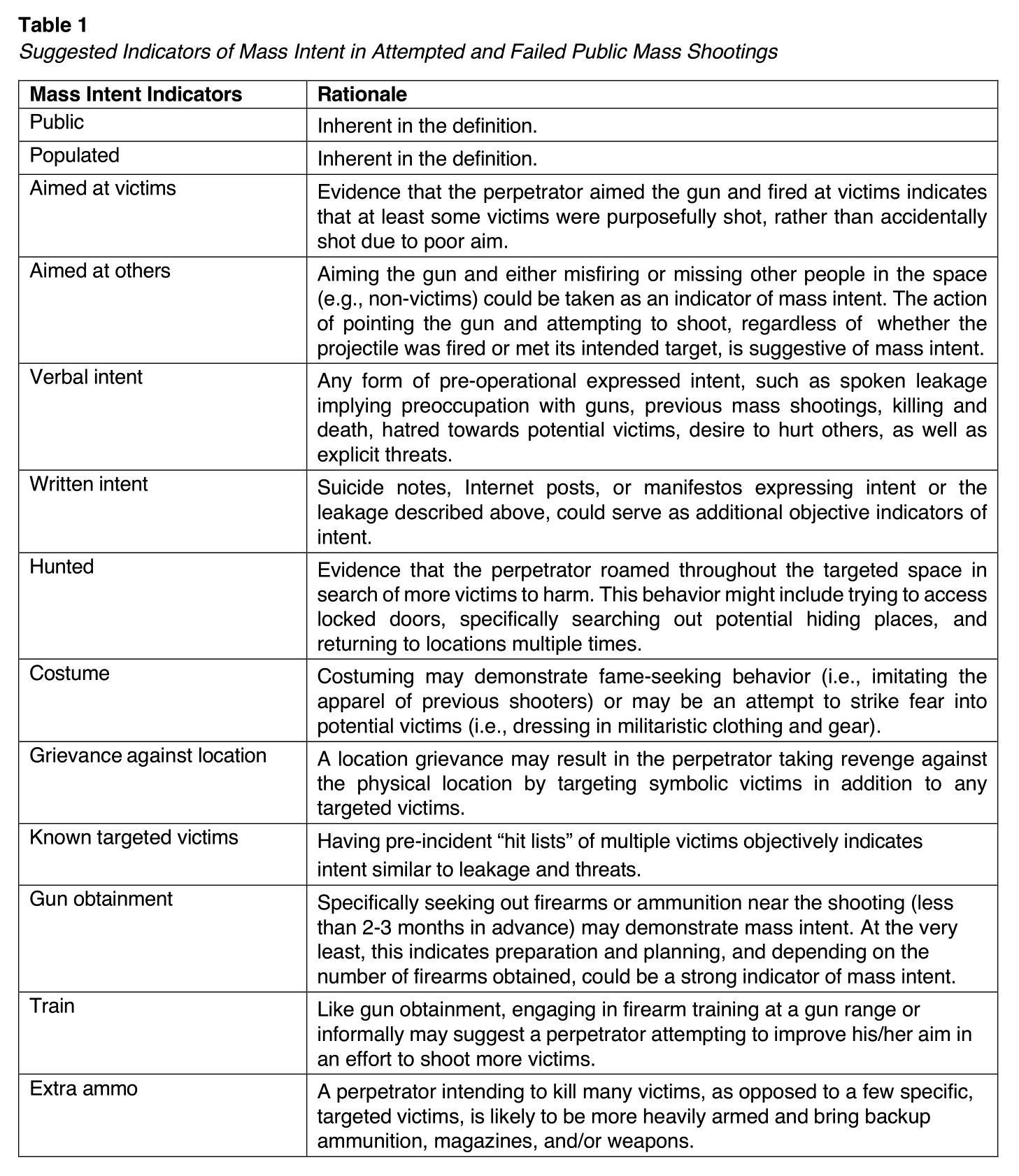
(Click table to enlarge)

As each of these indicators can be coded simply for presence (1=Yes) or absence (0=No), they can be easily summed into an aggregated scale of intent associated with each case or each crime scene. While some indicators are likely to be unreported or missing from media coverage, others are often mentioned in news coverage: whether the perpetrator was known to the location and victims (i.e., grievance and hitlist), if the perpetrator wore a costume, whether the perpetrator roamed and hunted during the course of the shooting, and finally, whether the perpetrator took care to aim individually at victims and witnesses. Even a partially complete scale of intent indicators can be useful for gaining insight into the perpetrator’s motivation to commit a predatory public shooting. As a holistic measure, this scale can help quantify the unempirical concept of intent to kill.

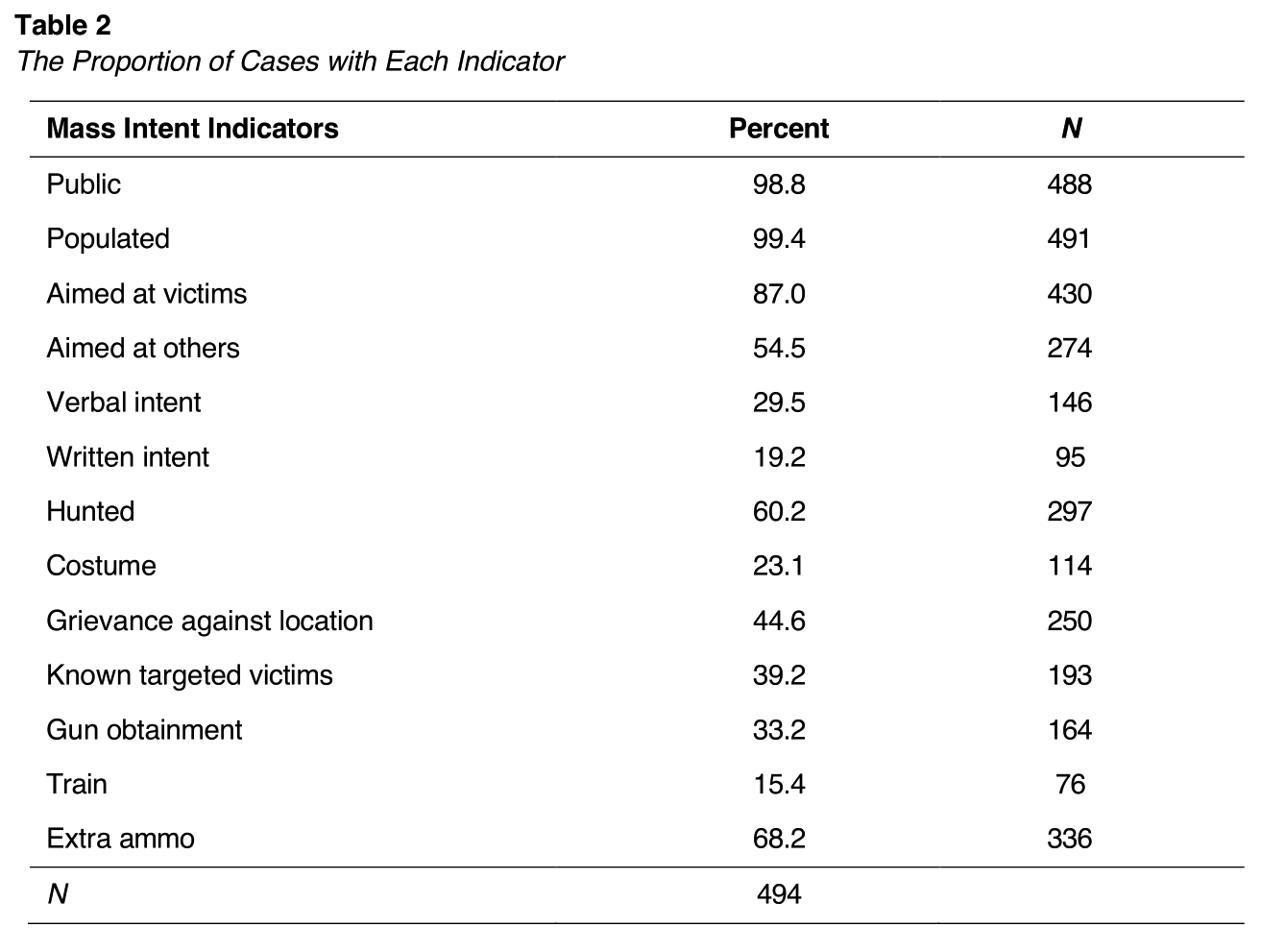
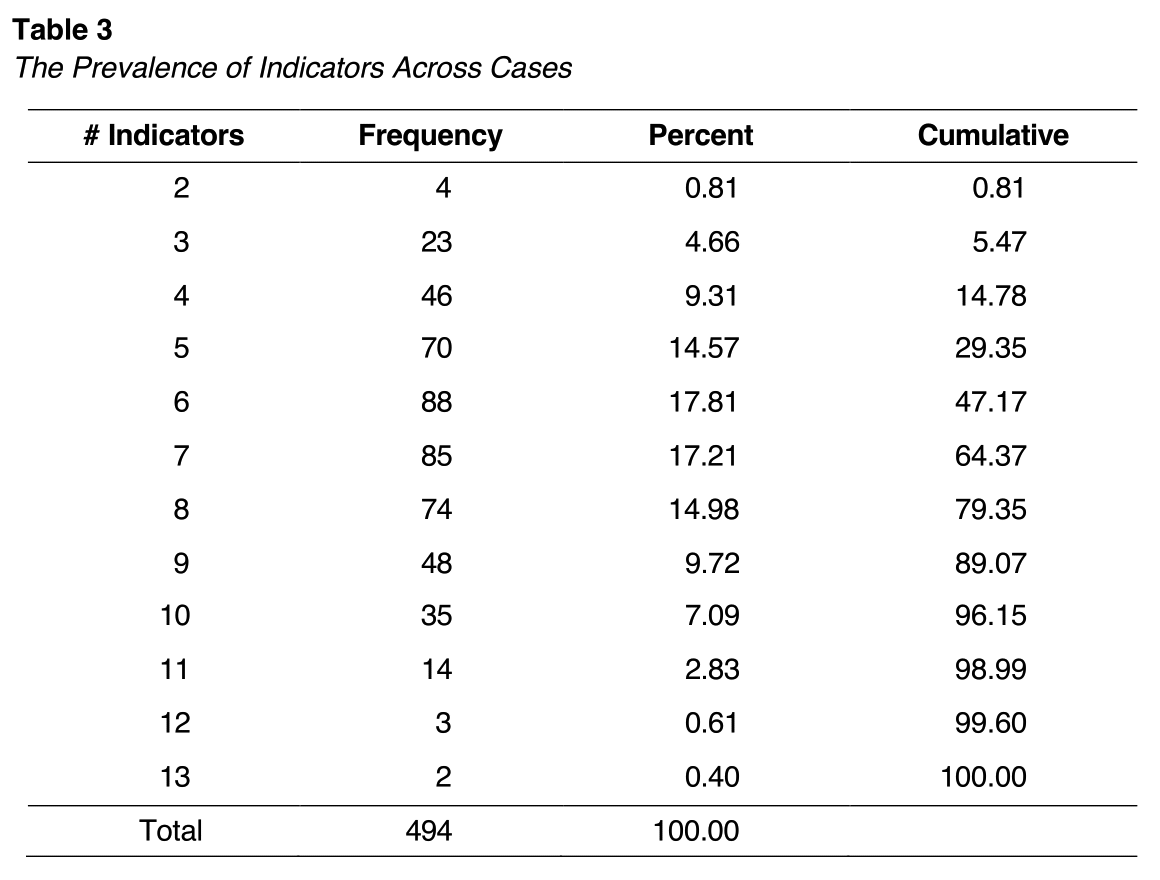
Author (2022) offers preliminary insight for the utility of this strategy – using this intent-focused data collection strategy to investigate situational crime prevention as a harm mitigation technique in the event of public mass shooting incidents. Public mass shootings included completed, attempted, and failed attacks,5 with no-minimum victim criterion. The resulting dataset consisted of 494 public mass shooting incidents between 1966 and 2019. Every scene was coded for 13 indicators of intent described in Table 1. Table 2 displays the proportion of cases with each indicator, and Table 3 displays the prevalence of indicators across cases.

As shown in Table 2, a large majority of scenes were public and populated, and in most scenes, the perpetrator aimed at the victim. Many perpetrators also aimed at additional people in the space but missed or misfired, and brought spare ammunition to the crime scene in preparation for mass victims. Hunting behavior was also common, with well over half of perpetrators roaming and searching within the space for more victims. Written and verbal intent and training were less frequently observed, although these low percentages may be partially due to media effects and missing data rather than a true lack of incidence.
(Click table to enlarge)

It is also important to consider the indicators as a scale rather than discrete variables (Table 3). When aggregated into a scale, the intent scores ranged from 2 to 13 indicators of intent. There were no cases with fewer than 2 indicators of intent since the dataset was developed to only include public and populated locations. Overall, the average intent score was 6.7 indicators out of a potential 13. Most incidents (70.7%) involved 6 or more indicators of intent and nearly all cases (99.2%) were characterized by at least three indicators of intent. Very few cases (n = 4) had only the public and populated indicators of intent. Thus, while not all cases were characterized by all intent indicators, most had three or more indicators, typically including the public and populated criteria and one or more additional behavioral indicators. As shown in Table 2, the more common behavioral indicators were aiming at victims, hunting, and bringing spare ammunition.
(Click table to enlarge)

An example case further emphasizes the importance of the no-minimum casualty criterion and the utility of an intent scale. In this case, the perpetrator made several verbal threats against his targeted location and bought hundreds of rounds of ammunition one hour before the shooting (Associated Press, 1993a; 1993b). He crashed his truck into the building and began shooting at potential victims from the car window at random, as people scattered and attempted to escape. This perpetrator fired at least 12 rounds from his gun in a relatively small office space, in addition to driving a large truck through the office, and did not willingly stop firing; he was shot by a responding security guard and rendered unconscious. Yet, this shooting resulted in zero injuries and zero fatalities. Based on the common public mass shooting definition prevalent in academia, this case would be excluded because the perpetrator did not kill or injure any victims. However, the intent score associated with this case was eight, indicating relatively high intent: the perpetrator made verbal threats, had a known grievance against the location, brought spare ammunition, targeted a public and populated location, aimed the gun at individuals in the space, hunted for victims, and obtained firearm supplies shortly before the incident. The incomplete nature of the shooting was due to the perpetrator’s poor aim and a rapid response from a security guard. Exclusion of this case would limit studies assessing intervention and harm mitigation: his attack was one of the few in the database that was successfully stopped by an armed place manager. Furthermore, this perpetrator displayed observable warning signs before the incident that indicate he was at risk of committing a shooting. These important warning signs would be notably absent in databases that implement a minimum victim criterion and aim to assess prediction and prevention, since this particular case would not be included.

Although the strategy outlined here has only been applied to failed, attempted, and completed public mass shootings, it is relevant for foiled incidents as well. In particular, we can modify the intent indicators in Table 1 to quantify intent displayed by foiled perpetrators. As discussed above, there are distinctions between “serious” mass homicide threats and unsubstantiated threats (O’Toole, 2000; Rocque et al., 2022; Sarteschi, 2016). Drawing from this literature and our own work (Silva, 2021, 2022c), we present Table 4 as a possible scale of intent for foiled public mass shootings. Unlike actualized shootings, this scale does not incorporate predatory crime scene behaviors, like hunting for victims or aiming at victims, but rather focuses on the planning and preparatory behaviors and warning signs exhibited by thwarted attackers. Since this scale has not been empirically validated with data, it is only an exploratory template of what scholars could use to determine intent for foiled cases. Given the renewed academic attention to the prevention and prediction of public mass shootings, there is much room for further development and empirical testing.
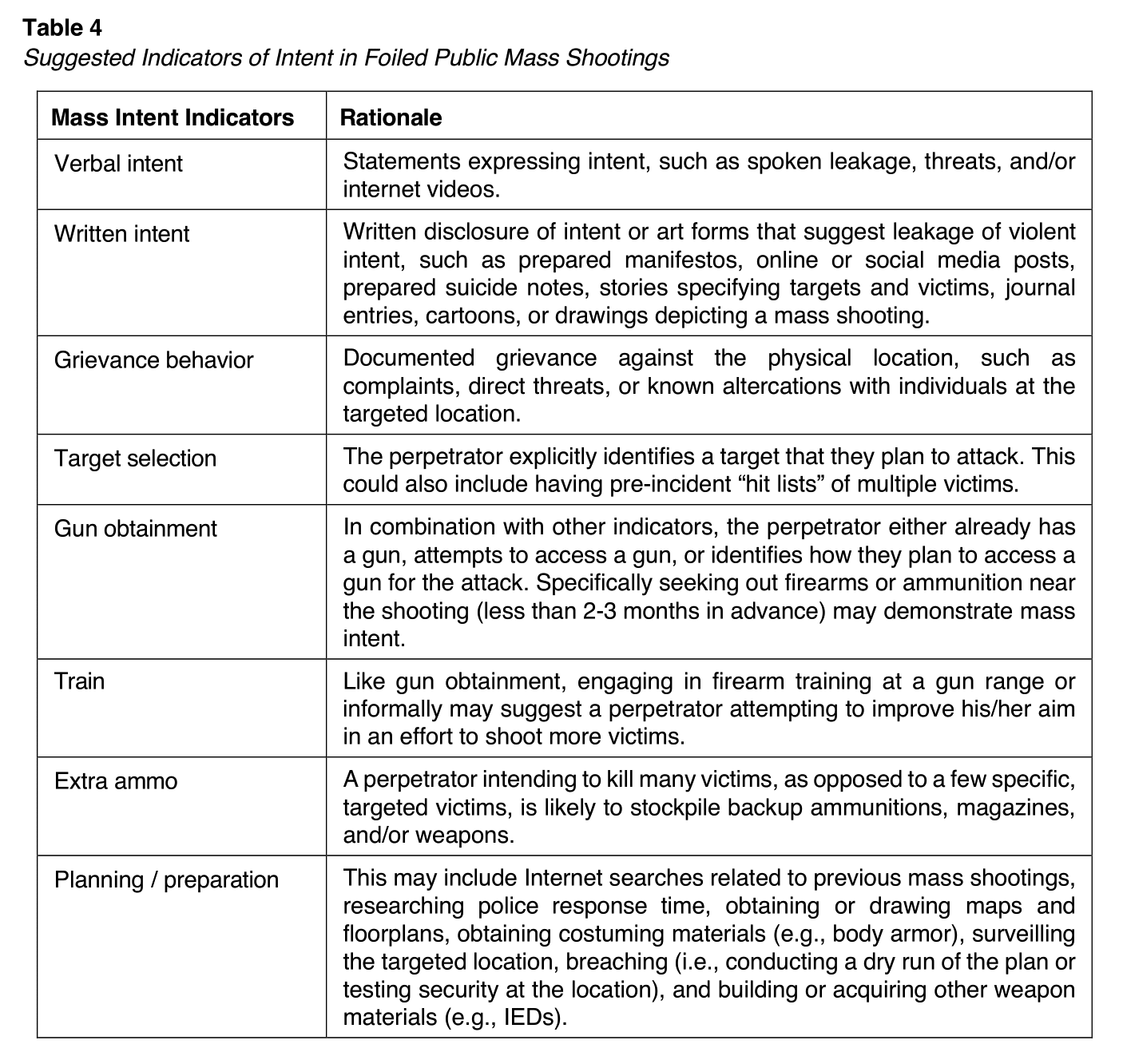
(Click table to enlarge)

Conclusion

Our research has made progress towards advancing the insights that can be drawn from a broader (no-minimum) casualty count definition (see Author, 2022; Author, 2022a, 2022b; Author, 2021, 2022c). However, this definitional approach has not been widely adopted in academia, despite its growing prevalence in official sources (i.e., FBI and NYPD). Below, we present three suggestions for future researchers examining the public mass shooting phenomenon.

First, researchers should expand their victim count inclusion criterion to gain valuable insight for public mass shooting prevention, intervention, and harm mitigation. The proposed definition of public mass shootings highlights mass intent instead of the completion of the shooting. Datasets with minimum victim counts are only including cases that occurred in the absence of mitigating situational factors, like fast intervention or strong situational crime prevention. There is always the potential for the environment and the situation to influence the incident outcome, and open-source scholars implementing a minimum casualty criterion might be systematically excluding cases characterized by mass intent and protective environments. Not only does this affect comparisons of environmental and mitigation factors, but it is an especially problematic source of selection bias for scholars aiming to understand the warning signs, behaviors, and psychosocial profiles of public mass shooting perpetrators.

Second, we advocate for scholars to use the current public mass shooting definition and completed, attempted, failed, and foiled outcome terminology. Critics may argue that our proposed definition more so aligns with an active shooter incident than a public mass shooting. However, we believe that it is beneficial to combine these two types of public gun violence involving random/symbolic victims into a single public mass shooting concept differentiated by outcomes. This will not only strengthen the rigor of empirical research, but also reduce public confusion. Currently, the mass media and general public are familiar with the phrases “public mass shooting” and “active shooting”, and understand both to be incidents of public, predatory gun violence committed by a highly motivated offender. We believe our definition, with its careful distinction between foiled, failed, attempted, and completed outcomes, could address some of the “mass confusion” (Fox & Levin, 2022) regarding public mass shootings.

Critics may argue that our proposal for an intent-focused, no minimum casualty count definition could contribute to journalistic abuse and further public confusion or concern. For comparison, after high-profile public mass shootings, media outlets often cite the number of mass shootings in America using the Gun Violence Archive and Mass Shooting Tracker data – which includes all mass shootings (i.e., felony and family), not just public mass shootings (Silva & Greene-Colozzi, 2019). The media thereby conflates all mass shootings with public mass shootings in the public consciousness. We do not want a consequence of this proposed public mass shooting definition to be the media’s inflation of the problem, given the increased number of incidents included in future research and datasets using this definition. To this end, we stress the importance of researchers using the completed public mass shooting terminology when referencing traditionally considered incidents – involving four or more fatalities – in research and during media interviews. In other words, like the usage of public mass shootings – which has recently become more popular in media usage – we are attempting to also incorporate completed public mass shootings into popular consciousness, to address public confusion and concerns.

Finally, to address the challenges involved in measuring public mass shooting intent, we suggest a mass intent rating system that uses objective behavioral criteria before and during the shooting. This scale of intent can be used as a methodological check for database development, or as a substantive predictor or outcome in inferential models. As with victim count, the intent scale can be filtered to examine cases with higher or lower intent scores, thereby creating greater opportunity for individual assessment of unique categories of perpetrators as well as comparative assessments of the different intent typologies. We encourage our colleagues to consider these guidelines and strategic suggestions in their unique database development, and to extend these intent criteria with future contributions. It is our hope that these strategies may nudge scholars and practitioners towards a more unified definition of the phenomenon and accelerate advancements aimed at identifying causes, correlates, and interventions for public mass shootings.

NOTES

  1. To date, no completed public mass shootings (with four or more fatalities) in the United States have involved more than two offenders, and they overwhelmingly involved one offender. Thus, the one or two offenders’ criterion offers a valuable baseline for measuring the phenomenon. Nonetheless, studies have identified a few foiled mass shootings (often targeting schools) involving more than two offenders (see Agnich, 2015; Larkin, 2009), and researchers may consider including these cases.
  2. If examining public mass shootings outside of the United States, researchers should also exclude incidents involving state-sponsored violence, battles over sovereignty, and/or organized terrorism, especially when making comparisons with the United States (see Lankford, 2020; Silva, 2022b). These types of incidents are not really an issue in the United States and including them in global comparisons would be comparing “apples to oranges.” However, public mass shooting definitions/studies should include ideologically motivated shooters without a direct connection to organized terrorist groups – such as the Charleston church (2015), Pulse nightclub (2016), and Buffalo supermarket (2022) shootings.
  3. Like the Gun Violence Archive, which examines all mass shootings involving four or more gunshot casualties.
  4. While we suggest obtaining a gun 2-3 months before the shooting may illustrate mass intent, it is important to note that some shooters acquire their firearms much further in advance. Additionally, simply obtaining a firearm 2-3 months in advance does not necessarily determine mass shooting intent. To this end, we suggest that this indicator be used only as further evidence alongside other (stronger) indicators.
  5. This database does not include foiled attacks.


DISCLOSURE
STATEMENT

No potential conflicts of interest were reported by the authors.


FUNDING STATEMENT
This work was supported in part by the National Institute of Justice Graduate Research Fellowship # 2019-RX-CX-0007.

REFERENCES

Agnich, L. E. (2015). A comparative analysis of attempted and completed school-based mass murder attacks. American Journal of Criminal Justice, 40(1), 1-22. https://doi.org/10.1007/s12103-014-9239-5

Associated Press. (1993a, July 11). Sex, SIIS frustrate Las Vegas gunman. The Reno-Gazette-Journal, p.15.

Associated Press. (1993b, July 13). Security beefed up at office. Elko Daily Free Press, p. 25.  

Berkowitz, B., & Alcantara, C. (2021). The terrible numbers that grow with each mass shooting. Washington Post. https://www.washingtonpost.com/graphics/2018/national/mass-shootings-in-america/

Blair, J. P., Sandel, W. L., & Martaindale, M. H. (2021). Correlates of the number shot and killed in active shooter events. Homicide Studies, 25(4), 335-360. https://doi.org/10.1177/1088767920976727

Blau, B. M., Gorry, D. H., & Wade, C. (2016). Guns, laws and public shootings in the United States. Applied Economics, 48(49), 4732-4746. https://doi.org/10.1080/00036846.2016.1164821

Chermak, S. M. & Gruenewald, F. (2006). The media’s coverage of domestic terrorism. Justice Quarterly, 23(4), 428-461.  https://doi.org/10.1080/07418820600985305

Chermak, S. M., Freilich, J. D., Parkin, W. S., & Lynch, J. P. (2012). American terrorism and extremist crime data sources and selectivity bias: An investigation focusing on homicide events committed by far-right extremists. Journal of Quantitative Criminology, 28(1), 191-218. https://doi.org/10.1007/s10940-011-9156-4

Clemmow, C., Gill, P., Bouhana, N., Silver, J. & Horgan, J. (2022) Disaggregating lone-actor grievance-fueled violence: Comparing lone-actor terrorists and mass murderers. Terrorism and Political Violence, 34(3), 558-584. https://doi.org/10.1080/09546553.2020.1718661

Cowan, R. G., & Cole, R. (2022). The pathway to violence and public mass shooters in mental health treatment before attacks. Safer Communities, 21(1), 31-44. https://doi.org/10.1108/SC-05-2021-0020

Dahl, E. J. (2011). The plots that failed: Intelligence lessons learned from unsuccessful terrorist attacks against the United States. Studies in Conflict & Terrorism, 34(8), 621-648. https://doi.org/10.1080/1057610X.2011.582628

Duwe, G. (2004). The patterns and prevalence of mass murder in twentieth-century America. Justice Quarterly, 21(4), 729-761. https://doi.org/10.1080/07418820400095971

Duwe, G. (2020). Patterns and prevalence of lethal mass violence. Criminology & Public Policy, 19(1), 17-35. https://doi.org/10.1111/1745-9133.12478

Ellis, R., Moon, S., & Mossburg, C. (2019, November 22). 13-year-old arrested for allegedly threatening school shooting in Los Angeles. CNN. https://www.cnn.com/2019/11/22/us/school-shooting-plot-thwarted-in-los-angeles/index.html

Federal Bureau of Investigation. (2021). Active shooter incidents 20-year review, 2000-2019. https://www.fbi.gov/file-repository/active-shooter-incidents-20-year-review-2000-2019-060121.pdf/view

Felson, M. (1995). Those who discourage crime. In J. E. Eck and D. Weisburd (Eds.) Crime and Place. Vol. 4, Crime Prevention Studies (pp. 53-66). Criminal Justice Press.

Fox, J. A., & Levin, J. (1994). Firing back: The growing threat of workplace homicide. The ANNALS of the American Academy of Political and Social Science, 536(1), 16-30. https://www.jstor.org/stable/1048005

Fox, J. A. & Levin, J. (2022). Mass murder in America: Trends, characteristics, explanations, and policy response. Homicide Studies, 26(1), 27-46. https://doi.org/10.1177/10887679211043803

Freilich, J. D., Chermak, S. M., & Klein, B. R. (2020). Investigating the applicability of situational crime prevention to the public mass violence context. Criminology & Public Policy, 19(1), 271-293. https://doi.org/10.1111/1745-9133.12480

Greene-Colozzi, E. A. (2022). Mitigating the harm of public mass shooting incidents through situational crime prevention. [Doctoral dissertation, John Jay College / Graduate Center, CUNY]. ProQuest Dissertations. https://academicworks.cuny.edu/cgi/viewcontent.cgi?article=6035&context=gc_etds

Greene-Colozzi, E. A., Freilich, J. D., & Chermak, S. M. (2021). Developing open-source databases from online sources. In T. J. Holt & A. Lavorgna. (Eds.) Researching cybercrimes, methodologies, ethics, and critical approaches. Palgrave MacMillan.

Gun Violence Archive. (2021). Gun Violence Archive. https://www.gunviolencearchive.org

Huff‐Corzine, L., & Corzine, J. (2020). The devil’s in the details: Measuring mass violence. Criminology & Public Policy, 19(1), 317-333.  https://doi.org/10.1111/1745-9133.12482

Hutchinson, B. (2019, June 17). Alleged Dallas gunman BIC opens fire outside federal courthouse, dies in gunbattle. ABC News. https://abcnews.go.com/US/gunman-opens-fire-dallas-federal-courthouse-police/story?id=63761439

Klein, B. R., Gruenewald, J., & Smith, B. L. (2017). Opportunity, group structure, temporal patterns, and successful outcomes of far-right terrorism incidents in the United States. Crime & Delinquency, 63(10), 1224-1249.  https://doi.org/10.1177/0011128716654925

Krouse, W. J., & Richardson, D. J. (2015). Mass murder with firearms: Incidents and victims, 1999–2013. Congressional Research Service. https://sgp.fas.org/crs/misc/R44126.pdf

Langman, P., & Straub, F. (2019). A comparison of averted and completed school attacks from the Police Foundation Averted School Violence Database. Office of Community Oriented Policing. https://www.avertedschoolviolence.org/wp-content/uploads/2019/04/ASV-A-Comparison-of-Averted-and-Completed-School-Attacks_Final-Report-2019.pdf

Lankford, A. (2015). Mass shooters in the USA, 1966-2010: Differences between attackers who live and die. Justice Quarterly, 32(2), 360-379. https://doi.org/10.1080/07418825.2013.806675

Lankford, A. (2020). The importance of analyzing public mass shooters separately from other attackers when estimating the prevalence of their behavior worldwide. Econ Journal Watch, 17(1), 40-55. https://econjwatch.org/File+download/1145/LankfordMar2020.pdf?mimetype=pdf

Larkin, R. W. (2009). The Columbine legacy: Rampage shootings as political acts. American Behavioral Scientist, 52(9), 1309-1326.  https://doi.org/10.1177/0002764209332548

Mass Shooting Tracker. (2021). Mass Shooting Tracker. https://massshootingtracker.org/

Newman, K. S., Fox, C., Harding, D. J., Mehta, J., & Roth, W. (2004). Rampage: The social roots of school shootings. Basic Books.

O’Neill, J. P., Miller, J. J., & Waters, J. R. (2016). Active shooter: Recommendations and analysis for risk mitigation. New York City Police Department. https://www1.nyc.gov/assets/nypd/downloads/pdf/counterterrorism/active-shooter-analysis2016.pdf

O’Toole, M.E. (2000). The school shooters: A threat assessment perspective. Critical Incident Response Group, National Center for the Analysis of Violent Crime. https://www.fbi.gov/file-repository/stats-services-publications-school-shooter-school-shooter/view

Paul, D., & Mettler, K. (2019, April 28). Authorities identify suspect in ‘hate crime’ synagogue shooting that left 1 dead, 3 injured. Washington Post. https://www.washingtonpost.com/nation/2019/04/27/california-synagogue-shooting-multiple-injuries/

Peterson, J. K., & Densley, J. A. (2019). The Violence Project Database of Mass Shootings in the United States, 1966–2019. The Violence Project.

Rocque, M. Gerdesn, M., Fox, J. A., Duwe, G., & Clark, M. (2022). Averting tragedy: An exploration of thwarted mass public shootings relative to completed attacks. Criminal Justice Review. https://doi.org/10.1177/07340168221117107

Sarteschi, C. M. (2016). An examination of thwarted mass homicide plots and threateners. Aggression and Violent Behavior, 30(5), 88-93. https://doi.org/10.1016/j.avb.2016.06.010

Schildkraut, J., & Elsass, H. J. (2016). Mass shootings: Media, myths, and realities. ABC-CLIO.

Schildkraut, J., & Turanovic, J. J. (2022). A new wave of mass shootings? Exploring the potential impact of COVID-19. Homicide Studies. https://doi.org/10.1177/10887679221101605

Silva, J. R. (2021). A comparative analysis of foiled and completed mass shootings. American Journal of Criminal Justice, 46(2), 187-208.  https://doi.org/10.1007/s12103-020-09552-2

Silva, J. R. (2022a). A comprehensive study of public, family, and felony mass shootings in the United States, 2006-2020. Violence and Victims, 37(6).

Silva, J. R. (2022b). Global mass shootings: Comparing the United States against developed and developing countries. International Journal of Comparative and Applied Criminal Justice. https://doi.org/10.1080/01924036.2022.2052126

Silva, J. R. (2022c). Mass shooting outcomes: A comparison of completed, attempted, failed, and foiled incidents in America. Deviant Behavior. https://doi.org/10.1080/01639625.2021.1991248

Silva, J. R., & Capellan, J. A. (2019). The media’s coverage of mass public shootings in America: Fifty years of newsworthiness. International Journal of Comparative and Applied Criminal Justice, 43(1), 77-97. https://doi.org/10.1080/01924036.2018.1437458

Silva, J. R., & Greene-Colozzi, E. A. (2019). Deconstructing an epidemic: Determining the frequency of mass gun violence. In S. Daly (Ed.), Assessing and Averting the Prevalence of Mass Violence (pp. 39-67). IGI Global.

Silva, J. R., & Greene-Colozzi, E. A. (2021). Mass shootings and routine activities theory: The impact of motivation, target suitability, and capable guardianship on fatalities and injuries. Victims and Offenders, 16(4), 565-586. https://doi.org/10.1080/15564886.2020.1823919

Silva, J. R., & Greene-Colozzi, E. A. (2022a). An exploratory study of failed mass shootings in America. Security Journal, 35(2), 367-399. https://doi.org/10.1057/s41284-020-00281-z

Silva, J. R., & Greene-Colozzi, E. A. (2022b). What we know about foiled and failed mass school shootings. Regional Gun Violence Research Consortium, Rockefeller Institute of Government. https://rockinst.org/wp-content/uploads/2022/08/Failed-Foiled-School-Shootings.pdf

USA Today. (2018). U.S. mass killings since 2006. http://www.gannett-cdn.com/GDContent/mass-killings/index.html#explore

About the Authors

Emily Ann Greene-Colozzi is an Assistant Professor in the University of Massachusetts Lowell School of Criminology and Justice Studies. Her research focuses on causes and prevention of mass gun violence and school violence, and has been published in Journal of School Violence, Justice Quarterly, and Aggression and Violent Behavior.

Jason R. Silva is an Assistant Professor in the Department of Sociology and Criminal Justice at William Paterson University. His research examines mass shootings, terrorism, school violence, and mass media. Silva’s recent publications have appeared in Homicide Studies, Journal of Interpersonal Violence, Justice Quarterly, and Violence & Victims. His work has also been featured in The New York Times, CNN, New York Magazine, NPR, Oxygen, and The Conversation.

CITATION (APA 7th Edition)
Greene-Colozzi, E. A., & Silva, J. R. (2022). Mass outcome or mass intent? A proposal for an intent-focused, no-minimum casualty count definition of public mass shooting incidents. Journal of Mass Violence Research, 1(2), 27-41. https://doi.org/10.53076/JMVR63403

Download an infographic summarizing the main takeaways of this article.
Available Formats: PDF  |  PNG

Keeping with Tradition: Preference for the Longstanding Definition of Mass Shooting

SHARE THIS ARTICLE

Keeping with Tradition: Preference for the Longstanding Definition of Mass Shooting

James Alan Fox Email the Corresponding Author1 and Emma E. Fridel

1 School of Criminology and Criminal Justice, Northeastern University
2 College of Criminology and Criminal Justice, Florida State University

https://doi.org/10.53076/JMVR59660  |  Full Citation Volume: 1, Issue: 2, Page(s): 17-26

Article History: Received June 27, 2022 | Accepted August 11, 2022 | Published Online September 12, 2022

ABSTRACT
As defined back in the 1980s, the term “mass shooting” has long been understood to mean the intentional killing of four or more victims with gunfire in a single incident. However, recent efforts to examine this rare and tragic crime have employed alternate definitional criteria. In order to facilitate cross-study comparisons and curb rampant public fear, it is imperative that scholars, politicians, and the media avoid using the same terminology to describe very different phenomena. In this article, we advocate for the traditional definition in view of a variety of theoretical and methodological considerations.

KEYWORDS
mass shooting, mass killing, definitions

Virtually all criminal offense types are clearly and incontrovertibly defined. Indeed, no one debates the meaning of homicide, robbery, auto theft, or kidnapping. In contrast, the definition of mass shooting has been—and continues to be—very much a matter of debate. For decades, the term “mass shooting” was simply an extension of the Federal Bureau of Investigation’s (FBI) seminal definition for mass murder: four or more victims killed in a single event, typically within 24 hours (Ressler et al., 1988). A mass shooting was essentially just a mass murder committed with firearms. Though somewhat arbitrary, this definition was designed to distinguish among types of multiple homicide and has been used by mass violence scholars for decades with minimal controversy, perhaps due to the paucity of research in this area.

Both public and academic interest in mass shootings, however, surged in the wake of several high-profile incidents in 2012, including the massacres in Aurora, CO, and Newtown, CT. With the “discovery” of mass shooting as a worthy focus of criminological research, the need for reliable data became clear. Given that there was no official resource for such incidents (other than the rather limited and sometimes erroneous cases drawn from the FBI’s Supplementary Homicide Reports), several news organizations, academic centers, and advocacy groups undertook efforts to fill the void by building their own databases from scratch.

(Click table to enlarge)

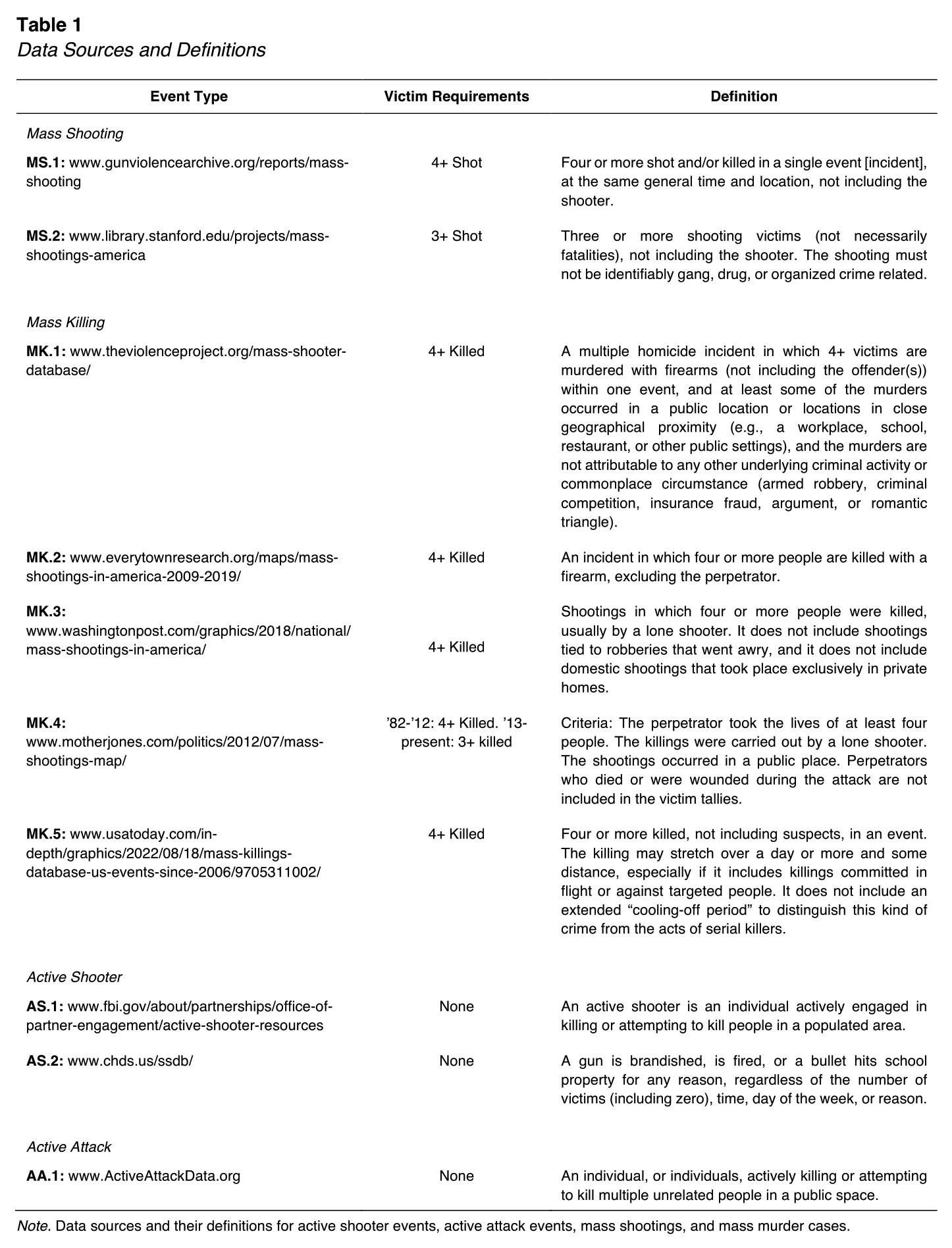
Unfortunately, there was no consensus as to the parameters of such an endeavor. As shown in Table 1, definitions of mass shooting vary by victim count threshold, extent of victim injury, and incident type, all of which fundamentally alter the nature and prevalence of the phenomenon itself. Based on our evaluation of the extant literature, the three most common definitions of mass shooting are:

  1. Four or more victims shot (but not necessarily killed), used, for example, by the Gun Violence Archive (GVA) beginning in 2013. There are approximately 600 mass shootings per year in the United States using this definition, averaging one fatality per incident.
  2. Four or more victims killed by gunfire, used, for example, by the Associated Press/USA TODAY/Northeastern University Mass Killing Database. This definition has been the standard since the 1980s. There are approximately two dozen mass shootings annually according to this definition, with an average of five victim deaths per incident.
  3. Four or more victims killed by gunfire in a public setting not involving ongoing criminal activity (such as gang conflict and drug trafficking), used, for example, by The Violence Project. This is a subset of the second definition, which is often referred to as “public mass shootings.” There are about a half dozen such incidents per year, claiming an average of seven victim fatalities per incident.

While all three definitions have their utility in different contexts, it is crucial that scholars, politicians, and the media avoid using the same terminology to describe these very different phenomena. Aside from limiting cross-study comparisons (e.g., datasets using differing definitions yielding contradictory results), the lack of a consensus on the definition for mass shootings has fomented public fear massively disproportionate to the risk of victimization. As such, we advocate for the traditional approach (Definition #2) for both theoretical and methodological reasons. Specifically, we contend that:

  1. Injury and death are qualitatively distinct and should not be conflated.
  2. Lowering the victim fatality threshold increases the risk of missing data bias, especially for cases occurring in earlier decades.
  3. Perpetrator deaths are not equivalent to those of victims and should not be included in fatality counts.
  4. All types of incidents—regardless of motivation, location, or weapon—are worthy of study.
  5. A concrete time frame establishing the length of “a single incident” is necessary to distinguish these events from serial and spree killings.
  6. Definitions must be applied consistently across cases and over time.

In the sections to follow, we discuss each of these six points in turn. It should be noted that these points are not equal in terms of salience nor addressed in such a way as to suggest order of importance.

Death is Different from Injury

A shooting with a large number of injuries is hardly equivalent to one that results in a large number of fatalities. A high death toll brings with it a series of funerals and memorials, which in certain cases attract national attention. We do not mean to ignore the awful suffering that comes from nonfatal gunshot wounds, but death is inherently different. Homicide leaves an indelible mark on the families, friends, and communities of the victims in a way that injury never can, no matter how severe. 

Is it reasonable to equate suffering a life-threatening wound with being grazed by a bullet? Is it logical that injuring four victims counts as a mass shooting, but fatally killing three does not, despite the fact that the latter is much more serious? Conflating fatalities with injuries, some of which may be minor, trivializes the severity and permanence of death. Expanding to include nonfatal injuries in the victim threshold fundamentally alters the nature of the crime—it is called mass murder, after all, not mass attempted-murder.

Even further, mass confusion arises when figures associated with the broadest notion of mass shooting (Definition #1) are referenced by the media in their reporting on an incident of much greater severity (Fox & Levin, 2015). After the May 2022 Robb Elementary School shooting in Uvalde, TX, that claimed the lives of 19 school children and two teachers, for example, countless media outlets noted that there already had been more than 200 mass shootings up to that point of the year, according to GVA statistics. But most of these were not like Uvalde: close to half of the GVA’s mass shooting incidents since 2013 resulted in no fatalities, and less than one-quarter involved multiple deaths (some of which were of the assailant). Beginning in 2019, the GVA began tallying mass murders (four or more victims killed by gunfire) in addition to mass shootings (four or more victims killed or wounded by gunfire). Of the 1,711 mass shootings from 2019 to 2021, only 80 (fewer than five percent) reached the four-victim fatality threshold for mass killing.

Equating fatalities with injuries can be terribly misleading and tends to elevate the level of fear, even if it was hardly the intention of the GVA to do so. Claims that mass shootings are “the new normal” (Holt & Gosk, 2018) or that there are more incidents than days (e.g., Silverstein, 2020) unfortunately lead many Americans to conclude incorrectly that massacres with double-digit death tolls are happening every time they turn around. 

As a prime example of blurring the distinction between injury and death, in May 2021, The New York Times (see Victor & Taylor, 2022) published what was described as a “partial list” of the 13 mass shootings that had occurred up to that point in the year, adding that there were “many more” not included. However, the “partial list” of mass shootings was the entire list of mass killings (with four or more victim fatalities), and the incidents not listed were of much lesser severity. In effect, the “partial list” characterization misleadingly implied that the omitted incidents were like the 13 deadliest.

Focusing on fatalities also has benefits for data collection and analysis. Death is unambiguous and thus easy to measure; injuries are a matter of degree, which can lead to confusing and somewhat subjective inclusion criteria. How severe does the wound have to be to count? And how accurate are casualty counts, if some victims do not report minor injuries that do not require medical treatment? In the same vein, it is generally much more challenging to find detailed information on victims who did not perish during the incident.

A key limitation of relying upon fatalities, however, is that the difference between life and death is often a matter of luck. Victim mortality depends on the number and location of wounds, emergency response times, and distance to medical facilities, and may not be a reflection of offender intent. In other words, many perpetrators may seek to kill multiple victims, but fail to do so as a result of factors outside of their control. Nevertheless, this raises the thorny issue of operationalizing motive, an impossible task when many offenders do not survive the incident. Therefore, while we acknowledge that a definition based exclusively on fatalities is inherently imperfect, we argue that it remains the most viable option.

Victim Threshold and Missing Data Bias

Another reason to exclude nonfatal injuries in establishing a victim count threshold—and to maintain a minimum of four fatalities—relates to the perils of retrospective collection of historical data. As mentioned earlier, for decades most researchers adopted the traditional definition of four or more victims shot to death, gradually collecting data on cases over the course of their careers. As a result, we have relatively reliable data on such incidents over a long period of time, providing crucial information for contextualizing whether mass shootings are indeed on the rise. In contrast, definitions involving fewer victims and/or including injuries are relatively new, and they require identifying cases from media reports and public records that are often decades old. Even further, such incidents are much more difficult to find due to the lower level of public attention and press coverage they receive—a task that becomes almost impossible for cases occurring prior to the internet era.

Existing databases have dealt with this issue in two ways: simply restrict the time period covered to more recent years (as does the GVA) or accept a high level of missing cases in earlier years (as does the Stanford University Geospatial Center, which has ceased data collection). Either way, such databases cannot provide accurate prevalence estimates of mass shootings over time and attempts by the media to do so have produced the myth that these massacres are becoming more and more commonplace. 

A case in point is the FBI’s effort, starting in 2014, to collect data on so-called “active shooter events,” defined as episodes in which “one or more individuals is actively engaged in killing or attempting to kill people in a populated area” (FBI, 2022, p. 2). Through a series of statistical reports, the FBI, in collaboration with Texas State University, has documented a sharp rise in such attacks since 2000. Although the FBI notes that active shooter events do not necessarily result in any deaths, the distinction is often lost in media coverage, with active shooter events incorrectly treated as synonymous with mass shootings (e.g., Schmidt, 2014). Aside from the confusion in terminology, the reported manifold increase in active shooter events is suspect because of apparent missing cases in the early years of the database (Lott, 2015). Although “active shooter event” became part of the law enforcement lexicon following the 1999 Columbine massacre, it did not start appearing in news stories until 2006, creating a challenge for identifying cases, particularly those of lesser severity, from the distant past. For example, the initial FBI report on active shooter events (Blair & Schweit, 2014) showing a nearly three-fold increase in cases—a finding that was covered widely by the media—was modified years later with additional incidents that had been overlooked. In fact, for the first three years (2000-2002), nine cases were added to the original 11, an update that would substantially lower the trendline presented in the original report.

Evidence of missingness bias is clear when comparing the FBI’s active shooter data from the early and later years. In the first five years of the dataset (2000-2004), where cases were identified retrospectively, 7.7% of the gunmen failed to kill anyone. By contrast, in the first five years of the project (2014-2018) where cases were identified concurrently, 37.0% of assailants failed to kill anyone. Although some of this increase in the share of nonfatal incidents may be linked to improved police response, most likely it reflects an inability to capture less serious cases of the earlier years that may not have been covered by major newspapers. Moreover, even if a nonfatal shooting did get reported in the local press, it could have been easily overlooked in searches of news archives for years when the term “active shooter” was relatively obscure.

It is important when assessing the ongoing frequency of mass shootings to have an accurate historical benchmark. For example, many observers comment on the prevalence of recent mass shootings in the GVA as an epidemic with no idea of how frequent shootings with four or more victims—but few, if any, fatalities—were in the early 1990s, when the nation’s murder rate was nearly twice the level it is now. Such early points of comparison can be hard to measure.

Perpetrators are not Victims

The idea that death is a singular phenomenon does not mean that all deaths are equally weighty. Specifically, an assailant’s death—be it by suicide, or by the intervention of police or a bystander—should not be included in a count of fatalities (as is the practice of the GVA and some other databases). Unlike the victims, the assailant is a willing participant in a crime that may lead to his or her demise. Including the death of an offender in the fatality count along with those of the victims only serves to inflate the severity of the event in the public’s mind.

The number of fatalities reported in the GVA incident listings, for example, can easily be misinterpreted as a victim fatality count because there is no indication of which incidents include an assailant’s death. One would need to open and inspect each incident report individually (a daunting task indeed) to identify which mass shooting fatality counts include an offender and which do not. Of course, this could very easily be resolved by noting with an asterisk which include an assailant’s death or by using separate columns for victim deaths and offender deaths. Moreover, offender fatalities could also be designated as a suicide versus killed by first responder or bystander.

All Types of Incidents are Important

While we consider death an important element in defining mass shooting, we do not concur with those who limit cases based on location, motive, or even weapon. Definition #3, for example, narrows the focus to indiscriminate slaughter of strangers as well as to targeted shootings in public places that may also put the lives of innocent bystanders at risk. These are the kinds of incidents that are reflected in the common stereotype of a mass shooting and that are most frightening to the public—as they can happen to anyone, at any time, and anywhere. In reality, public mass shootings account for only a small portion of incidents; familicides or family annihilations, for example, represent nearly half of all mass shootings annually, yet rarely inspire the same kind of public fear (Fox & Levin, 2022). Although they occur approximately as often as incidents in public, felony-related massacres involving gang violence and drug trafficking are all but ignored by the majority of Americans (Fridel, 2021). Focusing exclusively on public mass shootings essentially allows the rarest and most sensational type to define the phenomenon as a whole. Ignoring incidents in private spaces also does a disservice to the victims, who are just as dead no matter where or by whom they were killed. Some scholars, for example, list a victim count of 26 for the 2012 Sandy Hook Elementary School shooting, ignoring the fact that the perpetrator killed his mother at their joint home immediately prior for a total of 27 victims, each equally dead.

Besides and independent of our preference for including all types of motivations, relationships, and locations, we also advocate for expanding the focus of mass violence to encompass all types of weapons, not just firearms. Scholarship on other forms of lethal violence like homicide and suicide may focus on the role of guns, but certainly does not ignore deaths caused by other means. Although shootings account for nearly 80 percent of all mass killings in the United States (Carroll, 2021), ignoring victims who were slain with alternate weapons marginalizes their deaths. To them, did it really matter what weapon was used? In fact, the level of suffering experienced by victims who are stabbed, bludgeoned, or burnt to death is often more excruciating than that of gunshot victims. In the same vein, many of the deadliest massacres in U.S. history involved weapons other than guns, including the 1995 Oklahoma City bombing and the 1990 Happy Land Social Club arson fire. Including all mass murders also facilitates international comparisons, as massacres abroad disproportionately involve other weapons, such as vehicles.

Including all types of mass murders has its methodological advantages as well. Many cases defy categorization, as private violence sometimes spills into public spaces or vice versa. In a 2017 incident in Marathon County, WI, a 45-year-old man arrived at his wife’s workplace, threatening to kill her if she did not sign their divorce papers. As she fled to a nearby restaurant, the assailant retrieved his gun from his car and proceeded to shoot and kill two of his wife’s coworkers before gunning down his wife’s lawyer at her office and a responding officer at his own apartment. Similarly, in 2006, a 28-year-old man shot and killed six ravers at an open afterparty inside a private residence in the Capitol Hill neighborhood of Seattle, WA. Both cases illustrate the difficulty of defining what “public” really means. The first clearly was motivated by a domestic dispute, but just so happened to involve public locations; the second was a quintessential indiscriminate rampage shooting that took place in a private home. Moreover, many so-called “public” mass shootings occur in places that are not accessible to outsiders (e.g., military bases), undermining the “it could happen to anyone” logic often used to justify the focus on these incidents.

Including deaths from all weapons avoids similar issues for cases where multiple weapons are used, or the deaths are caused indirectly (e.g., jumping out of a window or being trampled while attempting to escape a mass shooting). In 2021, for example, a 30-year-old man in North Bend, OR, fatally shot two victims (including his father), stole his dad’s truck, and then drove over and killed two pedestrians.

While we recommend including all types of incidents, we acknowledge the unique offender, victim, and incident traits that characterize distinct types of mass shootings. Accordingly, we recommend that researchers disaggregate by type (e.g., familicides vs. felony killings vs. public massacres; shootings vs. other methods) rather than focusing exclusively on one subset of cases (e.g., public mass shootings).

Establishing a Time Frame

When FBI profilers originally distinguished among mass, serial, and spree murders, they identified two primary differentiating criteria: the number of victims and length of time between kills (Ressler et al., 1988). Although every definition of mass shooting includes some sort of victim threshold, many fail to establish a concrete time frame within which the incident must occur. Generally speaking, mass murders occur in “a single incident,” while serial and spree cases typically take place in multiple locations (the former separated by long “cooling off” periods, and the latter occurring in relatively quick succession over a few days). In the spirit of the original, we recommend defining mass shootings as incidents that occur within a 24-hour period, regardless of the number of physical locations. This would include, for example, the March 2021 killing of eight victims at three Metro Atlanta day spas during a time span of just over two hours. Also included would be rare cases in which an offender began or ended a multi-day killing spree with a mass shooting. In such instances, we recommend counting all of the victims (as long as four were killed within twenty-four hours). Although somewhat arbitrary, this choice of time frame is unambiguous, easy to apply, and avoids confusion with other forms of multiple homicide.

Consistency is Key

Regardless of which definition is chosen, it should be applied consistently to all cases over time to ensure the accuracy of prevalence estimates. Unfortunately, some databases include cases that violate their own inclusion criteria, especially if the incident is deemed particularly infamous. Mother Jones, for example, explicitly limits cases to lone shooters (Follman et al., 2022), yet includes the 2015 San Bernardino, CA, massacre, the 1999 Columbine High School shooting, and the 1998 Westside Middle School shooting, all of which involved two perpetrators. More problematic, Mother Jones changed its minimum victim threshold from four to three fatalities in accordance with the U.S. Congress’ Assistance for Violent Crimes Act of 2012 (which somewhat arbitrarily defined mass shootings as three or more victims killed) for all cases occurring in 2013 or later. They did not, however, retroactively update the incident counts for earlier years, leading to a dramatic and artificial increase in the number of mass shootings in recent years. Although Mother Jones makes note of the modified definition, individuals who download the data have sometimes failed to recognize the change and derive erroneous conclusions about the trend in mass shootings (see, for example, Reynolds, 2018).

Our Recommendation

 As indicated, we adopt the conventional definition of four or more victims killed. The broader notion of four victims injured or killed unjustifiably conflates injury with death, the most serious and permanent of outcomes. The narrower notion of four or more killed in a public setting unrelated to an ongoing criminal enterprise often by a stranger unfairly demeans the deaths of victims who are killed in private settings, who are slain by assailants known to them, or who are targeted by rivals in gang warfare or the illicit drug trade. Given the above arguments, we crafted this definition used in the Associated Press/USA TODAY/Northeastern University Mass Killing Database:

Mass murder is defined as the intentional killing of four or more victims— excluding the deaths of unborn children and the offender(s)—by any means within a 24-hour period. This definition includes cases involving all weapons (e.g., shooting, blunt force, stabbing, explosives, etc.), types (e.g., public, felony-related, and familicides), motivations (e.g., domestic dispute, profit, revenge, terrorism, hate, etc.), victim-offender relationships (e.g., stranger, family, acquaintance, co-worker, etc.), and number of locations. The time frame of 24 hours was chosen to eliminate conflation with spree killers who kill multiple victims over several days in different locations, and to satisfy the traditional requirement of occurring in a “single incident,” even if that incident involves an offender targeting multiple locations in an extended assault but within a relatively short time span. However, offenders who kill four or more victims during any 24-hour period of time as part of a multi-day spree are included, as are all their victims within seven days of the mass killing. Negligent homicides related to driving under the influence or accidental fires are excluded due to the lack of intent. Finally, consistent with the traditional definition, mass shootings are those mass killings (four or victim fatalities) in which most or all the victims are killed by gunfire.

It is important to acknowledge, however, that any definition is somewhat arbitrary and, thus, imperfect. In some cases, whether an incident qualifies as a mass killing is simply a matter of timing, opportunity, or the assailant’s skill. Public shooters try to gun down as many people as possible, but their aim may be poor, or first responders and ambulances may arrive in time to intervene and save lives. Also, some family annihilators are not mass murderers because they did not have enough children to kill. These caveats notwithstanding, we contend that this definition is at least unambiguous, easy to apply, and avoids subjective judgement calls. Regardless of whether one agrees with our approach, it is important to be aware of which definition is being used when interpreting study results and other statistics.

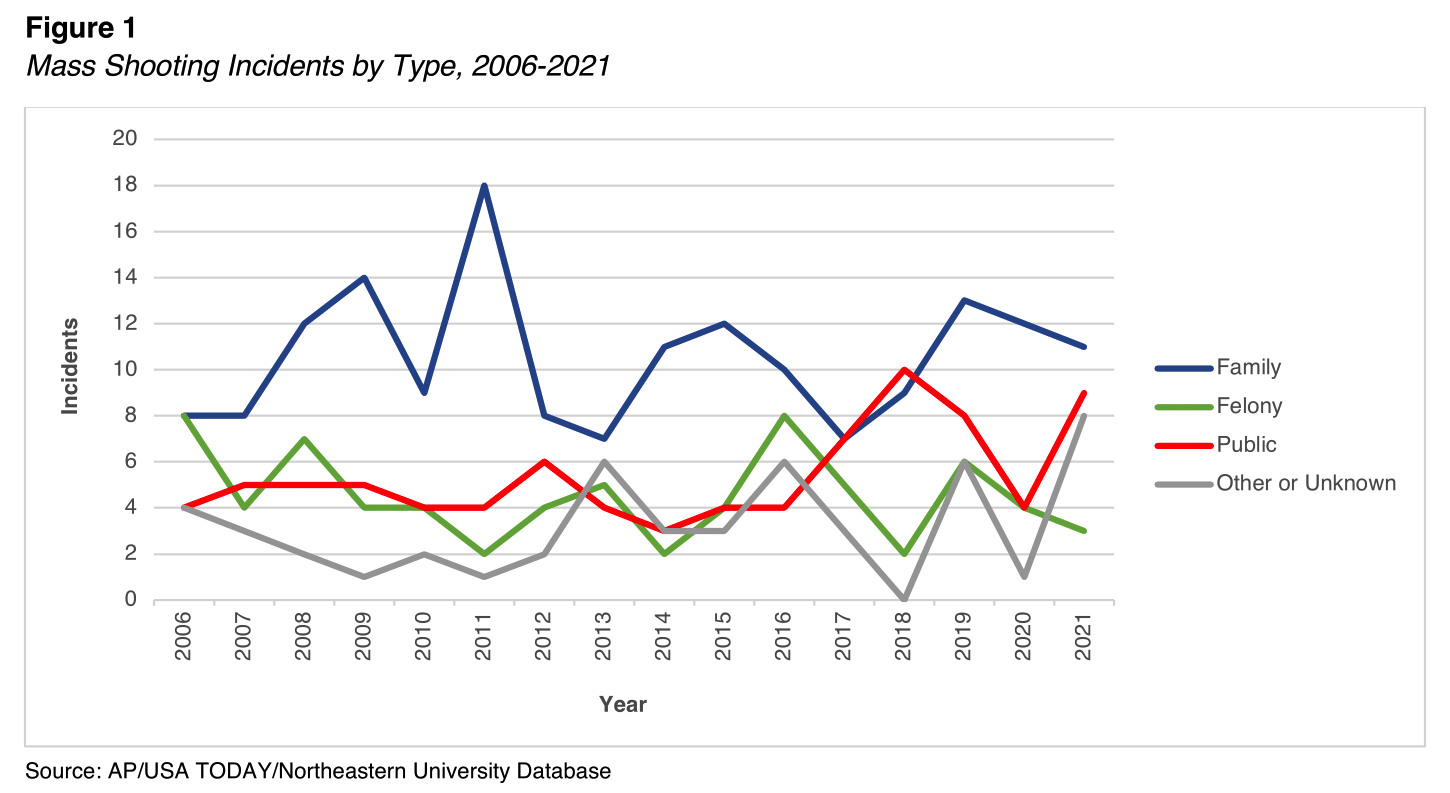
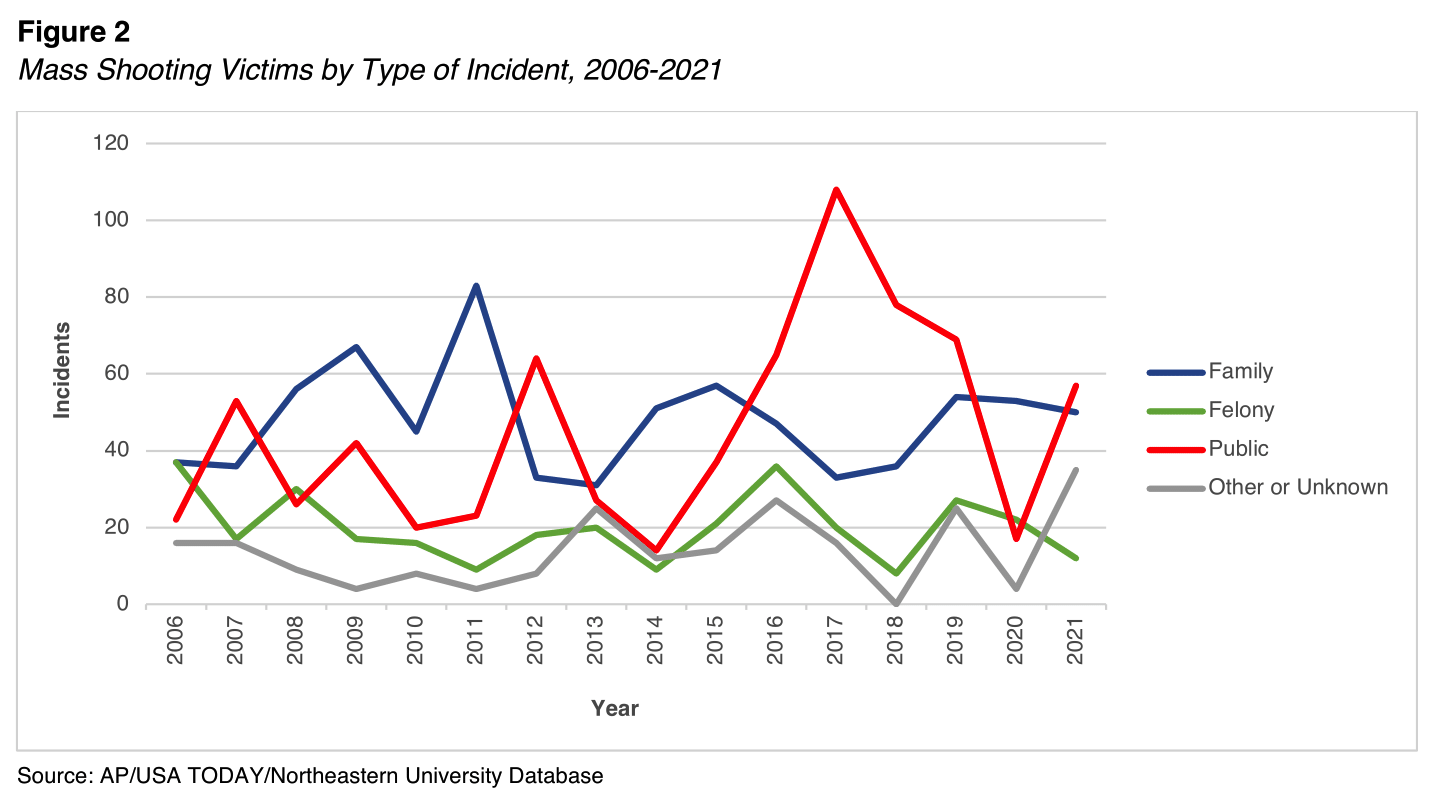
Based on our definition articulated above, Figures 1 and 2 display trends in the number of mass shootings and mass shooting victim fatalities from 2006 through 2021 by type of incident. Contrary to the widely held public perception of a growing epidemic, when it comes to the more serious shootings in which at least four victims are killed, the incident counts have not changed much over the past 15 years, except for a modest increase in public mass shootings. Even then, the increase is rather small in terms of absolute number—from an average of 4.6 incidents per year for 2006-2015 up to 7.0 for 2016-2021. There also has not been much change in the total number killed, except for an increase in public mass shooting victimization, which is largely the result of a few cases with unusually large death tolls: 49 killed in Orlando, FL, in 2016; 25 killed in Sutherland Springs, TX, and 60 killed in Las Vegas, NV, both in 2017; 17 killed in Parkland, FL, in 2018; and 23 killed in El Paso, TX, in 2019. 

(Click table to enlarge)

(Click table to enlarge)

Conclusion

Regardless of definition, mass shooting deaths constitute a small share of the annual number of gun homicides in the U.S. (five percent using Definition #1, one percent with Definition #2, and less than half of one percent by Definition #3). Despite these small shares, as many as one-quarter of Americans believe that mass shootings are responsible for the most gun fatalities—more than suicide, accidental shootings, and homicides other than mass shootings (APM Research Lab, 2019). 

Survey after survey has found disturbingly high levels of fear associated with mass shootings. Nearly half of Americans report being worried that they or a family member will fall victim to a mass shooting (Brenan, 2019), and one-third say they avoid certain public places because of the threat of a mass shooting (American Psychological Association, 2019). These exaggerated perceptions may in part be the result of frequent media reporting on broad definitions of mass shootings, such as the intent to kill multiple victims (as in the FBI’s active shooter data) or counting all victims regardless of the extent of injury (as in the Gun Violence Archive). Many politicians and pundits have characterized mass shootings as an epidemic. That certainly may be true with regard to public fear, but in terms of the actual incidence, such suggestions do not appear to be supported by the facts—regardless of how those facts are measured.

DISCLOSURE STATEMENT
No potential conflicts of interest were reported by the authors.

REFERENCES

American Psychological Association. (2019, August 15). One-third of US adults say fear of mass shootings prevents them from going to certain places or events. https://www.apa.org/news/press/releases/2019/08/fear-mass-shooting

APM Research Lab (2019, October 2). Knowledge of gun-related deaths. https://www.apmresearchlab.org/gun-survey-deaths

Blair, J. P., & Schweit, K. W. (2014). A study of active shooter incidents in the United States Between 2000 and 2013. Texas State University and Federal Bureau of Investigation, U.S. Department of Justice, Washington D.C. https://www.fbi.gov/file-repository/active-shooter-study-2000-2013-1.pdf/view

Brenan, M. (2019, September 10). Nearly half in U.S. fear being the victim of a mass shooting. Gallup. https://news.gallup.com/poll/266681/nearly-half-fear-victim-mass-shooting.aspx

Carroll, N (2021, May 28). The backstory: We’ve been tracking mass killings since 2006. USA TODAY. https://www.usatoday.com/story/opinion/2021/05/28/mass-shootings-most-mass-killings-happen-home-not-public-like-san-jose/7465616002/

Federal Bureau of Investigation. (2022). Active shooter incidents in the United States in 2021. U.S. Department of Justice, Washington, D.C.

Follman, M., Aronsen, G., & Pan, D. (2022, June 17). A guide to mass shootings in America. Mother Jones. https://www.motherjones.com/politics/2012/07/mass-shootings-map/#criteria

Fox, J. A., & Levin, J. (2015). Mass confusion concerning mass murder. The Criminologist, 40(1), 8-11.

Fox, J. A., & Levin, J. (2022). Mass murder in America: Trends, characteristics, explanations, and policy response. Homicide Studies,26(1), 27-46. https://doi.org/10.1177/10887679211043803

Fridel, E. E. (2021). A multivariate comparison of family, felony, and public mass murders in the United States. Journal of Interpersonal Violence, 36(3-4), 1092-1118. https://doi.org/10.1177/0886260517739286

Holt, L., & Gosk, S. (2018, November 8). Mass shootings becoming painful new normal in America. NBC Nightly News. https://www.nbcnews.com/nightly-news/video/mass-shootings-becoming-painful-new-normal-in-america-1365603395798

Lott, J. R. (2015). The FBI’s misrepresentation of the change in mass public shootings. Academy of Criminal Justice Sciences Today, 40(2), 18-29.

Ressler, R. K., Burgess, A. W., & Douglas, J. E. (1988). Sexual homicide: Patterns and motives. Lexington Books.

Reynolds, A. (2018, February 15). Are mass shootings becoming more frequent? The Cato Institute. https://www.cato.org/blog/are-mass-shootings-becoming-more-frequent

Schmidt, M. S. (2014, September 24). F.B.I. confirms a sharp rise in mass shootings since 2000. The New York Times. https://www.nytimes.com/2014/09/25/us/25shooters.html

Silverstein, J. (2020, January 2). There were more mass shootings than days in 2019. CBS News. https://www.cbsnews.com/news/mass-shootings-2019-more-than-days-365/

Victor, D., & Taylor, D. B. (2022, May 17). A partial list of mass shootings in the United States in 2021. The New York Times. https://www.nytimes.com/article/mass-shootings-2021.html

About the Authors

James Alan Fox is the Lipman Family Professor of Criminology, Law, and Public Policy at Northeastern University. His four decades of research on mass killing has been presented in several books, including Extreme Killing: Understanding Serial and Mass Murder, and dozens of articles in both academic journals and popular outlets. Finally, he is one of the principals in developing the Associated Press/USA TODAY/Northeastern University Mass Killing Database.

Emma E. Fridel is an assistant professor in the College of Criminology and Criminal Justice at Florida State University. She primarily studies violence and aggression with a focus on homicide, including homicide–suicide, serial and mass murder, gun violence, and police use of lethal violence. Her work has been published in Criminology, Social Forces, the Journal of Quantitative Criminology, and Justice Quarterly. She is also co-author of Extreme Killing: Understanding Serial and Mass Murder.

CITATION (APA 7th Edition) Fox, J. A., & Fridel, E. E. (2022). Keeping with tradition: Preference for the longstanding definition of mass shooting. Journal of Mass Violence Research, 1(2), 17-26. https://doi.org/10.53076/JMVR59660

Download an infographic summarizing the main takeaways of this article.
Available Formats: PDF  |  PNG

Defining Rampage Violence Across Completion Status: Towards a More Comprehensive Model

SHARE THIS ARTICLE

Defining Rampage Violence Across Completion Status: Towards a More Comprehensive Model

Janelle Hawes Email the Corresponding Author and Eric Madfis

School of Social Work and Criminal Justice, University of Washington Tacoma

https://doi.org/10.53076/JMVR51594  |  Full Citation Volume: 1, Issue: 2, Page(s): 42-52

Article History: Received July 28, 2022 | Accepted August 24, 2022 | Published Online September 12, 2022

ABSTRACT
The definitions and terms used to describe single-incident mass casualty events vary widely and remain contested. To allow for the inclusion of more incidents, larger and more representative samples, and more comprehensive analyses, we argue in favor of using the broad term “rampage” and propose a new model, the Rampage Violence Status Model (RVSM), which provides additional context on completion status and can subsume previous terminology. Additionally, by expanding upon previous researchers’ distinctions and definitions of various stages and completion statuses, we suggest adopting the following terms as stages in the progression of rampage violence, per the RVSM: researched, planned, prepared, initiated, interrupted, attempted, and completed.

KEYWORDS
mass shooting, rampage, rampage violence, averted, completion status, school shooting

Rampage violence has become a social problem of increasing concern in the 21st century, especially in the United States where more public mass shootings occur than anywhere else on the planet (Lankford, 2016, 2019; Lemieux, 2014; Madfis & Lankford, 2022; Silva, 2022). Further, public mass shootings have become more frequent (Peterson & Densley, 2020) and more deadly (Lankford & Silver, 2020) since the turn of the 21st century, and both public and private mass shootings have increased over the last few years during the COVID-19 pandemic (Schildkraut & Turanovic, 2022). As the problem has worsened and gained more public awareness over the last 20 years, the research on mass/rampage violence – public mass shootings, in particular – has also increased exponentially during this time (Duwe et al., 2021).

Traditionally, mass shootings have been defined as the killing of four or more people with firearms during a single episode at one or more closely related locations (Fox et al., 2018). However, this definition remains contested (Huff-Corzine & Corzine, 2020), and numerous similar terms can be found throughout the literature, such as mass murder (Duwe, 2007; Holmes & Holmes, 2001; Levin & Fox, 1985; Meloy & O’Toole, 2011), active shooting (Kissner, 2016; Rusho et al., 2021), mass violence (Daly, 2018; Huff-Corzine & Corzine, 2020), rampage (Madfis, 2014, 2020; Newman et al., 2004), and massacre (Harrison & Bowers, 2010; Schildkraut & Muschert, 2014). There are many more location-specific terms such as mass public shooting (Silva & Green-Colozzi, 2022), workplace massacre (Duwe, 2007), familicide (Liem at al., 2013), and mass school shooting (Curran et al., 2020; Paez et al., 2021). When considering terminology regarding how far into the act of mass violence the perpetrator was when it ceased, the list of terms grows further. Scholars have written about averted school rampage (Madfis, 2020), averted school violence (Cowan et al., 2022), averted school shooting (Daniels & Page, 2013), averted mass violence (Cowan et al., 2022), thwarted mass homicide (Sarteschi, 2016), and mass shooting with the designations of completed, attempted, failed, and foiled (Silva, 2021a, 2021b; Silva & Green-Colozzi, 2022), and school shootings as either completed or averted (Winch, 2021).

While some of the variations in terminology may be substantive (and entail important differences in offender profiles, attack behaviors, motivations, opportunities for intervention and prevention, etc.), far more research is needed to compare across these categories (Madfis, 2020). That said, we do know that many common factors and patterns among perpetrators exist (such as cumulative strains, extensive fantasizing about and planning for the rampage attack, desire for lasting fame, leakage of information about the threat to others, etc.; see Lankford et al., 2019; Levin & Madfis, 2009; Madfis, 2017) and persist despite, for example, variations in the site of the mass violence (see, for example, Silver et al., 2018).

As empirical knowledge of mass violence expands it would be helpful to utilize universal language to explore this violent phenomenon with a more standardized set of terminology. The increasing frequency of mass violence in the United States and its damaging effects on society suggest the dire need for empirical research which is more easily understandable and less contradictory in the use of language so that research may better inform public debate and policy. Scholars’ use of more universal and uniform language is one method to potentially address this need. Though some scholars (such as Huff-Corzine & Corzine, 2020) discourage the implementation of any standardized definitions around the phenomenon due to the desire to keep various forms of mass violence distinct from one another, we contend that more universal language and terminology for these acts can benefit this area of study if developed in a systematic way with holistic intent.

In this article, we summarize how previous studies have defined and operationalized mass violence (and associated terms such as mass shootings, rampage, mass murder, etc.) across the spectrum of attempts and completed acts and argue in favor of adopting terminology which is as broad as possible, yet retains the most crucial identifying features so as to maintain distinctions between single-incident mass casualty events and other multiple-incident mass casualty events like serial killings and state-sponsored mass violence such as genocides. To that end, we suggest adopting the broad term rampage to which specificity can be added. For example, the location and weapon of rampage violence may be further specified by referring to a school rampage stabbing or a workplace rampage shooting. Further, the completion status of an attack may be characterized as a completed, attempted, interrupted, arrived, prepared, planned, or researched rampage to clarify how far along the offender was able to carry out their deadly plot (these new terms will be defined and explained later in this piece). Thus, instances could be referred to as, for example, a completed school rampage stabbing or an attempted workplace rampage shooting.

Prior Debates Over Terminology

In scholarship on homicide, the first term used to refer to single-incident mass casualty events was “mass murder” (Fox & Levin, 1998), and the traditional definition limits the phenomenon to those events wherein at least four victims were killed during a single episode at one or more closely related locations (Duwe, 2007; Fox et al., 2018; Holmes & Holmes, 2001). The term mass murder is deliberately broad so as to encompass all types of weapons used, including knives, axes, guns, bombs, and any other potentially deadly weapon. In recent years, terms such as “mass shooting” and “active shooting” have become far more prevalent (Fox & Levin, 2015). The aforementioned terms focus only on gun violence, and many studies specifically limit their qualifying criteria to only include incidents of mass violence in which firearms were the primary weapon (see Newman et al., 2004 for an example). As Madfis (2020) notes, however, in his study of averted incidents of school rampage plots, numerous deadly school violence plans were formed by students which involved knife attacks and the use of various types of bombs, explosives, and incendiary weapons. Likewise, bombs were a vital component of the Columbine High School killer duo’s plan though most were not detonated (Larkin, 2007). Further, the deadliest mass murder at a school in American history (the 1927 Bath School Disaster in Michigan) involved dynamite and hundreds of pounds of pyrotol, but no firearms (Bernstein, 2009), and the deadliest mass casualty event committed by a single perpetrator (the 2011 Norway attacks) utilized both bombs and guns. Amman and colleagues (2022) recently found 138 mass stabbing attacks across the world between 2004 and 2017.

Accordingly, we suggest using the term rampage in line with Madfis (2020) so that all types of weaponry may be included in future operationalizations and subsequent datasets. Certainly, guns enable far more deaths in a shorter timespan than less lethal weapons like knives and axes (Madfis & Levin, 2013), but, until such time as there is evidence to suggest that substantial differences exist in terms of motivation or other characteristics between those who utilize guns and those who utilize other weapons to commit their attacks, the broader term rampage should be adopted to allow for the inclusion of more incidents, larger samples that are more representative, and thus more comprehensive analyses.

Other important definitional debates in the mass violence literature have included excluding cases based on the location of the attack (e.g., removing cases of familicides in private homes), offender’s connection to the attack site (e.g., limiting cases to school attacks only by former and current students), the relationship between offenders and victims (as specific or random targets), and by the number of victims killed or injured (Daniels et al., 2007, 2010; Levin & Madfis, 2009; Moore et al., 2003; Muschert, 2007; Newman & Fox, 2009; Newman et al., 2004; Vossekuil et al., 2002). We view all of these exclusion criteria as problematic (and as having the potential to create less representative samples), unless done for specific methodological, conceptual, or pragmatic reasons.

In particular, we take issue with the practice of requiring specific death counts as an inclusion criterion. Such a focused definition needlessly omits myriad cases which have not resulted in multiple deaths (Madfis, 2020). Cases in which the perpetrator has the desire and intent to kill multiple victims yet fails to do so when their plans come to the attention of authorities before being effectuated and those who severely injure many people but fail to do so fatally are excluded in conventional definitions of mass murders and mass shootings. As Madfis (2020) states, “These less-successful perpetrators may be distinguishable by their overall incompetence with weaponry and/or their inability to maintain secrecy about their future actions, but not necessarily by their original motivations and goals” (p. 169). Therefore, there is much use in adopting the broader notion of rampage violence and including all cases which involve an attempt to kill multiple people in a single event (White-Hamon, 2000; Madfis, 2020).

One of the newest and most interesting areas of emergent scholarship in this area is the issue of completion status, or how far along the perpetrator was able to carry out their deadly plot to kill multiple victims. The first studies to explore cases of averted incidents (such as Daniels & Page, 2013; Daniels et al., 2007, 2010; Larkin, 2009; Madfis, 2014) exclusively did so in the context of school settings, but knowledge and terminology in this area has rapidly expanded in recent years.

As Daniels and Page (2013) identify, studying something that may or may not have eventually happened but was stopped is complicated. To combat this, they took an approach inspired by the study of law, selecting only cases which had sufficient evidence to bring about conviction for an imminent shooting (Daniels & Page, 2013). Winch (2021) considered a case averted if there was any evidence that the perpetrator demonstrated pathway engagement (Calhoun & Weston, 2003), such as researching past school shootings, planning for an attack in various ways, or preparing for the attack by acquiring a gun. Other definitions and use of terminology regarding completion status also consider activity engagement and process. Meloy and O’Toole (2011) explore leakage, which is a type of pathway warning behavior wherein there is “communication to a third party of an intent to do harm to a target” (p. 513). These researchers found pathway warning behaviors to be a predominant theme in several types of violent crime, including mass murder and school shootings. According to Meloy and O’Toole (2011) pathway warning behaviors are any that contribute to the steps of researching (learning and gathering useful information from past attacks), planning (selection of the time, location, method of attack, and entry method), preparing for (weapons and materials acquisition), and implementation of a violent incident, and that with each step the risk of violence and harm to others increases. Incorporated into Winch’s (2021) conceptualization, each of these pathway warning behaviors up to implementation meets the criteria for an averted school shooting. Once a perpetrator reaches the implementation stage, the case was deemed a completed school shooting if there was at least one injury and the incident occurred on school grounds during school hours or at a school event after hours.

Silva (2021a, 2021b) introduced a series of terms defining the progress of a mass shooting incident based on outcome operationalization. This work defined a mass shooting as a gun incident committed by 1+ person in 1+ public or populated setting within a 24-hour period in which at least some intended victims were selected randomly and/or for symbolic value. This model expands on previously used completion status concepts, offering four casualty- and target-based outcome categories and terms from least to most severe: foiled, failed, attempted, and completed (Silva, 2021a, 2021b). Offering further clarification on stages of completion status, Silva and Green-Colozzi (2022) identify four stages of a mass shooting as preparation, arrival, event, and conclusion.  

A foiled mass shooting is an incident which the perpetrator has set into motion but was stopped before the incident began, such as never reaching their intended target (Silva, 2021a, 2021b). This definition is rooted in Sarteschi’s (2016) concept of high credibility cases, in which an offender has explicitly stated their intention to carry out a mass shooting attack, identified a target or type of target, and already has a gun, has attempted to acquire one, or has a plan to do so. An incident is considered a failed mass shooting if the plan was set into motion but stopped during the incident (Silva, 2021b). For example, in a failed mass shooting case, the perpetrator would have finished preparations, arrived at the intended target, and perhaps began shooting but is then interrupted (e.g., killed or tackled) (Capellan & Gomez, 2018; Silva & Green-Colozzi, 2022). Both foiled and failed mass shootings have no casualties (Silva, 2021b).

Conversely, attempted and completed mass shooting incidents both include casualties. The distinction between these two categories rests on the number and type of casualties associated. In an attempted mass shooting, the plan has been effectuated and ended with less than four deaths but at least one victim casualty (injury or fatality). A completed mass shooting is characterized by four or more fatalities, not including the perpetrator (Silva, 2021a, 2021b).

Silva’s (2021a, 2021b) outcome operationalization model and Meloy and O’Toole’s (2011) stages based on pathway warning behavior overlap, each adding specificity to different phases of an incident. We submit that, taken together, these approaches can offer unifying terminology and definitions that can be applied to all incidents of rampage violence, no matter the location or weaponry, and such an approach provides the most comprehensive way to provide information and analysis on the completion status of incidents. At present, Silva (2021b) created the stages of preparation, arrival, event, and conclusion, while Meloy and O’Toole (2011) specify research, planning, preparation, and implementation stages. As illustrated in Figure 1, the definitions of these stages overlap, allowing Meloy and O’Toole’s research, plan, and prepare stages to add a deeper level of detail to Silva’s preparation stage. Further, Silva’s arrival, event, and conclusion stages increase the detail and nuance of Meloy and O’Toole’s (2011) implementation stage.

(Click table to enlarge)

Rampage Violence Status Model

Taken together, previous scholarship has offered numerous varied conceptualizations, operationalizations, and terminology options to discuss mass and rampage violence incidents. However, some terms and definitions are needlessly limiting, several prior conceptualizations overlap, and some terms are synonymous and virtually indistinguishable from one another. Previous models and concepts have moved the field forward and provided much needed insight and clarity. However, we propose a new model, the Rampage Violence Status Model (RVSM) (see Figure 2), which is meant to be more comprehensive, cohesive, and inclusive as it provides additional context on completion status and can subsume previous terminology (see Figure 3 for examples of cases that represent each stage of the RVSM). Additionally, this model provides terms that move the field forward by allowing the examination of perpetrators’ intentions.

Building and expanding on previous researchers’ (such as Meloy & O’Toole, 2011; Silva 2021a, 2021b) distinctions and definitions of various stages and completion statuses, we suggest adopting the following terms as stages in the progression of rampage violence, per the RVSM: researched, planned, prepared, initiated, interrupted, attempted, and completed.

Researched rampage violence is an incident in which the perpetrator(s) has/have researched and gathered information from previous attacks for their own use before their efforts were stopped. At this early stage, any incident would be very undeveloped.

Planned rampage violence occurs when the perpetrator(s) has/have completed the research stage and moved on to planning their own attack. This could include decisions being made as to the time and location of their act, identifying and/or listing targets, selecting a method of attack or weaponry, creating plans to acquire those weapons, choosing entry points, acquiring or sketching blueprints/layouts of their selected location, etc. A rampage violence act is described as planned if any of these decisions have been made when the plot is discovered and stopped.

Prepared rampage violence is a plot which has passed the research and planning stages and the perpetrator(s) has/have now either acquired or attempted to acquire weapons and materials needed for the event when stopped. This definition also includes any efforts to create, pack, or transport the materials and weapons required for the plot.

An incident would be considered initiated rampage violence if the perpetrator(s) has/have surpassed the three previous stages and successfully arrived at their targeted location to carry out their plot. However, the

act is stopped before any injuries or fatalities have occurred at the target location. These four terms –researched, planned, prepared, and initiated rampage violence – refer to acts that could have been stopped by the perpetrator(s) via personal failure or leakage behaviors, by family, friends, or various community members, or by intervention from law enforcement. Additionally, these terms define completion stages of a rampage violence act in which there are no victim injuries or fatalities.

In contrast, interrupted rampage violence is an act in which the perpetrator(s) has/have successfully passed all previous stages and initiated their plot but was/were stopped or interrupted by anyone other than the perpetrator(s). An interrupted rampage violence event results in less than four victim fatalities but has at least one victim injury or fatality. Similarly, attempted rampage violence reaches the same stage of completion and victim outcomes as interrupted rampage violence, however, it is notably distinct in that this act concludes due to action(s) taken by the perpetrator(s). In other words, an attemptted rampage violence event stops by the perpetrator’s own hand, for example by suicide or surrender.

The interrupted and attempted rampage violence classifications provide terminology to explore perpetrators’ plans versus what occurred, by distinguishing between an act being stopped by others rather than a perpetrator choosing its completion. If a perpetrator is stopped by law enforcement, the ending was defined by law enforcement. The intended plot could have included more targets, additional types of weapons, and so on. However, if a perpetrator chooses when the event is finished, one can presume the perpetrator accomplished their intended plan or revised their plan during the event and reached a point of satisfaction or resolution.

Finally, completed rampage violence represents an event which passes all stages and meets the commonly accepted “mass” threshold of four or more victim fatalities. In this model, a completed rampage violence act can be stopped either by the perpetrator or any other means.

(Click table to enlarge)

(Click table to enlarge)

Conclusion

Rampage violence is an increasingly common and deadly social phenomenon, and the continued empirical work in this area is vital for future preventative efforts.  Prior conceptualizations and operationalizations are inconsistent across studies, and this can create confusion within the body of empirical research and among the public more generally.

The RVSM provides more standardized language and terminology around these devastating events, and its widespread adoption could serve to advance the discussion in meaningful, tangible ways. Adoption of the RVSM provides distinct, clearer terms which subsume previous terminology and clarify context about completion status and information on the number of victim casualties. In addition, the model furthers this area of study by capturing more events, therefore increasing sample sizes so that they are more representative and inclusive of various forms of single-incident mass casualty events. The unifying language of the RVSM allows scholars to adopt more standardized language and thus increase accessibility and comprehension for both scholars and relevant stakeholders outside of academia.

DISCLOSURE STATEMENT
No potential conflicts of interest were reported by the authors.


REFERENCES

Amman, M., Burnette, A., & Crowley, B. (2022). A review of mass stabbing attacks between 2004 and 2017. Journal of Threat Assessment and Management, 9(2), 111-128. https://doi.org/10.1037/tam0000177

Bernstein, A. (2009). Bath massacre: America’s first school bombing. Ann Arbor, MI: University of Michigan Press. https://doi.org/10.3998/mpub.283846

Calhoun, F. S., & Weston, S. (2003). Contemporary threat management: A practical guide for identifying, assessing, and managing individuals of violent intent. Specialized Training Services.

Capellan, J. A., & Gomez, S. (2018). Change and stability in offender, behaviours, and incident-level characteristics of mass public shootings in the United States, 1984–2015. Journal of Investigative Psychology and Offender Profiling, 15(1), 51-72. https://doi.org/10.1002/jip.1491

Cowan, R. G., Tedeschi, P. J., Corbin, M., & Cole, R. (2022). A mixed-methods analysis of averted mass violence in schools: Implications for professional school counselors. Psychology in the Schools, 59(4), 817-831. https://doi.org/10.1002/pits.22647

Curran, F. C., Fisher, B. W., & Viano, S. L. (2020). Mass school shootings and the short-run impacts on use of school security measures and practices: National evidence from the Columbine tragedy. Journal of School Violence, 19(1), 6-19. https://doi.org/10.1080/15388220.2019.1703713

Daly, S. E. (2018). Assessing and averting the prevalence of mass violence. Hershey, PA: IGI Global.

Daniels, J. A., & Page, J. W. (2013). Averted school shootings. In N. Böckler, W. Heitmeyer, P. Sitzer, & T. Seeger (Eds). School shootings: International research, case studies, and concepts for prevention (pp. 421-439). New York, NY: Springer. https://doi.org/10.1007/978-1-4614-5526-4_19

Daniels, J. A., Buck, I., Croxall, S., Gruber, J., Kime, P., & Govert, H. (2007). A content analysis of news reports of averted school rampages. Journal of School Violence, 6(1), 83-99. https://doi.org/10.1300/J202v06n01_06

Daniels, J. A., Volungis, A., Pshenishny, E., Gandhi, P., Winkler, A., Cramer, D., & Bradley, M. C. (2010). A qualitative investigation of averted school shooting rampages. The Counseling Psychologist, 38(1), 69-95. https://doi.org/10.1177/0011000009344774

Duwe, G. (2007). Mass murder in the United States: A history. Jefferson, NC: McFarland & Company.

Duwe, G., Sanders, N., Rocque, M., & Fox, J. A. (2021, November 30). Estimating the global prevalence of mass public shootings [presentation]. https://nij.ojp.gov/media/video/27696

Fox, J. A., & Levin, J. (1998). Multiple homicide: Patterns of serial and mass murder. Crime and Justice, 23, 407-455. https://doi.org/10.1086/449274

Fox, J. A., & Levin, J. (2015). Mass confusion concerning mass murder. The Criminologist, 40(1), 8-11.

Fox, J. A., Levin, J., & Fridel, E. E. (2018). Extreme killing: Understanding serial and mass murder. Thousand Oaks, CA: Sage.

Harrison, M. A., & Bowers, T. (2010). Autogenic massacre as a maladaptive response to status threat. Journal of Forensic Psychiatry & Psychology, 21(6), 916-932. https://doi.org/10.1080/14789949.2010.506618

Holmes, R. M., & Holmes, S. T. (2001). Mass murder in the United States. Upper Saddle River, NJ: Prentice Hall.

Huff‐Corzine, L., & Corzine, J. (2020). The devil’s in the details: Measuring mass violence. Criminology & Public Policy19(1), 317-333. https://doi.org/10.1111/1745-9133.12482

Kissner, J. (2016). Are active shootings temporally contagious? An empirical assessment. Journal of Police and Criminal Psychology, 31, 48-58. https://doi.org/10.1007/s11896-015-9163-8

Lankford, A. (2016). Public mass shooters and firearms: A cross-national study of 171 countries. Violence and Victims, 31(2), 187-199. https://doi.org/10.1891/0886-6708.VV-D-15-00093

Lankford, A. (2019). Confirmation that the United States has six times its global share of public mass shooters, courtesy of Lott and Moody’s data. Econ Journal Watch, 16(1), 69-83. https://econjwatch.org/File+download/1105/LankfordMar2019.pdf?mimetype=pdf

Lankford, A., Adkins, K. G., & Madfis, E. (2019). Are the deadliest mass shootings preventable? An assessment of leakage, information reported to law enforcement, and firearms acquisition prior to attacks in the United States. Journal of Contemporary Criminal Justice, 35 (3), 315-341. https://doi.org/10.1177/1043986219840231

Lankford, A., & Silver, J. (2020). Why have public mass shootings become more deadly? Assessing how perpetrators’ motives and methods have changed over time. Criminology & Public Policy, 19(1), 37-60. https://doi.org/10.1111/1745-9133.12472

Larkin, R. W. (2007). Comprehending Columbine. Philadelphia, PA: Temple University Press.

Larkin, R. W. (2009). The Columbine legacy: Rampage shootings as political acts. American Behavioral Scientist, 52(9), 1309-1326. https://doi.org/10.1177/0002764209332548

Lemieux, F. (2014). Effect of gun culture and firearm laws on gun violence and mass shootings in the United States: A multi-level quantitative analysis. International Journal of Criminal Justice Sciences, 9, 74-93.

Levin, J., & Fox, J. A. (1985). Mass Murder: America’s Growing Menace. New York, NY: Plenum Press.

Levin, J., & Madfis, E. (2009). Mass murder at school and cumulative strain: A sequential model. American Behavioral Scientist, 52(9), 1227-1245. https://doi.org/10.1177/0002764209332543

Liem, M., Levin, J., Holland, C. & Fox, J. A. (2013). The nature and prevalence of familicide in the United States, 2000–2009. Journal of Family Violence, 28, 351-358. https://doi.org/10.1007/s10896-013-9504-2

Madfis, E. (2014). Averting school rampage: Student intervention amid a persistent code of silence. Youth Violence and Juvenile Justice, 12(3), 229-249. https://doi.org/10.1177/1541204013497768

Madfis, E. (2017). In search of meaning: Are school rampage shootings random and senseless violence? The Journal of Psychology: Interdisciplinary and Applied, 151(1), 21-35. https://doi.org/10.1080/00223980.2016.1196161

Madfis, E. (2020). How to stop school rampage killing: Lessons from averted mass shootings and bombings. New York, NY: Palgrave Macmillan.

Madfis, E. (Forthcoming). School threat assessment in the pacific northwest: Challenges and opportunities.  Data analysis in progress.

Madfis, E., & Lankford, A. (Eds.). (2022, In press). All-American massacre: The tragic role of American culture and society in mass shootings. Philadelphia, PA: Temple University Press.

Madfis, E., & Levin, J. (2013). School rampage in international perspective: The salience of cumulative strain theory. In N. Böckler, W. Heitmeyer, P. Sitzer, & T. Seeger (Eds). School shootings: International research, case studies, and concepts for prevention (pp. 79-104). New York, NY: Springer.

Meloy, J., & O’Toole, M. E. (2011). The concept of leakage in threat assessment. Behavioral Sciences and the Law, 29(4), 513-527. https://doi.org/10.1002/bsl.986

Moore, M. H., Petrie, C. V., Braga, A. A., & McLaughlin, B. L. (2003). Deadly lessons: Understanding lethal school violence. Washington, DC: National Academies Press.

Muschert, G. W. (2007). Research in school shootings. Sociology Compass, 1(1), 60-80. https://doi.org/10.1111/j.1751-9020.2007.00008.x

Newman, K. S., & Fox, C. (2009). Repeat tragedy: Rampage shootings in American high school and college settings, 2002–2008. American Behavioral Scientist, 52(9), 1286-1308. https://doi.org/10.1177/0002764209332546

Newman, K. S., Fox, C., Roth, W., Mehta, J., & Harding, D. (2004). Rampage: The social roots of school shooters. New York: Perseus Books.

Paez, G. R., Capellan, J. A., & Johnson, M. G. (2021). Contextualizing mass school shootings in the United States. Journal of Investigative Psychology and Offender Profiling, 18(3), 170-184. https://doi.org/10.1002/jip.1577

Peterson, J., & Densley, J. (2020). The Violence Project database of mass shootings in the United States, 1966–2020. https://www.theviolenceproject.org

Rusho, M. A., Ahmed, A., & Sadri, A. M. (2021). Social media response and crisis communications in active shootings during COVID-19 pandemic. Transportation Research Interdisciplinary Perspectives, 11, 100420. https://doi.org/10.1016/j.trip.2021.100420

Sarteschi, C. (2016). An examination of thwarted mass homicide plots and threateners. Aggression and Violent Behavior, 30, 88-93. https://doi.org/10.1016/j.avb.2016.06.010

Schildkraut, J., & Muschert, G. W. (2014). Media salience and the framing of mass murder in schools: A comparison of the columbine and sandy hook massacres. Homicide Studies, 18(1), 23-43. https://doi.org/10.1177/1088767913511458

Schildkraut, J., & Turanovic, J. J. (2022). A new wave of mass shootings? Exploring the potential impact of COVID-19. Homicide Studies, 26(4), 362-378. https://doi.org/10.1177/10887679221101605

Silva, J. R. (2021a). A comparative analysis of foiled and completed mass shootings. American Journal of Criminal Justice. https://doi.org/10.1007/s12103-020-09552-2

Silva, J. R. (2021b). Mass shooting outcomes: A comparison of completed, attempted, failed, and foiled incidents in America. Deviant Behavior. https://doi.org/10.1080/01639625.2021.1991248

Silva, J. R. (2022). Global mass shootings: Comparing the United States against developed and developing countries. International Journal of Comparative and Applied Criminal Justice. https://doi.org/10.1080/01924036.2022.2052126

Silva, J. R., & Greene-Colozzi, E. A. (2022). An exploratory study of failed mass shootings in America. Security Journal35(2), 367-399. https://doi.org/10.1057/s41284-020-00281-z

Silver, J., Horgan, J., & Gill, P. (2018). Shared struggles? Cumulative strain theory and public mass murderers from 1990 to 2014. Homicide Studies, 23(1), 64-84. https://doi.org/10.1177/1088767918802881

Vossekuil, B., Fein, R., Reddy, M., Borum, R., & Modzeleski, W. (2002). The final report and findings of the safe school initiative: Implications for the prevention of school attacks in the United States. Washington, DC: U.S. Secret Service and U.S. Department of Education. https://www.govinfo.gov/content/pkg/ERIC-ED466024/pdf/ERIC-ED466024.pdf

White-Hamon, L. S. (2000). Mass murder and attempted mass murder: An examination of the perpetrator with an empirical analysis of typologies. Unpublished doctoral dissertation, California School of Professional Psychology, Fresno, CA

Winch, A. (2021). An evaluation of the differences between perpetrators in completed and averted school shootings. Electronic Theses and Dissertations. 785. https://stars.library.ucf.edu/etd2020/785/


About the Authors

Janelle Hawes is an Assistant Professor in the School of Social Work and Criminal Justice at the University of Washington Tacoma. Her past research focused on youth experiences in the education, foster care, and juvenile legal systems. Currently she is conducting program assessments and other applied evaluations for police departments in the region, with specific attention paid to matters of diversity, inclusion, workplace climate, and community engagement of police officers.

Eric Madfis is an Associate Professor in the School of Social Work and Criminal Justice at the University of Washington Tacoma. His work has been published in academic journals across a range of disciplines and featured in national and international media outlets.  He is the author of How to Stop School Rampage Killing: Lessons from Averted Mass Shootings and Bombings and co-editor of the forthcoming book All-American Massacre: The Tragic Role of American Culture and Society in Mass Shootings.

CITATION (APA 7th Edition) Hawes, J., & Madfis, E. (2022). Defining rampage violence across completion status: Towards a more comprehensive model. Journal of Mass Violence Research, 1(2), 42-52. https://doi.org/10.53076/JMVR51594

Download an infographic summarizing the main takeaways of this article.
Available Formats: PDF  |  PNG

Introduction to the Inaugural Issue of the Journal of Mass Violence Research: A Note from the Editors

SHARE THIS ARTICLE

Introduction to the Inaugural Issue of the Journal of Mass Violence Research: A Note from the Editors

Sarah E. Daly Email the Corresponding Author and Jaclyn Schildkraut

Department of Criminal Justice, State University of New York at Oswego

https://doi.org/10.53076/JMVR95494  |  Full Citation Volume: 1, Issue: 2, Page(s): 1-3

Since the inaugural issue of the Journal of Mass Violence Research in March 2022, the United States has seen continued acts of mass violence in Philadelphia, Buffalo, Uvalde, Highland Park, and other communities. This year (2022) also represents ten-year marks of mass shootings in Aurora, Oak Creek, and Sandy Hook. Remembering these events and all who were affected by them, while also reflecting on each new tragedy as it unfolds, we are heartbroken and frustrated but also reminded of the need for critical research aimed to inform policy and ultimately, save lives.

We created the Journal of Mass Violence Research with a goal of “sharing rigorous, multidisciplinary, peer-reviewed studies on a variety of topics in relation to mass violence” (see About JMVR). While the journal aims to publish articles on a variety of topics such as terrorism, genocide, and serial murder, we are both scholars who have worked in the mass and active shootings research space for years. As such, we recognize and value the wide range of methodologies and approaches to studying such a complex, difficult topic. Even more, we have long agreed that the ongoing definitional issues related to mass shootings (and similarly, active shootings, rampage violence, school shootings, etc.) have important implications for research, reporting, and public policy.

When we met to discuss how we might reflect on the ten years since Sandy Hook, Aurora, and Oak Creek, we considered ways in which we could bring together the leading researchers in the field—many of whom serve on our Editorial Board—and address some of the major definitional issues and points of contention. In addition to the articles presented in this special issue, we hosted a webinar to allow scholars to present their arguments and support for specific definitions or terminology in the hope of showcasing the nuance and benefits of each. The goal of the webinar and the special issue was not to make everyone agree, but rather to share and address the issues for the public and for practitioners. In this way, we can work together toward aligning research so that we might glean further insights across studies and disciplines while also informing practice. Additionally, we hope that the webinar might inform media terminology and practice in reporting to reduce confusion about mass and active shootings among the public. In sum, we hope that the articles within this special issue and the webinar can answer two questions: 1) What is a mass shooting? and 2) Even if we can decide, is this the best term to measure and study these types of events?

The special issue begins with William Sandel and Hunter Martaindale’s article, “What Are We Talking About? Definitional Confusion Within Active and Mass Shooting Research.” In this piece, the authors provide a rich, thorough review of current definitions, including active shooter and active attack, as well as clear guidance for those who seek to engage in mass and active violence research. They do not advocate for the use of a single definition, but instead issue a call for clear, specific definitions and representation in datasets, research, and reporting.

The second article recommends the continued use of the longstanding definition of mass shootings using a threshold of four or more deaths. In their article, “Keeping with Tradition: Preference for the Longstanding Definition of Mass Shooting,” authors James Alan Fox and Emma Fridel offer six compelling reasons for this traditional definition, highlighting theoretical and methodological applications and issues. Ultimately, they note the ways in which mass and active shootings are reported on and characterized has led to public fear and concern while only constituting a small proportion of gun homicides in the United States.

The final two articles suggest a focus not on a singular definition, but instead on unique categorization systems which highlight processes or outcomes. In the third article, “Mass Outcome or Mass Intent?: A Proposal for an Intent-Focused, No-Minimum Casualty Count Definition of Public Mass Shooting Incidents,” Emily Green-Colozzi and Jason Silva recommend that these types of attacks be classified as completed, attempted, failed, and foiled, regardless of the casualty count. Such a definition and strategy would highlight the intent behind the attack and address behavioral factors that may lead to public mass shootings.

In the final article, “Defining Rampage Violence across Completion Status: Toward a More Comprehensive Model,” Janelle Hawes and Eric Madfis suggest a shift from the term mass violence to rampage violence to include more incidents and encompass previous scholarship related to processes and outcomes. Like Green-Colozzi and Silva, they use various outcomes, but they also present multiple stages in the progression toward violence that often are reflected in perpetrators’ pre-attack behaviors. Their Rampage Violence Status Model (RVSM) encompasses various other definitions and provide additional context for each event.

In the webinar, the authors presented a brief overview of their article, sharing their arguments, and discussing with authors and other participants. It was recorded and shared on the JMVR website so that anyone with an interest in preventing, addressing, or reporting on mass violence can view and evaluate the options put forth in the webinar. In addition, we invite scholars and practitioners to submit responses for publication in the journal in the hope of continuing the conversation and informing research. As co-editors, we are considering additional ways to address this issue through conferences, interactive events, and more, and we look forward to similar opportunities about this and other issues related to mass violence.

There is clearly much to consider in this area of research, and as co-editors and scholars, we hope that the special issue and the webinar can contribute to the body of knowledge and continue to move toward practical, effective solutions and policies. In the ten years since Aurora, Oak Creek, and Sandy Hook, there have been countless researchers, organizers, survivors, and practitioners who have devoted their efforts to making spaces safer for everyone, and their work has not gone unnoticed or unappreciated. Yet, the past year has unfortunately taught us that there is still more work to be done, and JMVR renews its commitment to publishing high-quality, peer-reviewed research to explore these issues and seek new (and traditional) ways to study, measure, and apply this work. Despite the heartbreaking and devastating nature of this work, we are optimistic that research and collaboration can be transformative for the discipline, and we will continue to demand a better, safer future.

About the Authors

Sarah E. Daly was an Associate Professor and Director of a graduate program in criminology. She recently transitioned to the private sector, serving as a senior consultant for a private firm. She remains committed to her research and her role as the co-founder and co-editor of the Journal of Mass Violence Research, and she is currently affiliated with the Department of Criminal Justice at SUNY Oswego as a visiting scholar. Dr. Daly’s primary area of research is gender-based violence, particularly related to issues of involuntary celibacy. She has recent publications in the Journal of Qualitative Criminal Justice & Criminology and Sex Roles.

Jaclyn Schildkraut is an Associate Professor of Criminal Justice at the State University of New York (SUNY) at Oswego, interim executive director of the Regional Gun Violence Research Consortium at the Rockefeller Institute of Government, and the co-founder and co-editor of the Journal of Mass Violence Research. Her research interests include mass/school shootings, homicide trends, mediatization effects, moral panics, and crime theories. She is the co-author of Mass Shootings: Media, Myths, and Realities, Columbine, 20 Years Later and Beyond: Lessons from Tragedy, and, most recently, Lockdown Drills: Connecting Research and Best Practices for School Administrators, Teachers, and Parents. Dr. Schildkraut’s research has been published in journals such as Journal of School Violence, Homicide Studies, American Journal of Criminal Justice, Journal of Qualitative Criminal Justice & Criminology, Journal of Homeland Security and Emergency Management, and Crime, Law and Social Change.

CITATION (APA 7th Edition)
Daly, S. E., & Schildkraut, J. (2022). Introduction to the special issue of the Journal of Mass Violence Research: A note from the editors. Journal of Mass Violence Research, 1(2), 1-3. https://doi.org/10.53076/JMVR95494

What Are We Talking About? Definitional Confusion Within Active and Mass Shooting Research

SHARE THIS ARTICLE

What Are We Talking About? Definitional Confusion Within Active and Mass Shooting Research

William L. Sandel Email the Corresponding Author1 and M. Hunter Martaindale2
1 Department of Criminology and Criminal Justice, Missouri State University
2 Advanced Law Enforcement Rapid Response Training (ALERRT) Center, Texas State University

https://doi.org/10.53076/JMVR47829  |  Full Citation
Volume: 1, Issue: 2, Page(s): 4-16

Article History: Received May 18, 2022 | Accepted July 15, 2022 | Published Online September 12, 2022

ABSTRACT
Mass shootings and active shooter events have become a more prominent focus for practitioners, researchers, and the mass media. Unfortunately, there tends to be confusion regarding distinguishing characteristics of these events. This manuscript seeks to provide definitions and examples of cases to better formalize the understanding of such events. The terms selected for discussion are, at times, used inarguably when in fact they are markedly different. After discussing these various definitions, examples of existing datasets are provided along with their inclusion criteria. This transparency helps highlight confusion about these definitions as well as provide readers access to currently available data.

KEYWORDS
 

The most common terms used interchangeably, however incorrectly, are mass shootings, mass murder/killing, active shooter events, and active attacks. Each of these defines a very unique type of attack that cannot, and should not, be discussed as the same thing. Recent years have seen an increase in discussions, both socially and academically, surrounding attacks resulting in multiple victims. There is an increasing effort to establish the number of attacks that occur every year. This has proven to be a difficult task with a great deal of conflicting information published regularly. A majority of this conflict comes from the use of differing terms with differing definitions that tend to be used interchangeably. These terms generate various estimates depending on the precise definition for inclusion. This paper seeks to differentiate these definitions in order to move towards a better understanding of such events. Doing so will also provide a more accurate estimate for how many events take place every year.

This article will primarily focus on defining and differentiating mass shootings and killings from active shooter and active attack events. Other terms that will be discussed include serial killing, family annihilations, gang violence, terrorist attacks, and bombings. Such events are the mostly commonly associated with mass shootings and killings and/or have definitions with similar elements causing them to be easily mistaken. It should be noted that many of these definitions are not mutually exclusive, making it even more important to understand the different definitions to prevent over/under counting. Finally, it should be said that many variations of definitions exist for several of these terms. This discussion will focus on federally held definitions when possible and use the most widely held definitions when federal standards do not exist.

Differences in Mass Murder/Shooting and Active Shooter/Attacks

Mass Killing/Murder

For the purposes of this paper, mass murder and mass killing will be discussed interchangeably. An argument can be made to split the definitions to be more inclusive of events where a mass killing might not be considered murder under the guise of war. However, in the field of criminology and criminal justice for which this paper is written, these events are discussed in terms of a crime. There are several definitions regarding mass murder, which has increased the confusion surrounding such events (Holmes & Holmes, 2001). Prior to 2013 the mostly widely held definition of mass murder was an incident in which four or more people were killed in a single event (Krouse & Richardson, 2015; Levin & Fox, 1985, 2017). In addition to initiating a federal level investigation into mass murder and other similar events, the 2012 Investigative Assistance of Violent Crimes Act (IAVCA) established a new federal definition of mass murder. IAVCA states that “the term `mass killings’ means 3 or more killings in a single incident” (Investigative Assistance for Violent Crimes Act of 2012, 2013, para. 6). Researchers have agreed that this should be the new standard definition for academics as well (Levin & Fox, 2017). It should also be noted that a mass murder does not necessarily involve the use of a firearm. The most important thing to note is that for an event to qualify has a mass killing, both under the old and new definitions, there must be a minimum number of people killed. This is the primary difference between an active shooter event and a mass murder. Not a single person needs to be killed, or even injured, to qualify as an active shooter while a minimum of three people need to actually die for it to be a mass murder.

Many mass murders in the U.S. draw a lot of public attention; however, this is not always the case (Schildkraut et al., 2018). With the minimum victim count set by the IACVA, all cases where three or more people are killed qualify as mass murder. An example of a mass murder would be a shooting that took place in Pontiac, Michigan. A suspect who had a several-year-long dispute with his neighbors shot four of them one day while sitting on his front porch (Dickson, 2020). Three of the victims died, and one survived the shooting. This case meets the minimum criteria set forth by the federal standard of three people killed. This case would also necessarily qualify as a mass shooting, which will be discussed next.

Mass Shootings

Mass shootings garner a lot of media attention and focus but are statistically rare events (Schildkraut & Carr, 2020; Schildkraut et al., 2018). Mass shootings have not yet been federally defined; however, it is a logical step to use the federal definition for mass murder as a starting point. The IAVCA discusses mass shootings along with mass murder but never actually defines the shootings as a separate event. The term mass shooting should, however, be separately considered as the word shootingimplies different context than the words murder or killing. This would mean that the definition for a mass shooting would be three or more people shot in a single event. Furthermore, the term “shooting” implies the use of a firearm in the event. A mass shooting would encompass everyone shot, meaning both injured individuals and those who were killed. There will, of course, be cases where someone might use the old definition of four or more people killed in a single event to inform their definition of a mass shooting, making it four or more people shot in a single event. Once again, unlike an active shooter event, this term specifies that a certain number of individuals be shot in order to qualify as a mass shooting. This is another reason confusion exist surrounding the idea of a multiple victim attack.

An example of a mass shooting would include a drive by shooting that occurred in San Antonio, Texas. In this case, four teenagers were shot when another vehicle pulled up beside them on the road and fired 20 rounds into the car (Croix, 2020). Two of the teenagers were killed and two injured. This illustrates a mass shooting, three or more shot, but does not qualify as a mass murder. As this attack was considered to be targeted (Croix, 2020) and there was no danger to the general public, it would not qualify as an active shooter event, which will be discussed in the next section.

Active Shooter Events

Active shooter events are a relatively recent topic of research in academia as they have become more prevalent in the last 20 years. The incident known for beginning the modern age of active shooter events occurred at Columbine High School located in Littleton, CO, USA in 1999. This shooting was the catalyst that changed law enforcement response to such events (Martaindale & Blair, 2019). Prior to, and including, this event, many departments were trained to have responding officers establish a perimeter and wait for the Special Weapons and Tactics (SWAT) team to arrive (Martaindale & Blair, 2019). Such a tactic can potentially lead to an increased number of civilians shot or killed because the attacker(s) is actively attempting to shoot people. This was unfortunately true for the Columbine High School attack where 13 people were killed and 21 injured by gunfire (Columbine Review Commission, 2001). The SWAT team was established and authorized to make entry 33 minutes after the first 911 call and actually made entry 14 minutes after that, totaling 47 minutes after the initial call (Jefferson County Sheriff’s Office, 2000).

Working with the Advanced Law Enforcement Rapid Repose Training (ALERRT) Center, the Federal Bureau of Investigation (FBI) released a report on active shooter events, hereafter referred to as the report, in 2014 that provided data and background on such events. Additionally, this report gave the first federally recognized and standardized definition of an active shooter event. It states that an active shooter event is defined as “an individual actively engaged in killing or attempting to kill people in a confined and populated area” (Blair & Schweit, 2014, p. 5). Directly following this definition, the report states that “[i]mplicit in this definition is that the subject’s criminal actions involve the use of firearms” (Blair & Schweit, 2014, p. 5). It is worth noting that this definition was agreed upon by the White House, U.S. Department of Justice/FBI, U.S. Department of Education, and U.S. Department of Homeland Security/Federal Emergency Management Agency (Blair & Schweit, 2014).

There are several important aspects of this definition and statement that need to be highlighted. The first of which is that the definition explicitly states that an individual is actively engaged in killing. This means that for events to qualify under this definition, they need to have an active component. An active component means that the attacker is not merely shooting a couple times and leaving, or that he/she is not attacking multiple locations with large amounts of time between attacks. The report specifically mentions the importance of this being a shooting that is in progress because officers and victims can affect the outcome of the event (Blair & Schweit, 2014). It is crucial for officers to know whether an incident is ongoing when they arrive to the scene. Remember, an active shooter event in-and-of-itself is not a defined crime, it is merely the title of a type of incident. This active component of the event demonstrated the need for a standardized definition of active shooter events for training and response purposes.

The second salient part of the active shooter definition is that the attacker is killing or attempting to kill people. This means that an attacker does not have to be successful in killing a single person for an event to qualify as an active shooter. Furthermore, an attack does not require a single person to even be shot if it can be shown that the attacker was actively attempting to commit murder. This fact is proven by the inclusion of the Memorial Middle School shooting, among others, which occurred in Joplin, Missouri in 2006. In this case, a student came to school with two guns but was only able to fire a single shot, hitting no one, before his gun jammed and he was stopped. This case demonstrates the fact that not a single person needs to be shot to qualify as an active shooter event. This is a defining characteristic of active shooter events that differentiates them from other types of attacks, which will be discussed in more detail later.

The third and final aspect of this definition worth noting is that the attack occurs in a populated area. The report mentions that the term confined is loosely used and events were included that occurred both indoors and out (Blair & Schweit, 2014). An event would not be considered an active shooter case if a person was randomly shooting in an unpopulated area where the general public was not at risk. An example of a case excluded from the FBI’s active shooter dataset based on this populated area was the Nacogdoches, TX shooting in 2019 where a man shot at, and hit, a few men working on a house down a private road where no other people were located (Sedovic, 2019). The general public was not potentially at harm because there was no general public in the area.

Moving beyond the definition, the follow-up statement provides more clarification, though this may seem obvious. For such attacks to be included in the dataset, the attacker needed to use a firearm. Once again, this may seem obvious being that the type of event is called an active shooter. This is, however, important when discussing the idea of active attacks rather than active shooter. The term and definitional requirement of the inclusion of a firearm can better help officers know the situation to which they are responding.

These pieces of the active shooter definition will be important in differentiating it from other definitions discussed later in this paper. Another way to think about the active shooter definition would be someone actively attempting to commit mass murder in a public space with a gun (Blair et al., 2021; Martaindale et al., 2017). Note that this reshaping of the idea of an active shooter definition does not say that mass murder has to be committed, but instead that it is someone actively attempting it. This will be an important distinction later.

Active Attack Events

The idea of an active attack event rather than an active shooter event is even more recent and has less research and attention. The ALERRT Center moved beyond the more confining definition of an active shooter to the more inclusive definition of an active attack to better capture cases that would require a similar response. The ALERRT Center, who is the national standard for active shooter training and response (FBI, 2020), states that “[a]n active attack occurs when an individual or individuals is actively killing or attempting to kill multiple unrelated people in a public space” (ALERRT, 2020, para. 2). This definition and title do not require a specific weapon type to be used. The ALERRT Center states that such events “include vehicle attacks, knife attacks, and any other type of event where the primary concern is an attempt at mass murder” (ALERRT, 2020, para. 1). Once again, the concept of an event being active is stressed by the ALERRT Center for the purposes of the police response. If an attack is not active or ongoing, then police officers do not have the chance to intervene (ALERRT, 2020). This definition is very similar to that of the active shooter definition with the exception of two phrases: multiple unrelated people and public space.

By including these two phrases, this definition is more inclusive while also being more specific. The concept of multiple unrelated people further differentiates the idea of an active attack from something like family annihilation. Recall that family annihilation cases are not included under the active shooter definition, mostly through the use of the phrase populated area. The active attack definition specifically addresses this exclusion by including the word unrelated. Additionally, it is stated a family annihilation case is typically confined to the home meaning that officers are mostly unaware of the attack until after it is complete (ALERRT, 2020).

The use of the phrase public space also improves on the definition of active shooter events by making the idea of potential harm to the general public more explicit. As previously stated, the active shooter definition mentions populated areas and, based on the discussion of the definition in the report, uses confined very loosely. This is the part of the active shooter definition that is used to exclude events such as the shooting in Nacogdoches, TX mentioned earlier. The definition for active attack rephrased this as a public space, which focuses the events to those where the public is potentially at harm while also further excluding family annihilation events.

Active attacks can be summarized at events where someone is actively attempting to commit mass murder in a public space with any weapon. Note that once again, there is no requirement that anyone being attacked is even injured, not to mention killed. This concept of an active attack expands on the definition of an active shooter by excluding the weapon type requirement and increases specificity by changing the two major phrases discussed above. An example of an active attack would be the incident in New York on October 31st, 2017. In this case, an individual drove a truck into people on a walking/biking path. This attack resulted in the death of eight individuals and 11 others being injured (Mueller et al., 2017).

Incident Overlap

Mass murder is probably the term most commonly mistaken with, or used interchangeably with, active shooter events. Some of this confusion likely stems from the IAVCA, which began the federal level investigation into active shooter events. The IAVCA, in part, granted the authority to investigate violent acts, shootings, mass killings, and attempted mass killings (Blair & Schweit, 2014; Investigative Assistance for Violent Crimes Act of 2012, 2013). Active shooter events can be described as attempted mass murder (Blair et al., 2020; Martaindale et al., 2020). This concept, while a simplistic summation of active shooter events, is closely related to the concept of actual mass murder. Additionally, the proximity in which it is discussed with other multiple victim crimes means that it is easily confused when discussing data or statistics. This confusion is prevalent in the media’s discussion of such events (Blair & Martaindale, 2015; Blair et al., 2021; Fox & Levin, 2015; Lott, 2015).

There are of course events that qualify as both a mass murder and an active shooter event. For example, the Sandy Hook Elementary shooting where 26 students and school personnel were killed. Under the current federal definition, 135 of the 333 active shooter events from 2000 – 2019 identified by the FBI also qualify as mass murder (FBI, 2021). The overlapping cases and variations in the definition of mass murder help generate conflicting reports of active shooter numbers. This confusion increases with the addition of the term mass shootings when discussing events with multiple victims.

As with mass murder, mass shooting cases can qualify as both mass shootings and active shooter events. Using the federally informed definition of a mass shooting (three or more shot in a single event), 226 of the 305 active shooter events would qualify as mass shootings. Using the older definition of four or more shot, 175 active shooter events would qualify as mass shootings. It should be noted that a mass shooting does not require that anyone actually be killed in order to qualify has an event. This means that by definition, a mass murder involving a firearm necessarily qualifies as a mass shooting, but a mass shooting does not necessarily qualify as a mass murder as there may not be any fatalities resulting from the shooting. The FBI report explicitly states “[t]his is not a study of mass killings or mass shootings, but rather a study of a specific type of shooting situation law enforcement and the public may face” (Blair & Schweit, 2014, p. 5).

Other Single-Incident Multi-Victim Crime Definitions

There are also other terms that can have overlap or are sometimes confused with mass murder, shooting, or active shooter incidents. Many of these terms have their own specifically defined criteria that need to be met in order to qualify. Understanding these definitions helps delineate different types of events and allows for a clearer picture of the state of mass violence in the US. Different crime types require different responses by law enforcement. For example, officers investigating a bombing would use different tactics than officers investigating a gang shooting. Additionally, different crime types are associated with varying level of danger to the public. For instance, there might be a high degree of danger to the general public during a terrorist attack but not during a family annihilation event. Finally, a better understanding of such definitions allows for better research to be conducted. Several of these definitions will be discussed in this section to further illustrate both the overlap and exclusion of such incidents when examining mass and active shootings.

Spree Killing/Murder

Spree killing/murder is an example of a specifically defined series of events that can be confused with mass murder. Some definitions of spree killing are similar to mass murder in that it requires a specific number of victims. For example, the FBI states that spree killing is “two or more murders committed by an offender or offenders, without a cooling-off period” (FBI, 2005, p. 9). Other documents define it as “the killing of three or more people usually within a 30-day period and typically during the course of another felony (such as a robbery)” (Holmes & Holmes, 2001, para. 1). The FBI active shooter report explicitly states that events do not qualify as active shooter events if they are “[c]rossfire as a byproduct of another ongoing criminal act” (Blair & Schweit, 2014, p. 44). Spree killing also does not necessarily qualify as mass murder because only two or more murders need to be committed according to the FBI’s definition. While these distinctions are important, it should be noted that the FBI has rejected the idea of spree killing as a saliant term for law enforcement. The FBI (2005) stated that the idea of a cooling-off period was too subjective and that “[t]he designation [of spree killing as a separate crime] does not provide any real benefit for use by law enforcement” making it irrelevant for this discussion (p. 9). While this excludes it from common use at the federal level, the term may still be heard in media coverage.

Serial Killing/Murder

Serial killing, like mass murder, has seen a variety of federal definitions over the years. The most widely held definition prior to the new standard came from the Protection of Children from Sexual Predator Act of 1998, which stated “[t]he term ‘serial killings’ means a series of three or more killings, not less than one of which was committed within the United States, having common characteristics such as to suggest the reasonable possibility that the crimes were committed by the same actor or actors” (FBI, 2005, p. 8). This definition was created to allow the FBI to assist with investigations of serial murder and was not intended to be a generic definition of serial killing (FBI, 2005). A symposium was held to set forth a federally standardized definition of serial murder. The final definition stated that serial murder was “[t]he unlawful killing of two or more victims by the same offender(s), in separate events” (FBI, 2005, p. 9). Additionally, note that there is no use of the terms shooting or firearm to define this type of event.

Though rarely discussed with active shooter events, serial murder is important to discuss because of the similarity and proximity to mass murder, which is frequency confused with active shooter events. The distinguishing characteristic of serial murder being the phrase in separate events. Recall that mass murder occurs in a single incident, and active shooter events rely heavily on the term actively. Therefore, by definition, serial killing can never be an active shooter event because it lacks a continually active component. Additionally, a single event of a serial killing could qualify as a mass murder if three or more people were killed, but the series of killings as a whole, regardless of the number of victims, would not qualify as mass murder. The FBI (2005) stated that “incidents should be occurring in separate events, at different times” and that “the time period between murders separates serial murder from mass murder” (p. 9). These distinctions further separate serial murder from both mass murder and active shooter events.

Family Annihilation

Family annihilation is another term that has no federally standardized definition. The term was first introduced in the medical field by Dr. Park Dietz in the Bulletin of the New York Academy of Medicine. Dietz (1986) stated that the family annihilator “kills each member of the family who is present, sometimes including pets” (p. 482). Reinforcing this definition, experts in the FBI have stated “there’s a term for people who kill their entire family — they’re called family annihilators” (as cited in Shapiro, 2019, para. 1). Such an event could easily qualify as mass murder if the number of family killed is three or more, however, this type of incident does not qualify as an active shooter event because it lacks some necessary elements.

One major element lacking in many family annihilations is potential harm to the general public. The active shooter report states “an event was excluded if research established it involved primarily […] residential or domestic disputes” (Blair & Schweit, 2014, p. 44). For family attacks to be included, there had to be an aspect of danger to the public. The report explicitly states that events were considered for inclusion where the shooting occurred “in public places” (Blair & Schweit, 2014, p. 44). Furthermore, family annihilations do not require the use of a firearm to qualify. There are, however, incidents of family annihilation that then turned into active shooter events. One family attack that occurred at a residence that was determined to be an active shooter event involved a man shooting his family members at their home-run business and then moving to a different location to continue the attack (Blair & Schweit, 2014). This is an example of spillover that will be further discussed in the section on gang violence.

Gang Violence

Gang-related violence, or more specifically gang shootings, are another multi-victim crime that is frequently included in discussions of active shooter events. As part of the federal definition related to gang violence it is said that criminal offenses include “a [f]ederal felony crime of violence that has as an element the use or attempted use of physical force against the person of another” (as cited in National Gang Center, 2016, para. 7). It has been suggested that much gang violence is targeted towards other gang members and not the general public (Vaughan & Feere, 2008). This sentiment was also found in a study conducted by the Centers for Disease Control and Prevention (CDC) which found “gang homicides were more likely to occur with firearms and in public places, which suggests that gang homicides are quick, retaliatory reactions to ongoing gang-related conflict” (CDC, 2012, para. 1). This, like family annihilation, means most incidents of gang violence lack the necessary elements to be considered an active shooter event. While such shootings may occur in public places, the targets of the violence are generally not the public. Beyond the fact that most gang violence is targeted at other gang members and not the general public, the FBI’s active shooter report states “[s]pecifically, shootings that resulted from gang or drug violence—pervasive, long-tracked, criminal acts that could also affect the public—were not included” (Blair & Schweit, 2014, p. 5). Additionally, it states that “an event was excluded if research established it involved primarily […] gang violence” (Blair & Schweit, 2014, p. 44). There are cases where gang violence can be considered an active shooter event and/or mass murder if the incident involves individuals not associated with gangs or has spillover.

In more recent research, gang violence has been found to spread into the community and involves victims not associated with gangs (Bichler et al., 2020). An incident might qualify as an active shooter event in a case where community members are randomly targeted rather than rival gang members. And such an event would qualify as mass murder if three or more people were killed. Furthermore, an incident involving spillover might also qualify. Spillover is where an event starts as targeted violence and then moves to an attack against the general public. For instance, spillover would occur if a gang member began shooting at a rival gang member but then began targeting members of the general public in the surrounding areas. While spillover is uncommon and has, to the knowledge of the authors, yet to occur in such a way to be include in the active shooter reports, it is possible and therefore should be mentioned. A more likely crossover with gang violence is mass shootings or murder. Gang violence can qualify as a mass shooting or murder when cases involve three or more individuals shot/killed in a single event. This contributes to the confusion surrounding gang shootings as active shooter events.

Terrorist Attacks

Terrorist attacks can result in multiple victims, though such attacks do not necessarily qualify as active attacks or active shooter events. Terrorism is federally defined as “the unlawful use of force and violence against persons or property to intimidate or coerce a government, the civilian population, or any segment thereof, in furtherance of political or social objectives” (Title 28 Judicial Administration, 2021, para. 12). There are important elements here that should be considered. The act has to be to intimidate or coerce in the furtherance of political or social objectives. This means that someone shooting/attacking the general public for the mere sake of doing so would not qualify as a terrorist attack. On the other hand, there are events that are deemed as terrorist attacks that do not qualify as active shooter/attack events because they lack some of the necessary elements such as an active component. An example of this would be the attack on the World Trade Centers in 2001. While there were multiple strikes, there was no real active component to the 9/11 attack. This attack would, however, qualify as a mass murder and a terrorist attack.

While terrorist attacks are not always active attacks/shootings, there are events where a terrorist attack would qualify if the attacker(s) committing an active attack/shooting to further a political or social objective. An example of this would be the 2015 shooting at the Inland Regional Center in San Bernadino, California that was found to qualify as an act of terrorism under federal guidelines (Braziel et al., 2016; Lee et al., 2016). This event also qualified as a mass shooting and mass murder as 14 people were killed and 22 injured. Another example of such a crossover event would be the 2020 shooting at the Naval Air Station in Corpus Christi, Texas. This case, however, does not qualify as a mass shooting or a mass murder as only one person was injured.

Bombings

Bombings have no standardized federal definition though logically it would be defined as an attack using and explosive or incendiary device as the primary weapon. Explosives are federally defined by Title 18 Crimes and Criminal Procedures (2009) as

any chemical compound mixture, or device, the primary or common purpose of which is to function by explosion; the term includes, but is not limited to, dynamite and other high explosives, black powder, pellet powder, initiating explosives, detonators, safety fuses, squibs, detonating cord, igniter cord, and igniters. (para. 4)

Explosives are regulated and overseen by the Bureau of Alcohol, Tabacco, and Firearms. Bombings are typically discussed in regard to acts of foreign or domestic terror attacks nowadays. Such attacks can qualify under several other definitions discussed here including terrorist attacks, mass murder, serial killing, and even active attacks. An example of an active attack using primarily explosives would be one where an attacker was throwing Molotov cocktails or grenades around a building. This would mean the principle weapon used was an explosive, and there was an active component to the attack. That being said, no active attack shown in the data since 2000 has been counted as a bombing.

Most examples of bombings involve no active component, which excludes them from being considered active attacks. For example, the Boston Marathon bombing on April 15th, 2013, involved the use of two explosive devices resulting in the death of three individuals and resulting in hundreds of injuries (Sutton et al., 2015). While two explosive devices were used, the bombings were all part of one attack. This event qualifies as a terrorist attack, due to the motive of the attackers, and a mass murder, but does not qualify as an active attack. Another example includes the Austin, Texas bombings that occurred between March 2nd and March 22nd, 2018. This incident involved an individual planting five explosive devices around the Austin area resulting in the death of two individuals and injuring four others (Gaynor, 2020). This attack involved multiple explosive devices sent out over 20 days making it a serial bombing. The event would not qualify as mass murder or an active attack because the timing between attacks was too great.

Examples of Existing Data Sites

As we’ve pointed out, there are many different definitions used to describe what ultimately are meant to be mass shootings or murder and active shooter events. As such, it should come as no surprise that there are also several different data sites that collect and disseminate mass violence related data and resources. This section will attempt to identify different sources of data for the various mass violence related terms (i.e., active shooter, active attack, mass killing, and mass shooting) and not data sources for similar, but different, terms (e.g., family annihilation, gang violence, terrorist attack). We attempt to include all the data sources that are unique and do not simply reference another data source. It is important to understand what data sources are readily available and how they define their terms (as well as what data are actually included). Many of these sources are used by researchers, in the media, and by law enforcement to discuss the topic of mass violence. Using the information presented above as a foundation will allow for a better understanding what data are presented and if incorrect definitions are being applied. See Table 1 for links to the various data sources. The code referencing each data source will be linked in text (e.g., MK.1 refers to the first Mass Killing dataset discussed below). It is worth noting that data sources may operationalize constructs in different manners. For this reason, it is important for users to assess data sources to ensure the data are capable of answering specific research / policy questions. This article moves towards standardizing definitions and presents datasets for individuals to both better understand how to interpret the data and to make assessments regarding the usefulness of each dataset for their particular needs.

Mass Killing

The Violence Project (MK.1) maintains data from 1966 through 2020 where there are a minimum of four victims killed. Interestingly, the Violence Project refers to itself as a mass shooting database and not a mass killing or mass murder database. Visitors can request access to the full database of over 150 variables. Everytown for Gun Safety (MK.2) provides data from 2009 through 2021 for download. The data include events where at least four victims were killed in the attack. The Everytown for Gun Safety dataset also refers to the data as mass shooting even though the definition requires four victims to be killed. The dataset only includes 13 variables (including geospatial data).

The Washington Post (MK.3) also includes mass killing data from 1966 until May 2021. However, the website notes that the project is no longer being updated. The Washington Post also incorrectly refers to their data as mass shooting data. Furthermore, the raw data cannot be downloaded, but visitors can scroll through and manipulate several data visualization tools. Mother Jones (MK.4) maintains mass killing data from 1982 through November 2021. They too mislabel their data as mass shooting. Interestingly, their definition changes over time. From 1982 until 2012 the data required at least four fatalities to be included. However, beginning in 2013 the data only required three fatalities for inclusion to be consistent with changes to the federal mass murder definition. The Mother Jones data can be downloaded in raw form, and several data visualization tools are present on their website.

Lastly, USA Today (MK.5) provides visitors with mass killing data from 2006 until 2017. The USA Today data only include events where four people were killed and does not incorrectly refer to itself as mass shooting. These data are not downloadable; however, visitors do get to explore the dataset at the bottom of the website. The website does include several graphics for users to understand patterns in the data.

Mass Shooting

There are several sources for mass shooting data. The Gun Violence Archive (MS.1) curates news sources for any shooting where at least four people are injured by gunfire. The GVA list is updated daily, and users can download the raw data/source information. The GVA list does not exclude shootings unless they have less than four victims.

Stanford University’s Mass Shootings in America (MS.2) contains data on mass shootings where at least three victims were struck by gunfire. The data include events from August 1966 until June 2016. The data have not been maintained since June 2016. However, the database is accessible via a GitHub repository.

Active Shooter

The most widely known active shooter database is maintained by the FBI (AS.1). The FBI active shooter dataset is updated yearly to include the previous year’s attacks. Data are available from 2000 until 2020 as of this publication. Data do not require a specific number of victims to be included. Resources include multiple PDF reports wherein the list of events are maintained but are not downloadable as raw data. The Center for Homeland Defense and Security (CHDS; AS.2) maintains data on all K-12 school shootings. While the dataset includes any gun related incident, within these data are classifications for active shooter events that occur on

school grounds. The CHDS utilizes the same definition of an active shooter as the FBI. The CHDS maintains data from 1970 to present day. The data can be downloaded in their raw form.

Active Attack

The only known source of active attack data is maintained by the ALERRT Center at Texas State University (AA.1). Data are available from 2000 through 2020. While summaries of events are present, the raw data are not downloadable from the website. However, visitors can request data directly from the ALERRT Center. Visitors can also request specific data visualizations to be created.

(Click table to enlarge)

Conclusion

Research into active shooter events has been on the rise over the last two decades. Unfortunately, it is not uncommon for authors to cofound the terms active shooter with mass shooting or mass killing/murder. In fact, as the previous section illustrated, it’s not uncommon for the original data sources to confuse terminology. Four of the five mass killing/murder data sources incorrectly refer to themselves as mass shooting data sources even though they only report events with at least three or four fatalities. While on its face, different terminology may seem like a minor inconvenience, it is important to be clear what data and issues are being discussed so scholars, practitioners, and other stakeholders can accurately address research questions and policy issues. This paper attempts to add much needed clarity to the different terms and definitions used to describe events, such as an active shooter. This ensures that the correct data are sourced. Ultimately it is our position that there is not a single definition that should be used by scholars or stakeholders. Rather, research questions should be accurately presented with a specific aim and scope, and the appropriate definition and dataset should be selected to answer the questions. The true salience of this discussion is that researchers, practitioners, and the general public are aware of what federally standardized definitions (or practically standardized definitions) exist, and what that means for defining mass violence in the US.


DISCLOSURE STATEMENT

No potential conflicts of interest were reported by the authors.


REFERENCES

ALERRT. (2020). ALERRT active attack datahttps://activeattackdata.org/index.html

Bichler, G., Norris, A., & Ibarra, C. (2020). Evolving patterns of aggression: Investigating the structure of gang violence during the era of civil gang injunctions. Social Sciences, 9(11), 203. https://doi.org/10.3390/socsci9110203

Blair, J. P., & Martaindale, M. H. (2015). Misrepresenting the FBI active shooter report: A response to Lott. ACJS Today, 40(3), 32-35. https://www.hoplofobia.info/wp-content/uploads/2015/08/ACJSTodayMay2015.pdf

Blair, J. P., Sandel, W. L., & Martaindale, M. H. (2021). Correlates of the number shot and number killed in active shooter events. Homicide Studies 25(4), 335-360. https://doi.org/10.1177/1088767920976727

Blair, J. P., & Schweit, K. W. (2014). A study of active shooter incidents in the United States between 2000 and 2013. US Department of Justice. https://www.fbi.gov/file-repository/active-shooter-study-2000-2013-1.pdf/view

Braziel, R., Straub, F., Watson, G., & Hoops, R. (2016). Bringing calm to chaos: A critical incident review of the San Bernardino public safety response to the December 2, 2015, terrorist shooting incident at the Inland Regional Center. United States Department of Justice, Office of Community Oriented Policing Services. https://www.justice.gov/usao-cdca/file/891996/download

Center for Disease Control and Prevention. (2012). Gang homicides – five U.S. cities, 2003-2008. https://www.cdc.gov/mmwr/preview/mmwrhtml/mm6103a2.htm

Columbine Review Commission. (2001). The report of Governor Bill Owens’ Columbine Review Commission. Denver, CO: Author. http://hermes.cde.state.co.us/drupal/islandora/object/co:2067/datastream/OBJ/view

Croix, V. (2020, August 31). Police identify 17-year-old victim killed in drive-by shooting. KENS5 News. https://www.kens5.com/article/news/crime/police-identify-17-year-old-victim-killed-in-drive-by-shooting/273-41354d6f-4084-4885-a618-d9ace7c02354

Dietz, P. (1986). Mass, serial and sensational homicides. Bulletin of the New York Academy of Medicine, 62(5), 477-491. https://www.ncbi.nlm.nih.gov/pmc/articles/PMC1629267/

Dickson, J. D. (2020, August 28). Pontiac man faces 10 felony charges in triple homicide. The Detroit News. https://www.detroitnews.com/story/news/local/oakland-county/2020/08/28/pontiac-man-faces-10-felony-charges-triple-homicide/5657120002/

Federal Bureau of Investigation. (2005). Serial murder multi-disciplinary perspectives for investigators. https://www.fbi.gov/stats-services/publications/serial-murder

Federal Bureau of Investigation. (2020). Overview of FBI roles. https://www.fbi.gov/about/partnerships/office-of-partner-engagement/active-shooter-resources

Federal Bureau of Investigation. (2021). Active Shooter Incidents 20-Year Review 2000-2019. U.S. Department of Justice. https://www.fbi.gov/file-repository/active-shooter-incidents-20-year-review-2000-2019-060121.pdf/view

Fox, J. A., & Levin, J. (2015). Mass confusion concerning mass murder. The Criminologist, 40(1), 8-11.

Gaynor, J. (2020, October 20). Inside the FBI’s race to stop Austin, Texas, bombing spree. CBS News. https://www.cbsnews.com/news/austin-serial-bomber-mark-conditt-fbi-declassified/

Holmes, R. M., & Holmes, S. T. (2001). Mass murder in the United States. Upper Saddle River, NJ: Prentice Hall.

Investigative Assistance for Violent Crimes Act of 2012, Pub. L. No. 112-265, § 1, 126 Stat. 2435 (2013).

Jefferson County Sheriff’s Office. (2000, May 15). Jefferson County Sheriff’s Office final report. Author. https://www.jeffco.us/3832/Columbine-Records

Krouse, W. J., & Richardson, D. J. (2015). Mass murder with firearms: Incidents and victims, 1999-2013. Congressional Research Service, Library of Congress. https://sgp.fas.org/crs/misc/R44126.pdf

Lee, C., Walters, E., Borger, R., Clem, K., Fenati, G., Kiemeney, M., Seng, S., Yuen, H., Neeki, M., & Smith, D. (2016). The San Bernardino, California, terror attack: Two emergency departments’ response. Western Journal of Emergency Medicine, 17(1), 1-7. https://doi.org/10.5811/westjem.2016.1.29720

Levin, J., & Fox, J. A. (1985). Mass murder: America’s growing menace. New York: Plenum Press.

Levin, J., & Fox, J. A. (2017). Multiple Homicide: Understanding Serial and Mass Murder. The Handbook of Homicide, 249-267.

Lott, J. R. (2015). The FBI’s misinterpretation of the change in mass public shooting. ACJS Today, 40(2), 18-29. https://dx.doi.org/10.2139/ssrn.2524731

Martaindale, M. H., & Blair, J. P. (2019). The evolution of active shooter response training protocols since Columbine: Lessons from the Advanced Law Enforcement Rapid Response Training Center. Journal of Contemporary Criminal Justice, 35(3), 342-356. https://doi.org/10.1177/1043986219840237

Martaindale, M. H., Sandel, W. L., & Pete Blair, J. (2017). Active-shooter events in the workplace: Findings and policy implications. Journal of Business Continuity & Emergency Planning, 11(1), 6-20. https://pubmed.ncbi.nlm.nih.gov/28903808/

Mueller, B., Rashbaum, W. K., & Baker, A. (2017, October 31). Terror attack kills 8 and injures 11 in Manhattan. The New York Times. https://www.nytimes.com/2017/10/31/nyregion/police-shooting-lower-manhattan.html

National Gang Center. (2016). Brief review of federal and state definition of the terms “gang,” “gang crime’” and “gang member” (as of December 2016)https://www.nationalgangcenter.gov/Content/Documents/Definitions.pdf

Schildkraut, J., & Carr, C. M. (2020). Mass shootings, legislative responses, and public policy: An endless cycle of inaction. Emory Law Journal, 69(5), 1043-1076. https://scholarlycommons.law.emory.edu/cgi/viewcontent.cgi?article=1392&context=elj

Schildkraut, J., Elsass, H. J., & Meredith, K. (2018). Mass shootings and the media: Why all events are not created equal. Journal of Crime and Justice, 41(3), 223-243. https://doi.org/10.1080/0735648X.2017.1284689

Sedovic, D. (2019, November 5). Nacogdoches county sheriff: Murder may have been case of mistaken identity. ABC News. https://www.ktre.com/2019/11/05/nacogdoches-county-sheriff-murder-may-have-been-case-mistaken-identity/

Shapiro, E. (2019, February 27). When people kill close relatives: Explaining ‘family annihilators’. ABC News. https://abcnews.go.com/US/people-kill-close-relatives-explaining-family-annihilators/story?id=57305463

Sutton, J., Gibson, C. B., Spiro, E. S., League, C., Fitzhugh, S. M., & Butts, C. T. (2015). What it takes to get passed on: Message content, style, and structure as predictors of retransmission in the Boston Marathon bombing response. PLoS One, 10(8), 1-20. https://doi.org/10.1371/journal.pone.0134452

Title 18 Crimes and Criminal Procedures. 18 U.S. Code § 841. (2009). https://www.govinfo.gov/content/pkg/USCODE-2009-title18/html/USCODE-2009-title18.htm  

Title 28 Judicial Administration. 28 CFR § 0.85. (2021). https://www.ecfr.gov/cgi-bin/text-idx?node=pt28.1.0&rgn=div5

Vaughan, J. M., & Feere, J. (2008, September 30). ICE and local law enforcement target immigrant gangs: Taking back the streets. Center for Immigration Studies. https://cis.org/Report/ICE-and-Local-Law-Enforcement-Target-Immigrant-Gangs

About the Authors

William L. Sandel, PhD is an Assistant Professor of Criminology and Criminal Justice at Missouri State University. He is also the director of the graduate crime prevention certificate at MSU. Dr. Sandel started his career as the Research Specialist at the ALERRT Center. His research interests include police and citizen perceptions of use-of-force, police tactics, active shooter events, and hostage negotiations.

Hunter Martaindale, PhD is the Director of Research at the Advanced Law Enforcement Rapid Response Training (ALERRT) Center at Texas State University. Dr. Martaindale is responsible for the development and implementation of ALERRT’s research agenda. His research interests include active shooter events, law enforcement decision making, and the impact of stress on law enforcement performance.

CITATION (APA 7th Edition)
Sandel, W. L., & Martaindale, M. H. (2022). What are we talking about? Definitional confusion within active and mass shooting research. Journal of Mass Violence Research, 1(2), 4-16. https://doi.org/10.53076/JMVR47829