Rage, Prayers, and Partisanship: US Congressional Membership’s Engagement of Twitter as a Framing Tool Following the Parkland Shooting

SHARE THIS ARTICLE

Rage, Prayers, and Partisanship: US Congressional Membership's Engagement of Twitter as a Framing Tool Following the Parkland Shooting

Allen Copenhaver1 Email the Corresponding Author, Nick Bowman,2 and Christopher J. Ferguson3

1School of Justice Studies, Eastern Kentucky University
2Newhouse School of Public Communications, Syracuse University
3Department of Psychology, Stetson University

Article History: Received February 17, 2023 | Accepted September 25, 2023 | Published Online November 5, 2023

ABSTRACT

Twitter is a popular social medium for members of U.S. Congress, and the platform has become focal for framing policy discussions for constituents and the media. The current study examines the corpus of N = 5,768 Congressional tweets sent on the day of and week following the 2018 Parkland shooting, over 25 percent of which (n = 1,615) were related to the shooting. Democrats were far more likely to engage Parkland as a prominent topic in their Twitter feeds. Democrats framed Parkland discussions in terms of outrage and criticism, as well as discussions of the potential causes of and (legislative) solutions to gun violence. Republicans mostly avoided Parkland discussions and political framing.

KEYWORDS
U.S. Congress, framing theory, Parkland shooting, gun control, Twitter

On February 14, 2018, a teenage gunman shot and killed 17 people and injured 14 others at Marjory Stoneman Douglas High School in Parkland, Florida, in what is colloquially referred to as “the Parkland shooting.”1 In response to the Parkland shooting politicians turned to various media channels and outlets, including their own social media accounts, to express grief for victims, discuss gun violence and gun control policies, and generally engage the public. Such social media engagement could be seen as a natural extension of Congressional office – engaging with constituents in an open and public space. However, this engagement can also be understood through the lens of framing theory (Goffmann, 1974), as “frames” exist as a way for politicians to quickly establish heuristics for how these issues are discussed by constituents (Conway et al., 2015) and taken up by media institutions (Shapiro & Hemphill, 2016). To this end, the current study takes a quantitative content analysis approach to analyze the frequency and qualitative content of the population of Tweets sent by members of Congress on the day of and week following the Parkland Shooting. We do this to (a) analyze the discussion frames used in those tweets and to (b) understand key Congressional variables (such as political party affiliation) that correlate with the use of some frames over others.

Literature Review

The Parkland shooting was unique and politically important because of the social significance and volume of the social movements which took place after the shooting. The Parkland shooting commanded more news coverage than any other recent school shooting both in volume and duration (Nass, 2018), with perhaps the exception of the Robb Elementary School shooting in Uvalde, Texas on May 24, 2022 in which 19 students and two teachers were killed (Osteen, 2022).2 One of the distinctive aspects of The Parkland shooting was the fact that its coverage extended beyond the normal 30-day lifespan of mass shooting coverage in the U.S. (Holody, 2020). The Parkland shooting garnered social significance in large part from survivor gun control activists. These activists engaged Florida state and federal politicians, as well as the NRA to take up legislative solutions to gun violence, such as regulations for stricter gun control. In the days after the shooting, survivors challenged politicians who offered prayers and condolences on Twitter, staged school walkouts, and even directly challenged Florida Senator Marco Rubio at a town hall meeting for his acceptance of NRA campaign contributions – much of this culminating in the March 24, 2018, nationwide “March for Our Lives” (Torres, 2018). Much of this conversation took place via Twitter (Williams et al., 2019).

Social media has influenced how politicians interact with their constituents, making it easier and faster to disseminate messages to broader audiences (Straus & Glassman, 2016). Research has identified major social media platform (Facebook, Twitter, and YouTube) usage rates of between 94 and 100% for members of the Senate and between 87 and 100% for Representatives (Straus, 2018). Congressional members use social media to gauge their constituents’ opinions and communicate their own political views and activities to the public (Congressional Management Foundation, 2011), although Golbeck, Grimes, and Rogers (2010) suggest that this usage tends “not to provide new insights into government or the legislative process or to improve transparency; rather, they are vehicles for self-promotion” (p. 1612). Similarly, the political stances adopted by most politicians tend to cluster broadly around conservative or liberal leanings, rather than being issue specific (Copenhaver et al., 2017).

One way to consider this Congressional engagement with social media is through the perspective of framing, or the “selection of some aspects of a perceived reality” (Entman, 1993, p. 52), which results in audiences paying attention to some elements of an event more than others. Framing efforts are purposeful and uniquely communicative in nature, as they are formed through the careful selection and omission of information (Entman, 1993; Gitlin, 1981), and are politically advantageous to politicians who employ such frames. Iyengar (1990) suggests that framing efforts are a crucial tool for assigning blame or responsibility for political issues. Scholarly research on mass shootings has a history of employing framing analysis to understand how media covers mass shooting events, as well as how it further influences the public’s understanding of such events. In one example, Silva (2021) found the New York Times employed four different frames in its coverage of mass shooting events from 2000 to 2016: 1) gun access, 2) mental illness, 3) violent entertainment, and 4) terrorism. In another example, Schildkraut and Muschert (2014) found that media coverage is not stagnant over time in terms of the frames it chooses to cover such events.

Congressional members and their campaigns fuel social media conversations with potential discussion. For example, Lee and Xu (2018) found that attacks and other negative tweets sent by campaigns are more likely to be engaged, while also resulting in more followers (and thus, more users to take up and promote the candidate and campaign messages). This careful crafting of discussion frames is magnified when users engage very selective and specific political ideologies while online. Hong and Kim (2016) report that politicians who take more extreme political positions tend to have more Twitter followers. Wang et al. (2017) were able to predict Twitter users as being either Donald J. Trump or Hillary Clinton followers, based on the user’s everyday tweets and shared photos. Lee et al. (2014) demonstrate that even in groups that are not politically polarized, users still amplify political frames—likely a function of confirmation bias by which individuals with strong opinions simply reinforce these opinions through continued efforts to defend their opinions (see Guerin & Innes, 1989). In all of this, as politicians use Twitter to distribute their own political messages, those messages are taken up and distributed by ardent ideologues and thus, reinforcing the discussion frames that originate from these politicians (Hemphill et al., 2013). The Parkland shooting is a particular example of how this process works, as gun-violence policy advocates drove social media engagement across both Instagram and Twitter in the wake of the shooting (Austin et al., 2020). 

The Current Study

The current study involves two broad exploratory research questions. First, we are curious to understand (RQ1) What were the common frames in U.S. Congressional tweets in response to the Parkland Shooting? Following, we ask (RQ2) Did those frames vary as a function of (a) the political affiliation of the Congressional member (b) the amount of funding the Congressional member received from the NRA, or (c) the proximity of the Congressional member to Parkland, FL?  

Method

The data for this project includes a complete analysis of active public U.S. Congressional Twitter accounts from the day of the Parkland shooting (February 14, 2018), to one week following the shooting (February 21, 2018). English-language tweets were gathered using Twitter’s native search function via a customizable URL below:

https://twitter.com/search?l=&q=from%3A
[Insert Twitter Handle]
%20since%3A2018-02-14%20until%3A2018-02-21&src=typd&lang=en

The complete database for this project (N = 5,768 unique tweets), as well as our coding and data analyses, are freely available online: https://osf.io/h9mev/?view_only=b7c17f1d35834e9ebd4299a2cacffb70. These tweets were analyzed using a mixed methodological approach, first by using thematic analysis (Braun & Clarke, 2006) to induce emergent themes from the data corpus (RQ1), and then using quantitative content analysis techniques (Neuendorf, 2002) to compare the frequency of those induced themes as a function of relevant independent variables (RQ2).

A total of 526 of a potential 536 (98.13%) Congress members were included in final analysis (n = 97 Senate members, n = 429 House members),3 as not all members had public Twitter accounts during our search frame. The gender breakdown of all Congress members was 114 female (21.3%) and 422 males (78.7%), and included 419 White (79.7%), 47 Black (8.9%), and Hispanic (5.5%) individuals. The average member age was 59.32 (SD = 10.80) years, with a range of 33 to 87, and they had served in Congress an average of 10.43 (SD = 9.08) years, ranging from “1” to “45.” By political party, 54.6% (n = 287) were Republicans and 45.4% (n = 239) were Democrats. By region, 185 (35.2%) were from Southern states, 94 (17.9%) from Northeastern states, 116 (22.1%) from Midwestern states, 126 (24.0%) from Western states, and 5 (1%) from other territories and regions of the U.S. with non-voting representation in US Congress. Raw NRA scores (pulled from www.votesmart.org) were translated into letter grades, with 251 (47.7%) members earning a rating of “A”, and 234 (44.5%) earning a grade of “F.” Given this bimodal distribution, we decided to break the sample into “passing” grades of “C,” “B,” and “A” (n = 278, or 53.9% of the sample), and “failing” grades of “D” and “F” (n = 238, 46.1%); 10 members did not receive an NRA score. Notably, there was a very strong correlation between political party affiliation (being a Republican coded as “1”) and both accepting NRA donations4 (r = .802, p < .001, n = 523) and receiving a passing grade from the NRA (r = .918, p < .001, n = 516) and thus, the measures are empirically isomorphic. For this reason, only political affiliation scores were retained for further analyses.

NRA grades are established by considering where a political candidate stands on the gun control issue, regardless of whether they identify politically as a Republican, Democrat, Independent, etc. The NRA reviews candidates based on a candidate’s public statements about gun control, voting record on gun control issues, and responses to the NRA-PVF or National Rifle Association-Political Victory Fund Questionnaire. Overall, the NRA grades political candidates according to how well a candidate recognizes gun control efforts as futile in crime fighting efforts, as well as infringing upon U.S. citizens’ Second Amendment rights (Votesmart, 2023). It is pertinent to note that simply receiving the grade of “A” does not automatically equate to a candidate receiving monetary support from the NRA.

Congressional members in this sample sent an average of 2.33 (SD = 4.23) tweets during the scrape period – .72 (SD = .838) on the day of the shooting, and 1.61 (SD = 3.87) on the week of the shooting. Just under 70% (n = 367) of Congressional members made at least one Parkland-related tweet. On the day of the Parkland shooting, Congressional members made 411 tweets about the event specifically (of n = 1,651 total tweets made that day, or about 25% of all Congressional tweets that day). For the entire scrape period, 1,204 tweets about Parkland were sent (about 20% of all Congressional tweets for that period).
                         (Click table to enlarge)

Results

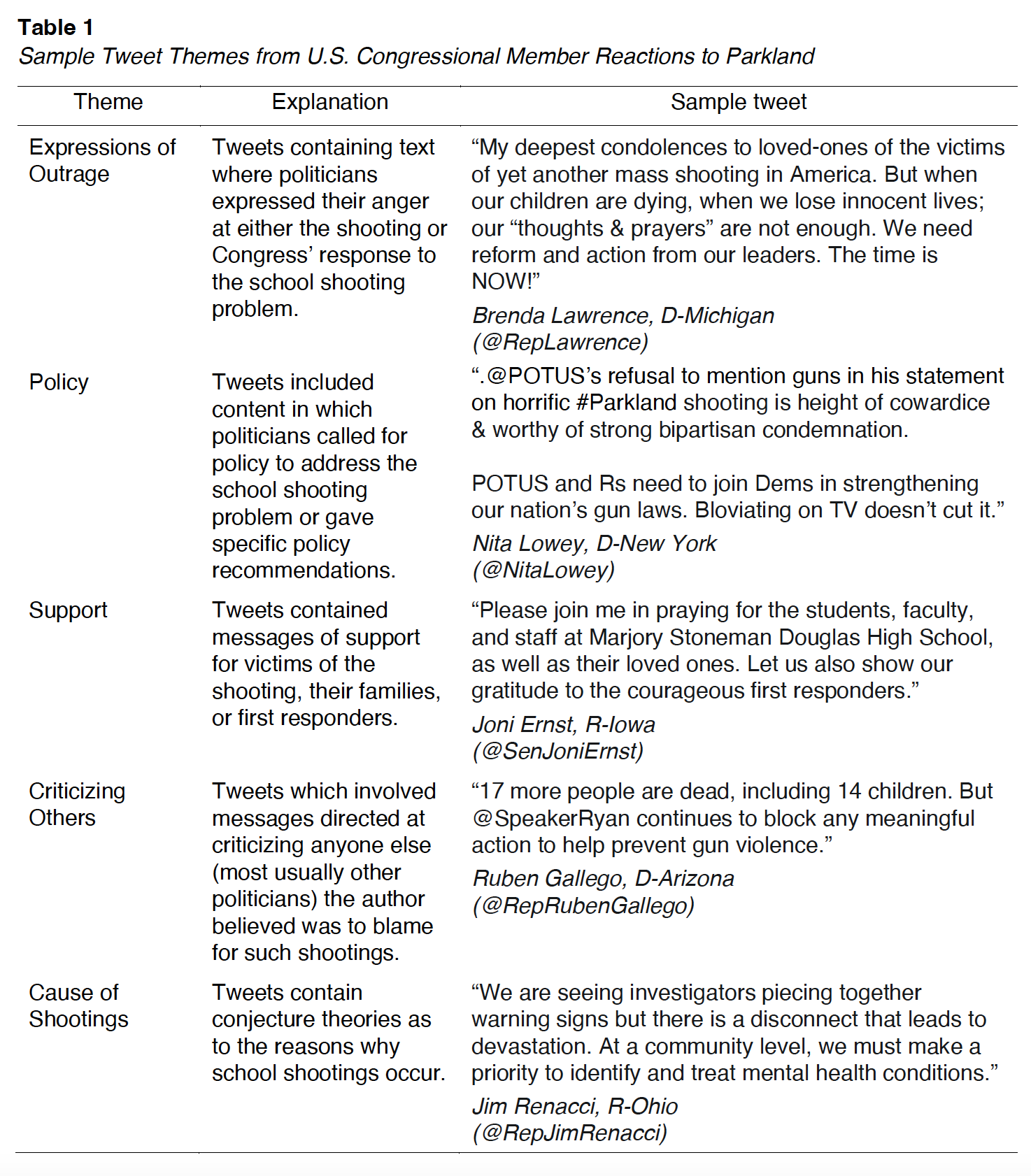
For the first research question, an emergent thematic analysis was used to uncover consistent patterns of discussion in the corpus of tweets, an inductive and qualitative analysis approach suggested by Braun & Clarke (2006). For this process, a random selection of 10% of all Twitter accounts (n = 55) was given a deep read by one author of this project, resulting in five emergent frames: expressions of outrage, policy, support, criticizing others, and causes of shootings (Table 1). These themes were independently confirmed by a different author and provide the answer to RQ1. Notably, theoretical saturation was reached within this 10% sample.

After establishing the themes above (and thus answering RQ1), the two coding authors then assigned binary codes (“0” for absence, “1” for presence) to 10% of the data corpus to prepare data for answering RQ2 (the quantitative comparison of the frequency of induced themes as a function of pre-defined variables; see Neuendorf, 2002). Coders achieved acceptable interrater reliability on each discussion frame category (calculated as Krippendorf’s a): expressions of outrage = .882, policy = .897, support = .939, criticizing others = .897, cause of shootings = .884.5 It is important to note that coding categories are not mutually exclusive, and one individual Tweet could be coded across multiple frames.

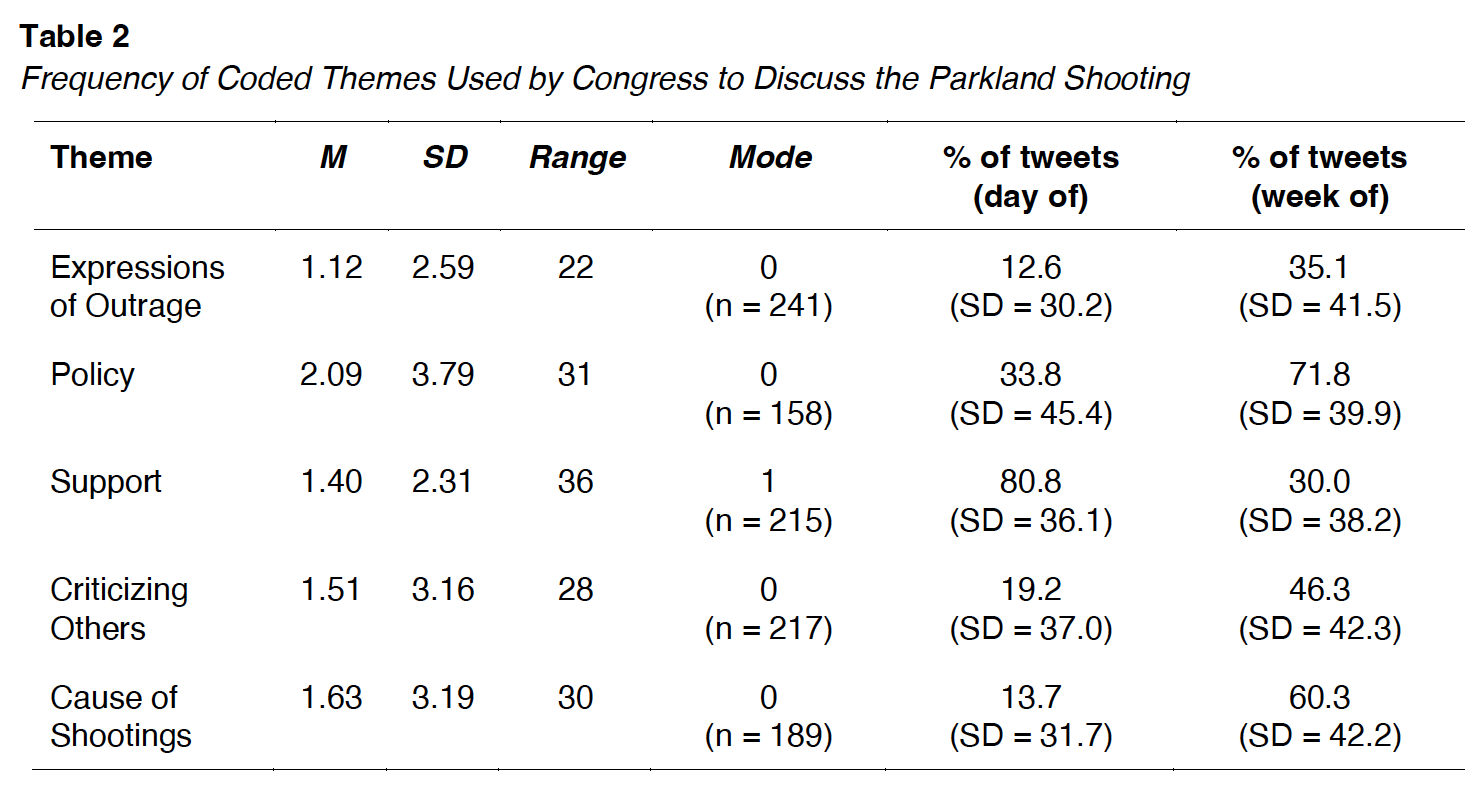
Having established the validity of these five themes, or frames, their sample-wide frequencies are reported below in Table 2 – these, based on 367 Congressional members who had at least one Parkland-related tweet. In sum there were 1,615 Congressional tweets included in the sample. All 1,615 Tweets were included in the data analysis, with results presented below in Tables 2 and 3 below.
                         (Click table to enlarge)

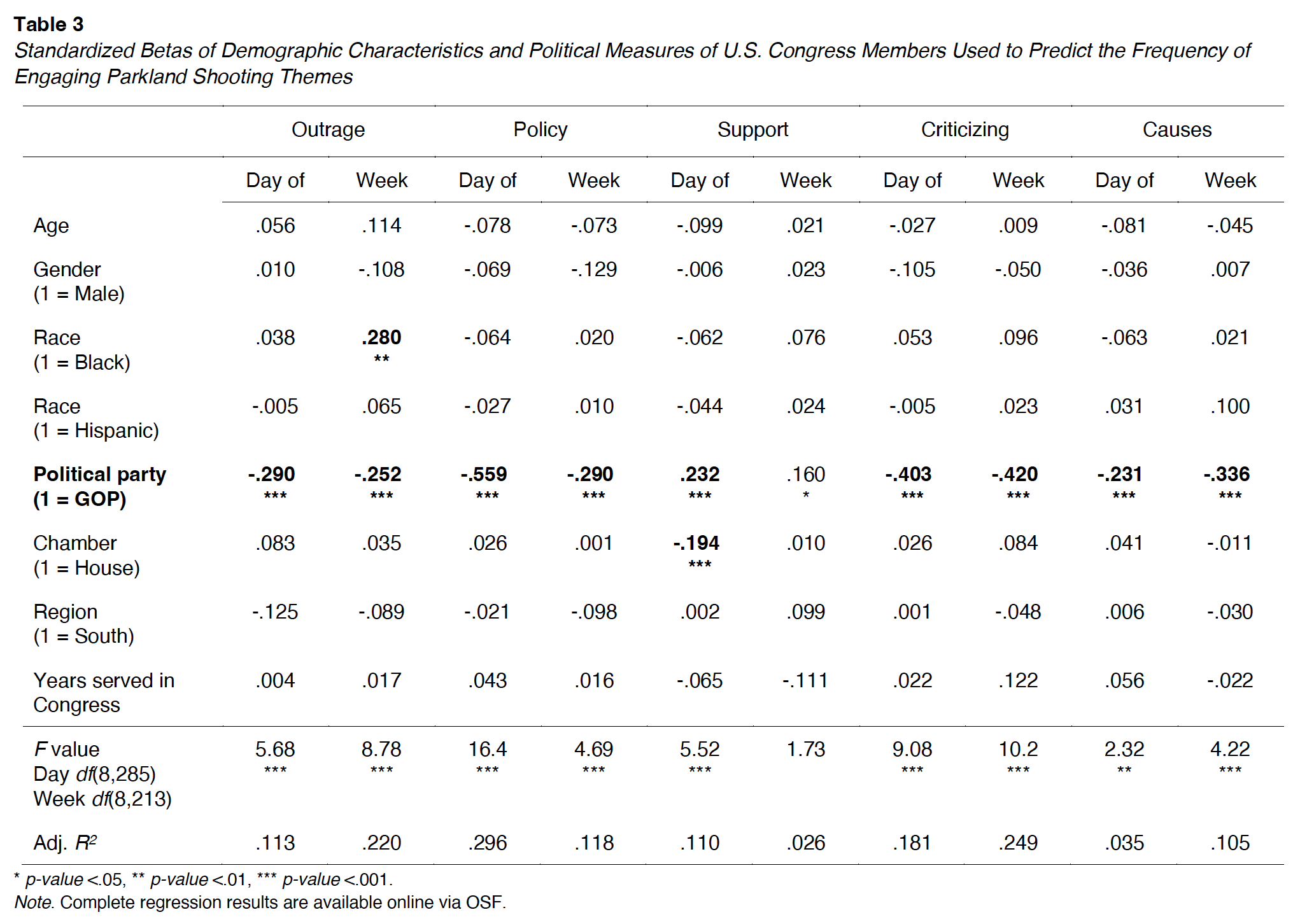
For the focal test of RQ2, the proportion of each of the five tweet categories (for both the day of the Parkland shooting and the week of the Parkland shooting) was regressed onto each of the eight independent variables above. For tweets sent on the day of the Parkland shooting, all five regression models were significant (see Table 3) and showed a clear pattern such that Democrats were more likely to demonstrate outrage, discuss policy, share criticism, and discuss causes of school shootings, while Republicans were more likely to tweet messages of support. These same patterns were replicated when examining each Parkland theme for the week following the Parkland shooting (although variance in engaging the support frame was non-significant).
                         (Click table to enlarge)

Discussion

The Parkland shooting represented a critical moment in the modern political discourse that dominated U.S. newspaper headlines and social media discussions for weeks following the event. Social media was saturated with discussions about Parkland, including engagement from members of U.S. Congress who took to Twitter to share their views and perspectives. The goals of this project were to analyze Congressional engagement with Twitter on the day of and in the week following Parkland, and to both (a) identify common discussion frames within those Congressional tweets and (b) explore potential patterns associated with the use of those frames.

As presented in Table 1, five discussion frames emerged in our data: expressions of outrage, calls for policy, support for victims and first responders, criticizing others, and discussing the causes of such shootings. As might be expected, support frames were far more common in Parkland-related tweets on the day of the shooting (nearly 81% of all tweets), which can be broadly understood through the lens of rally effects, by which immediate reactions to crises tend to be more supportive than critical (Baker & Oneal, 2001). That said, political framing increased sharply in the days following the shooting—that is, there was an increase in the number of tweets expressing outrage, discussing policy, criticizing others (such as other politicians and entities), and debating the causes of school shootings. 

On the day of the shooting, nearly one in four Congressional tweets focused on the Parkland shooting; in one week following the shooting, nearly one in five tweets were still discussing Parkland. Such engagement clearly highlights the importance of the shooting to members of Congress, but a closer look at the political affiliation of those members shows starkly different engagement among Democrats and Republicans. After controlling for numerous other factors, Republicans were far less likely (73% less likely) to tweet about Parkland than Democrats; when they did, Congressional Republicans tweeted their support for victims on the day of the shooting and said very little afterwards. Conversely, Democrats were far more likely to engage political frames associated with outrage, policy changes, criticizing others, and causes of shootings.

Implications

From the perspective of framing theory, both patterns align with partisan politics. In particular, for the pro-gun control Democrat platform, the official stance of the Democratic National Committee is that “[w]ith 33,000 Americans dying every year, Democrats believe that we must finally take sensible action to address gun violence” (see Democratic National Committee, 2023, para. 1). For Democrats, the Parkland Shooting seems to have served as a catalyst for engaging social media to provide discussion frames towards legislative solutions to mass shootings. Democrats’ dual engagement of emotional themes (criticism and outrage), as well as more practical themes (potential causes of and solutions to gun violence), shows an effort to push dialogue around the Parkland shooting proactively, ostensibly to reinforce the party’s larger political platform. Conversely, Republican members of Congress seemed to avoid any political elaboration related to the Parkland shooting. Republicans were far more likely to show initial support for the victims and others affected by the shooting (such as first responders), often in the form of thoughts and prayers, before turning attention away from any further discussion of the Parkland shooting. One interpretation of such a finding is that Republican members chose to disengage from any further discussion of the shooting, perhaps to either (a) reduce focus on debates and discussion of gun control not central to their national platform or (b) draw focus away to other topics (although here, our current analysis does not attempt to interpret non-Parkland related tweets, and as such, these were excluded from data collection and analysis). These findings are somewhat confirmed by a broader comparison of Tweets sent as a function of political affiliation, wherein Democrats sent nearly 100% more tweets on the day of the shooting, and nearly 400% more tweets during the week following the shooting. For Democrats, the Parkland shooting provided the opportunity to engage several different discussion frames associated with gun violence.

Limitations

There are limitations to this study which must be discussed. Twitter was the focus of this study due to its centrality in modern political campaigning as well as the public structure of the platform (Lee & Xu, 2018), but future work might consider other social platforms. Additionally, two central themes of the research highlighted in this study surround: 1) number of tweets and 2) content of tweets. First, as it pertains to the number of tweets, future research should also study how the number of tweets politicians send after a tragedy affects public support for politicians as individuals. Since most constituents never have direct interactions with their representatives, the public has limited opportunities to see their politicians at work. Do tweets affect how members of the public see their leaders and affect their perceptions of the amount and quality of the work they perform? Does this further influence public policy when the public feels satisfied about a particular politician based on the impression management of their Twitter account? Second, are there differences in how politicians respond to mass shootings since the passage of the Bipartisan Safer Communities Act? After the Uvalde shooting, Congress passed a historical bill designed to increase background checks for certain individuals wishing to purchase a firearm, increased community access to mental health services, and provided resources to make schools safer (see Executive Office of the President, 2022). In the current study there were important differences in whether and how members of Congress tweeted about the Parkland shooting. Given the bipartisan nature of the Bipartisan Safer Communities Act, which was supported by both major political parties, would similar tweeting behaviors observed in this study be seen after a mass shooting? Alternatively, would members of Congress be more akin to send similar messages after such a tragic event given that both parties adopted the Safer Communities Act?

Future work might also extend the analysis frame to a longer time-lag, which might reveal other discussion frames or the evolution of initial frames; some members of Congress (including the Republicans in this sample) might have been trying to avoid accusations of “politicizing tragedies” (Robinson, 2017) and thus, stayed silent. A particularly intriguing area for future work would be to correlate emerging discussion frames with agenda-setting effects—that is, to understand how these tweets might impact downstream media coverage and public discourse (Neuman et al., 2014). For example, Donald J. Trump’s 2016 campaign for the U.S. Presidency was successful and largely built on his ability to engage and leverage Twitter to establish issue frames (Wells et al., 2016; Zhang et al., 2017), and his success is a bellwether for future campaigns.

Conclusion

Overall, this study adds to the framing theory literature on how politicians use Twitter in responding to a highly publicized school shooting. This study also adds to the broader framing literature that examines how media coverage of mass shooting events is framed.  Particularly, this study furthers understanding of how politicians framed a highly politicized school shooting tragedy. Emphasized above was the fact that news media coverage of The Parkland shooting was different in terms of its salience, as measured by the extended lifespan of the event’s coverage. As such, the Parkland shooting and the social response to it, including media coverage, must be analyzed as part of a contemporary understanding of the mass shooting problem in the U.S. Furthermore, this research points to the need to study other highly publicized and politicized mass shootings and school shootings in particular, while focusing on how politicians employ frames via media in the aftermath of mass shootings.


NOTES

  1. We refer to the mass school shooting at Marjory Stoneman Douglas High School in February, 2018 as “The Parkland shooting”, as is often colloquially done in the United States.
  2. In addition to traditional national media “swarming” of school shooting locations, ABC created the news series “Uvalde:365” to provide coverage across all its network programs and platforms (Osteen, 2022).
  3. Eight Representatives did not have Twitter accounts. Two Senators did not have Twitter accounts.
  4. Only four Democrats in our study had received campaign contributions from the NRA: Sanford Bishop, Henry Cuellar, Collin Peterson, and Timothy Walz. However, Bishop and Peterson had no Twitter account active during our analysis, and Cuellar made no posts about Parkland. Peterson discussed gun control concerns and victim support in his lone Parkland tweet, sent the day of the attack: https://twitter.com/RepTimWalz/status/963909358433292290.
  5. Complete coder training details, as well as alternative metrics of intercoder reliability, are available in our online supplement files on OSF.


DISCLOSURE
STATEMENT

No potential conflicts of interest were reported by the authors.

REFERENCES

Austin, L., Guidry, J., & Meyer, M. (2020). #GunViolence on Instagram and Twitter: Examining Social Media Advocacy in the Wake of the Parkland School Shooting. The Journal of Public Interest Communications, 4(1). https://doi.org/10.32473/jpic.v4.i1.p4

Baker, W. D., & Oneal, J. R. (2001). Patriotism or opinion leadership?: The Nature and origins of the “Rally ‘Round the Flag” effect. Journal of Conflict Resolution, 45(5), 661-687. https://doi.org/10.1177/0022002701045005006

Braun, V., & Clarke, V. (2006). Using thematic analysis in psychology. Qualitative Research in Psychology, 3(2), 77-101. https://doi.org/10.1191/1478088706qp063oa

Conway, B. A., Kenski, K., & Wang, D. (2015). The rise of Twitter in the political campaign: Searching for intermedia agenda-setting effects in the presidential primary. Journal of Computer-Mediated Communication, 20(4), 363-380. https://doi.org/10.1111/jcc4.12124

Congressional Management Foundation. (2011). #SocialCongress: Perceptions and use of social media on Capitol Hill.http://www.congressfoundation.org/storage/documents/CMF_Pubs/cmf-social-congress-2011.pdf

Copenhaver, A., Schwendau, A., & Tewksbury, R. (2017). Southern legislative candidates’ expressions of support for criminal justice issues: The Internet and politics. Critical Issues in Justice and Politics, 10(1), 97-112. https://www.suu.edu/hss/polscj/journal/v10n1.pdf#page=99

Democratic National Committee. (2023). Preventing gun violence. https://democrats.org/where-we-stand/the-issues/preventing-gun-violence/

Entman, R. M. (1993). Framing: Toward clarification of a fractured paradigm. Journal of Communication, 43, 51-58. https://doi:10.1111/j.1460-2466.1993.tb01304.x

Executive Office of the President. (2022, June 23). Statement of administration policy: S. 2938–Bipartisan Safer Communities Act. https://www.whitehouse.gov/wp-content/uploads/2022/06/Bipartisan-Safer-Communities-Act-SAP-1.pdf

Gitlin, T. (1981). The whole world is watching: Mass media in the making & unmaking of the new left. University of California Press. https://www.ucpress.edu/book/9780520239326/the-whole-world-is-watching

Goffman, E. (1974). Frame analysis: An essay on the organization of experience. Harvard University Press.

Golbeck, J., Grimes, J. M., & Rogers, A. (2010). Twitter use by the US Congress. Journal of the American Society for Information Science and Technology, 61(8), 1612-1621. https://doi.org/10.1002/asi.21344

Guerin, B., & Innes, J. M. (1989). Cognitive tuning sets: Anticipating the consequences of communication. Current Psychology, 8(3), 234-249. https://doi.org/10.1007/BF02686752

Hemphill, L., Culotta, A., & Heston, M. (2013). Framing in social media: How the US Congress uses twitter hashtags to frame political issues. Social Science Research Network. https://dx.doi.org/10.2139/ssrn.2317335

Holody, K. J. (2020). Attributes in community and national news coverage of the Parkland mass shootings. In J. Mathews & E. Thorsen (Eds.), Media, journalism, and disaster communities (pp. 179-200). Palgrave Macmillan. https://doi.org/10.1007/978-3-030-33712-4_12

Hong, S., & Kim, S-H. (2016). Political polarization on Twitter: Implications for the use of social media in digital governments. Government Information Quarterly, 33(4), 777-782. https://doi.org/10.1016/j.giq.2016.04.007

Iyengar, S. (1990). Framing responsibility for political issues: The case of poverty. Political Behavior, 12, 19-35. https://doi.org/10.1007/BF00992330

Lee, J., & Xu, W. (2018). The more attacks, the more retweets: Trump’s and Clinton’s agenda setting on Twitter. Public Relations Review, 44(2), 201-213. https://doi.org/10.1016/j.pubrev.2017.10.002

Lee, J-K., Choi, J., Kim, C., & Kim, Y. (2014). Social media, network heterogeneity, and opinion polarization. Journal of Communication, 64(4), 702-722. https://doi.org/10.1111/jcom.12077

Nass, D. (2018, May 17). Parkland generated dramatically more news coverage than most mass shootings. https://www.thetrace.org/2018/05/parkland-media-coverage-analysis-mass-shooting/

Neuendorf, K. (2002). The content analysis guidebook. Sage. https://us.sagepub.com/en-us/nam/the-content-analysis-guidebook/book234078

Neuman, W. R., Guggenheim, L., Jang, S. M., & Bae, S. Y. (2014). The dynamics of public attention: Agenda-setting theory meets big data. Journal of Communication, 64, 193-214.  https://doi.org/10.1111/jcom.12088

Osteen, O. (2022, August 11). Uvalde paper spotlights ABC News’ continuing coverage of local community in wake of massacre. ABC News. https://abcnews.go.com/US/uvalde-paper-spotlights-abc-news-continuing-coverage-local/story?id=88206090

Robinson, N. J. (2017, June 15). The politics of tragedy. Current Affairs. https://www.currentaffairs.org/2017/06/the-politics-of-tragedies

Schildkraut, J., & Muschert, G. W. (2014). Media salience and the framing of mass murder in schools: A comparison of the Columbine and Sandy Hook massacres. Homicide studies, 18(1), 23-43. https://doi.org/10.1177/1088767913511458

Shapiro, M. A., & Hemphill, L. (2016). Politicians and the policy agenda: Does use of Twitter by the U.S. Congress direct New York Times content? Policy & Internet, 9(1), 109-132. https://doi.org/10.1002/poi3.120

Silva, J. R. (2021). The news media’s framing of mass shootings: Gun access, mental illness, violent entertainment, and terrorism. Criminology, Criminal Justice, Law & Society, 21(2), 76-98. https://heinonline.org/HOL/LandingPage?handle=hein.journals/wescrim21&div=18&id=&page=

Straus, J. R. (2018). Social media adoption by members of Congress: Trends and Congressional considerations. Congressional Research Service. https://iadvocate.celiac.org/wp-content/uploads/2020/06/Social-Media-Adoption-by-Members-of-Congress-Trends-and-Congressional-Considerations.pdf

Straus, J. R., & Glassman, M. E. (2016). Social media in Congress: The impact of electronic media on member communications. Congressional Research Service. https://sgp.fas.org/crs/misc/R44509.pdf

Torres, A. (2018). Timeline: How the never again movement gained momentum after tragedy.  WPLG 10. https://www.local10.com/news/parkland-school-shooting/timeline-of-never-again-movement-

Volsky, I., & Sakran, J. V. (2019). Unlike US, New Zealand isn’t just offering thoughts and prayers. CNN. https://www.cnn.com/2019/03/18/opinions/new-zealand-mosque-attack-us-gun-policy-volsky-sakran/index.html

Votesmart. (2023). National Rifle Association (NRA). Votesmart. https://justfacts.votesmart.org/interest-group/1034/national-rifle-association-nra

Wang, Y., Feng, Y., Hong, Z., Berger, R., & Luo, J. (2017). How polarized have we become? A multimodal classification of Trump followers and Clinton followers. In G. Ciampaglia, A. Mashhadi, & T. Yasseri (Eds.), Social Informatics, 440-456. Springer.

Wells, C., Shah, D. V., Pevehouse, J. C., Yang, J., Pelled, A., Boehm, F., Lukito, J., Ghosh, S., & Schmidt, J. L. (2016). How Trump drove coverage to the nomination: Hybrid media campaigning. Political Communication, 33, 669-676. https://doi.org/10.1080/10584609.2016.1224416

Williams, N. W., Casas, A., Zuidema, W., Aslett, K., & Wilkerson, J. (2019). A social media approach to measuring frame impacts: What was the problem in Parkland? Policy Studies Journal, 50(1), 266-289. https://doi.org/10.1111/psj.12410

Zhang, Y., Wells, C., Wang, S., & Rohe, K. (2017). Attention and amplification in the hybrid media system: The composition and activity of Donald Trump’s Twitter following during the 2016 presidential election. New Media & Society, 20(9), 3161-3182. https://doi.org/10.1177/1461444817744390


About the Authors

Allen Copenhaver, PhD is an Assistant Professor of criminal justice at Eastern Kentucky University.  He conducts research on violent video games, intersections between law enforcement and those on the autism spectrum, and various other areas of research.

Nick Bowman, PhD (PhD, Michigan State University) is an Associate Professor in the S.I. Newhouse School of Public Communication at Syracuse University. His research examines the cognitive, emotional, social, and physical demands of interactive media, such as video games and social media.

Christopher J. Ferguson, PhD is a professor of psychology at Stetson University.  He has researched the impact of various media on behavior for 20 years.  He is a licensed psychologist and lives in Orlando with his wife and son.

CITATION (APA 7th Edition)
Copenhaver, A., Bowman, N., & Ferguson, C. J. (2023). Rage, prayers, and and partisanship: US congressional membership’s engagement of Twitter as a framing tool following the Parkland shooting. Journal of Mass Violence Research. https://doi.org/10.53076/JMVR74816

Keeping with Tradition: Preference for the Longstanding Definition of Mass Shooting

SHARE THIS ARTICLE

Keeping with Tradition: Preference for the Longstanding Definition of Mass Shooting

James Alan Fox Email the Corresponding Author1 and Emma E. Fridel

1 School of Criminology and Criminal Justice, Northeastern University
2 College of Criminology and Criminal Justice, Florida State University

https://doi.org/10.53076/JMVR59660  |  Full Citation Volume: 1, Issue: 2, Page(s): 17-26

Article History: Received June 27, 2022 | Accepted August 11, 2022 | Published Online September 12, 2022

ABSTRACT
As defined back in the 1980s, the term “mass shooting” has long been understood to mean the intentional killing of four or more victims with gunfire in a single incident. However, recent efforts to examine this rare and tragic crime have employed alternate definitional criteria. In order to facilitate cross-study comparisons and curb rampant public fear, it is imperative that scholars, politicians, and the media avoid using the same terminology to describe very different phenomena. In this article, we advocate for the traditional definition in view of a variety of theoretical and methodological considerations.

KEYWORDS
mass shooting, mass killing, definitions

Virtually all criminal offense types are clearly and incontrovertibly defined. Indeed, no one debates the meaning of homicide, robbery, auto theft, or kidnapping. In contrast, the definition of mass shooting has been—and continues to be—very much a matter of debate. For decades, the term “mass shooting” was simply an extension of the Federal Bureau of Investigation’s (FBI) seminal definition for mass murder: four or more victims killed in a single event, typically within 24 hours (Ressler et al., 1988). A mass shooting was essentially just a mass murder committed with firearms. Though somewhat arbitrary, this definition was designed to distinguish among types of multiple homicide and has been used by mass violence scholars for decades with minimal controversy, perhaps due to the paucity of research in this area.

Both public and academic interest in mass shootings, however, surged in the wake of several high-profile incidents in 2012, including the massacres in Aurora, CO, and Newtown, CT. With the “discovery” of mass shooting as a worthy focus of criminological research, the need for reliable data became clear. Given that there was no official resource for such incidents (other than the rather limited and sometimes erroneous cases drawn from the FBI’s Supplementary Homicide Reports), several news organizations, academic centers, and advocacy groups undertook efforts to fill the void by building their own databases from scratch.

(Click table to enlarge)

Unfortunately, there was no consensus as to the parameters of such an endeavor. As shown in Table 1, definitions of mass shooting vary by victim count threshold, extent of victim injury, and incident type, all of which fundamentally alter the nature and prevalence of the phenomenon itself. Based on our evaluation of the extant literature, the three most common definitions of mass shooting are:

  1. Four or more victims shot (but not necessarily killed), used, for example, by the Gun Violence Archive (GVA) beginning in 2013. There are approximately 600 mass shootings per year in the United States using this definition, averaging one fatality per incident.
  2. Four or more victims killed by gunfire, used, for example, by the Associated Press/USA TODAY/Northeastern University Mass Killing Database. This definition has been the standard since the 1980s. There are approximately two dozen mass shootings annually according to this definition, with an average of five victim deaths per incident.
  3. Four or more victims killed by gunfire in a public setting not involving ongoing criminal activity (such as gang conflict and drug trafficking), used, for example, by The Violence Project. This is a subset of the second definition, which is often referred to as “public mass shootings.” There are about a half dozen such incidents per year, claiming an average of seven victim fatalities per incident.

While all three definitions have their utility in different contexts, it is crucial that scholars, politicians, and the media avoid using the same terminology to describe these very different phenomena. Aside from limiting cross-study comparisons (e.g., datasets using differing definitions yielding contradictory results), the lack of a consensus on the definition for mass shootings has fomented public fear massively disproportionate to the risk of victimization. As such, we advocate for the traditional approach (Definition #2) for both theoretical and methodological reasons. Specifically, we contend that:

  1. Injury and death are qualitatively distinct and should not be conflated.
  2. Lowering the victim fatality threshold increases the risk of missing data bias, especially for cases occurring in earlier decades.
  3. Perpetrator deaths are not equivalent to those of victims and should not be included in fatality counts.
  4. All types of incidents—regardless of motivation, location, or weapon—are worthy of study.
  5. A concrete time frame establishing the length of “a single incident” is necessary to distinguish these events from serial and spree killings.
  6. Definitions must be applied consistently across cases and over time.

In the sections to follow, we discuss each of these six points in turn. It should be noted that these points are not equal in terms of salience nor addressed in such a way as to suggest order of importance.

Death is Different from Injury

A shooting with a large number of injuries is hardly equivalent to one that results in a large number of fatalities. A high death toll brings with it a series of funerals and memorials, which in certain cases attract national attention. We do not mean to ignore the awful suffering that comes from nonfatal gunshot wounds, but death is inherently different. Homicide leaves an indelible mark on the families, friends, and communities of the victims in a way that injury never can, no matter how severe. 

Is it reasonable to equate suffering a life-threatening wound with being grazed by a bullet? Is it logical that injuring four victims counts as a mass shooting, but fatally killing three does not, despite the fact that the latter is much more serious? Conflating fatalities with injuries, some of which may be minor, trivializes the severity and permanence of death. Expanding to include nonfatal injuries in the victim threshold fundamentally alters the nature of the crime—it is called mass murder, after all, not mass attempted-murder.

Even further, mass confusion arises when figures associated with the broadest notion of mass shooting (Definition #1) are referenced by the media in their reporting on an incident of much greater severity (Fox & Levin, 2015). After the May 2022 Robb Elementary School shooting in Uvalde, TX, that claimed the lives of 19 school children and two teachers, for example, countless media outlets noted that there already had been more than 200 mass shootings up to that point of the year, according to GVA statistics. But most of these were not like Uvalde: close to half of the GVA’s mass shooting incidents since 2013 resulted in no fatalities, and less than one-quarter involved multiple deaths (some of which were of the assailant). Beginning in 2019, the GVA began tallying mass murders (four or more victims killed by gunfire) in addition to mass shootings (four or more victims killed or wounded by gunfire). Of the 1,711 mass shootings from 2019 to 2021, only 80 (fewer than five percent) reached the four-victim fatality threshold for mass killing.

Equating fatalities with injuries can be terribly misleading and tends to elevate the level of fear, even if it was hardly the intention of the GVA to do so. Claims that mass shootings are “the new normal” (Holt & Gosk, 2018) or that there are more incidents than days (e.g., Silverstein, 2020) unfortunately lead many Americans to conclude incorrectly that massacres with double-digit death tolls are happening every time they turn around. 

As a prime example of blurring the distinction between injury and death, in May 2021, The New York Times (see Victor & Taylor, 2022) published what was described as a “partial list” of the 13 mass shootings that had occurred up to that point in the year, adding that there were “many more” not included. However, the “partial list” of mass shootings was the entire list of mass killings (with four or more victim fatalities), and the incidents not listed were of much lesser severity. In effect, the “partial list” characterization misleadingly implied that the omitted incidents were like the 13 deadliest.

Focusing on fatalities also has benefits for data collection and analysis. Death is unambiguous and thus easy to measure; injuries are a matter of degree, which can lead to confusing and somewhat subjective inclusion criteria. How severe does the wound have to be to count? And how accurate are casualty counts, if some victims do not report minor injuries that do not require medical treatment? In the same vein, it is generally much more challenging to find detailed information on victims who did not perish during the incident.

A key limitation of relying upon fatalities, however, is that the difference between life and death is often a matter of luck. Victim mortality depends on the number and location of wounds, emergency response times, and distance to medical facilities, and may not be a reflection of offender intent. In other words, many perpetrators may seek to kill multiple victims, but fail to do so as a result of factors outside of their control. Nevertheless, this raises the thorny issue of operationalizing motive, an impossible task when many offenders do not survive the incident. Therefore, while we acknowledge that a definition based exclusively on fatalities is inherently imperfect, we argue that it remains the most viable option.

Victim Threshold and Missing Data Bias

Another reason to exclude nonfatal injuries in establishing a victim count threshold—and to maintain a minimum of four fatalities—relates to the perils of retrospective collection of historical data. As mentioned earlier, for decades most researchers adopted the traditional definition of four or more victims shot to death, gradually collecting data on cases over the course of their careers. As a result, we have relatively reliable data on such incidents over a long period of time, providing crucial information for contextualizing whether mass shootings are indeed on the rise. In contrast, definitions involving fewer victims and/or including injuries are relatively new, and they require identifying cases from media reports and public records that are often decades old. Even further, such incidents are much more difficult to find due to the lower level of public attention and press coverage they receive—a task that becomes almost impossible for cases occurring prior to the internet era.

Existing databases have dealt with this issue in two ways: simply restrict the time period covered to more recent years (as does the GVA) or accept a high level of missing cases in earlier years (as does the Stanford University Geospatial Center, which has ceased data collection). Either way, such databases cannot provide accurate prevalence estimates of mass shootings over time and attempts by the media to do so have produced the myth that these massacres are becoming more and more commonplace. 

A case in point is the FBI’s effort, starting in 2014, to collect data on so-called “active shooter events,” defined as episodes in which “one or more individuals is actively engaged in killing or attempting to kill people in a populated area” (FBI, 2022, p. 2). Through a series of statistical reports, the FBI, in collaboration with Texas State University, has documented a sharp rise in such attacks since 2000. Although the FBI notes that active shooter events do not necessarily result in any deaths, the distinction is often lost in media coverage, with active shooter events incorrectly treated as synonymous with mass shootings (e.g., Schmidt, 2014). Aside from the confusion in terminology, the reported manifold increase in active shooter events is suspect because of apparent missing cases in the early years of the database (Lott, 2015). Although “active shooter event” became part of the law enforcement lexicon following the 1999 Columbine massacre, it did not start appearing in news stories until 2006, creating a challenge for identifying cases, particularly those of lesser severity, from the distant past. For example, the initial FBI report on active shooter events (Blair & Schweit, 2014) showing a nearly three-fold increase in cases—a finding that was covered widely by the media—was modified years later with additional incidents that had been overlooked. In fact, for the first three years (2000-2002), nine cases were added to the original 11, an update that would substantially lower the trendline presented in the original report.

Evidence of missingness bias is clear when comparing the FBI’s active shooter data from the early and later years. In the first five years of the dataset (2000-2004), where cases were identified retrospectively, 7.7% of the gunmen failed to kill anyone. By contrast, in the first five years of the project (2014-2018) where cases were identified concurrently, 37.0% of assailants failed to kill anyone. Although some of this increase in the share of nonfatal incidents may be linked to improved police response, most likely it reflects an inability to capture less serious cases of the earlier years that may not have been covered by major newspapers. Moreover, even if a nonfatal shooting did get reported in the local press, it could have been easily overlooked in searches of news archives for years when the term “active shooter” was relatively obscure.

It is important when assessing the ongoing frequency of mass shootings to have an accurate historical benchmark. For example, many observers comment on the prevalence of recent mass shootings in the GVA as an epidemic with no idea of how frequent shootings with four or more victims—but few, if any, fatalities—were in the early 1990s, when the nation’s murder rate was nearly twice the level it is now. Such early points of comparison can be hard to measure.

Perpetrators are not Victims

The idea that death is a singular phenomenon does not mean that all deaths are equally weighty. Specifically, an assailant’s death—be it by suicide, or by the intervention of police or a bystander—should not be included in a count of fatalities (as is the practice of the GVA and some other databases). Unlike the victims, the assailant is a willing participant in a crime that may lead to his or her demise. Including the death of an offender in the fatality count along with those of the victims only serves to inflate the severity of the event in the public’s mind.

The number of fatalities reported in the GVA incident listings, for example, can easily be misinterpreted as a victim fatality count because there is no indication of which incidents include an assailant’s death. One would need to open and inspect each incident report individually (a daunting task indeed) to identify which mass shooting fatality counts include an offender and which do not. Of course, this could very easily be resolved by noting with an asterisk which include an assailant’s death or by using separate columns for victim deaths and offender deaths. Moreover, offender fatalities could also be designated as a suicide versus killed by first responder or bystander.

All Types of Incidents are Important

While we consider death an important element in defining mass shooting, we do not concur with those who limit cases based on location, motive, or even weapon. Definition #3, for example, narrows the focus to indiscriminate slaughter of strangers as well as to targeted shootings in public places that may also put the lives of innocent bystanders at risk. These are the kinds of incidents that are reflected in the common stereotype of a mass shooting and that are most frightening to the public—as they can happen to anyone, at any time, and anywhere. In reality, public mass shootings account for only a small portion of incidents; familicides or family annihilations, for example, represent nearly half of all mass shootings annually, yet rarely inspire the same kind of public fear (Fox & Levin, 2022). Although they occur approximately as often as incidents in public, felony-related massacres involving gang violence and drug trafficking are all but ignored by the majority of Americans (Fridel, 2021). Focusing exclusively on public mass shootings essentially allows the rarest and most sensational type to define the phenomenon as a whole. Ignoring incidents in private spaces also does a disservice to the victims, who are just as dead no matter where or by whom they were killed. Some scholars, for example, list a victim count of 26 for the 2012 Sandy Hook Elementary School shooting, ignoring the fact that the perpetrator killed his mother at their joint home immediately prior for a total of 27 victims, each equally dead.

Besides and independent of our preference for including all types of motivations, relationships, and locations, we also advocate for expanding the focus of mass violence to encompass all types of weapons, not just firearms. Scholarship on other forms of lethal violence like homicide and suicide may focus on the role of guns, but certainly does not ignore deaths caused by other means. Although shootings account for nearly 80 percent of all mass killings in the United States (Carroll, 2021), ignoring victims who were slain with alternate weapons marginalizes their deaths. To them, did it really matter what weapon was used? In fact, the level of suffering experienced by victims who are stabbed, bludgeoned, or burnt to death is often more excruciating than that of gunshot victims. In the same vein, many of the deadliest massacres in U.S. history involved weapons other than guns, including the 1995 Oklahoma City bombing and the 1990 Happy Land Social Club arson fire. Including all mass murders also facilitates international comparisons, as massacres abroad disproportionately involve other weapons, such as vehicles.

Including all types of mass murders has its methodological advantages as well. Many cases defy categorization, as private violence sometimes spills into public spaces or vice versa. In a 2017 incident in Marathon County, WI, a 45-year-old man arrived at his wife’s workplace, threatening to kill her if she did not sign their divorce papers. As she fled to a nearby restaurant, the assailant retrieved his gun from his car and proceeded to shoot and kill two of his wife’s coworkers before gunning down his wife’s lawyer at her office and a responding officer at his own apartment. Similarly, in 2006, a 28-year-old man shot and killed six ravers at an open afterparty inside a private residence in the Capitol Hill neighborhood of Seattle, WA. Both cases illustrate the difficulty of defining what “public” really means. The first clearly was motivated by a domestic dispute, but just so happened to involve public locations; the second was a quintessential indiscriminate rampage shooting that took place in a private home. Moreover, many so-called “public” mass shootings occur in places that are not accessible to outsiders (e.g., military bases), undermining the “it could happen to anyone” logic often used to justify the focus on these incidents.

Including deaths from all weapons avoids similar issues for cases where multiple weapons are used, or the deaths are caused indirectly (e.g., jumping out of a window or being trampled while attempting to escape a mass shooting). In 2021, for example, a 30-year-old man in North Bend, OR, fatally shot two victims (including his father), stole his dad’s truck, and then drove over and killed two pedestrians.

While we recommend including all types of incidents, we acknowledge the unique offender, victim, and incident traits that characterize distinct types of mass shootings. Accordingly, we recommend that researchers disaggregate by type (e.g., familicides vs. felony killings vs. public massacres; shootings vs. other methods) rather than focusing exclusively on one subset of cases (e.g., public mass shootings).

Establishing a Time Frame

When FBI profilers originally distinguished among mass, serial, and spree murders, they identified two primary differentiating criteria: the number of victims and length of time between kills (Ressler et al., 1988). Although every definition of mass shooting includes some sort of victim threshold, many fail to establish a concrete time frame within which the incident must occur. Generally speaking, mass murders occur in “a single incident,” while serial and spree cases typically take place in multiple locations (the former separated by long “cooling off” periods, and the latter occurring in relatively quick succession over a few days). In the spirit of the original, we recommend defining mass shootings as incidents that occur within a 24-hour period, regardless of the number of physical locations. This would include, for example, the March 2021 killing of eight victims at three Metro Atlanta day spas during a time span of just over two hours. Also included would be rare cases in which an offender began or ended a multi-day killing spree with a mass shooting. In such instances, we recommend counting all of the victims (as long as four were killed within twenty-four hours). Although somewhat arbitrary, this choice of time frame is unambiguous, easy to apply, and avoids confusion with other forms of multiple homicide.

Consistency is Key

Regardless of which definition is chosen, it should be applied consistently to all cases over time to ensure the accuracy of prevalence estimates. Unfortunately, some databases include cases that violate their own inclusion criteria, especially if the incident is deemed particularly infamous. Mother Jones, for example, explicitly limits cases to lone shooters (Follman et al., 2022), yet includes the 2015 San Bernardino, CA, massacre, the 1999 Columbine High School shooting, and the 1998 Westside Middle School shooting, all of which involved two perpetrators. More problematic, Mother Jones changed its minimum victim threshold from four to three fatalities in accordance with the U.S. Congress’ Assistance for Violent Crimes Act of 2012 (which somewhat arbitrarily defined mass shootings as three or more victims killed) for all cases occurring in 2013 or later. They did not, however, retroactively update the incident counts for earlier years, leading to a dramatic and artificial increase in the number of mass shootings in recent years. Although Mother Jones makes note of the modified definition, individuals who download the data have sometimes failed to recognize the change and derive erroneous conclusions about the trend in mass shootings (see, for example, Reynolds, 2018).

Our Recommendation

 As indicated, we adopt the conventional definition of four or more victims killed. The broader notion of four victims injured or killed unjustifiably conflates injury with death, the most serious and permanent of outcomes. The narrower notion of four or more killed in a public setting unrelated to an ongoing criminal enterprise often by a stranger unfairly demeans the deaths of victims who are killed in private settings, who are slain by assailants known to them, or who are targeted by rivals in gang warfare or the illicit drug trade. Given the above arguments, we crafted this definition used in the Associated Press/USA TODAY/Northeastern University Mass Killing Database:

Mass murder is defined as the intentional killing of four or more victims— excluding the deaths of unborn children and the offender(s)—by any means within a 24-hour period. This definition includes cases involving all weapons (e.g., shooting, blunt force, stabbing, explosives, etc.), types (e.g., public, felony-related, and familicides), motivations (e.g., domestic dispute, profit, revenge, terrorism, hate, etc.), victim-offender relationships (e.g., stranger, family, acquaintance, co-worker, etc.), and number of locations. The time frame of 24 hours was chosen to eliminate conflation with spree killers who kill multiple victims over several days in different locations, and to satisfy the traditional requirement of occurring in a “single incident,” even if that incident involves an offender targeting multiple locations in an extended assault but within a relatively short time span. However, offenders who kill four or more victims during any 24-hour period of time as part of a multi-day spree are included, as are all their victims within seven days of the mass killing. Negligent homicides related to driving under the influence or accidental fires are excluded due to the lack of intent. Finally, consistent with the traditional definition, mass shootings are those mass killings (four or victim fatalities) in which most or all the victims are killed by gunfire.

It is important to acknowledge, however, that any definition is somewhat arbitrary and, thus, imperfect. In some cases, whether an incident qualifies as a mass killing is simply a matter of timing, opportunity, or the assailant’s skill. Public shooters try to gun down as many people as possible, but their aim may be poor, or first responders and ambulances may arrive in time to intervene and save lives. Also, some family annihilators are not mass murderers because they did not have enough children to kill. These caveats notwithstanding, we contend that this definition is at least unambiguous, easy to apply, and avoids subjective judgement calls. Regardless of whether one agrees with our approach, it is important to be aware of which definition is being used when interpreting study results and other statistics.

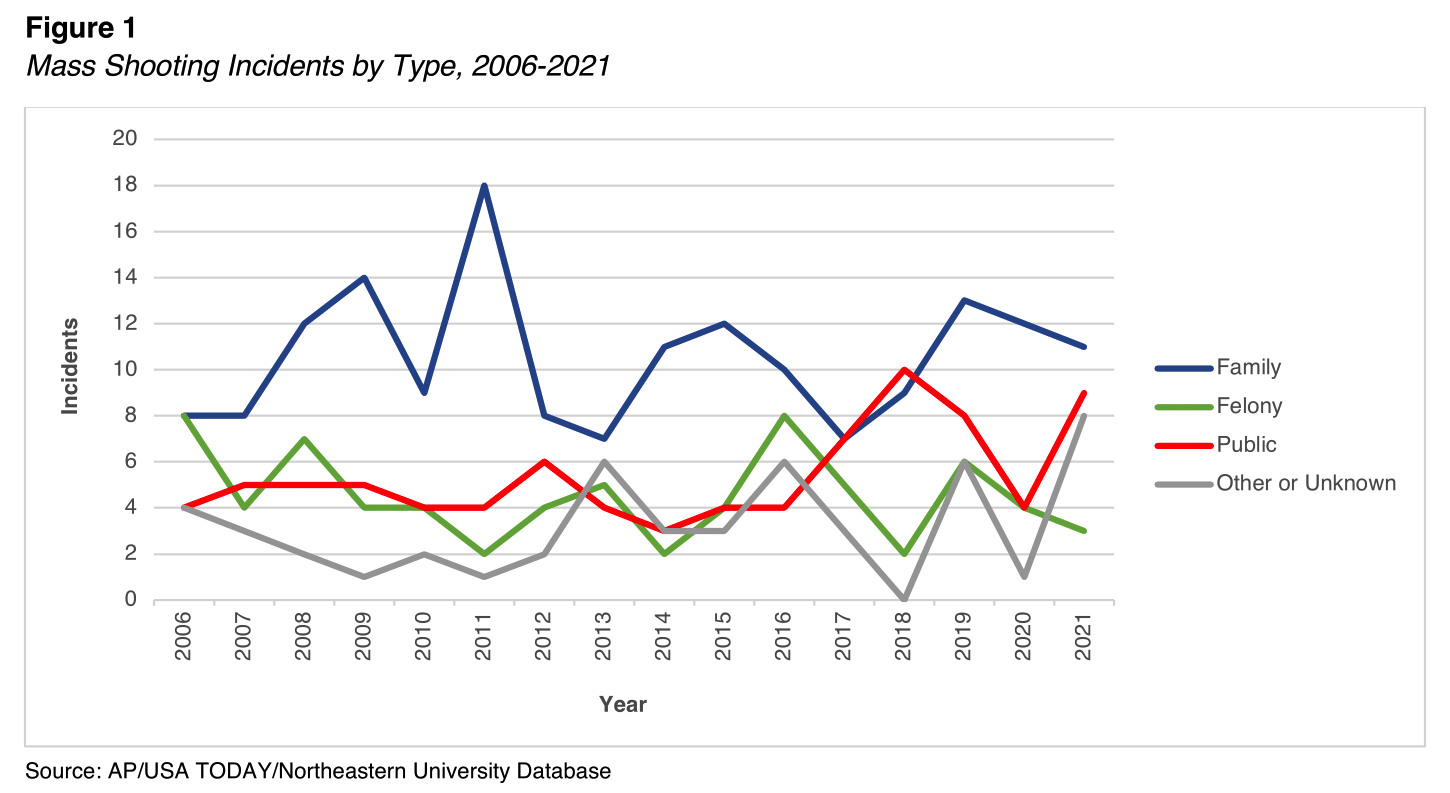
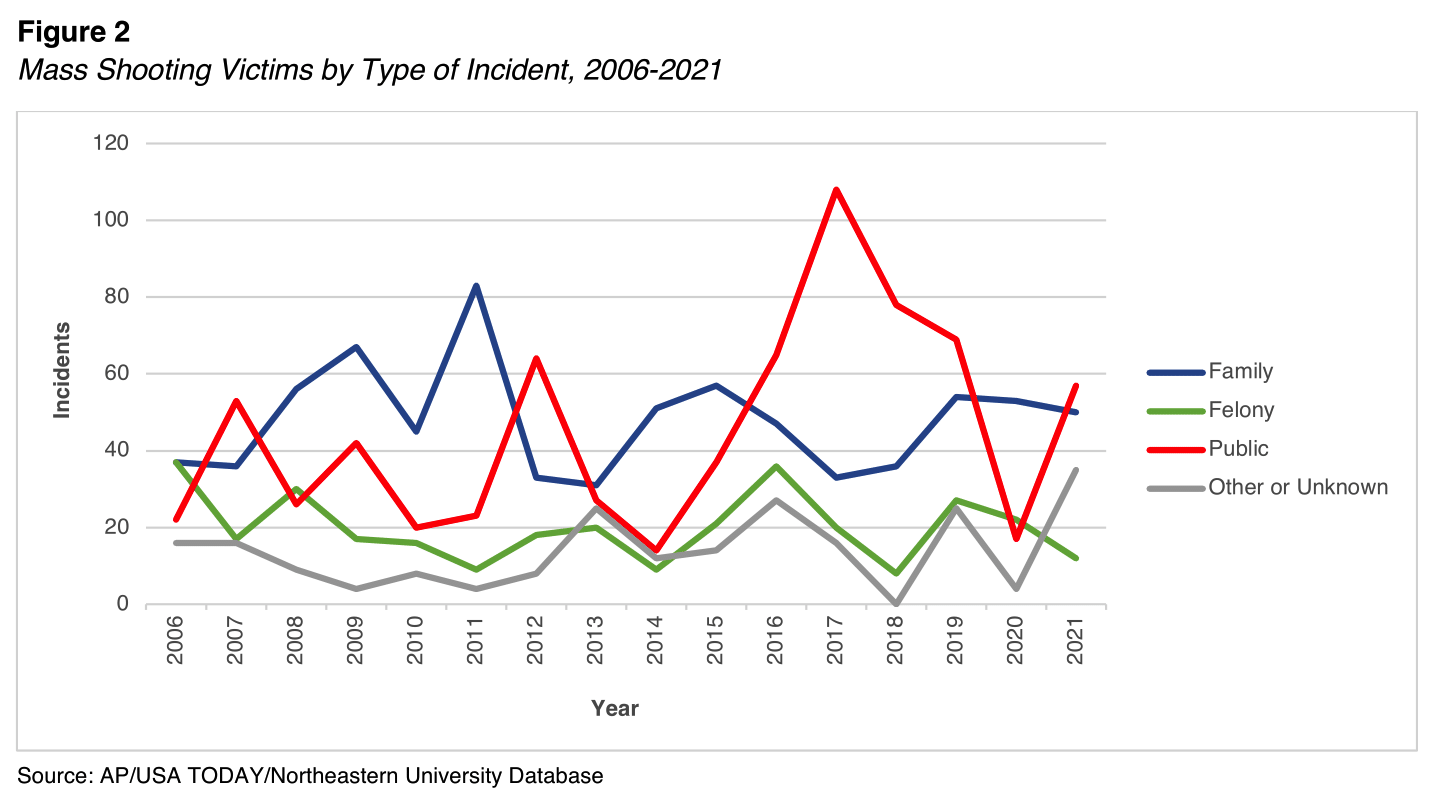
Based on our definition articulated above, Figures 1 and 2 display trends in the number of mass shootings and mass shooting victim fatalities from 2006 through 2021 by type of incident. Contrary to the widely held public perception of a growing epidemic, when it comes to the more serious shootings in which at least four victims are killed, the incident counts have not changed much over the past 15 years, except for a modest increase in public mass shootings. Even then, the increase is rather small in terms of absolute number—from an average of 4.6 incidents per year for 2006-2015 up to 7.0 for 2016-2021. There also has not been much change in the total number killed, except for an increase in public mass shooting victimization, which is largely the result of a few cases with unusually large death tolls: 49 killed in Orlando, FL, in 2016; 25 killed in Sutherland Springs, TX, and 60 killed in Las Vegas, NV, both in 2017; 17 killed in Parkland, FL, in 2018; and 23 killed in El Paso, TX, in 2019. 

(Click table to enlarge)

(Click table to enlarge)

Conclusion

Regardless of definition, mass shooting deaths constitute a small share of the annual number of gun homicides in the U.S. (five percent using Definition #1, one percent with Definition #2, and less than half of one percent by Definition #3). Despite these small shares, as many as one-quarter of Americans believe that mass shootings are responsible for the most gun fatalities—more than suicide, accidental shootings, and homicides other than mass shootings (APM Research Lab, 2019). 

Survey after survey has found disturbingly high levels of fear associated with mass shootings. Nearly half of Americans report being worried that they or a family member will fall victim to a mass shooting (Brenan, 2019), and one-third say they avoid certain public places because of the threat of a mass shooting (American Psychological Association, 2019). These exaggerated perceptions may in part be the result of frequent media reporting on broad definitions of mass shootings, such as the intent to kill multiple victims (as in the FBI’s active shooter data) or counting all victims regardless of the extent of injury (as in the Gun Violence Archive). Many politicians and pundits have characterized mass shootings as an epidemic. That certainly may be true with regard to public fear, but in terms of the actual incidence, such suggestions do not appear to be supported by the facts—regardless of how those facts are measured.

DISCLOSURE STATEMENT
No potential conflicts of interest were reported by the authors.

REFERENCES

American Psychological Association. (2019, August 15). One-third of US adults say fear of mass shootings prevents them from going to certain places or events. https://www.apa.org/news/press/releases/2019/08/fear-mass-shooting

APM Research Lab (2019, October 2). Knowledge of gun-related deaths. https://www.apmresearchlab.org/gun-survey-deaths

Blair, J. P., & Schweit, K. W. (2014). A study of active shooter incidents in the United States Between 2000 and 2013. Texas State University and Federal Bureau of Investigation, U.S. Department of Justice, Washington D.C. https://www.fbi.gov/file-repository/active-shooter-study-2000-2013-1.pdf/view

Brenan, M. (2019, September 10). Nearly half in U.S. fear being the victim of a mass shooting. Gallup. https://news.gallup.com/poll/266681/nearly-half-fear-victim-mass-shooting.aspx

Carroll, N (2021, May 28). The backstory: We’ve been tracking mass killings since 2006. USA TODAY. https://www.usatoday.com/story/opinion/2021/05/28/mass-shootings-most-mass-killings-happen-home-not-public-like-san-jose/7465616002/

Federal Bureau of Investigation. (2022). Active shooter incidents in the United States in 2021. U.S. Department of Justice, Washington, D.C.

Follman, M., Aronsen, G., & Pan, D. (2022, June 17). A guide to mass shootings in America. Mother Jones. https://www.motherjones.com/politics/2012/07/mass-shootings-map/#criteria

Fox, J. A., & Levin, J. (2015). Mass confusion concerning mass murder. The Criminologist, 40(1), 8-11.

Fox, J. A., & Levin, J. (2022). Mass murder in America: Trends, characteristics, explanations, and policy response. Homicide Studies,26(1), 27-46. https://doi.org/10.1177/10887679211043803

Fridel, E. E. (2021). A multivariate comparison of family, felony, and public mass murders in the United States. Journal of Interpersonal Violence, 36(3-4), 1092-1118. https://doi.org/10.1177/0886260517739286

Holt, L., & Gosk, S. (2018, November 8). Mass shootings becoming painful new normal in America. NBC Nightly News. https://www.nbcnews.com/nightly-news/video/mass-shootings-becoming-painful-new-normal-in-america-1365603395798

Lott, J. R. (2015). The FBI’s misrepresentation of the change in mass public shootings. Academy of Criminal Justice Sciences Today, 40(2), 18-29.

Ressler, R. K., Burgess, A. W., & Douglas, J. E. (1988). Sexual homicide: Patterns and motives. Lexington Books.

Reynolds, A. (2018, February 15). Are mass shootings becoming more frequent? The Cato Institute. https://www.cato.org/blog/are-mass-shootings-becoming-more-frequent

Schmidt, M. S. (2014, September 24). F.B.I. confirms a sharp rise in mass shootings since 2000. The New York Times. https://www.nytimes.com/2014/09/25/us/25shooters.html

Silverstein, J. (2020, January 2). There were more mass shootings than days in 2019. CBS News. https://www.cbsnews.com/news/mass-shootings-2019-more-than-days-365/

Victor, D., & Taylor, D. B. (2022, May 17). A partial list of mass shootings in the United States in 2021. The New York Times. https://www.nytimes.com/article/mass-shootings-2021.html

About the Authors

James Alan Fox is the Lipman Family Professor of Criminology, Law, and Public Policy at Northeastern University. His four decades of research on mass killing has been presented in several books, including Extreme Killing: Understanding Serial and Mass Murder, and dozens of articles in both academic journals and popular outlets. Finally, he is one of the principals in developing the Associated Press/USA TODAY/Northeastern University Mass Killing Database.

Emma E. Fridel is an assistant professor in the College of Criminology and Criminal Justice at Florida State University. She primarily studies violence and aggression with a focus on homicide, including homicide–suicide, serial and mass murder, gun violence, and police use of lethal violence. Her work has been published in Criminology, Social Forces, the Journal of Quantitative Criminology, and Justice Quarterly. She is also co-author of Extreme Killing: Understanding Serial and Mass Murder.

CITATION (APA 7th Edition) Fox, J. A., & Fridel, E. E. (2022). Keeping with tradition: Preference for the longstanding definition of mass shooting. Journal of Mass Violence Research, 1(2), 17-26. https://doi.org/10.53076/JMVR59660

Download an infographic summarizing the main takeaways of this article.
Available Formats: PDF  |  PNG

Defining Rampage Violence Across Completion Status: Towards a More Comprehensive Model

SHARE THIS ARTICLE

Defining Rampage Violence Across Completion Status: Towards a More Comprehensive Model

Janelle Hawes Email the Corresponding Author and Eric Madfis

School of Social Work and Criminal Justice, University of Washington Tacoma

https://doi.org/10.53076/JMVR51594  |  Full Citation Volume: 1, Issue: 2, Page(s): 42-52

Article History: Received July 28, 2022 | Accepted August 24, 2022 | Published Online September 12, 2022

ABSTRACT
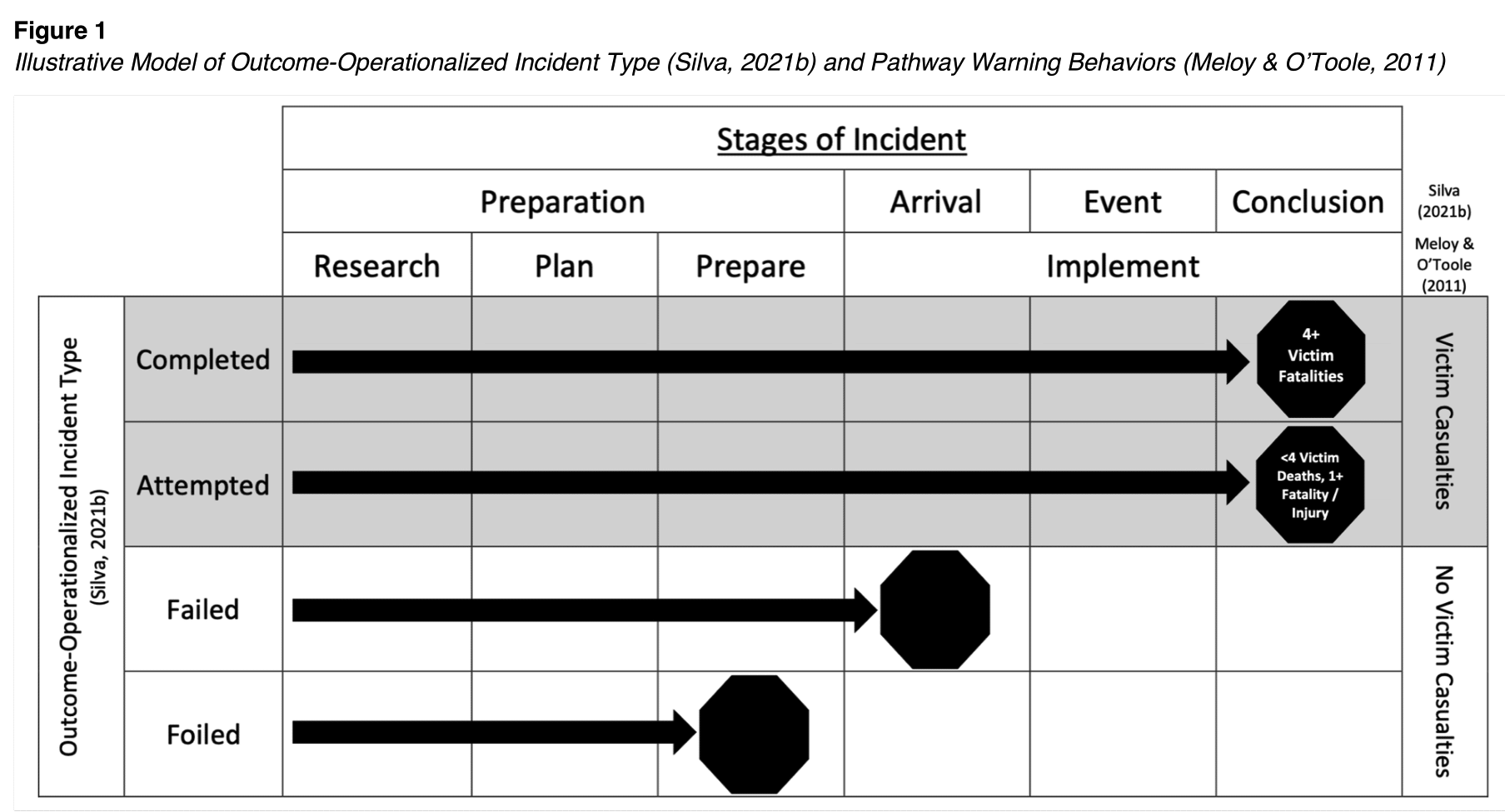
The definitions and terms used to describe single-incident mass casualty events vary widely and remain contested. To allow for the inclusion of more incidents, larger and more representative samples, and more comprehensive analyses, we argue in favor of using the broad term “rampage” and propose a new model, the Rampage Violence Status Model (RVSM), which provides additional context on completion status and can subsume previous terminology. Additionally, by expanding upon previous researchers’ distinctions and definitions of various stages and completion statuses, we suggest adopting the following terms as stages in the progression of rampage violence, per the RVSM: researched, planned, prepared, initiated, interrupted, attempted, and completed.

KEYWORDS
mass shooting, rampage, rampage violence, averted, completion status, school shooting

Rampage violence has become a social problem of increasing concern in the 21st century, especially in the United States where more public mass shootings occur than anywhere else on the planet (Lankford, 2016, 2019; Lemieux, 2014; Madfis & Lankford, 2022; Silva, 2022). Further, public mass shootings have become more frequent (Peterson & Densley, 2020) and more deadly (Lankford & Silver, 2020) since the turn of the 21st century, and both public and private mass shootings have increased over the last few years during the COVID-19 pandemic (Schildkraut & Turanovic, 2022). As the problem has worsened and gained more public awareness over the last 20 years, the research on mass/rampage violence – public mass shootings, in particular – has also increased exponentially during this time (Duwe et al., 2021).

Traditionally, mass shootings have been defined as the killing of four or more people with firearms during a single episode at one or more closely related locations (Fox et al., 2018). However, this definition remains contested (Huff-Corzine & Corzine, 2020), and numerous similar terms can be found throughout the literature, such as mass murder (Duwe, 2007; Holmes & Holmes, 2001; Levin & Fox, 1985; Meloy & O’Toole, 2011), active shooting (Kissner, 2016; Rusho et al., 2021), mass violence (Daly, 2018; Huff-Corzine & Corzine, 2020), rampage (Madfis, 2014, 2020; Newman et al., 2004), and massacre (Harrison & Bowers, 2010; Schildkraut & Muschert, 2014). There are many more location-specific terms such as mass public shooting (Silva & Green-Colozzi, 2022), workplace massacre (Duwe, 2007), familicide (Liem at al., 2013), and mass school shooting (Curran et al., 2020; Paez et al., 2021). When considering terminology regarding how far into the act of mass violence the perpetrator was when it ceased, the list of terms grows further. Scholars have written about averted school rampage (Madfis, 2020), averted school violence (Cowan et al., 2022), averted school shooting (Daniels & Page, 2013), averted mass violence (Cowan et al., 2022), thwarted mass homicide (Sarteschi, 2016), and mass shooting with the designations of completed, attempted, failed, and foiled (Silva, 2021a, 2021b; Silva & Green-Colozzi, 2022), and school shootings as either completed or averted (Winch, 2021).

While some of the variations in terminology may be substantive (and entail important differences in offender profiles, attack behaviors, motivations, opportunities for intervention and prevention, etc.), far more research is needed to compare across these categories (Madfis, 2020). That said, we do know that many common factors and patterns among perpetrators exist (such as cumulative strains, extensive fantasizing about and planning for the rampage attack, desire for lasting fame, leakage of information about the threat to others, etc.; see Lankford et al., 2019; Levin & Madfis, 2009; Madfis, 2017) and persist despite, for example, variations in the site of the mass violence (see, for example, Silver et al., 2018).

As empirical knowledge of mass violence expands it would be helpful to utilize universal language to explore this violent phenomenon with a more standardized set of terminology. The increasing frequency of mass violence in the United States and its damaging effects on society suggest the dire need for empirical research which is more easily understandable and less contradictory in the use of language so that research may better inform public debate and policy. Scholars’ use of more universal and uniform language is one method to potentially address this need. Though some scholars (such as Huff-Corzine & Corzine, 2020) discourage the implementation of any standardized definitions around the phenomenon due to the desire to keep various forms of mass violence distinct from one another, we contend that more universal language and terminology for these acts can benefit this area of study if developed in a systematic way with holistic intent.

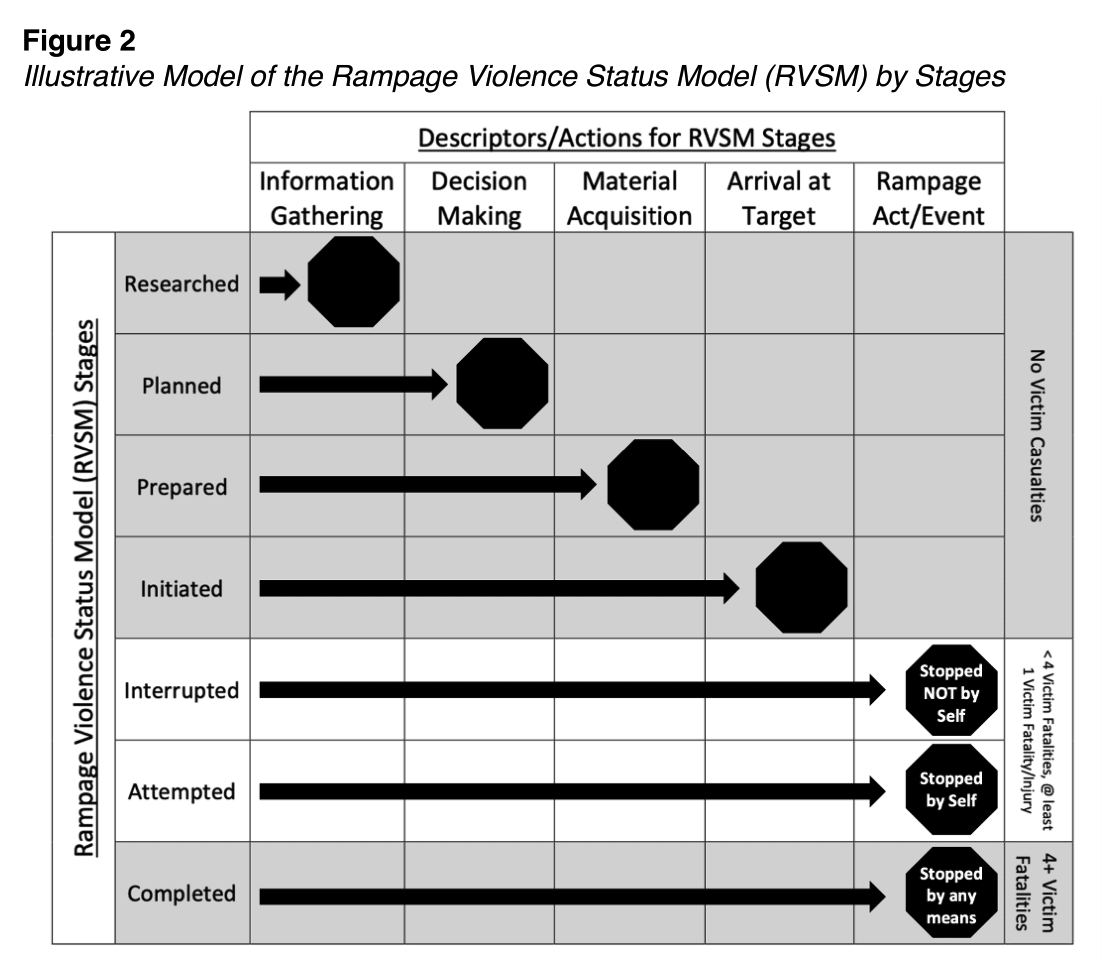
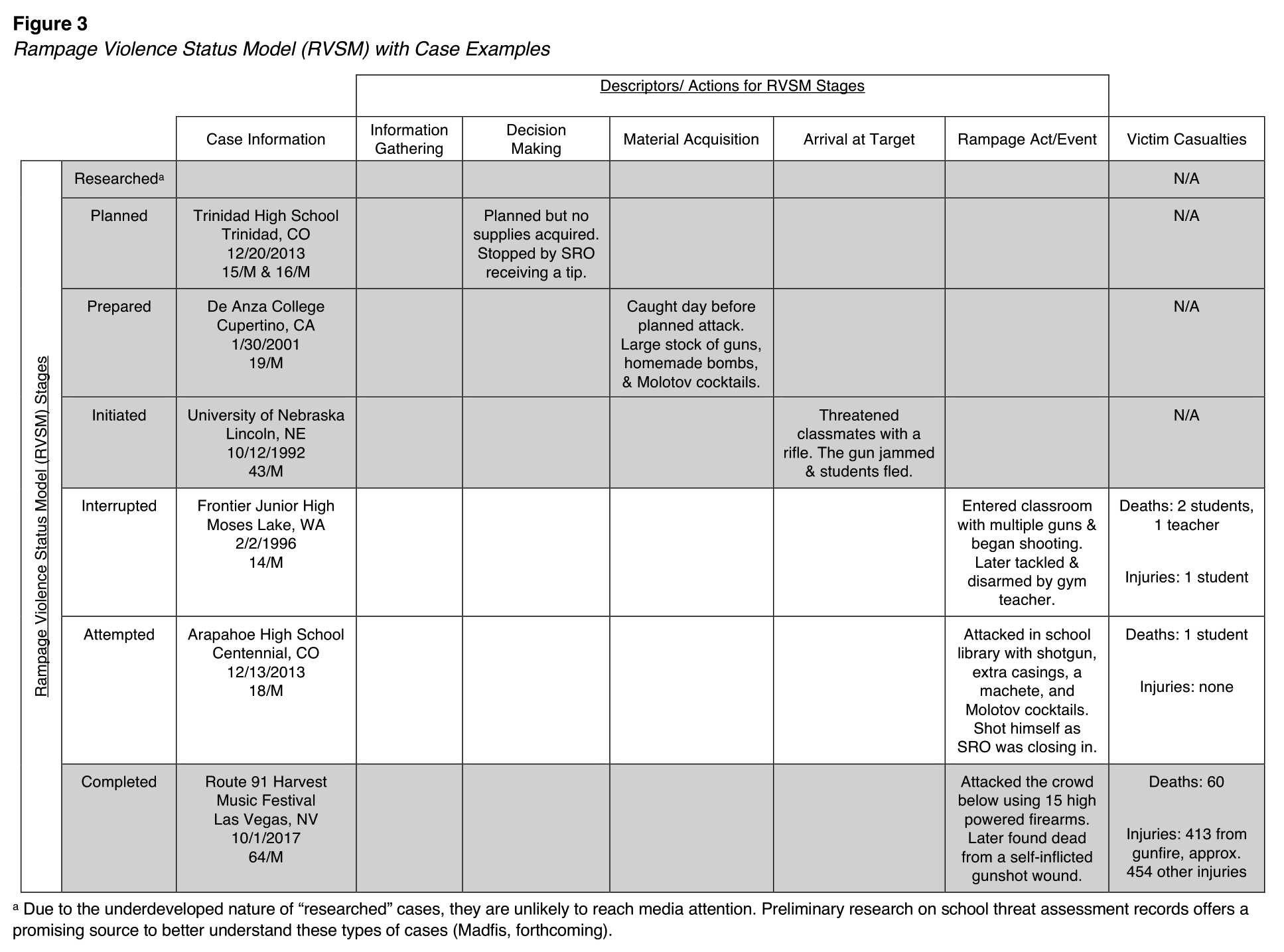
In this article, we summarize how previous studies have defined and operationalized mass violence (and associated terms such as mass shootings, rampage, mass murder, etc.) across the spectrum of attempts and completed acts and argue in favor of adopting terminology which is as broad as possible, yet retains the most crucial identifying features so as to maintain distinctions between single-incident mass casualty events and other multiple-incident mass casualty events like serial killings and state-sponsored mass violence such as genocides. To that end, we suggest adopting the broad term rampage to which specificity can be added. For example, the location and weapon of rampage violence may be further specified by referring to a school rampage stabbing or a workplace rampage shooting. Further, the completion status of an attack may be characterized as a completed, attempted, interrupted, arrived, prepared, planned, or researched rampage to clarify how far along the offender was able to carry out their deadly plot (these new terms will be defined and explained later in this piece). Thus, instances could be referred to as, for example, a completed school rampage stabbing or an attempted workplace rampage shooting.

Prior Debates Over Terminology

In scholarship on homicide, the first term used to refer to single-incident mass casualty events was “mass murder” (Fox & Levin, 1998), and the traditional definition limits the phenomenon to those events wherein at least four victims were killed during a single episode at one or more closely related locations (Duwe, 2007; Fox et al., 2018; Holmes & Holmes, 2001). The term mass murder is deliberately broad so as to encompass all types of weapons used, including knives, axes, guns, bombs, and any other potentially deadly weapon. In recent years, terms such as “mass shooting” and “active shooting” have become far more prevalent (Fox & Levin, 2015). The aforementioned terms focus only on gun violence, and many studies specifically limit their qualifying criteria to only include incidents of mass violence in which firearms were the primary weapon (see Newman et al., 2004 for an example). As Madfis (2020) notes, however, in his study of averted incidents of school rampage plots, numerous deadly school violence plans were formed by students which involved knife attacks and the use of various types of bombs, explosives, and incendiary weapons. Likewise, bombs were a vital component of the Columbine High School killer duo’s plan though most were not detonated (Larkin, 2007). Further, the deadliest mass murder at a school in American history (the 1927 Bath School Disaster in Michigan) involved dynamite and hundreds of pounds of pyrotol, but no firearms (Bernstein, 2009), and the deadliest mass casualty event committed by a single perpetrator (the 2011 Norway attacks) utilized both bombs and guns. Amman and colleagues (2022) recently found 138 mass stabbing attacks across the world between 2004 and 2017.

Accordingly, we suggest using the term rampage in line with Madfis (2020) so that all types of weaponry may be included in future operationalizations and subsequent datasets. Certainly, guns enable far more deaths in a shorter timespan than less lethal weapons like knives and axes (Madfis & Levin, 2013), but, until such time as there is evidence to suggest that substantial differences exist in terms of motivation or other characteristics between those who utilize guns and those who utilize other weapons to commit their attacks, the broader term rampage should be adopted to allow for the inclusion of more incidents, larger samples that are more representative, and thus more comprehensive analyses.

Other important definitional debates in the mass violence literature have included excluding cases based on the location of the attack (e.g., removing cases of familicides in private homes), offender’s connection to the attack site (e.g., limiting cases to school attacks only by former and current students), the relationship between offenders and victims (as specific or random targets), and by the number of victims killed or injured (Daniels et al., 2007, 2010; Levin & Madfis, 2009; Moore et al., 2003; Muschert, 2007; Newman & Fox, 2009; Newman et al., 2004; Vossekuil et al., 2002). We view all of these exclusion criteria as problematic (and as having the potential to create less representative samples), unless done for specific methodological, conceptual, or pragmatic reasons.

In particular, we take issue with the practice of requiring specific death counts as an inclusion criterion. Such a focused definition needlessly omits myriad cases which have not resulted in multiple deaths (Madfis, 2020). Cases in which the perpetrator has the desire and intent to kill multiple victims yet fails to do so when their plans come to the attention of authorities before being effectuated and those who severely injure many people but fail to do so fatally are excluded in conventional definitions of mass murders and mass shootings. As Madfis (2020) states, “These less-successful perpetrators may be distinguishable by their overall incompetence with weaponry and/or their inability to maintain secrecy about their future actions, but not necessarily by their original motivations and goals” (p. 169). Therefore, there is much use in adopting the broader notion of rampage violence and including all cases which involve an attempt to kill multiple people in a single event (White-Hamon, 2000; Madfis, 2020).

One of the newest and most interesting areas of emergent scholarship in this area is the issue of completion status, or how far along the perpetrator was able to carry out their deadly plot to kill multiple victims. The first studies to explore cases of averted incidents (such as Daniels & Page, 2013; Daniels et al., 2007, 2010; Larkin, 2009; Madfis, 2014) exclusively did so in the context of school settings, but knowledge and terminology in this area has rapidly expanded in recent years.

As Daniels and Page (2013) identify, studying something that may or may not have eventually happened but was stopped is complicated. To combat this, they took an approach inspired by the study of law, selecting only cases which had sufficient evidence to bring about conviction for an imminent shooting (Daniels & Page, 2013). Winch (2021) considered a case averted if there was any evidence that the perpetrator demonstrated pathway engagement (Calhoun & Weston, 2003), such as researching past school shootings, planning for an attack in various ways, or preparing for the attack by acquiring a gun. Other definitions and use of terminology regarding completion status also consider activity engagement and process. Meloy and O’Toole (2011) explore leakage, which is a type of pathway warning behavior wherein there is “communication to a third party of an intent to do harm to a target” (p. 513). These researchers found pathway warning behaviors to be a predominant theme in several types of violent crime, including mass murder and school shootings. According to Meloy and O’Toole (2011) pathway warning behaviors are any that contribute to the steps of researching (learning and gathering useful information from past attacks), planning (selection of the time, location, method of attack, and entry method), preparing for (weapons and materials acquisition), and implementation of a violent incident, and that with each step the risk of violence and harm to others increases. Incorporated into Winch’s (2021) conceptualization, each of these pathway warning behaviors up to implementation meets the criteria for an averted school shooting. Once a perpetrator reaches the implementation stage, the case was deemed a completed school shooting if there was at least one injury and the incident occurred on school grounds during school hours or at a school event after hours.

Silva (2021a, 2021b) introduced a series of terms defining the progress of a mass shooting incident based on outcome operationalization. This work defined a mass shooting as a gun incident committed by 1+ person in 1+ public or populated setting within a 24-hour period in which at least some intended victims were selected randomly and/or for symbolic value. This model expands on previously used completion status concepts, offering four casualty- and target-based outcome categories and terms from least to most severe: foiled, failed, attempted, and completed (Silva, 2021a, 2021b). Offering further clarification on stages of completion status, Silva and Green-Colozzi (2022) identify four stages of a mass shooting as preparation, arrival, event, and conclusion.  

A foiled mass shooting is an incident which the perpetrator has set into motion but was stopped before the incident began, such as never reaching their intended target (Silva, 2021a, 2021b). This definition is rooted in Sarteschi’s (2016) concept of high credibility cases, in which an offender has explicitly stated their intention to carry out a mass shooting attack, identified a target or type of target, and already has a gun, has attempted to acquire one, or has a plan to do so. An incident is considered a failed mass shooting if the plan was set into motion but stopped during the incident (Silva, 2021b). For example, in a failed mass shooting case, the perpetrator would have finished preparations, arrived at the intended target, and perhaps began shooting but is then interrupted (e.g., killed or tackled) (Capellan & Gomez, 2018; Silva & Green-Colozzi, 2022). Both foiled and failed mass shootings have no casualties (Silva, 2021b).

Conversely, attempted and completed mass shooting incidents both include casualties. The distinction between these two categories rests on the number and type of casualties associated. In an attempted mass shooting, the plan has been effectuated and ended with less than four deaths but at least one victim casualty (injury or fatality). A completed mass shooting is characterized by four or more fatalities, not including the perpetrator (Silva, 2021a, 2021b).

Silva’s (2021a, 2021b) outcome operationalization model and Meloy and O’Toole’s (2011) stages based on pathway warning behavior overlap, each adding specificity to different phases of an incident. We submit that, taken together, these approaches can offer unifying terminology and definitions that can be applied to all incidents of rampage violence, no matter the location or weaponry, and such an approach provides the most comprehensive way to provide information and analysis on the completion status of incidents. At present, Silva (2021b) created the stages of preparation, arrival, event, and conclusion, while Meloy and O’Toole (2011) specify research, planning, preparation, and implementation stages. As illustrated in Figure 1, the definitions of these stages overlap, allowing Meloy and O’Toole’s research, plan, and prepare stages to add a deeper level of detail to Silva’s preparation stage. Further, Silva’s arrival, event, and conclusion stages increase the detail and nuance of Meloy and O’Toole’s (2011) implementation stage.

(Click table to enlarge)

Rampage Violence Status Model

Taken together, previous scholarship has offered numerous varied conceptualizations, operationalizations, and terminology options to discuss mass and rampage violence incidents. However, some terms and definitions are needlessly limiting, several prior conceptualizations overlap, and some terms are synonymous and virtually indistinguishable from one another. Previous models and concepts have moved the field forward and provided much needed insight and clarity. However, we propose a new model, the Rampage Violence Status Model (RVSM) (see Figure 2), which is meant to be more comprehensive, cohesive, and inclusive as it provides additional context on completion status and can subsume previous terminology (see Figure 3 for examples of cases that represent each stage of the RVSM). Additionally, this model provides terms that move the field forward by allowing the examination of perpetrators’ intentions.

Building and expanding on previous researchers’ (such as Meloy & O’Toole, 2011; Silva 2021a, 2021b) distinctions and definitions of various stages and completion statuses, we suggest adopting the following terms as stages in the progression of rampage violence, per the RVSM: researched, planned, prepared, initiated, interrupted, attempted, and completed.

Researched rampage violence is an incident in which the perpetrator(s) has/have researched and gathered information from previous attacks for their own use before their efforts were stopped. At this early stage, any incident would be very undeveloped.

Planned rampage violence occurs when the perpetrator(s) has/have completed the research stage and moved on to planning their own attack. This could include decisions being made as to the time and location of their act, identifying and/or listing targets, selecting a method of attack or weaponry, creating plans to acquire those weapons, choosing entry points, acquiring or sketching blueprints/layouts of their selected location, etc. A rampage violence act is described as planned if any of these decisions have been made when the plot is discovered and stopped.

Prepared rampage violence is a plot which has passed the research and planning stages and the perpetrator(s) has/have now either acquired or attempted to acquire weapons and materials needed for the event when stopped. This definition also includes any efforts to create, pack, or transport the materials and weapons required for the plot.

An incident would be considered initiated rampage violence if the perpetrator(s) has/have surpassed the three previous stages and successfully arrived at their targeted location to carry out their plot. However, the

act is stopped before any injuries or fatalities have occurred at the target location. These four terms –researched, planned, prepared, and initiated rampage violence – refer to acts that could have been stopped by the perpetrator(s) via personal failure or leakage behaviors, by family, friends, or various community members, or by intervention from law enforcement. Additionally, these terms define completion stages of a rampage violence act in which there are no victim injuries or fatalities.

In contrast, interrupted rampage violence is an act in which the perpetrator(s) has/have successfully passed all previous stages and initiated their plot but was/were stopped or interrupted by anyone other than the perpetrator(s). An interrupted rampage violence event results in less than four victim fatalities but has at least one victim injury or fatality. Similarly, attempted rampage violence reaches the same stage of completion and victim outcomes as interrupted rampage violence, however, it is notably distinct in that this act concludes due to action(s) taken by the perpetrator(s). In other words, an attemptted rampage violence event stops by the perpetrator’s own hand, for example by suicide or surrender.

The interrupted and attempted rampage violence classifications provide terminology to explore perpetrators’ plans versus what occurred, by distinguishing between an act being stopped by others rather than a perpetrator choosing its completion. If a perpetrator is stopped by law enforcement, the ending was defined by law enforcement. The intended plot could have included more targets, additional types of weapons, and so on. However, if a perpetrator chooses when the event is finished, one can presume the perpetrator accomplished their intended plan or revised their plan during the event and reached a point of satisfaction or resolution.

Finally, completed rampage violence represents an event which passes all stages and meets the commonly accepted “mass” threshold of four or more victim fatalities. In this model, a completed rampage violence act can be stopped either by the perpetrator or any other means.

(Click table to enlarge)

(Click table to enlarge)

Conclusion

Rampage violence is an increasingly common and deadly social phenomenon, and the continued empirical work in this area is vital for future preventative efforts.  Prior conceptualizations and operationalizations are inconsistent across studies, and this can create confusion within the body of empirical research and among the public more generally.

The RVSM provides more standardized language and terminology around these devastating events, and its widespread adoption could serve to advance the discussion in meaningful, tangible ways. Adoption of the RVSM provides distinct, clearer terms which subsume previous terminology and clarify context about completion status and information on the number of victim casualties. In addition, the model furthers this area of study by capturing more events, therefore increasing sample sizes so that they are more representative and inclusive of various forms of single-incident mass casualty events. The unifying language of the RVSM allows scholars to adopt more standardized language and thus increase accessibility and comprehension for both scholars and relevant stakeholders outside of academia.

DISCLOSURE STATEMENT
No potential conflicts of interest were reported by the authors.


REFERENCES

Amman, M., Burnette, A., & Crowley, B. (2022). A review of mass stabbing attacks between 2004 and 2017. Journal of Threat Assessment and Management, 9(2), 111-128. https://doi.org/10.1037/tam0000177

Bernstein, A. (2009). Bath massacre: America’s first school bombing. Ann Arbor, MI: University of Michigan Press. https://doi.org/10.3998/mpub.283846

Calhoun, F. S., & Weston, S. (2003). Contemporary threat management: A practical guide for identifying, assessing, and managing individuals of violent intent. Specialized Training Services.

Capellan, J. A., & Gomez, S. (2018). Change and stability in offender, behaviours, and incident-level characteristics of mass public shootings in the United States, 1984–2015. Journal of Investigative Psychology and Offender Profiling, 15(1), 51-72. https://doi.org/10.1002/jip.1491

Cowan, R. G., Tedeschi, P. J., Corbin, M., & Cole, R. (2022). A mixed-methods analysis of averted mass violence in schools: Implications for professional school counselors. Psychology in the Schools, 59(4), 817-831. https://doi.org/10.1002/pits.22647

Curran, F. C., Fisher, B. W., & Viano, S. L. (2020). Mass school shootings and the short-run impacts on use of school security measures and practices: National evidence from the Columbine tragedy. Journal of School Violence, 19(1), 6-19. https://doi.org/10.1080/15388220.2019.1703713

Daly, S. E. (2018). Assessing and averting the prevalence of mass violence. Hershey, PA: IGI Global.

Daniels, J. A., & Page, J. W. (2013). Averted school shootings. In N. Böckler, W. Heitmeyer, P. Sitzer, & T. Seeger (Eds). School shootings: International research, case studies, and concepts for prevention (pp. 421-439). New York, NY: Springer. https://doi.org/10.1007/978-1-4614-5526-4_19

Daniels, J. A., Buck, I., Croxall, S., Gruber, J., Kime, P., & Govert, H. (2007). A content analysis of news reports of averted school rampages. Journal of School Violence, 6(1), 83-99. https://doi.org/10.1300/J202v06n01_06

Daniels, J. A., Volungis, A., Pshenishny, E., Gandhi, P., Winkler, A., Cramer, D., & Bradley, M. C. (2010). A qualitative investigation of averted school shooting rampages. The Counseling Psychologist, 38(1), 69-95. https://doi.org/10.1177/0011000009344774

Duwe, G. (2007). Mass murder in the United States: A history. Jefferson, NC: McFarland & Company.

Duwe, G., Sanders, N., Rocque, M., & Fox, J. A. (2021, November 30). Estimating the global prevalence of mass public shootings [presentation]. https://nij.ojp.gov/media/video/27696

Fox, J. A., & Levin, J. (1998). Multiple homicide: Patterns of serial and mass murder. Crime and Justice, 23, 407-455. https://doi.org/10.1086/449274

Fox, J. A., & Levin, J. (2015). Mass confusion concerning mass murder. The Criminologist, 40(1), 8-11.

Fox, J. A., Levin, J., & Fridel, E. E. (2018). Extreme killing: Understanding serial and mass murder. Thousand Oaks, CA: Sage.

Harrison, M. A., & Bowers, T. (2010). Autogenic massacre as a maladaptive response to status threat. Journal of Forensic Psychiatry & Psychology, 21(6), 916-932. https://doi.org/10.1080/14789949.2010.506618

Holmes, R. M., & Holmes, S. T. (2001). Mass murder in the United States. Upper Saddle River, NJ: Prentice Hall.

Huff‐Corzine, L., & Corzine, J. (2020). The devil’s in the details: Measuring mass violence. Criminology & Public Policy19(1), 317-333. https://doi.org/10.1111/1745-9133.12482

Kissner, J. (2016). Are active shootings temporally contagious? An empirical assessment. Journal of Police and Criminal Psychology, 31, 48-58. https://doi.org/10.1007/s11896-015-9163-8

Lankford, A. (2016). Public mass shooters and firearms: A cross-national study of 171 countries. Violence and Victims, 31(2), 187-199. https://doi.org/10.1891/0886-6708.VV-D-15-00093

Lankford, A. (2019). Confirmation that the United States has six times its global share of public mass shooters, courtesy of Lott and Moody’s data. Econ Journal Watch, 16(1), 69-83. https://econjwatch.org/File+download/1105/LankfordMar2019.pdf?mimetype=pdf

Lankford, A., Adkins, K. G., & Madfis, E. (2019). Are the deadliest mass shootings preventable? An assessment of leakage, information reported to law enforcement, and firearms acquisition prior to attacks in the United States. Journal of Contemporary Criminal Justice, 35 (3), 315-341. https://doi.org/10.1177/1043986219840231

Lankford, A., & Silver, J. (2020). Why have public mass shootings become more deadly? Assessing how perpetrators’ motives and methods have changed over time. Criminology & Public Policy, 19(1), 37-60. https://doi.org/10.1111/1745-9133.12472

Larkin, R. W. (2007). Comprehending Columbine. Philadelphia, PA: Temple University Press.

Larkin, R. W. (2009). The Columbine legacy: Rampage shootings as political acts. American Behavioral Scientist, 52(9), 1309-1326. https://doi.org/10.1177/0002764209332548

Lemieux, F. (2014). Effect of gun culture and firearm laws on gun violence and mass shootings in the United States: A multi-level quantitative analysis. International Journal of Criminal Justice Sciences, 9, 74-93.

Levin, J., & Fox, J. A. (1985). Mass Murder: America’s Growing Menace. New York, NY: Plenum Press.

Levin, J., & Madfis, E. (2009). Mass murder at school and cumulative strain: A sequential model. American Behavioral Scientist, 52(9), 1227-1245. https://doi.org/10.1177/0002764209332543

Liem, M., Levin, J., Holland, C. & Fox, J. A. (2013). The nature and prevalence of familicide in the United States, 2000–2009. Journal of Family Violence, 28, 351-358. https://doi.org/10.1007/s10896-013-9504-2

Madfis, E. (2014). Averting school rampage: Student intervention amid a persistent code of silence. Youth Violence and Juvenile Justice, 12(3), 229-249. https://doi.org/10.1177/1541204013497768

Madfis, E. (2017). In search of meaning: Are school rampage shootings random and senseless violence? The Journal of Psychology: Interdisciplinary and Applied, 151(1), 21-35. https://doi.org/10.1080/00223980.2016.1196161

Madfis, E. (2020). How to stop school rampage killing: Lessons from averted mass shootings and bombings. New York, NY: Palgrave Macmillan.

Madfis, E. (Forthcoming). School threat assessment in the pacific northwest: Challenges and opportunities.  Data analysis in progress.

Madfis, E., & Lankford, A. (Eds.). (2022, In press). All-American massacre: The tragic role of American culture and society in mass shootings. Philadelphia, PA: Temple University Press.

Madfis, E., & Levin, J. (2013). School rampage in international perspective: The salience of cumulative strain theory. In N. Böckler, W. Heitmeyer, P. Sitzer, & T. Seeger (Eds). School shootings: International research, case studies, and concepts for prevention (pp. 79-104). New York, NY: Springer.

Meloy, J., & O’Toole, M. E. (2011). The concept of leakage in threat assessment. Behavioral Sciences and the Law, 29(4), 513-527. https://doi.org/10.1002/bsl.986

Moore, M. H., Petrie, C. V., Braga, A. A., & McLaughlin, B. L. (2003). Deadly lessons: Understanding lethal school violence. Washington, DC: National Academies Press.

Muschert, G. W. (2007). Research in school shootings. Sociology Compass, 1(1), 60-80. https://doi.org/10.1111/j.1751-9020.2007.00008.x

Newman, K. S., & Fox, C. (2009). Repeat tragedy: Rampage shootings in American high school and college settings, 2002–2008. American Behavioral Scientist, 52(9), 1286-1308. https://doi.org/10.1177/0002764209332546

Newman, K. S., Fox, C., Roth, W., Mehta, J., & Harding, D. (2004). Rampage: The social roots of school shooters. New York: Perseus Books.

Paez, G. R., Capellan, J. A., & Johnson, M. G. (2021). Contextualizing mass school shootings in the United States. Journal of Investigative Psychology and Offender Profiling, 18(3), 170-184. https://doi.org/10.1002/jip.1577

Peterson, J., & Densley, J. (2020). The Violence Project database of mass shootings in the United States, 1966–2020. https://www.theviolenceproject.org

Rusho, M. A., Ahmed, A., & Sadri, A. M. (2021). Social media response and crisis communications in active shootings during COVID-19 pandemic. Transportation Research Interdisciplinary Perspectives, 11, 100420. https://doi.org/10.1016/j.trip.2021.100420

Sarteschi, C. (2016). An examination of thwarted mass homicide plots and threateners. Aggression and Violent Behavior, 30, 88-93. https://doi.org/10.1016/j.avb.2016.06.010

Schildkraut, J., & Muschert, G. W. (2014). Media salience and the framing of mass murder in schools: A comparison of the columbine and sandy hook massacres. Homicide Studies, 18(1), 23-43. https://doi.org/10.1177/1088767913511458

Schildkraut, J., & Turanovic, J. J. (2022). A new wave of mass shootings? Exploring the potential impact of COVID-19. Homicide Studies, 26(4), 362-378. https://doi.org/10.1177/10887679221101605

Silva, J. R. (2021a). A comparative analysis of foiled and completed mass shootings. American Journal of Criminal Justice. https://doi.org/10.1007/s12103-020-09552-2

Silva, J. R. (2021b). Mass shooting outcomes: A comparison of completed, attempted, failed, and foiled incidents in America. Deviant Behavior. https://doi.org/10.1080/01639625.2021.1991248

Silva, J. R. (2022). Global mass shootings: Comparing the United States against developed and developing countries. International Journal of Comparative and Applied Criminal Justice. https://doi.org/10.1080/01924036.2022.2052126

Silva, J. R., & Greene-Colozzi, E. A. (2022). An exploratory study of failed mass shootings in America. Security Journal35(2), 367-399. https://doi.org/10.1057/s41284-020-00281-z

Silver, J., Horgan, J., & Gill, P. (2018). Shared struggles? Cumulative strain theory and public mass murderers from 1990 to 2014. Homicide Studies, 23(1), 64-84. https://doi.org/10.1177/1088767918802881

Vossekuil, B., Fein, R., Reddy, M., Borum, R., & Modzeleski, W. (2002). The final report and findings of the safe school initiative: Implications for the prevention of school attacks in the United States. Washington, DC: U.S. Secret Service and U.S. Department of Education. https://www.govinfo.gov/content/pkg/ERIC-ED466024/pdf/ERIC-ED466024.pdf

White-Hamon, L. S. (2000). Mass murder and attempted mass murder: An examination of the perpetrator with an empirical analysis of typologies. Unpublished doctoral dissertation, California School of Professional Psychology, Fresno, CA

Winch, A. (2021). An evaluation of the differences between perpetrators in completed and averted school shootings. Electronic Theses and Dissertations. 785. https://stars.library.ucf.edu/etd2020/785/


About the Authors

Janelle Hawes is an Assistant Professor in the School of Social Work and Criminal Justice at the University of Washington Tacoma. Her past research focused on youth experiences in the education, foster care, and juvenile legal systems. Currently she is conducting program assessments and other applied evaluations for police departments in the region, with specific attention paid to matters of diversity, inclusion, workplace climate, and community engagement of police officers.

Eric Madfis is an Associate Professor in the School of Social Work and Criminal Justice at the University of Washington Tacoma. His work has been published in academic journals across a range of disciplines and featured in national and international media outlets.  He is the author of How to Stop School Rampage Killing: Lessons from Averted Mass Shootings and Bombings and co-editor of the forthcoming book All-American Massacre: The Tragic Role of American Culture and Society in Mass Shootings.

CITATION (APA 7th Edition) Hawes, J., & Madfis, E. (2022). Defining rampage violence across completion status: Towards a more comprehensive model. Journal of Mass Violence Research, 1(2), 42-52. https://doi.org/10.53076/JMVR51594

Download an infographic summarizing the main takeaways of this article.
Available Formats: PDF  |  PNG