SHARE THIS ARTICLE
Successfully Securing a Classroom Door in a Lockdown: Evaluating Two Types of Door Locks
 , William L. Sandel,2 and Aaron Duron1
1Advanced Law Enforcement Rapid Response Training (ALERRT) Center, Texas State University
2School of Criminology and Criminal Justice, Missouri State University
Article History: Received December 15, 2022 | Accepted May 15, 2023 | Published Online July 24, 2023

ABSTRACT
While schools face a variety of security threats, none draw the attention of the community quite like an active shooter event. In fact, following an active shooter event in a school many states, local governments, and/or school districts will announce proposed security measures to better protect students, staff, and visitors to schools. While there are innovated security measures proposed, it is well-known that no shooter has breached a locked door. For this reason, this paper seeks to examine the efficacy of a simple security measure that could have an immediate impact on improving survivability during lockdown procedures – the type of door lock. Specifically, this paper examines two different types of door locks utilizing a randomized control trial. This research effort finds that simple, push-button door locks can be secured with fewer errors and faster than a door lock that requires a key. .
KEYWORDS
door locks, active shooter, school shooting, lockdown
On May 24, 2022, a shooter attacked Robb Elementary School in Uvalde, Texas. The shooter shot 38 people, of whom 21 died (Advanced Law Enforcement Rapid Response Training [ALERRT], 2022a). This attack is unfortunately only one recent example of an active shooter event to take place in our nation’s schools. While schools face a variety of security threats, none draw the attention of the community quite like an active shooter. In fact, following an active shooter event in a school many states, local governments, and/or school districts will announce proposed security measures. For example, the Broward County League of Cities’ (2018) School and Community Public Safety Task Force released a 90-page report, containing over 100 recommendations, following the tragic February 14, 2018, attack at Marjory Stoneman Douglas High School in Parkland, Florida. Some of the recommendations include, but are not limited to, improving security cameras, hiring more school-based law enforcement officers, keyless access systems, mental health teams, improved fencing, and implementing ballistic resistant material in safe spaces (Broward County League of Cities, 2018). While we believe many of the recommendations in this report are important, this manuscript provides empirical evidence for a simple security measure that can have an immediate impact on improving survivability in an active shooter event – door locks. The importance of door locks is no more evident than in the attack at Robb Elementary School.
According to the Sandy Hook Advisory Commission (2015) report, there has never been an active shooter event in which an active shooter breached a locked classroom door. There have been instances where an attacker shot through classroom windows to gain access to a controlled space; however, none have breached a locked door (Schildkraut & Muschert, 2019). This issue has become especially salient in the aftermath of the attack at Robb Elementary School. Early reports indicate that the door to Room 111 was not locked, and this enabled the shooter to gain unfettered access to the classrooms (ALERRT, 2022a; Texas Department of Public Safety [DPS], 2022). Furthermore, reports and teachers from Robb Elementary School have indicated that all classroom doors could only be secured by inserting a key from the hallway side of the door (ALERRT, 2022a; DPS, 2022). In fact, one Robb Elementary School teacher stated in an interview that she had to step into the hallway to lock her classroom door with a key while the initial gunshots were fired outside of the building (Khimm et al., 2022).
While it is important to ensure the doors are locked, can the type of door lock impact how accurately and quickly a door can be locked? This article attempts to answer this question by testing two different types of door locks utilizing a randomized control trial. One of the tested door locks is the same as the style used at Robb Elementary School.
Literature Review
While active shooter events in schools are rare,1 they are at the forefront of the public’s attention. This is especially true when the events qualify as a mass shooting or mass murder event (see Sandel & Martaindale, 2022 for distinction). Attacks like the ones carried out at Robb Elementary School and Sandy Hook Elementary School have led to the country demanding changes to ensure the safety of children at school (Addington, 2009; Burns & Crawford, 1999; Madfis, 2014; Muschert & Peguero, 2010; Rocque, 2012). Responses to these demands usually result in policymakers implementing policies that are designed to prevent school shootings and increase school safety. Examples of these school safety measures include, but are not limited to, having armed police officers present at schools, the use of metal detectors, and stricter measures controlling access to the school (Campus Safety Magazine, 2009; Fox & DeLateur, 2014; Muschert & Peguero, 2010; Newman et al., 2004; Rocque, 2012). However, researchers have shown that these measures may not be effective at preventing attacks (Madfis, 2016).
While intricate security measures continue to be introduced, one of the most effective ways to prevent multiple casualties at a school may be one of the simplest: quickly performing a lockdown to deny access. It has been found that no active shooter has ever breached a locked door in the United States (Martaindale et al., 2017; Schildkraut & Muschert, 2019). In fact, Kirkland (2018) has suggested that a simple door lock may be the most cost-effective device that can be used to prevent casualties during active shooter events.
Lockdown Drills
It is reported that as many as 95% of schools in the United States conduct lockdown drills at least once per year (Musu-Gillette et al., 2018). While drills may vary, lockdown drills, generally, include locking the door, turning off lights, moving out of the line of sight from any windows, and remaining silent/not responding to prompts from outside the door (Keyes & Deffner, 2015; Trump, 2011). It is important to note that lockdown drills are not synonymous with active shooter drills (Schildkraut et al., 2020). Active shooter drills include actions to take in response to active shooter events (e.g., Avoid, Deny, Defend or Run, Hide, Fight; avoiddenydefend.org; Federal Emergency Management Agency [FEMA]), whereas lockdown drills are intended to be used for any type of threat in, or immediately around, a school. The actions taken during a lockdown are a component of the multi-option response protocols utilized in active shooter training (Jonson et al., 2020).
Although most schools implement some form of lockdown drill, there is a paucity of research on the mechanisms of performing lockdown drills. To our knowledge, much of the limited research assesses performance or skill retention following some form of lockdown or response training (Jonson et al., 2020; Dickson & Vargo, 2017; Schildkraut & Nickerson, 2020; Zhe & Nickerson, 2007), while other scholarship focuses on participants’ perception of fear, safety, or preparedness (Schildkraut et al., 2020). In the most recent study, Schildkraut and Nickerson (2020) found, after completing lockdown training, students exhibited mastery with three of the four steps in lockdown (i.e., locking the door, turning off lights, and not responding to door knocks) and near mastery for remaining silent and out of sight. Participants also self-reported increased levels of preparedness (Schildkraut & Nickerson, 2020).
While it is important to master all aspects of lockdown procedures, the most foundational aspect repeatedly identified by scholars is successfully locking the door (Schildkraut et al., 2023). While the type of door lock may have an impact on one’s ability to be successful, it is important to understand the impact of fine motor skills and stress. As such, the following section will discuss the performance mechanism required to be successful.
Motor Skills Learning Process
Although engaging the lock of a classroom door may seem simple, the learning of this motor skill involves a variety of cognitive processes and steps. When first beginning to learn new motor skills, such as how to operate a classroom door lock, the ability to understand and remember the correct sequence of movements involved in the action is essential (Di Nota & Huhta, 2019). A person’s brain does this by breaking down large movements into component (motor) chunks, which are small discrete movements from a larger action sequence (Zacks & Sargent, 2010). With continued training, these motor chunks can eventually be grouped together into larger action sequences that allow for a person to perform the larger action with less mental effort (Bläsing, 2015; Sakai et al., 2003).
Stress can impact the use of motor skills. Stress can be described as an individual experience that can be triggered by the environment (e.g., the presence or sounds of a firearm being discharged) and internal factors (e.g., the fear of seeing or hearing a firearm; see Di Nota & Huhta, 2019). Using attentional control theory (ACT), it has been suggested that stressful or threatening stimuli draws attention towards the threat and increases the mental effort required to perform a task (Eysenck et al., 2007). In order to offset the negative influence of stress on a person trying to perform a task, researchers have suggested that experiencing occupationally relevant stress can lead to the promotion of performance (Di Nota & Huhta, 2019; Oudejans & Pijpers, 2009, 2010). It is within reason that ongoing lockdown drills can provide much needed stress relevant practice for school personnel.
Typical Door Lock Mechanisms
The motor learning process is the same when it comes to learning how to operate a door lock. However, depending on the type of door lock that is used in a school, the physical operation of the door lock will differ. Whalin (2015) suggests there are a couple different types of locks that can be used in schools that are building code compliant and follow the guidelines set forth by the National Association of State Fire Marshals (2018).
(Click table to enlarge)
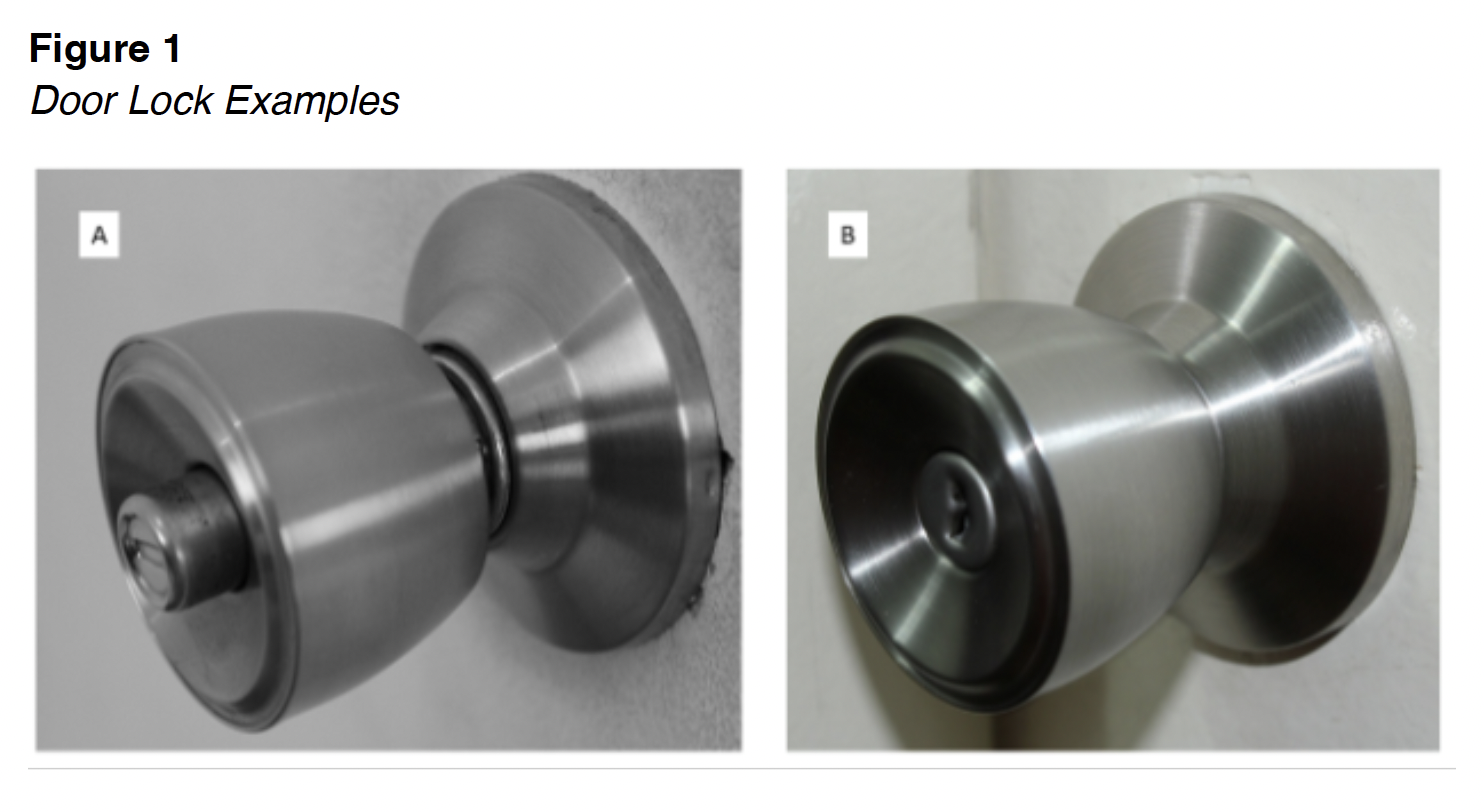
One type is known as the office entry lock (see Figure 1A for an example). A door equipped with an office entry lock can be locked from the inside of the room using a thumb-turn or push of a button. The office entry lock routinely has keyed access on the outside of the lock. The next type of lock is the storeroom lock. This type of lock requires that the door be unlocked or locked using a key outside of the classroom (such as the locks used at Robb Elementary School; Figure 1B for example). The storeroom lock is also known in the industry as the classroom function lock. The storeroom / classroom function lock is popular because of its ease of access from outside the room and a reduced likelihood of accidentally locking the door (ASSA ABLOY, n.d.). Lastly, schools can also use an electronic classroom lock. This type of lock can be locked remotely using a fob worn by teachers or other staff members. The lock can always be unlocked from the inside by turning the door lever. However, electronic classroom locks can be expensive to install compared to traditional door locks.
Door Devices
More recently, devices designed to secure classroom doors in the event of a shooting have been developed. The 123 Lock-Down Latch is one such device. Osier (2018) states that this device is attached to a classroom door via screws and works similarly to a hotel door bumper. The idea is that classroom doors can always be kept locked. The 123 Lock-Down Latch keeps the door slightly open so students and teachers can enter and exit the classroom freely. However, if there is a shooter at the school, the 123 Lock-Down Latch can be quickly and easily manipulated to allow the already locked door to close.
TeacherLock® is another device that is designed to secure classrooms during a shooting (TeacherLock: Protecting students one door at a time, 2018). This device is made from aircraft aluminum and stainless steel. It is mounted beneath the door handle to the classroom door via a set of screws. There is a unique cylindrical-shaped key that is made to work with this device. In the case of an emergency, a person will insert the key into the device, which will create a deadbolt-type lock. This will prevent anyone from entering the room. When people need to exit the classroom, there is a plate that is pushed forward in order to disengage the lock. This device is ADA compliant and also allows first responders to open the door from the outside.
The JustinKase Universal In-Swings and JustinKase Out-Swing Door Arm are two other devices that were developed to prevent school shooters from entering a classroom (Justin Kase: When seconds count…, n.d.). The first device slides under the door and is then extended to fit securely around the frame of the door. The second device requires a holder that is attached to the door. The device is then slid into the holder and hooks over the door frame to keep the door from being opened.
Problems with door devices include being costly, the likely violation of fire codes, and making it difficult for first responders to bypass the device to gain access to the classroom (Dorn, 2018). Therefore, researchers have suggested that the use of a lock that does not require a key is best to prevent a shooter from entering a classroom, such as the office entry lock activated by a push button. This type of lock is recommended because it could be easier to activate under life-threatening stress (Martaindale et al., 2017). Unless the person that will be engaging the lock (e.g., teacher) is properly trained in operating the lock, which includes practicing using the lock for numerous hours and operating it under stressful conditions, it is likely that the person will struggle engaging a more complex lock. This is because fine motor skills and near vision are impaired in highly stressful situations like school shootings (Grossman & Christensen, 2007; Ripley, 2008). In instances where a key is needed, or when more steps are involved in order to lock the door, both the response time to accomplish this task and the difficulty of the task will probably increase (Blair & Martaindale, 2017; Blair et al., 2011; Luce, 1983; Martaindale et al., 2017). Despite these suggestions, researchers have not directly examined which type of door lock should be used to secure a classroom door.
The Current Study
The literature suggests that lockdown procedures hinge on successfully locking the classroom door quickly and accurately. Furthermore, stress can negatively impact the fine motor skills needed to actuate locking mechanisms. For these reasons, our research question is simple: Does the style of door lock impact a user’s ability to quickly and accurately secure a classroom door in a stressful lockdown situation? To answer this question, the current study will test the following hypotheses:
H1: Participants will make more errors attempting to secure a door with a keyed lock than a door with a push button.
H2: Participants will take longer to secure a door with a keyed lock than a door with a push button lock.
Methodology
Design
The randomized controlled trial utilized an independent groups design with random assignment to two conditions. The two conditions included: (1) a door lock that required a key to lock the door from the outside (i.e., storeroom / classroom function lock), and (2) a door lock that required a button to be compressed to lock the door from the inside (i.e., office entry lock). Because the design incorporated random participant assignment to conditions, the participants were blind to which condition of the experiment they were assigned.
Procedure
All procedures used in the study were reviewed and approved by an Institutional Review Board. Following the signing of the consent form, participants were brought to the lab to complete the study. The lab was designed to mimic local elementary school classrooms. Members of the research team visited local elementary schools to determine where to place the teacher’s desk in relation to the door. On average, the teacher’s desk was 35 feet from the classroom door; therefore, the participants were placed at a desk 35 feet from the lab door. Participants were told, if they heard sounds of gunfire, to protect all their students by rushing to the door and secure it by shutting the door and activating the lock. Participants assigned to the lock with a key were given a lanyard with a single key on it. Participants assigned to the lock with a push button were not given a lanyard. Participants were shown the door and how to lock it prior to the study beginning.
Participants were brought back to the desk to wait for the study to start. Unknown to the participants, a researcher was stationed outside of the lab with a blank gun. The blank gun simulates the sound of real gunfire. Without the participant knowing, the researcher would randomly shoot two shots with the blank gun signifying the start of the scenario. Participants would rush to the door, lock it, and shut the door. The researcher in the hallway would fire a third shot while the participant was trying to secure the door. Once the door was secured (either by shutting the door or by the participant walking away from the door as if successful) the researcher in the lab would inform everyone that the scenario was over, check if the door was successfully locked, debrief the participant, and then dismiss the participant.
Sample
Participants were recruited from criminal justice classes at a large southwestern university. The target sample was 50 participants per condition for a total sample of 100. This would give an approximate power of 0.80 to detect effects of a moderate size within the t-distribution (d = 0.50; Cohen, 1988, p. 30).
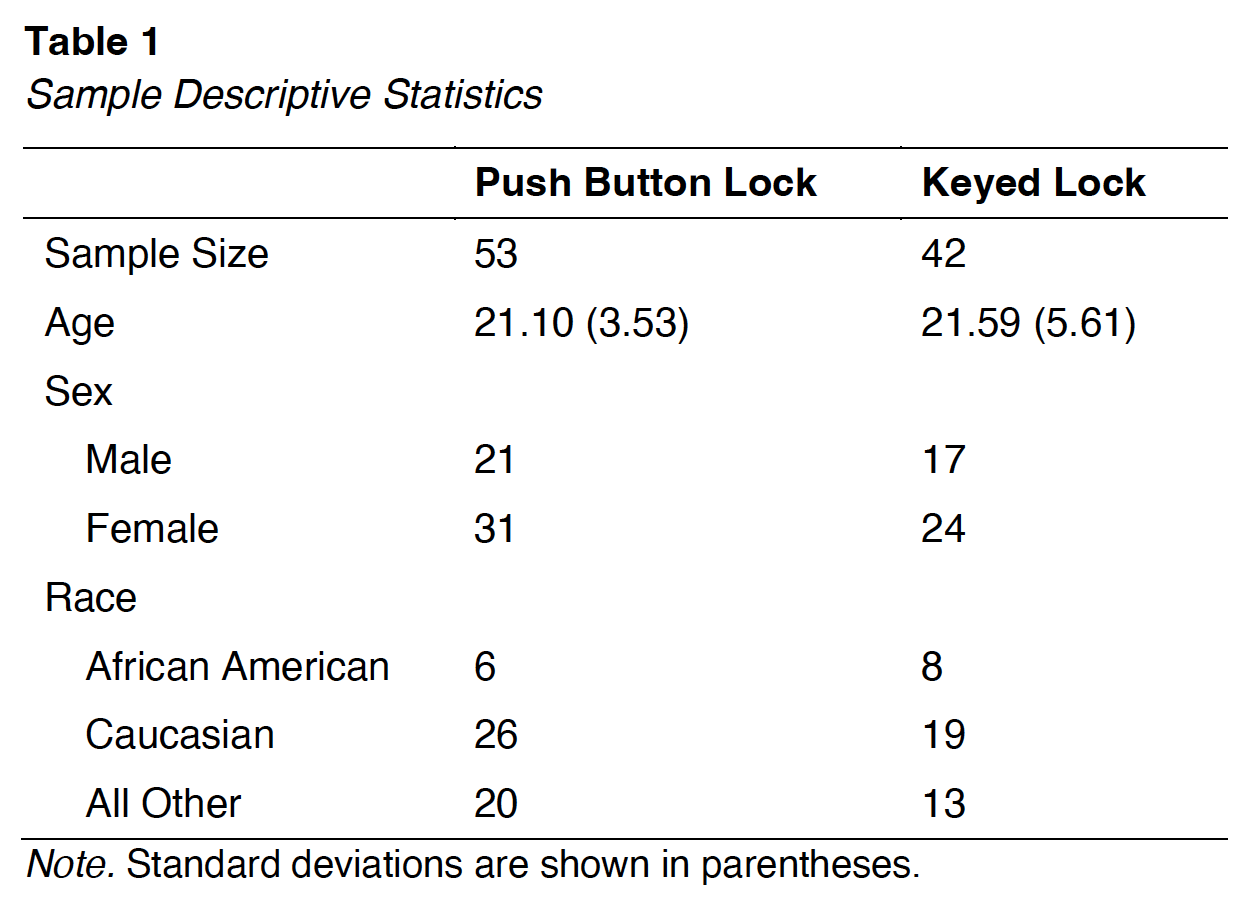
A total of 95 people completed the experiment (push button lock: n = 53; keyed lock n: = 42). For the push button condition, one participant did not provide his/her sex, age, or race. For the key condition, one participant did not provide his/her age or sex and two participants did not provide their race. Participants were of equal age in both conditions (t(91) = .48, p = .63, Cohen’s d = .11). There was no observed difference between conditions in terms of participant sex (χ2(1) = 0.00, p = 1, Cramer’s V = 0.00). There was also no observed difference between conditions in terms of participant race (χ2(2) = 1.32, p = 0.52, Cramer’s V = 0.12). This sample, while slightly smaller than 100, results in a power of 0.79 to detect effects of a moderate size within the t-distribution (Cohen, 1988, p. 30).
(Click table to enlarge)
Primary Variables
GoPro cameras were placed inside the lab and on the lab door to record each participant’s performance. These videos were then coded to capture the primary variables. A member of the research team coded 100% of the videos and a second member coded 25% to assess interrater reliability. Intraclass correlation coefficient (ICC) scores are provided for both primary variables.
Error
A participant made an error if he or she was unable to secure the door. In the key lock condition, an error was made if the participant 1) did not place the key inside the keyhole and lock the door, 2) left the key in the doorknob after shutting the door (meaning the key was in the hallway), or 3) successfully locked and shut the door but remained in the hallway (meaning the participant and the key were both in the hallway with the shooter). In the push button condition, an error was made if 1) the participant closed the door but failed to push the button to lock the door or 2) did not close the door completely. Furthermore, a member of the research team verified if the door was locked by attempting to open the door. The error variable was a dichotomous variable coded as 1 if the participant failed to secure the door and 0 if the participant was successful at securing the door. A high degree of interrater reliability was found for this variable (ICC = 1.00).
Speed
The speed variable is a continuous measure of how long it took each participant to successfully secure the door. This was measured as the time from the first gunshot until the door was both locked and closed. If a participant failed to secure the door, he/she is excluded from this variable. The GoPro cameras record at 30 frames per second (fps) (0.03 s of data specificity; i.e., a new frame is visible every 0.03 s). A high degree of interrater reliability was found for this variable (ICC = 1.00).
Results
Errors by Lock Type
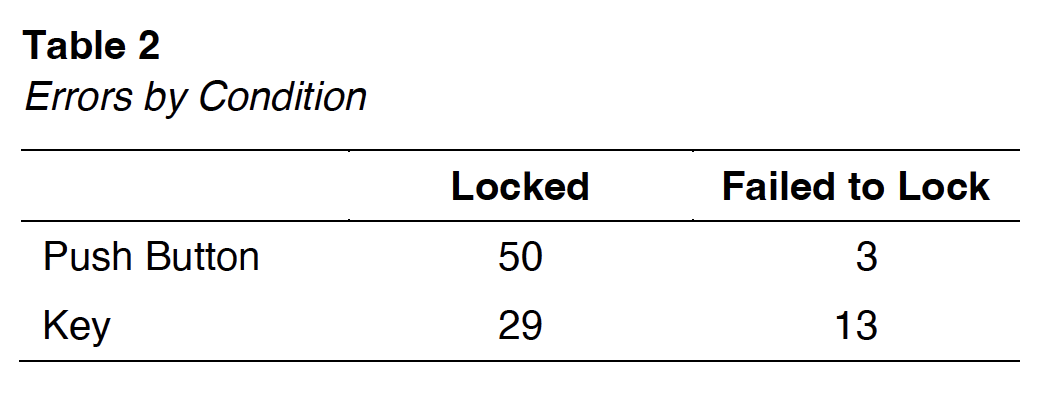
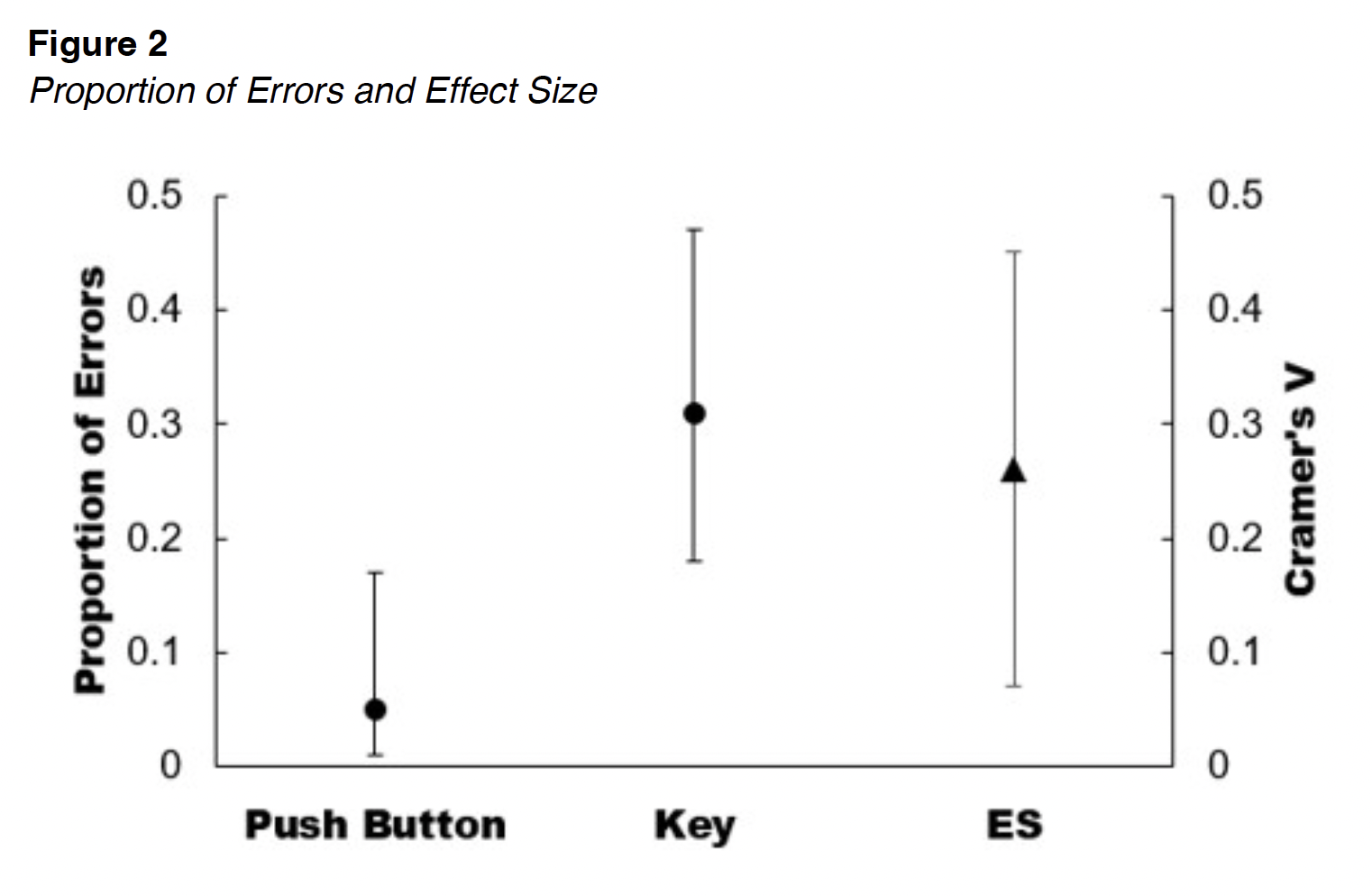
Three of the 53 participants (5%) in the push button condition failed to lock the door (95% CI 0.01, 0.17; see Table 2). Thirteen of the 42 participants (31%) in the key condition failed to lock the door (95% CI 0.18, 0.47).
(Click table to enlarge)
A test of the proportions of errors comparing the push button and key lock was significant and reflective of a moderate effect (χ2(1) = 6.11, p < .05, Cramer’s V = 0.26; 95% CI: 0.07, 0.45). The resulting proportions and confidence intervals are presented in Figure 1.
While the test statistic is a Chi-square, a test of proportions is not sensitive to small cell sizes. Regardless, as these are count data, a Fisher’s Exact Test was performed and was also significant and reflective of a moderate effect (Fisher’s Exact, p = 0.002, Odds Ratio = 7.31; Cramer’s V = 0.34; 95% CI 0.13, 0.54). Hypothesis 1 (participants will make more errors attempting to secure a door with a keyed lock than a door with a push button) was supported by both tests.
(Click table to enlarge)
Speed
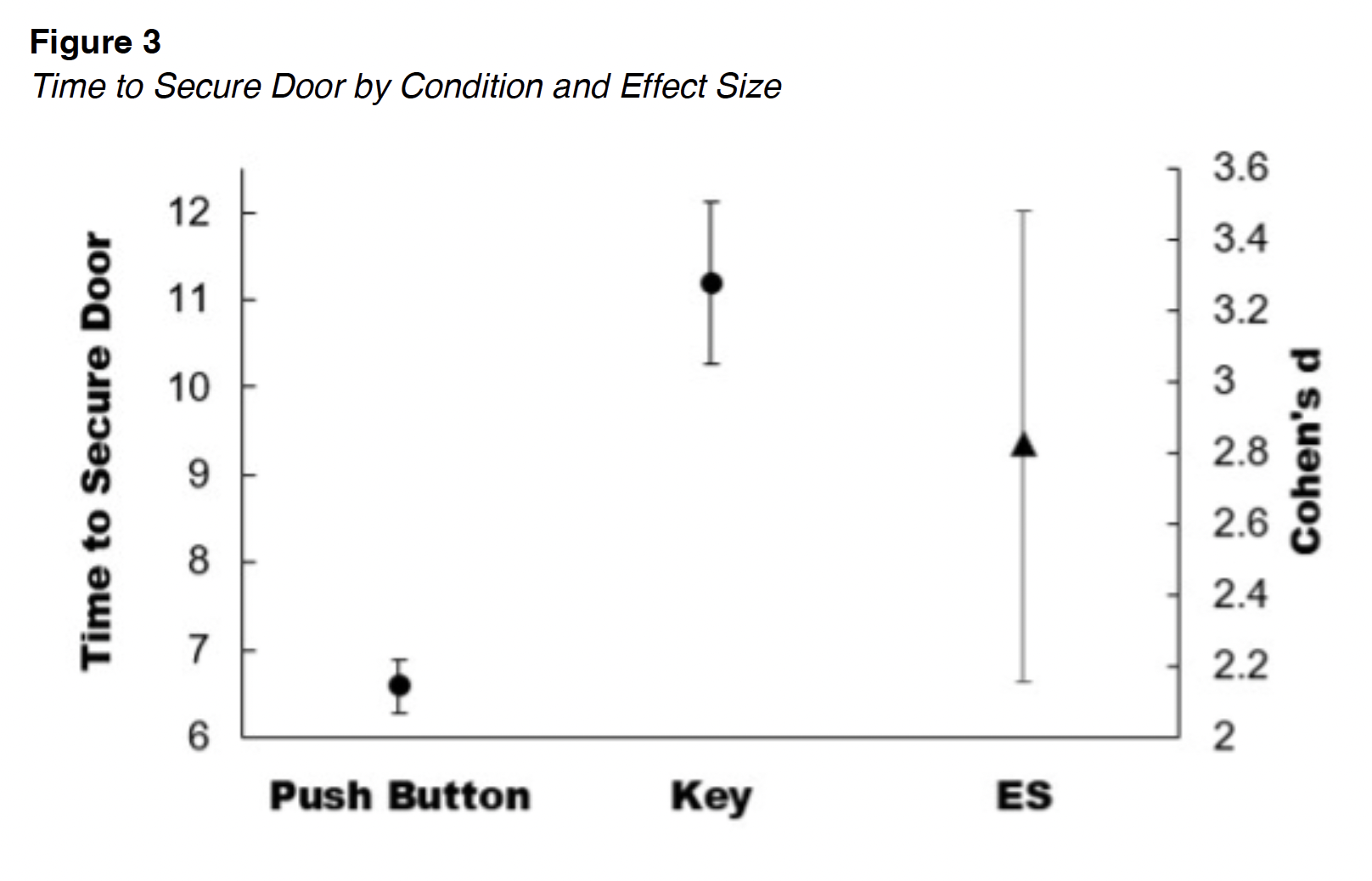
The 16 participants who failed to secure the door were excluded from the following analysis as they did not have a completion time. A Shapiro-Wilk normality test indicated that the participant speed data violated the normality assumption for both the push button condition (W = 0.92, p < .05) and the key condition (W = .78, p < .001). Boxplots were created and five outliers were found in the data, four in the key condition and one in the push button condition. The five participants successfully closed the door, but each took a long time to get the door secured for a variety of reasons. For example, the one push button outlier slowly walked the 35 feet to the door. The key condition outliers either walked to the door or had a hard time getting the key in the keyhole. These points were removed, and another normality test was conducted. These tests were not significant (push button: W = 0.98, p = 0.54; key: W = 0.94, p = 0.15), suggesting that the normality assumption was not violated when the outliers were removed. Participants in the push button condition took an average of 6.59 seconds to secure the door (95% CI: 6.29, 6.90; SD = 1.06), while participants in the key condition took an average of 11.18 seconds (95% CI: 10.26, 12.11; SD = 2.33). A t-test was then conducted to examine the differences between means with the outliers removed (see Figure 2). This test was significant and suggested a large effect size (t(31.99) = 9.66, p < .001, Cohen’s d = 2.83 [95% CI: 2.16, 3.48]).
(Click table to enlarge)
While we removed the outliers to correct for normality, some might prefer to deal with non-normality using a non-parametric test rather than removing the outlier data. A Mann-Whitney U-test is one appropriate non-parametric test. This test was significant (U = 192, p < .001) and suggested a large effect size (Cohen’s d = 2.17, 95% CI: 1.59, 2.75). Hypothesis 2 (participants will take longer to secure a door with a keyed lock than a door with a push button lock) was supported by both the parametric test with outliers removed and the non-parametric test with the outliers in place.
Discussion
This study found that the type of door lock used can save precious seconds that it takes to successfully secure a door should there be a threat in a school. In fact, participants assigned to the push button lock made significantly fewer errors than participants assigned to the key lock. Furthermore, a door with a simple push button style lock was able to be secured in about half the time it took for a door that required participants to insert a key to activate the lock.
These findings intuitively make sense. The key lock requires the participant to remove the lanyard from where they kept it (i.e., from around their neck or out of their pocket), step into the hallway to access the key slot, place the key in the key slot, turn the key to activate the lock, remove the key, and then return to the classroom while shutting the door, wßhereas the push button simply requires the participant to shut the door and push the button on the lock to secure it. There are many more steps involved in securing a door with a key lock and more ways to fail to secure the lock.
Doors with key locks that can only be used from the hallway are historically common in classrooms (ASSA ABLOY, n.d.). While Whalin (2015) referred to this as a storeroom lock, this locking function is also known in the industry as a classroom function lock. The reason for using this type of lock involves ease of access from the hallway and a reduction in the number of accidental lockings (ASSA ABLOY, n.d.). As shown by these results, however, the downside is that such locks increase the error rate and time for securing a classroom. Another reason these locks are so commonly used in schools is because this type of lock prevents students from locking themselves in classrooms. This can be seen as a positive or negative depending on the situation. Such a lock can prevent a student who is acting out from denying access to their location or the location of other students. Although, many of the office-entry locks also have keyed access from the outside and mitigate these concerns. At the same time, the classroom function lock prevents students from being able to lock the door in the event of a school attack. If there is no teacher around or if the teacher has been hurt, it would be up to the students to secure the classroom. This is made impossible by the classroom function lock. In this case, the only option students would have is to try and barricade the classroom door with furniture, whereas an office-entry lock would allow students to successfully lock the door without needing a key.
Some schools have moved towards having the classroom function locks perpetually in the locked position and only allowing doors to be open during passing periods. This prevents anyone from the hall entering the classroom while class is in session. Though a more secure method of operation, there are still instances where security becomes an issue. The first would be attacks that occur during passing periods when doors are open, and students are generally in the hallways. Another breach to this increased safety involves classrooms with substitute teachers. Substitute teachers are generally not given a key to the classroom; instead, the door is usually unlocked by the custodial staff in the morning and relocked after school. This means that classrooms with substitute teachers have no way of securing their rooms in an emergency situation if the doors utilize classroom function locks. Lastly, the February 14, 2018, attack at Marjory Stoneman Douglas High School highlighted the issue of students evacuating their classroom due to a fire alarm and then not being able to get back into their classrooms once the gunfire started.
School is supposed to be a safe place where students are free to learn and develop. School administrators want to protect students, staff, and visitors to their campus. However, there is wide-spread community outcry following a school shooting, especially if it is an active shooter event. Many times, school administrators immediately announce proposed security changes to their facilities in hope of not only protecting their students and staff, but also assuring the community that the school district is taking security seriously. Many of the proposed security measures are prohibitively expensive (e.g., gunshot detection, panic buttons, metal detectors) that require large bond measures to pass or are never implemented. The efficacy of the various security measures generally isn’t known either. We know, based on the official active shooter data, that no shooter has ever breached a locked door by going through the door. This means that attackers have been stopped from gaining access to potential victims because of lockdown procedures where the doors were successfully locked. This experiment showed that something as simple as installing doorknobs that can be locked by the push of a button can be successfully locked with significantly fewer errors and save several seconds over a lock that can only be locked with a key.
It may seem like locking a door, regardless of stress, is something that everyone should be able to do without much practice. These findings, however, suggest otherwise. This is made clear by the fact that there were errors made by participants whose only task was to push a button to lock a door. Schools and administrators must take this into consideration when deciding what measures to take regarding classroom door lock functionality. The commonly used keyed lock (i.e., classroom function lock/storeroom lock) may work better for day-to-day life in schools; however, this can come at the cost of easy security. The simpler push button lock seems to be more effectively used in high stress situations, like an active shooter event. Students having the ability to lock a classroom could provide a more quickly secured environment during a lockdown, though it could also potentially hinder a teacher from accessing his or her classroom. However, as previously noted, many of the office-entry locks also have keyed access from the outside to mitigate this concern. That being said, based on the finding and literature, training seems to be an important part of increasing speed and reducing errors regardless of the type of lock. While research has shown that mastering a door lock during a lockdown drill can be achieved with practice, there is still room for improvement (Schildkraut & Nickerson, 2020). This is especially true when considering the potential impossibility of securely locking a room as a substitute teacher or student.
It is not our position that the other security measures cannot be effective at protecting students and staff. Rather, we believe school administrators should have data to guide their decision-making process. School security measures should also be tested through randomized controlled trials to ensure their effectiveness. School administrators, and the community, need to know that the security measures they have in place are empirically shown to be effective at improving the safety of students and staff members. There is much work to be done examining the various security measures.
Limitations
As with all research, this study is not without limitations. For the sake of experimental control, we made the scenario simplistic and only focused on two types of door locks. The participant was informed that he or she would have to lock a door after they heard gunfire. In a real situation, the teacher would be taken completely by surprise. There is also no way to simulate the true stress felt by a teacher in a real-life scenario. It is possible that elevated levels of stress would increase the number of errors and the amount of time it takes to properly secure a classroom door. Additionally, there were no students in the scenario. The participant simply had to get to the door quickly, activate the lock, and shut the door. They had a single key on a lanyard where teachers may have many keys to contend with. There were no panicked students to run past, no students or desks between the participant and the door; rather, this was a best-case scenario for the participants and mimicked a classroom where the teacher would have unfettered access to the door.
Future Research
Further research should examine other devices that can be used to secure a door. There are several different types of door locks, wedges, and barricade items marketed for the sole purpose of securing school doors. Additional experiments should examine the efficacy of these items so school administrators can make informed decisions regarding the devices they want implemented in their respective school buildings. Furthermore, this study could be replicated with additional measures. The scenarios could adjust where the teacher’s desk is placed in the room relative to the door, where the students’ desks are placed in the room, and how the teachers are notified to perform the lockdown procedures. Future endeavors should utilize teachers and school administrators as study participants as they do undergo more lockdown drills and practice, as well as use their keys to access classroom doors, more often than the study participants here. Lastly, future research should control for participant stress. This can be accomplished either by self-report measures (e.g., Spielberger State-Trait Anxiety Inventory) or through physiological measures such as heart rate variability or salivary measures of acute stress (e.g., α-amylase or secretory immunoglobulin-a). These control measures would help researchers understand the impact of stress on performance during lockdown drills.
NOTES
- Schildkraut (2021) contends approximately 100 of the 402 mass shootings between 1966 and 2020 occurred in schools (25%). Data sources using other definitions indicate approximately 15% of attacks may occur at schools (ALERRT, 2022b).
DISCLOSURE STATEMENT
No potential conflicts of interest were reported by the authors.
REFERENCES
Addington, L. A. (2009). Cops and cameras: Public school security as a policy response to Columbine. American Behavioral Scientist, 52(10), 1426-1446. https://doi.org/10.1177/0002764209332556
ALERRT. (2022a). Robb Elementary School attack response assessment and recommendations. Texas State University. http://www.alerrt.org/r/31
ALERRT. (2022b). ALERRT active attack data. https://activeattackdata.org/index.html
ASSA ABLOY. (n.d.). Choosing the right classroom locks. https://www.corbinrusswin.com/en/commercial-door-locks-solutions/classroom-door-locks
Blair, J. P., & Martaindale, M. H. (2017). Throwing a chair could save officers’ lives during room entries. International Journal of Police Science & Management, 19(2), 110-119. https://doi.org/10.1177/1461355717711452
Blair, J., Pollock, J., Montague, D., Nichols, T., Curnutt, J., & Burns, D. (2011). Reasonableness and reaction time. Police Quarterly, 14(4), 323-343. https://doi.org/10.1177/1098611111423737
Bläsing, B. E. (2015). Segmentation of dance movement: Effects of expertise, visual familiarity, motor experience and music. Frontiers in Psychology, 5, 311-353. https://doi.org/10.3389/fpsyg.2014.01500
Broward County League of Cities. (2018). The Broward County League of Cities’ school and community public safety task force: Initial report and recommendations. https://browardleague.org/wp-content/uploads/2019/08/BLOC_PUBLICSAFETY_TASKFORCE_FINAL_8_13_19_Report_Recommendations.pdf
Burns, R. G., & Crawford, C. (1999). School shootings, the media, and public ingredients for a moral panic. Crime, Law and Social Change, 32(2), 147-168. https://doi.org/10.1023/A:1008338323953
Campus Safety Magazine. (2009). Columbine 10-year anniversary survey: Campuses improve security, but require more funding.https://www.campussafetymagazine.com/news/columbine-10-year-survey-campuses-improve-security-but-require-more-funding/
Cohen, J. (1988). Statistical power analysis for the behavioral sciences (2nd ed.). Lawrence Erlbaum.
Department of Public Safety. (2022, June 21). Texas DPS Director Steve McCraw Senate Special Committee to Protect All Texans testimony. https://abc13.com/uvalde-hearings-mass-shooting-texas-department-of-public-safety-col-steve-mccraw/11984334/
Dickson, M. J., & Vargo, K. K. (2017). Training kindergarten students lockdown drill procedures using behavioral skills training. Journal of Applied Behavior Analysis, 50(2), 407-412. https://doi.org/10.1002/jaba.369
Di Nota, P. M., & Huhta, J.-M. (2019). Complex motor learning and police training: Applied, cognitive, and clinical perspective. Frontiers in Psychology, 10, 1-20. https://doi.org/10.3389/fpsyg.2019.01797
Dorn, C. (2018, February 22). Door locking devices and school shootings: No simple answers. https://safehavensinternational.org/door-locking-devices-and-school-shootings-no-simple-answers/
Eysenck, M. W., Derakshan, N., Santos, R., & Calvo, M. G. (2007). Anxiety and cognitive performance: Attentional control theory. Emotion, 7(2), 336-353. https://doi.org/10.1037/1528-3542.7.2.336
Fox, J. A., & DeLateur, M. J. (2014). Mass shootings in America: Moving beyond Newtown. Homicide Studies, 18(1), 125-145. https://doi.org/10.1177/1088767913510297
Grossman, D., & Christensen, L. W. (2007). On combat: The psychology and physiology of deadly conflict in war and peace. Human Factor Research Group Incorporated.
Jonson, C. L., Moon, M. M., & Hendry, J. A. (2020). One size does not fit all: Traditional lockdown versus multioption responses to school shootings. Journal of School Violence, 19(2), 154-166. https://doi.org/10.1080/15388220.2018.1553719
Justin Kase: When seconds count… (n.d.). https://www.dominatesafety.com/
Keyes, J. M., & Deffner, R. (2015). The Standard Response Protocol K12: Operational guidance for schools, districts, departments and agencies. I Love U Guys Foundation.
Khimm, S., Schuppe, J., & Hixenbaugh, M. (2022, July 12). Uvalde school’s classrooms lacked a basic security feature – and it’s missing across America. NBC News. https://www.nbcnews.com/news/us-news/uvalde-classrooms-lacked-security-door-locks-rcna37358
Kirkland, A. (2018, July 09). Simple locks can be the most effective solution for active shooter prevention. https://www.campussafetymagazine.com/university/locks-active-shooter-prevention/
Luce, R. D. (1983). Response times: Their role in inferring elementary mental organization. New York, NY: Oxford University Press.
Madfis, E. (2014). The risk of school rampage: Assessing and preventing threats of school violence. Palgrave Macmillan.
Madfis, E. (2016). “It’s better to overreact”: School officials’ fear and perceived risk of rampage attacks and the criminalization of American public schools. Critical Criminology, 24(1), 39-55. https://doi.org/10.1007/s10612-015-9297-0
Martaindale, M. H., Sandel, W. L., & Blair, J. P. (2017). Active-shooter events in the workplace: Findings and policy implications. Journal of Business Continuity & Emergency Planning, 11(1), 6-20.
Muschert, G. W., & Peguero, A. (2010). The Columbine effect and school anti-violence policy. In M. Peyrot & S. Lee Burns (Eds)., Research in Social Problems and Public Policy, Vol. 17 (pp. 117-148). http://dx.doi.org/10.1108/S0196-1152(2010)0000017007
Musu-Gillette, L., Zhang, A., Wang, K., Zhang, J., & Oudekerk, B. A. (2019). Indicators of school crime and safety: 2018. National Center for Education Statistics. https://nces.ed.gov/pubs2019/2019047.pdf
National Association of State Fire Marshals. (2018, September 26). Classroom door security & locking hardware. https://www.firemarshals.org/resources/Documents/Members%20Only/Documents/NASFM%20Classroom%20Door%20Security%20Update%209-2018%20FINAL.pdf
Newman, K. S., Fox, C., Roth, W., Mehta, J., & Harding, D. (2004). Rampage: The social roots of school shootings. Basic Books.
Osier, V. (2018, February 26). In an era of school shootings, this door latch invented by a former Peninsula campus carpenter can keep kids safe. https://www.dailybreeze.com/2018/02/26/in-an-era-of-school-shootings-this-door-latch-invented-by-a-former-peninsula-campus-carpenter-can-keep-kids-safe/
Oudejans, R. R., & Pijpers, J. R. (2009). Training with anxiety has a positive effect on expert perceptual-motor performance under pressure. The Quarterly Journal of Experimental Psychology, 62(8), 1631-1647. https://doi.org/10.1080/17470210802557702
Ripley, A. (2008). The unthinkable: Who survives when disaster strikes-and why. Three Rivers Press.
Rocque, M. (2012). Exploring school rampage shootings: Research, theory, and policy. The Social Science Journal, 49(3), 304-313. https://doi.org/10.1016/j.soscij.2011.11.001
Sakai, K., Kitaguchi, K., & Hikosaka, O. (2003). Chunking during human visuomotor science learning. Experimental Brain Research, 152(2), 229-242. https://doi.org/10.1007/s00221-003-1548-8
Sandel, W. L., & Martaindale, M. H. (2022). What are we talking about? Definitional confusion within active and mass shooting research. Journal of Mass Violence Research 1(2), 4-16. https://doi.org/10.53076/JMVR47829
Sandy Hook Advisory Commission. (2015). Final report of the Sandy Hook Advisory Commission. https://portal.ct.gov/-/media/Malloy-Archive/Sandy-Hook-Advisory-Commission/SHAC_Final_Report_3-6-2015.pdf
Schildkraut, J. (2021). Can mass shootings be stopped? To address the problem, we must better understand the phenomenon. Rockefeller Institute of Government. https://rockinst.org/wp-content/uploads/2021/07/Public-Mass-Shootings-Brief.pdf
Schildkraut, J., Greene-Colozzi, E., Nickerson, A. B., & Florczykowski, A. (2023). Can school lockdowns save lives? An assessment of drills and use in real-world events. Journal of School Violence, 22(2), 167-182. https://doi.org/10.1080/15388220.2022.2162533
Schildkraut, J., Grogan, K., & Nabors, A. (2020). Should schools be conducting lockdown drills? WestEd. https://www.wested.org/wp-content/uploads/2020/06/WestEd_JPRC_School_Lockdown_Brief.pdf
Schildkraut, J., & Muschert, G. W. (2019). Columbine, 20 years later and beyond: Lessons from tragedy. Praeger.
Schildkraut, J., & Nickerson, A. B. (2020). Ready to respond: Effects of lockdown drills and training on school emergency preparedness. Victims & Offenders, 15(5), 619-638. https://doi.org/10.1080/15564886.2020.1749199
TeacherLock: Protecting students one door at a time. (2018). https://teacherlock.com/
Trump, K. S. (2011). Proactive school security and emergency preparedness planning. Corwin Press.
Whalin, M. (2015, May). Understanding lock functions. Doors + Hardware. https://lockdontblock.org/wp-content/uploads/2017/07/Understanding-Lock-Functions-DH-May-2015.pdf
Zacks, J. M., & Sargent, J. Q. (2010). Chapter 7 – Event perception: A theory and its application to clinical neuroscience. Psychology of Learning and Motivation, 53, 253-299. https://doi.org/10.1016/S0079-7421(10)53007-X
Zhe, E. J., & Nickerson, A. B. (2007). Effects of an intruder crisis drill on children’s knowledge, anxiety, and perceptions of school safety. School Psychology Review, 36(3), 501-508. https://doi.org/10.1080/02796015.2007.12087936
About the Authors
Hunter Martaindale, PhD is the Director of Research at the Advanced Law Enforcement Rapid Response Training (ALERRT) Center at Texas State University. Dr. Martaindale is responsible for the development and implementation of ALERRT’s research agenda. His research interests include active shooter events, law enforcement decision making, and the impact of stress on law enforcement performance.
William L. Sandel, PhD is an Assistant Professor of Criminology and Criminal Justice at Missouri State University. He is also the director of the graduate crime prevention certificate at MSU. Dr. Sandel started his career as the Research Specialist at the ALERRT Center. His research interests include police and citizen perceptions of use-of-force, police tactics, active shooter events, and hostage negotiations.
Aaron Duron is a doctoral student and doctoral teaching assistant in the School of Criminal Justice at Texas State University. He is currently working on his dissertation involving perceptions of procedural justice and policing. His research interests are policing, mass shootings, and criminal psychology.
CITATION (APA 7th Edition)
Martaindale, M. H., Sandel, W. L., & Duron, A. (2023). Successfully securing a classroom door in a lockdown: Evaluating two types of door locks. Journal of Mass Violence Research. https://doi.org/10.53076/JMVR74565