Introduction to the Inaugural Issue of the Journal of Mass Violence Research: A Note from the Editors

SHARE THIS ARTICLE

Introduction to the Inaugural Issue of the Journal of Mass Violence Research: A Note from the Editors

Sarah E. Daly Email the Corresponding Author and Jaclyn Schildkraut

Department of Criminal Justice, State University of New York at Oswego

https://doi.org/10.53076/JMVR95494  |  Full Citation Volume: 1, Issue: 2, Page(s): 1-3

Since the inaugural issue of the Journal of Mass Violence Research in March 2022, the United States has seen continued acts of mass violence in Philadelphia, Buffalo, Uvalde, Highland Park, and other communities. This year (2022) also represents ten-year marks of mass shootings in Aurora, Oak Creek, and Sandy Hook. Remembering these events and all who were affected by them, while also reflecting on each new tragedy as it unfolds, we are heartbroken and frustrated but also reminded of the need for critical research aimed to inform policy and ultimately, save lives.

We created the Journal of Mass Violence Research with a goal of “sharing rigorous, multidisciplinary, peer-reviewed studies on a variety of topics in relation to mass violence” (see About JMVR). While the journal aims to publish articles on a variety of topics such as terrorism, genocide, and serial murder, we are both scholars who have worked in the mass and active shootings research space for years. As such, we recognize and value the wide range of methodologies and approaches to studying such a complex, difficult topic. Even more, we have long agreed that the ongoing definitional issues related to mass shootings (and similarly, active shootings, rampage violence, school shootings, etc.) have important implications for research, reporting, and public policy.

When we met to discuss how we might reflect on the ten years since Sandy Hook, Aurora, and Oak Creek, we considered ways in which we could bring together the leading researchers in the field—many of whom serve on our Editorial Board—and address some of the major definitional issues and points of contention. In addition to the articles presented in this special issue, we hosted a webinar to allow scholars to present their arguments and support for specific definitions or terminology in the hope of showcasing the nuance and benefits of each. The goal of the webinar and the special issue was not to make everyone agree, but rather to share and address the issues for the public and for practitioners. In this way, we can work together toward aligning research so that we might glean further insights across studies and disciplines while also informing practice. Additionally, we hope that the webinar might inform media terminology and practice in reporting to reduce confusion about mass and active shootings among the public. In sum, we hope that the articles within this special issue and the webinar can answer two questions: 1) What is a mass shooting? and 2) Even if we can decide, is this the best term to measure and study these types of events?

The special issue begins with William Sandel and Hunter Martaindale’s article, “What Are We Talking About? Definitional Confusion Within Active and Mass Shooting Research.” In this piece, the authors provide a rich, thorough review of current definitions, including active shooter and active attack, as well as clear guidance for those who seek to engage in mass and active violence research. They do not advocate for the use of a single definition, but instead issue a call for clear, specific definitions and representation in datasets, research, and reporting.

The second article recommends the continued use of the longstanding definition of mass shootings using a threshold of four or more deaths. In their article, “Keeping with Tradition: Preference for the Longstanding Definition of Mass Shooting,” authors James Alan Fox and Emma Fridel offer six compelling reasons for this traditional definition, highlighting theoretical and methodological applications and issues. Ultimately, they note the ways in which mass and active shootings are reported on and characterized has led to public fear and concern while only constituting a small proportion of gun homicides in the United States.

The final two articles suggest a focus not on a singular definition, but instead on unique categorization systems which highlight processes or outcomes. In the third article, “Mass Outcome or Mass Intent?: A Proposal for an Intent-Focused, No-Minimum Casualty Count Definition of Public Mass Shooting Incidents,” Emily Green-Colozzi and Jason Silva recommend that these types of attacks be classified as completed, attempted, failed, and foiled, regardless of the casualty count. Such a definition and strategy would highlight the intent behind the attack and address behavioral factors that may lead to public mass shootings.

In the final article, “Defining Rampage Violence across Completion Status: Toward a More Comprehensive Model,” Janelle Hawes and Eric Madfis suggest a shift from the term mass violence to rampage violence to include more incidents and encompass previous scholarship related to processes and outcomes. Like Green-Colozzi and Silva, they use various outcomes, but they also present multiple stages in the progression toward violence that often are reflected in perpetrators’ pre-attack behaviors. Their Rampage Violence Status Model (RVSM) encompasses various other definitions and provide additional context for each event.

In the webinar, the authors presented a brief overview of their article, sharing their arguments, and discussing with authors and other participants. It was recorded and shared on the JMVR website so that anyone with an interest in preventing, addressing, or reporting on mass violence can view and evaluate the options put forth in the webinar. In addition, we invite scholars and practitioners to submit responses for publication in the journal in the hope of continuing the conversation and informing research. As co-editors, we are considering additional ways to address this issue through conferences, interactive events, and more, and we look forward to similar opportunities about this and other issues related to mass violence.

There is clearly much to consider in this area of research, and as co-editors and scholars, we hope that the special issue and the webinar can contribute to the body of knowledge and continue to move toward practical, effective solutions and policies. In the ten years since Aurora, Oak Creek, and Sandy Hook, there have been countless researchers, organizers, survivors, and practitioners who have devoted their efforts to making spaces safer for everyone, and their work has not gone unnoticed or unappreciated. Yet, the past year has unfortunately taught us that there is still more work to be done, and JMVR renews its commitment to publishing high-quality, peer-reviewed research to explore these issues and seek new (and traditional) ways to study, measure, and apply this work. Despite the heartbreaking and devastating nature of this work, we are optimistic that research and collaboration can be transformative for the discipline, and we will continue to demand a better, safer future.

About the Authors

Sarah E. Daly was an Associate Professor and Director of a graduate program in criminology. She recently transitioned to the private sector, serving as a senior consultant for a private firm. She remains committed to her research and her role as the co-founder and co-editor of the Journal of Mass Violence Research, and she is currently affiliated with the Department of Criminal Justice at SUNY Oswego as a visiting scholar. Dr. Daly’s primary area of research is gender-based violence, particularly related to issues of involuntary celibacy. She has recent publications in the Journal of Qualitative Criminal Justice & Criminology and Sex Roles.

Jaclyn Schildkraut is an Associate Professor of Criminal Justice at the State University of New York (SUNY) at Oswego, interim executive director of the Regional Gun Violence Research Consortium at the Rockefeller Institute of Government, and the co-founder and co-editor of the Journal of Mass Violence Research. Her research interests include mass/school shootings, homicide trends, mediatization effects, moral panics, and crime theories. She is the co-author of Mass Shootings: Media, Myths, and Realities, Columbine, 20 Years Later and Beyond: Lessons from Tragedy, and, most recently, Lockdown Drills: Connecting Research and Best Practices for School Administrators, Teachers, and Parents. Dr. Schildkraut’s research has been published in journals such as Journal of School Violence, Homicide Studies, American Journal of Criminal Justice, Journal of Qualitative Criminal Justice & Criminology, Journal of Homeland Security and Emergency Management, and Crime, Law and Social Change.

CITATION (APA 7th Edition)
Daly, S. E., & Schildkraut, J. (2022). Introduction to the special issue of the Journal of Mass Violence Research: A note from the editors. Journal of Mass Violence Research, 1(2), 1-3. https://doi.org/10.53076/JMVR95494

Introduction to the Inaugural Issue of the Journal of Mass Violence Research: A Note from the Editors

SHARE THIS ARTICLE

Introduction to the Inaugural Issue of the Journal of Mass Violence Research: A Note from the Editors

Jaclyn Schildkraut Email the Corresponding Author1 and Sarah E. Daly2

1Department of Criminal Justice, State University of New York at Oswego
2Department of Criminology, Law, & Society, Saint Vincent College

https://doi.org/10.53076/JMVR75527  |  Full Citation
Volume: 1, Issue: 1, Page(s): 1-3

Various forms of mass violence plague the United States and countries around the world, and all require critical scholarship aimed at understanding their root causes and prevalence. Moreover, this type of research requires an understanding of the specific nuances of these issues to better inform policy and work towards prevention efforts. As researchers in this area, we, like others, have experienced challenges in getting our research published. Even more, while there are many researchers and practitioners working in this space, our efforts may lack cohesion due to the absence of a dedicated resource through which to publish our work. These obstacles highlighted the importance and demand for an outlet that can speak to and enhance the research and the conversation about mass violence in all forms.

Recognizing this need, the idea of the Journal of Mass Violence Research (JMVR) was born in October 2020 and the journal was officially launched the following month. From the earliest days, we envisioned JMVR as an outlet to showcase scholarship on these contemporary issues to not only address the need for such a journal but also to present our findings in a way that is more accessible to policymakers, the media, and the public alike. As we share on our website, the purpose of the journal is:

[T]o share rigorous, multidisciplinary, peer-reviewed studies related to different facets of mass violence in the U.S. and beyond. With a focus on public research and accessibility, the Journal of Mass Violence Research seeks to promote high-quality scholarship and authors, disseminate findings via articles, videos, and infographics, and generate academic and public interest in this important research area.

Informed by this goal, we set out to create a journal that showcases this research while adhering to best practices regarding violence research, encouraging authors to refrain from naming the perpetrators, and recognizing (and respecting) the trauma of such violence of victims and survivors of mass violence.

We also wanted to address the shortcomings and stressors of publishing and academia more broadly. As such, we created guiding principles for editors and the editorial board, authors, reviewers, and the journal to make the review and publication process a more positive experience. Since its inception, we have had the pleasure of working with enthusiastic scholars who share in our vision for the journal and recognize the need for such research and the myriad of considerations that it demands. The editorial board and other external reviewers have been dedicated to the promotion, support, and growth of the journal, and their thoughtful contributions along with thorough and prompt reviews of articles ultimately have enhanced the articles that we have published, ensuring that we remain committed to publishing high-quality multidisciplinary studies. We are grateful to those who have made the journal possible, and we look forward to the ways that we can enhance the reach and the impact of JMVR.

The creation, promotion, and publication of the journal is the culmination of hard work, commitment, and dedication, and these efforts make the inaugural issue even more exciting. We hope that readers will find articles of both interest and value. Addressing issues of serial murder, familicide, and nuanced aspects of mass homicide and shootings, the research notes and articles present unique and useful insights about these topics.

In the article “A Rose by Any Other Name: Problems in Defining and Conceptualising Serial Murder with a New Proposed Definition,” authors Wayne Petherick, Shuktika Bose, Amber McKinley, and Candice Skrapec describe definitional challenges that have long plagued the research on serial murder, including outlining the history of the term. The authors contend that the way in which definitions are crafted can have a considerable impact both for individuals who are investigating and research this form of mass violence, and that variability in required victim count is one of the most significant issues. Other elements that must be considered when defining serial murder include case linkage, cooling-off periods, motive, and propensity. After carefully laying out the respective challenges for each of these individual elements, the authors then propose a revised definition designed to overcome such limitations and help move the body of research on serial murder forward.

The second article of the issue, “Out of Sight, Out of Mind: An Analysis of Family Mass Murder Offenders in the US, 2006-2017” by authors Madelyn Diaz, Kayla Toohy, Ketty Fernandez, Lin Huff-Corzine, and Amy Reckdenwald seeks to expand our understanding of family mass murderers beyond the more sensationalized forms of mass violence. With specific focus paid to offender, victim, and incident characteristics, the authors shed important light on the context of family mass murder events in the U.S. The authors highlight how these incidents vary based on the differences in offenders’ relationships with their victims, which can be further impacted by disparities in their motivations. The findings of this study lead the authors to call for more robust research and policy examinations dedicated to better understanding the relationship between domestic violence and mass violence.

The issue’s third article, “Changing Media Framings of School Shootings: A Case Study of the Parkland School Shooting” by Jennifer LaRose, Jose Torres, and Michael Barton, explores the media coverage of the 2018 shooting at Marjory Stoneman Douglas High School in Parkland, Florida, and how it differed between local and national outlets. Grounded in the Social Coping model, this analysis of front-page news stories in three Florida-based and three national newspapers finds that the shooting was covered more at the local level, which mirrors coverage patterns related to previous school-based mass shootings like Virginia Tech. At the same time, the authors highlight the important ways in which the coverage of the Parkland shooting departed from the media attention dedicated to earlier shootings. Given that most individuals will not be directly impacted by mass shootings like Parkland and that the media then serve as their primary source of information about these events, understanding the impact of framing is all the more critical to contextualizing the public reactions that follow in the wake of these tragedies.

Our first research note, “An Exploration of Female Mass Shooters” by Jason Silva and Margaret Schmuhl, explores a critically overlooked subset of mass shooters – female perpetrators. Although a small segment of such perpetrators, it is critical to understand the characteristics of these individuals and their corresponding events, including motivating factors, to better understand how to inform not only response strategies to mass shootings, but how they may need to be tailored based on who is carrying out the act. In this note, the authors highlight how mass shootings perpetrated by females are most likely to occur at their workplace, are more likely to be motivated by problems in the workplace rather than relationship issues, and how female offenders are more likely to work in dyads than mass shooters more broadly (more commonly perpetrated by males).

Finally, we conclude the issue with a research note from Miranda Sanchez and Christopher Ferguson entitled “Exposure to Bullying, Childhood Trauma, and Violence in Video Games Among Perpetrators of Mass Homicides: A Brief Report,” which compares these different childhood experiences among firearm mass homicide offenders against matched samples. Contrary to the common discourse that often follows such events, the authors find that mass homicide perpetrators did not experience more bullying nor play more video games than members of the general public, though they did find a higher prevalence of reported child abuse among the mass homicide perpetrators. The authors further consider how this more nuanced understanding of the etiological factors of firearm-related mass homicides can be used to inform prevention efforts.

As the creators and editors, we are excited to present the inaugural issue of the Journal of Mass Violence Research. At the same time, we are continuing to accept article submissions while also creating additional opportunities to continue and expand on this work. Beyond this first issue, we remain committed to our original goal of become a leading research and platform to promote quality scholarship on mass violence research. By publishing high-quality, peer-reviewed articles and research notes that are open-access and linguistically and intellectually accessible, we hope that these publications reach a broader audience and can, therefore, shape the way that people consider and address issues of mass violence. We look forward to the chance to collaborate and engage with scholars, practitioners, and the public, and we are excited about the future of the Journal of Mass Violence Research.

About the Authors

Jaclyn Schildkraut is an Associate Professor of Criminal Justice at the State University of New York (SUNY) at Oswego and is the co-founder and co-editor of the Journal of Mass Violence Research. Her research interests include mass/school shootings, homicide trends, mediatization effects, moral panics, and crime theories.  She is the co-author of Mass Shootings: Media, Myths, and Realities and Columbine, 20 Years Later and Beyond: Lessons from Tragedy, and has published in journals such as Journal of School Violence, Homicide Studies, American Journal of Criminal Justice, Journal of Qualitative Criminal Justice & Criminology, Crime, Law and Social Change, and Journal of Homeland Security and Emergency Management.

Sarah E. Daly is an assistant professor and director of the graduate program for the Criminology, Law, and Society department at Saint Vincent College. She teaches courses on mass violence, race and gender, research methods, and policy analysis. Her primary area of research is gender-based violence, particularly related to issues related to involuntary celibates. She has a book manuscript in progress on incels as well as recent publications in the Journal of Qualitative Criminal Justice & Criminology and Sex Roles. She is also co-founder and an editor of the Journal of Mass Violence Research.

CITATION (APA 7th Edition)
Schildkraut, J., & Daly, S. E. (2022). Introduction to the inaugural issue of the Journal of Mass Violence Research: A note from the editors. Journal of Mass Violence Research, 1(1), 1-3. https://doi.org/10.53076/JMVR75527

Out of Sight, Out of Mind: An Analysis of Family Mass Murder Offenders in the US, 2006-2017

SHARE THIS ARTICLE

Out of Sight, Out of Mind: An Analysis of Family Mass Murder Offenders in the US, 2006-2017

Madelyn L. Diaz Email the Corresponding Author,1 Kayla Toohy,1 Ketty Fernandez,1 Lin Huff-Corzine,1 and Amy Reckdenwald1

1Department of Sociology, University of Central Florida

https://doi.org/10.53076/JMVR82831  |  Full Citation
Volume: 1, Issue: 1, Page(s): 25-43

Article History: Received June 1, 2021 | Accepted January 21, 2022 | Published Online February 21, 2022

ABSTRACT

In recent years, media attention has increasingly focused on sensationalized forms of mass murder across the United States, thereby diverting attention on the most frequent typology of mass murder events: family mass murders. The current study addresses limitations within this body of work and provides an analysis of demographic and case characteristics associated with distinct family mass murder offender types. The current study utilizes the USA Today database, Behind the Bloodshed, and public news articles to assess 163 family mass murder incidents that occurred from 2006 to 2017. Using this database, which defines mass murder as the killing of four or more victims excluding the offender, there were an average of 14 family mass murders annually, most often committed by a current or former intimate male partner using a firearm as the weapon of choice. Additional case characteristics were examined and revealed significant differences based on the gender of the offender as well as by victim-offender relationship type. Recommendations for future research include examining the impact of gun violence prevention responses in domestic violence cases and providing a comparative study of two and three victim counts to better inform law, policy, and the public about what is often hidden away as a private family matter.

KEYWORDS
family mass murder, family killings, offender/victim relationship, mass murder, familial homicides, familicides

Mass murder, defined as four or more victims killed excluding the offender, perpetrated by one or multiple offenders within a single event (Duwe, 2000, 2004, 2007; FBI, 2005; Fox & Levin, 1998, 2015), is an extremely rare form of violence, occupying less than 1% of all U.S. homicides (Fridel, 2021; Krouse & Richardson, 2015; Levin & Fox, 1996). Yet in recent years, public mass murder incidents have gained extensive attention within large-scale news reports and in scholarly literature (Croitoru et al., 2020; Duwe, 2007; Petee et al., 1997). Though coverage on public mass murder events is important, extensive coverage on select mass murders excludes discussions of the most common typology of mass killings.

A persistent finding in research suggests that over 50% of mass murder incidents lie within the familial unit (Bowers et al., 2010; Dietz, 1986; Duwe, 2000; 2004; 2007; Fox & Levin, 1998; Fridel, 2021; Levin & Fox, 1996; Petee et al., 1997; Taylor, 2018; Zeoli & Paruk, 2020). In one of the earliest attempts to create distinct typologies of mass murder incidents, Dietz (1986) introduced the term family annihilation within the psychiatric literature. These were cases where the entire nuclear family was killed by one or two other family members. The family annihilator, otherwise referred to here as family mass murderer, was identified as the male head of household who killed at least four family members within a short time and at one location (Fox & Levin, 1998; Levin & Fox, 1996; Ressler et al., 1988). Despite an increase in attention to public mass murder events, there is a surprising dearth of research examining the most common type of these events: family mass murders (FMM).

Research on FMM incidents generally appears as a byproduct within studies focusing on broader multiple-victim homicide trends (Bowers et al., 2010; Duwe, 2007; Fox & Levin, 1994; Karlsson et al., 2021; Liem & Reichelmann, 2014) and are limited to descriptive statistics (Fegadel & Heide, 2017; Liem & Reichelmann, 2014). Although the mass murder literature in general has grown in scope by beginning to examine differences among specific mass murder types (Duwe, 2016; Petee et al., 1997; Siegel et al., 2020), there remains a dearth of literature that examines possible heterogeneity among FMM incidents. As such, it is currently unknown if, and to what extent, offender, victim, and incident characteristics differ among FMM offender types.

To advance research on mass murder, the current study quantitatively analyzes FMM1 event characteristics. Specifically, we searched for differences among offender types by examining if family mass murder case characteristics are significantly different across gender and victim-offender relationship. To meet this aim, data from USA Today’s Behind the Bloodsheddataset were utilized to gather information on 163 cases of family mass killing incidents from 2006 to 2017. Each case was then matched with news articles through Nexis Uni and Google to obtain a more detailed overview of the offenders, victims, and event characteristics. The results from the present study add to familial and mass murder literature by providing a quantitative analysis of family mass murder types beyond descriptive approaches.

Literature Review

Past Research on Mass Murder 

Most research on mass murder has limited the methodological approach to descriptive case summaries with small sample sizes due to the rarity of these type of events. As such, mass murder offender typologies that have been identified by early scholars (see Fox & Levin, 1994; Holmes & Holmes, 1994; Levin & Fox, 1985; 1996; Petee et al., 1997) have seldom been empirically assessed in research, with the exception of a small number of recent studies (Fridel, 2021; Taylor, 2018). In one multivariate analysis comparing family, public, and felony mass murder events using the USA Today database, defined by incidents including 4 or more victims, Fridel (2021) found a number of significant differences across offender, victim, and incident characteristics. Fridel’s (2021) analyses suggest that incidents involving a history of domestic violence, romantic and familial difficulty, a greater number of child victims, occurring in the South, and the offender dying by suicide are more likely to be associated with a family mass murder than a felony mass murder. Additionally, Fridel’s (2021) findings suggest that family mass murder victims are more likely to be younger in age and of the same race as their victims (children or family members) when compared to both public and felony mass murders. The most significant differentiating factor between family, public, and felony mass murders were the type of victims involved.

In a separate study incorporating a multivariate analysis to examine mass murder incidents, Taylor (2018) examined possible differences in victim, offender, and incident characteristics based on an offender’s motivation to commit mass violence. Similar to Fridel’s (2021) results, Taylor (2018) found that offenders motivated by a relationship issue were more likely to kill a family member, die by suicide following the event, and be older in age than other mass murder offender types. Furthermore, her findings identified that relationship issues were present in over 40% of all mass murder cases and among these cases, a firearm was most often the lethal weapon of choice.

With research showing that gun availability substantially increases lethality in domestic violence situations (Campbell et al., 2003), scholars have begun to examine the potential link between domestic violence perpetration, firearm access, and mass murder. In an analysis of 89 offenders of mass shootings from 2014 to 2017, Zeoli and Paruk (2020) found about 30% of offenders had a suspected domestic violence history and 61% of these offenders, or 18.3% of the total, had come in contact with the criminal justice system for domestic violence. Among these individuals, only six offenders were eventually convicted of domestic violence-related charges. However, despite a conviction and qualifying for firearm restrictions, these offenders were still able to obtain a lethal weapon and execute mass killings.

In subsequent research examining 128 mass shootings from 2014 to 2019, Geller and colleagues (2021) found that about 68% of mass shootings were domestic violence related or the offender had a known history of domestic violence, and that these types of mass shootings resulted in a greater total of fatal and non-fatal victims (582 total victims) than non-domestic violence related incidents (352 total victims; see Geller et al., 2021). From these findings, some scholars have suggested that implementing stricter gun restriction policies against individuals with a domestic violence restraining order or a conviction of domestic violence could be one way to potentially lessen the opportunity of committing acts of mass violence (Geller et al., 2021; Taylor, 2018; Zeoli & Paruk, 2020). Others have similarly noted that individuals with personalities more likely to accept aggression behaviors as an appropriate solution to stress are more likely to also have a history of convictions for violent offenses, including intimate partner abuse (Peterson & Densley, 2019; Silver et al., 2018) and lethal forms of violence (Huff-Corzine & Corzine, 2020; Madfis, 2014).

Family Mass Murder

Literature on FMM is often included within more generalized research on mass murder as well as within more specific research analyses oriented on defining categories of multiple victim family homicides (e.g., Bowers, et al., 2010; Delisi & Scherer, 2006; Duwe, 2007; Karlsson et al., 2021; Liem & Koenraadt, 2008; Liem & Reichelmann, 2014; Liem et al., 2013). An important distinction between mass murder and the different types of multiple victim family homicides is that the former includes a broad definition of victims not limited to a specific type and includes cases with four or more victims. The latter employs categorical methods to analyze distinct types of multiple family homicides such as familicide (e.g., the killing of a spouse and one or more children), parricide (e.g., the killing of one’s parents), and siblicide (e.g., the killing of one’s siblings), and may include cases with one or more victims. Current mass murder literature, however, limits thorough discussions of possible heterogeneity among family mass murder instances as studies most often only examine how FMM cases are different from other types of mass murder (Dietz, 1986; Duwe, 2007; Fridel, 2021; Taylor, 2018). As such, studies examining multiple victim family homicides are useful to gain a more comprehensive understanding of specific offender, victim, and case characteristics. Notably, not all multiple victim family homicides fit the commonly accepted definition of mass murder events (4+ victims). Though recent work has suggested including multiple victim family homicide cases with 2+ or 3+ victims may offer additional insight to further understand acts of lethal violence in the family unit (Huff-Corzine & Corzine, 2020).

Cases involving the killing of multiple family members are often perpetrated by the husband or male intimate partner (Liem et al., 2013). The earliest attempt to further understand this phenomenon was completed by Frazier (1975), who identified two distinguishing motivators leading to the event as “murder by proxy” and “suicide by proxy.” “Murder by proxy” includes offenders who are motivated by anger and revenge aimed at their intimate partner following a threat of or actual withdrawal or estrangement (Websdale, 2010). In this scenario, children may also be killed because the offender sees them as an extension of the intimate partner (Liem & Reichelmann, 2014; Sillito & Salari, 2011; Wilson et al, 1995). Although the children are not regarded as the primary object of aggression, they are seen to be equally responsible for the offender’s feelings of betrayal caused by the intimate partner (Dietz, 1986; Fridel, 2021; Fox & Levin, 2011, Liem & Koenraadt, 2008; Liem & Reichelmann, 2014). Websdale (2010) further described these violent men as “livid coercive” because these offenders act out on profound feelings of anger and shame.

“Suicide by proxy” describes an offender who commits the murderous act to “protect” his family from the fate that would ensue without his financial support (Frazier, 1975; Websdale, 2010). These cases often involve offenders who have recently lost a job, face continuous unemployment, or increasing amounts of debt (Ewing, 1997; Fox & Levin, 2011; Liem & Reichelmann, 2014; Scheinin et al., 2011). Offenders most commonly view themselves as the provider and central figure of the family. Thus, when their ability to provide for their family is threatened, they may become suicidal and kill their family unit because they are seen as extension of themselves, in order to save the family from a life without the offender (Liem et al., 2013; Websdale, 2010; Wilson et al., 1995). Websdale (2010) classified this type of familicide offender as “civil reputable” and one who frequently dies by suicide following the event (Liem et al., 2013). Both distinctive familicidal offenders share a motivation marked by a sense of loss of control (Ewing, 1997; Liem & Koenraadt, 2008; Wilson et al., 1995).

Less frequent forms of multiple victim family homicides include a combination of parricides, the killing of one or more parents, and siblicides, the killing of one or more siblings. Current literature on these rare phenomena is mainly limited to case studies and descriptive statistics to explain offender, victim, and event characteristics. Findings show that most parricides and siblicides are committed by male offenders (Heide, 2013; Heide & Frei, 2010; Liem & Reichelmann, 2014; Marleau et al., 2006; Peck & Heide, 2012). In a recent study analyzing multiple family homicides, Liem and Reichelmann (2014) identified an extended parricide typology that involved cases of offenders killing their parents and siblings. They found that, similar to previous literature, most offenders were male, white, and did not typically die by suicide after the event. Compared to the other typologies identified in their study, these cases were the least likely to be premeditated and most often the perpetrator’s problems were not primarily related to the victims. The source of aggression stemmed from outside circumstances, such as intimate partner problems, unemployment, or drug/alcohol problems for which parents may be seen as partially responsible. Siblings became fatal victims as they were seen as extensions of the parents or simply witnesses that needed to be removed (Liem & Reichelmann, 2014).

To summarize, what is currently known about FMM offenders is that these instances overwhelmingly involve male perpetrators (Dietz, 1986; Duwe, 2000; 2007; Fegadel & Heide, 2017; Fox & Levin, 2011; Fridel, 2021; Liem et al., 2013), currently or formerly in a romantic relationship with at least one of the victims (Fox & Levin, 2011; Fridel, 2021; Liem et al., 2013), where firearms are frequently the weapon of choice (Fridel, 2021; Taylor, 2018), and many mass murder offenders have a recorded history of domestic violence (Fox & Levin, 2011; Fridel, 2021; Zeoli & Paruk, 2020). Additionally, among mass murder offenders with a recorded history of domestic violence, they are often not successfully restricted from acquiring firearms (Zeoli & Paruk, 2020) and involve greater fatal victim counts compared to mass murder offenders without a history of domestic violence (Geller et al., 2021).

Current Study

Previous literature on mass murder has primarily focused on the most sensationalized typologies (i.e., public mass murder) and research on multiple family homicides is generally limited to a small sample of case studies aimed to further understand only distinct subsets of familicide. Although recent scholars have begun to apply quantitative approaches beyond descriptive statistics to examine significant difference between unique types of mass murder incidents (Fridel, 2021; Taylor, 2018; Zeoli & Paruk, 2020), no studies to date have exclusively assessed the most frequent typology of mass murders. Consequently, there is an important gap in the literature that has yet to closely examine FMM cases to identify possible heterogeneity of victim, offender, and incident characteristics across offender types. As such, using the USA Today dataset, the purpose of the current study is to begin addressing this gap in literature by examining 163 U.S. family mass murder cases from 2006-2017 to assess significant differences by offender gender and victim-offender relationship.

Methods

To examine family mass murder incidents, the present study utilizes the open-access mass murder incident data from USA Today’s Behind the Bloodshed database. Based on the availability of data presented within this data source, the time period for the current study was limited to cases that occurred from 2006 to 2017 (see Overberg et al., 2016). The USA Today dataset is an interactive report that has been a preferred source by some scholars of mass murder events in recent research (Fridel, 2021; Taylor, 2018) as it overcomes known data reporting limitations of multiple victim homicide cases within the FBI’s Supplementary Homicide Report (SHR) database (see Fox & Pierre, 1996; Overberg et al., 2016). Compiled by researchers, this dataset was created through a corroborated process involving verification among the FBI’s SHR, local police records, and news media reports. Mass murder cases in the USA Today dataset were defined as a mass killing of 4 or more victims, excluding the offender, in a single event. Events may have occurred throughout hours, days, or more as long as there was no definite cooling off period. For each case, USA Today used information on the social and familial distance between offender(s) and victims to separate cases into four distinct mass murder categories: family killings, public killings, felony killings, and other. For the present study, only cases documented as family killings were collected to confirm the validity of the information of each FMM incident.

After each case listed under family killings was collected from the USA Today report, similar to previous research (Liem & Reichelmann, 2014; Liem et al., 2013; Petee et al., 1997; Taylor, 2018), Nexis Uni was utilized to find more information on the case. Specifically, data were collected to document the age of the primary offender, accomplice(s) present, victim information, the location of the event, the weapon(s) used, whether the offender died by suicide, and the motivation or trigger for the mass murder event. Together with the location, a range of a week from the date detailed on the USA Today report was first used to find each case in the Nexis Uni database. If no articles were found or there were over 50 results from the search, the articles were further filtered by keywords, such as “family,” “murder,” “killings,” or the perpetrator’s last name if that information was available on the USA Today report. If, after this approach was complete, no article was located through Nexis Uni, Google was used to identify a news source that offered more details about the case (Liem & Reichelmann, 2014).

Inclusion Criteria

We define family mass murder as any event where four or more victims are murdered, not including the offender, in one or more locations in close proximity to each other, without a cooling off period, where a majority of the victims were related to each other and have an intimate or familial relationship with the offender. Cases were excluded if there was no familial relationship between the offender and the victims, even if all of the victims were related to one another.2

Of the 185 cases originally documented under family killings in the USA Today report, twelve cases were excluded from the study because they did not fit the definition of family mass murder (i.e., the killings occurred between cooling off periods, there were less than three victims, or there was no familial relationship between offender and a majority of the victims). An additional ten cases were removed because the offender was unknown. This left a total of 163 family mass murder cases with 163 primary offenders, 397 adult victims, and 361 victims under the age of 18.

Variables

Data were collected to obtain a comprehensive look at family mass murder incidents from 2006 to 2017 based on event characteristics, offender/victim characteristics, and motivations. The event characteristics of each case were documented by the year, the month, and the state where the family mass murder occurred. Following Fox and Levin’s (1998) structure of situational characteristics, cases were further broken down to the number of incidents that occurred in each Census region of the United States. The incident locations were grouped into three categories: residential setting, multiple locations, and public settings. Additionally, information on the weapon used for the killings was gathered and categorized by gun, other close contact weapon (e.g., knife, blunt force object), multiple methods (e.g., gun and fire, gun and knife), arson, and other/unknown if the method of killing did not fit into any of these categories or no information could be found.   

Offender and victim characteristics collected for the current study included offender type, the age of the offender, offender gender, the number of victims per incident, the number of minor victims per incident, whether the offender died by suicide, and whether the offender had an accomplice present. Of the 163 cases included in the study, offenders were grouped into four distinct types based on their relationship to the victims: current intimate spouse or partner, former intimate spouse or partner, direct family member, and distant family member. Cases were grouped under current intimate spouse or partner if at least one of the victims was currently married or in a relationship with the offender and the other victims were related to each other and/or to the offender in some way. The former intimate spouse or partner category included cases where at least one of the victims was once in a relationship with the offender but was estranged at the time of the mass murder incident. The remaining victims were either related to the offender or the former intimate partner. Offenders grouped under direct and distant family members included offenders who did not kill anyone they were or had been involved with in a romantic relationship with. Instead, FMM direct family member offenders only killed individuals within their immediate family unit, including parents, stepparents, siblings, and children, whereas FMM distant family member offenders killed individuals within their extended familial unit, including grandparents, aunts, and cousins.

As discussed above, there are several ways that prior research has categorized motives and triggers of offenders that commit multiple murders. The current study uses Taylor’s (2018) categories that build upon Petee et al.’s (1997) classifications of offender motivations. Although there were a handful of cases where no information could be found from our data sources on the offender’s motivation, most of the cases were categorized under one or more of the following: mental illness, financial problems, emotional triggers, and relationship issues. The mental illness of an offender was documented using explicit statements found in news sources made by law enforcement, family, or friends about specific mental health issues the offender had exhibited or was previously diagnosed with (Taylor, 2018). Financial problems were determined by information included in news sources that indicated that the offender was going through a financial hardship at the time of the event and was perceived to be one of the leading motivations for the killings. Emotional triggers were grouped by events that were motivated by a loss of a job or a documented dispute shortly before the mass murder incident. Relationship issues included cases where the offender experienced a recent loss of a relationship, had engaged in a fight with their current or former intimate spouse or partner, and/or had a history of familial disorder, or domestic violence accusations illustrated through statements by the offender or victim’s family.

Analytic Strategy

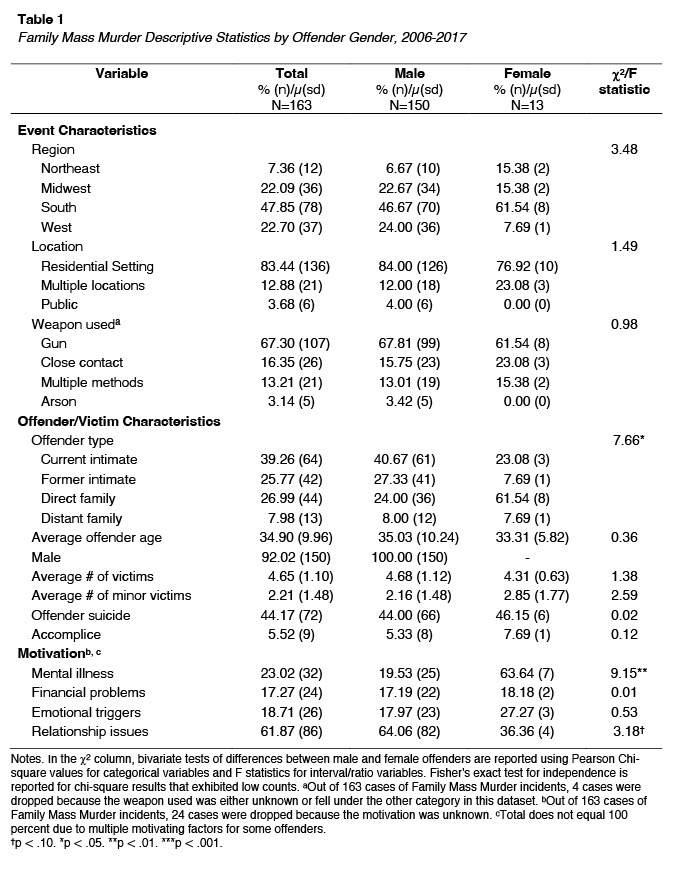
First, descriptive statistics were computed to examine the total number of family mass murders that occurred between 2006 to 2017 across all of our independent variables (Table 1). Next, to differentiate family mass murder cases across the offender’s gender and each of the four offender types, we conducted a series of bivariate analyses. Chi-square (χ2) tests were conducted for independent variables measured at the ordinal or nominal level and ANOVAs were conducted for independent variables measured at the interval/ratio level of measurement. Fisher’s exact tests were utilized when low expected counts were observed in bivariate chi-square analyses. Finally, to further examine if there are unique differences among family mass murder incidents across offender type, a multinomial logistic regression was performed. Considering that there were too few cases in the distant family member offender category, our dependent variable (FMM offender types) for the multivariate analysis was recoded to measure three distinct offender groups: current intimate partner, former intimate, and non-intimate, which combined the direct and distant family offender groups. Findings from the multinomial logistic regression will be used to determine relative risk ratios to understand which, and to what extent, victim, offender, and incident characteristics can predict the type of family mass murder offender over another. Unfortunately, due to the small sample size of female offenders, differences of family mass murder incidents across gender were not able to be analyzed. Given the exploratory nature of this study and the lack of statistical power as a result of the small sample size of FMM cases, coefficients with p ≤ 0.10 are reported as significant and discussed.

                         (Click table to enlarge)

Results

Demographic and Case Characteristics

Descriptive statistics for case characteristics of the entire sample are displayed in Table 1 (column 1). From 2006 to 2017, there were an average of 14 FMMs annually, with a range of 8 incidents that occurred in 2012 and 2013 to 20 incidents in 2009. Across the 12-year span, the most common months that these incidents occurred in were April (21 incidents) and August (18 incidents). Almost half of the FMM incidents occurred in the Southern region of the U.S. (48%) and the fewest number of incidents occurred in the Northeast (7%). Furthermore, most of the cases of FMM occurred inside a residential setting (83%). In a majority of cases, the offenders used a gun as their weapon of choice (67%), followed by other close contact objects (16%) or multiple methods of killings across victim types (13%).

The majority of cases involved offenders who were current or former intimate partners (39% and 26%, respectively), by marriage or by relationship, with at least one of the victims. Direct family members were involved in 27% of the family murder cases, while distant family members accounted for 8% of the cases. Almost all offenders were male (92%) with an average age of 35. A little less than half of the FMM cases were characterized by the offender dying by suicide following the incident (44%), and only a small percentage of the cases involved the offender acting with an accomplice (5%).

FMM offenders varied in the type and number of possible motivating factors preceding the event. The average number of motivations recorded per FMM incident were 1.2. The most common motivation for offenders stemmed from relationship issues from a current or former intimate partner, with 62% of the cases falling into this category. This included family units that experienced a long history of familial disorder, those cases with associated statements of domestic violence, as well as those reported to have experienced a recent separation between the offender and one of the victims. Reports of mental illness experienced by the offender were identified as one of the motivational factors for nearly a quarter of FMM incidents (23%). Within this category, some offenders claimed that committing these acts were “a part of their destiny,” were knowingly suicidal, or had been previously diagnosed with bipolar disorder or schizophrenia. Emotional triggers, such as recent job loss or a recent prior dispute, accounted for 19% of the offender’s primary motivating factor in the cases. Finally, financial hardship was identified in 17% of the family mass murder incidents.

Bivariate Findings

The first set of bivariate analyses were conducted to examine the differences between FMM cases involving male and female offenders (Table 1, columns 2 and 3). The bivariate tests revealed significant gender differences in offender type and the likelihood of a case characterized by mental illness of the offender. To reiterate, reports of offender mental illness were captured through explicit statements found in new reports that identified specific symptoms of mental illness exhibited by the offender, irrespective of a formal mental illness diagnosis. The adjusted residuals revealed that there were significantly (χ2 = 7.66, p < 0.05) more cases of female offenders that were immediate family members (61%) than expected, and there were significantly fewer cases of male offenders who were direct family members (24%) than expected if gender and offender types were independent of each other. In other words, family mass murders committed by female offenders did not commonly involve romantic partners (current or former) as murder victims, whereas family mass murders committed by males overwhelmingly did. Cases with female offenders were significantly (χ2 = 9.15, p < 0.01) more likely to include reports regarding mental illnesses (64%) than expected compared to cases with male offenders (20%).

                         (Click table to enlarge)

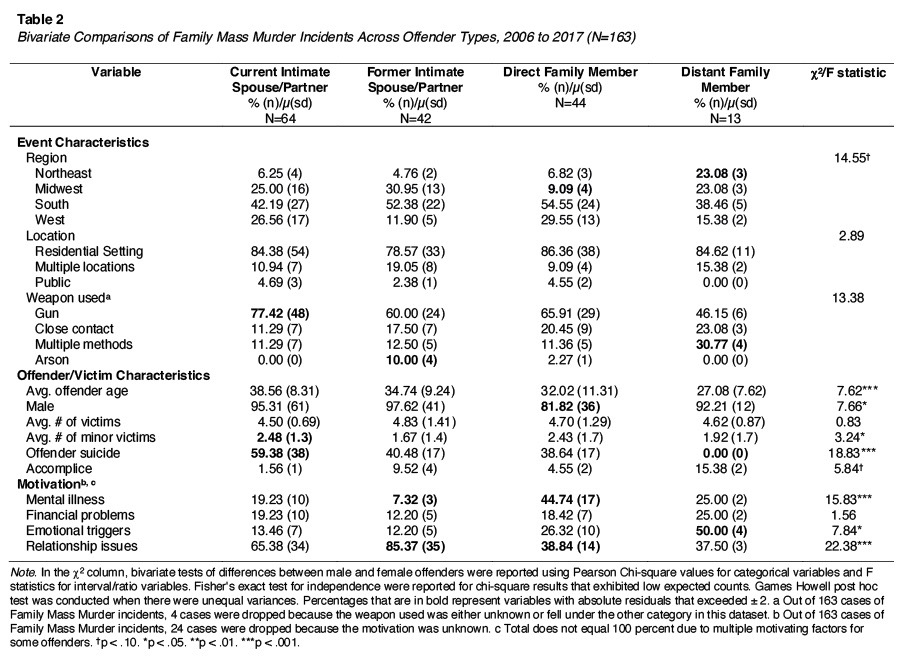
Next, bivariate analyses were conducted to assess the differences among cases based on the four offender types (Table 2). Findings suggest FMM cases with offenders under the direct family member category were less likely to occur in the Midwest (9%) than expected and cases with offenders under the distant family member category were more likely to occur in the Northeast (23%) than expected (χ2 = 14.55, p < .10). Recorded cases where the offender was categorized as a former intimate partner had the highest percentage of arson related killings (10%) as the primary method of murder. Cases with offenders categorized as current intimate partners were more often than any other category to have been perpetrated with a firearm (77%). Finally, cases where a distant family member had committed the mass murder were more likely than expected to involve multiple methods (31%) to carry out the incident (χ2 = 13.38, p < .10).

Significant results also revealed meaningful differences in age, gender, number of minor victims, suicide, and motivational factors across FMM cases based on the four offender types. Current and former intimate partners tended to be older than other offender categories, with the average ages of 39 and 35 years, respectively (χ2 = 7.62, p < .001). Direct family member offenders were more likely to be female compared to other offender types (18%; χ2 = 7.66, p < .05). Cases with offenders that were distant family members exhibited the youngest average age at 27. Cases with current intimate partner offenders were more likely to involve the killing of more victims under the age of 18 years (2.48; χ2 = 3.24, p < .05) and die by suicide following the family mass murder incident (59%; χ2 = 18.83, p < .001) compared to the other offender type cases. Interestingly, none of the cases of distant family member offenders involved suicide following the incident.

Excluding financial problems, motivations exhibited statistically significant differences in offender types. Comparisons and analysis of adjusted residuals revealed cases with former intimate partner offenders were less likely to have public reports of mental illness (7%) than expected, whereas cases with direct family member offenders were more likely to have reports of mental illness (45%) than expected (χ2 = 15.83, p < .001). Cases with offenders under the distant family member category were more likely than expected to be motivated by emotional triggers (50%; χ2 = 7.84, p < .05). Finally, it was found that cases with former intimate partner offenders were more often characterized by relationship issues (85%) as the leading motivational factor of the family mass murder incident, whereas relationship issues were less likely than expected a motivating factor for cases of direct family member offenders (39%; χ2 = 7.66, p < .001).

Multivariate Findings

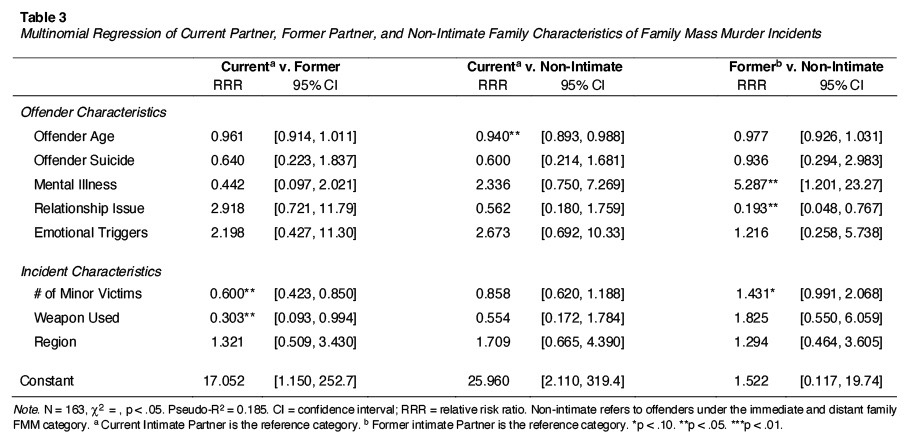
Multinomial logistic regression was performed in order to examine the effect of victim, offender, and incident characteristics on the probability of a family mass murder involving a current intimate offender, former intimate offender, or a non-intimate offender (Table 3). The relative risk ratios will be interpreted to understand which characteristics are associated with the relative risk of a FMM incident involving a specific offender category relative to the reference group. Current intimate partner FMM offender was set as the reference group for the first two comparisons in Table 3 (Current intimate partner offender [reference] vs. Former intimate partner offender; Current intimate partner [reference] vs. non-intimate partner). Former intimate offender was set as the reference group for the last comparison (Former intimate partner [reference] vs. non-intimate partner). Significant variables with relative risk ratios above one indicate that the FMM incident is more likely to be associated with the comparison category of FMM offenders, while significant relative risk ratios below one suggests that the FMM incident is more likely to be associated with the reference category of FMM offenders.

                         (Click table to enlarge)

Current intimate partner FMM offenders vs. Former intimate partner FMM offenders

Two significant outcomes emerged when examining offender and incident characteristics that significantly predict the relative risk of a FMM incident involving a current intimate partner offender compared to a former intimate partner offender: the number of minor victims and offender firearm use. More specifically, for every one unit increase in the number of minor victims, the odds of the FMM incident involving a former intimate partner offender relative to a current intimate partner offender are 40% lower, controlling for all other variables. FMM incidents using a firearm have odds of involving a former intimate partner offender that are 70% lower relative to a current intimate partner offender, controlling for all other variables. In other words, FMM incidents with a greater minor victim count and FMM incidents involving a firearm are more likely to fall into the current intimate partner FMM offender category over the former intimate partner FMM offender category.

Current intimate partner offenders vs. non-intimate partner offenders

The offender age was the only significant outcome when examining offender and incident characteristics that significantly predict the relative risk of a FMM incident involving a current intimate partner offender compared to a non-intimate partner offender. For every one unit increase in the offender’s age, the odds of the FMM incident involving a non-intimate partner relative to a current intimate partner offender are 6% lower, controlling for all other variables. Put differently, as an offender’s age increases, it is more likely the FMM incident involves a current intimate partner than a non-intimate FMM offender type.

Former intimate partner offenders vs. non-intimate partner offenders

In the final multinomial logistic regression model examining offender and incident characteristics that significantly predict the relative risk of a FMM incident involving a former intimate partner offender compared to a non-intimate partner offender, three significant outcomes emerged: reported offender mental illness, relationship issues, and the number of minor victims. FMM incidents with a reported offender mental illness have odds of involving a non-intimate partner offender that are 428% higher relative to a former intimate FMM offender, controlling for all other variables. In other words, cases with non-intimate partner offenders are significantly more likely to have reports of mental illness. FMM incidents with a reported relationship issue have odds of involving a non-intimate partner offender that are 81% lower relative to a former intimate FMM offender, controlling for all other variables. Stated differently, FMM incidents with a reported relationship issue are more likely to involve former intimate FMM offenders than non-intimate partner offenders. Finally, for every one unit increase in the number of minor victims, the odds of the FMM incident involving a non-intimate partner relative to a former intimate partner are 43% higher, controlling for all other factors. This finding suggests that FMM incidents with greater minor victim counts are more likely to involve a non-intimate partner offender.

Discussion

In recent years, there has been an increase in studies conducted on mass murder with a particular focus on public mass shootings (Duwe, 2020; Petee et al., 1997; Siegel et al., 2020) as well as significant contributions to multiple victim family homicide literature (Bowers et al., 2010; Karlsson et al., 2021; Liem & Reichelmann, 2014). Yet, there are limited studies that have analyzed characteristics of the largest aggregate of mass murder occupying over 50% of cases – incidents that occur within the family. To fill this gap in the literature, this study quantitatively analyzes 163 FMM incidents in the U.S. from 2006 to 2017 across offender types. It is important to restate that the results from this study are based on a small sample of family mass murder incidents and therefore should be interpreted with caution. Nonetheless, the findings in the current study advance mass murder research by identifying distinct case differences among family mass murder offender types and providing a structure for future multivariate approaches to study FMMs.

Similar to Fox and Levin’s (1998) early work on mass murder, most cases occurred in the Southern region of the U.S. and took place in a private residence (Fox & Levin, 1998; Fridel, 2021). Additionally, in support of previous literature, FMM offenders were most often male, older in age, and chose a firearm as their primary weapon (Duwe, 2007; Fox & Levin, 1998; Fridel, 2021; Huff-Corzine et al., 2014; Taylor, 2018). Though the mental health of an offender is commonly a dominant discussion following a mass murder, consistent with previous research (Fridel, 2021; Taylor, 2018), a little less than one fourth of our sample of FMM cases included offenders with a reported mental illness concern and a little less than half of the total sample of cases involved offenders dying by suicide (Fridel, 2021). As expected, the most common motivation among the family mass murder incidents included in this study was a relationship issue between the offender and one of the victims. To reiterate, these cases included reports of a recent loss of a relationship, a known fight between a current or former intimate partner offender and at least one of the victims, history of familial disorder, and reported past domestic violence events.

When comparing cases of male and female offenders, results from our bivariate analysis revealed statistically significant gender differences in offender type and motivation. More precisely, cases with female offenders were less likely to involve a killing of an intimate partner during the family mass murder incident and more likely to have reports of mental illness as the leading motivation, whereas cases with male offenders most often involved the killing of an intimate partner and predominantly involved reports of a relationship issue as motivation for the killing. It is important to note, however, that significant gender differences observed between FMM offenders are reported based on a small sample of women offenders. Therefore, these results should be interpreted with caution until additional studies perform similar analyses to compare FMM gender differences using a bigger sample of female offenders.

From our analysis comparing cases across four offender types (current intimate partner, former intimate partner, direct family member, and distant family member), key findings from our multivariate analyses identified statistically significant differences in the weapon used, offender age, number of minor victims, as well as motivation. Though firearms were the most common weapon used across each offender type, cases with offenders that were a current intimate partner to at least one of the victims were the most likely to use a firearm than other FMM offender types. Current intimate partner FMM offenders were also more likely to kill a greater number of minor victims when compared to former intimate partner FMM offenders and more likely to be older in age when compared to non-intimate partner FMM offenders.

Though relationship issues were the most common motivation reported in the total sample of cases, bivariate results highlight cases involving offenders under the former intimate partner category were the most likely to be characterized by relationship issues as the motivating factor for committing the mass family murder. This pattern was also identified in our multivariate model. When compared to non-intimate FMM offenders, FMM offenders who were a former intimate partner with at least one of the victims were more likely to be motivated by a relationship issue.

Policy Implications

There are several key policy implications that may be taken from our findings. Research examining the relationship between mental illness and incidents of mass violence most often suggests that there is a much weaker association than what is represented in media reports (see Skeem & Mulvey, 2020). For studies that rely on informal mental illness reports of an offender gathered through news reports, scholars have identified mental illness to be a concern with only a quarter of offenders (Duwe, 2007; Fridel, 2021; Taylor, 2018). Limited studies that have collected formal psychiatric histories found an even smaller percentage (less than 20%) of adult and juvenile offenders with documented mental disorders (Fox & Fridel, 2016; Meloy et al. 2001; Skeem & Mulvey, 2020). Though media reports immediately following a mass murder event often highlight the mental health of an offender, our results support previous work to suggest that mental health is not as prominent among offenders as publicized.

A second dominant topic to mass murder responses often involve broad gun violence prevention policies, including ineffective suggestions to enact bans on assault rifles infrequently used in most mass murder incidents (Duwe, 2007). Considering that a majority of mass murder offenders obtain their firearms legally (Fox & Fridel, 2016), recent scholars have urgently suggested it is important to consider gun violence prevention policies aimed to decrease violence overall (Duwe, 2020). More precisely, if a large impact is to be made on reducing mass murder incidents, it may be important to begin by turning more attention to state and federal level domestic violence responses. Not only were relationship issues one of the primary motivations for family mass murders in our study, but offenders of other subtypes of mass murder have also noted reported histories of domestic violence prior to the attack (Fridel, 2021; Taylor, 2018; Zeoli & Paruk, 2020).

When firearms are present in a home with a suspected domestic violence offender, or anyone likely to use violence to deal with social stressors, it not only exponentially increases the risk of homicide against their intimate partner (Campbell et al., 2003) but also elevates the risk that there will be multiple victims as well (Smucker et al., 2018). In a recent analysis (Zeoli & Paruk, 2020), scholars found that among mass shooters with mention of domestic violence histories gathered from media reports, 40% did not have any formal contact with the criminal justice system for domestic violence. This leaves 60% of mass shooters in this study to be known by law enforcement to have a history of violence. Not only is the lack of criminal justice involvement among potential domestic violence offenders congruent with larger patterns of domestic violence responses in the U.S., but this study also illuminates on a number of missed opportunities by law enforcement which could have potentially prevented lethal acts of violence (see Zeoli & Paruk, 2020). Using 2005-2015 data from the National Crime Victimization Survey (NCVS) to analyze police responses to domestic violence, findings indicated that only 39% of victimizations reported to law enforcement resulted in an arrest or charges filed (Reaves, 2017). This statistic is especially concerning given that an even smaller percentage of these cases likely resulted in a formal domestic violence conviction, actions to prevent future purchase of a firearm, or relinquishment of any firearms in an offender’s possession. As such, noncriminal responses to address potentially violent domestic violence offenders are particularly crucial. Noncriminal responses to domestic violence include domestic violence restraining order (DVRO) firearm restrictions, extreme risk protection orders (ERPOs), and firearm relinquishing polices. In recent studies, authors have found that states with laws that prohibit individuals with a domestic violence-related restraining order from possessing firearms and also require the relinquishment of firearms from the individuals’ home are associated with lower state-level intimate partner homicide rates (Diez et al., 2017; Vigdor & Mercy, 2006; Zeoli & Paruk, 2020; Zeoli & Webster, 2010; Zeoli et al., 2017).

To increase the impact of current policies against potentially violent offenders, there must first be an effort encouraging families of domestic violence to report acts of violence to the police through assurance that cooperation in this process would be positive and end with a just outcome (Zeoli & Paruk, 2020). This may arguably be the biggest obstacle to overcome as research notes there are many barriers that discourage reporting of domestic disputes, such as victim fear of retaliation and discrimination (Campbell et al., 2003; Diez et al., 2017; National Domestic Violence Hotline, 2015). These barriers are especially true for minority communities. Despite higher rates of domestic violence against racial and ethnic minority women compared to White women, Black women are not only are they less likely to report abuse to law enforcement, but domestic violence offenders are less likely to be arrested when cases involve Black victims (see McCormack & Hirschel, 2021). Future research should continue to examine not only reasons why families of domestic violence do not report to the police, but also their understanding of the reporting process and awareness of life-saving firearm restriction policies against potentially violent offenders. Furthermore, there needs to be a push to adopt more effective, uniform procedures to prevent individuals with a domestic violence restraining order against them and offenders convicted of domestic violence from possessing a firearm. This includes mandatory reporting to a national firearm purchasing database as well as non-discretionary court mandated policies to relinquish firearms from the residence of perpetrators of domestic violence (Zeoli & Paruk, 2020).

Limitations

With every study there are limitations, and this study is no exception. First, we did not cross-reference cases included in this study to the FBI’s supplementary homicide report (SHR) due to known limitations of how multiple victim homicides cases are documented (Fox & Pierre, 1996; Overberg et al., 2016). However, it may be useful for future studies to cross-reference family mass murder incidents to more official data sources, such as SHR or the National Incident Based Reporting System (NIBRS; see Huff-Corzine & Corzine, 2020; Szalewski, 2020). By doing this, researchers may collect more comprehensive demographic information that may be missing from media sources. Second, while media often contains more detailed information than official data sources of mass murder incidents (Duwe, 2007; Liem & Reichelmann, 2014; Petee et al., 1997; Taylor, 2018), missing information or inaccuracies of case details gathered by media reports is possible. Also, as a result of relying solely on news media sources, the race of offender(s) and victims were not taken into account to avoid false assumptions of the racial identity of any individual based upon incomplete information provided by news reports. Lastly, results from the current study are based on a very small count of female offenders (N = 13) and a small count of FMM offender types. As such, our findings are not generalizable to FMM incidents outside of the scope of this study. 

Future Research

Due to the lack of research on family mass murder incidents, there are several suggestions for future scholars to add to the literature on this topic. Future research should continue to examine case details of family mass murder incidents by collecting additional data on more specific motivations. For instance, similar to Liem and Reichelmann’s (2014) study of patterns of multiple family homicide, it would be beneficial to assess relationship issues into more detailed motivation categories such as past domestic violence convictions, presence of a restraining order, or child custody disputes. Moreover, though the current study analyzed mass murder incidents based on the most commonly adopted victim threshold (a minimum of four victims as defined by the FBI), future studies should also consider examining FMM cases with three or more victims. Broadening the inclusion criteria for family mass murder incidents will allow for a similar analysis to be conducted for smaller family types as well as increasing the statistical power to conduct a multivariate analysis with a bigger sample size of cases and to substantiate results from the current study. Additionally, as family mass murder represents the most extreme form of family violence, future work comparing family homicides with one fatal victim to cases with two, three, and four or more victims may reveal further insight to distinguishable characteristics of single victim family homicide vs. mass murder incidents. It is currently unknown if, and how, these different family homicide types are unique or similar to each other.

Conclusion

Our study has begun to bridge the gap in literature by providing an analysis of U.S. family mass murder cases from 2006 to 2017. Results from the current study support that there is heterogeneity within family mass murder incidents, highlighting key differences based on an offender sex and victim-offender relationship type. As expected, one of the leading motivations for a family mass murder attack stemmed from a relationship issue between the offender and at least one of the victims. The current study highlights the importance for future scholars to begin paying more attention to family mass murders – the largest aggregate of mass murder events. In the end, efforts need to focus on improving strategies to prevent potentially violent offenders, especially in domestic settings.

NOTES

  1. In this study, family mass murder is defined as any event where four or more victims are murdered not including the offender, in one or more locations in close proximity to each other, without a cooling off period, where a majority of the victims were related to each other through a relationship to the offender.
  2. For example, on May 14th, 2015, a mass murder incident occurred involving an offender that was a former employee of one of the victims. In addition to killing a former employer, the offender also killed his former employer’s wife, son, and housekeeper after extorting the family of $40,000 (Brown et al., 2015). This incident was excluded from our analysis because although the majority of the victims were connected by a familial relationship, the offender is not a family member by blood or an intimate relationship with any of the victims.
  3. Due to the small sample size, variable selection was carefully considered. Variables that showed a significant bivariate relationship with the offender relationship, with the exception of offender’s gender, were included in the multivariate model. Offender’s gender was unable to be included in the final model because the majority of cases involved male offenders.


DISCLOSURE
STATEMENT

No potential conflicts of interest were reported by the authors.

REFERENCES

Bowers, T. G., Holmes, E. S., & Rhom, A. (2010). The nature of mass murder and autogenic massacre. Journal of Police Criminal Psychology, 25(2), 59-66. https://doi.org/10.1007/s11896-009-9059-6

Campbell, J. C., Webster, D. W., Koziol-McLain, J., Block, C., Campbell, D., Curry, M. A., Gary, F., Glass, N., McFarlane, J., Sachs, C., Sharps, P., Ulrich, Y., Wilt, S. A., Manganello., J., Xu, X., Schollenberger, J., Frye, V., & Laughon, K. (2003). Risk factors for femicide in abusive relationships: Results from a multisite case control study. American Journal of Public Health, 93(7), 1069-1097. https://doi.org/10.2105/AJPH.93.7.1089

Croitoru, A., Kien, S., Mahabir, R., Radzikowski, J., Crooks, A., Schuchard, R., Begay, T., Lee, A., Bettios, A., & Stefanidis, A. (2020). Responses to mass shooting events: The interplay between the media and the public. Criminology & Public Policy, 19(1), 335-360. https://doi.org/10.1111/1745-9133.12486

Delisi, M., & Scherer, A. M. (2006). Multiple homicide offenders: offense characteristics, Social correlates, and criminal careers. Criminal Justice and Behavior, 33(3), 367-391. https://doi.org/10.1177/0093854806286193  

Dietz, P. E. (1986). Mass, serial, and sensational homicides. Bulletin of the New York Academy of Medicine, 62(5), 477-491. https://www.ncbi.nlm.nih.gov/pmc/articles/PMC1629267/pdf/bullnyacadmed00051-0111.pdf

Diez, C., Kurland, R. P., Rothman, E. F., Bair-Merritt, M., Fleegler, E., Xuan, Z., Galea, S., Ross, C. S., Kalesan, B., Goss, K. A., & Siegel, M. (2017). State intimate partner violence-related firearm laws and intimate partner homicide rates in the United States, 1991 to 2015. Annals of Internal Medicine, 167(8), 536-543. https://doi.org/10.7326/M16-2849

Duwe, G. (2000). Body-count journalism: The presentation of mass murder in the news media. Homicide Studies, 4(4), 364-399. https://doi.org/10.1177/1088767900004004004

Duwe, G. (2004). The patterns and prevalence of mass murder in twentieth-century America. Justice Quarterly, 21(4), 729-761. https://doi.org/10.1080/07418820400095971

Duwe, G. (2007). Mass murder in the United States: A history. McFarland & Company.

Duwe, G. (2016). Patterns and prevalence of mass public shootings in the United States, 1915- 2013. In L. C. Wilson (Ed)., The Wiley Handbook of the Psychology of Mass Shootings (pp. 20-35). John Wiley & Sons, Inc.

Duwe, G. (2020). Patterns and prevalence of lethal mass violence. Criminology & Public Policy, 19(1), 17-35. https://doi.org/10.1111/1745-9133.12478

Ewing, C. P. (1997). Fatal families. Sage.

Federal Bureau of Investigation. (2005). Serial murder: Multi-disciplinary perspectives for investigators. U.S. Department of Justice. https://www.fbi.gov/stats-services/publications/serial-murder/serial-murder-july-2008-pdf

Fegadel, A. R., & Heide, K. M. (2017). Offspring-perpetrated familicide: examining family homicides involving parents as victims. International Journal of Offender Therapy and Comparative Criminology, 61(1), 6-24. https://doi.org/10.1177/0306624X15589091

Fox, J. A., & Fridel, E. E. (2016). The tenuous connections involving mass shootings, mental illness, and gun laws. Violence and Gender, 3(1), 14119. https://doi.org/10.1089/vio.2015.0054

Fox, J. A., & Levin, J. (1994). Overkill: Mass murder and serial killing exposed. Plenum Press.

Fox, J. A., & Levin, J. (1998). Multiple homicide: Patterns of serial and mass murder. Crime and Justice, 23, 407-455. http://www.jstor.org/stable/1147545

Fox, J. A., & Levin, J. (2011). Extreme killing: Understanding serial and mass murder (2nd ed.). Sage.

Fox, J. A., & Levin, J. (2015). Mass confusion concerning mass murder. The Criminologist, 40(1), 8-11. https://www.hoplofobia.info/wp-content/uploads/2015/08/Mass-Confusion-Concerning-Mass-Murder.pdf

Fox, J. A., & Pierre, G. L. (1996). Uniform Crime Reports [United States]: Supplementary Homicide Reports, 1976-1983 (ICPSR 8657). Inter-university Consortium for Political and Social Research. https://www.ojp.gov/pdffiles1/Digitization/107057NCJRS.pdf

Frazier, S. H. (1975). Violence and social impact. In J. C. Schoolar (Ed.), Research and the Psychiatric Patient (pp.191-200). Brunner & Mazel.

Fridel, E. E. (2021). A multivariate comparison of family, felony, and public mass murders in the United States. Journal of Interpersonal Violence, 36(3–4), 1092-1118. https://doi.org/10.1177/0886260517739286

Geller, L. B., Booty, M., & Crifasi, C. K. (2021). The role of domestic violence in fatal mass shootings in the United States, 2014-2019. Injury Epidemiology, 8(1), 38. https://doi.org/10.1186/s40621-021-00330-0

Heide, K. M. (2013). Understanding parricide: When sons and daughters kill parents. Oxford University Press.

Heide, K. M. & Frei, A. (2010). Matricide: A critique of the literature. Trauma, Violence, & Abuse, 11(1), 3-17. https://doi.org/10.1177/1524838009349517

Holmes, R. M., & Holmes, S. T. (1994). Murder in America. Sage.

Huff-Corzine, L., & Corzine, J. (2020). The devil’s in the details: Measuring mass violence. Criminology & Public Policy, 19(1), 317-333. https://doi.org/10.1111/1745-9133.12482

Huff-Corzine, L., McCutcheon, J. C., Corzine, J., Jarvis, J. P., Tetzlaff-Bemiller, M. J., Weller, M., & Landon, M. (2014). Shooting for accuracy. Homicide Studies, 18(1), 105-124. https://doi.org/10.1177/1088767913512205

Karlsson, L. C., Antfolk, J., Putkonen, H., Amon, S., Guerreiro, J. D., Vogel, V. D., Flynn, S., & Weizmann-Henelius, G. (2021). Familicide: A systematic literature review. Trauma, Violence, and Abuse, 22(1), 83-98. https://doi.org/10.1177/1524838018821955

Krouse, W. J., & Richardson, D. J. (2015). Mass murder with firearms: Incidents and victims, 1999-2013. Congressional Research Service.

Levin, J., & Fox, J. A. (1985). Mass murder: America’s growing menace. Plenum Press.

Levin, J., & Fox, J. A. (1996). A psycho-social analysis of mass murder. In T. O’Reilly-Fleming (Ed.), Serial and mass murder: Theory, research, and policy (pp. 55-76). Canadian Scholars’ Press.

Liem, M., & Koenraadt, F. (2008). Familicide: A comparison with spousal and child homicide by mentally disordered perpetrators. Criminal Behavior and Mental Health, 18(5), 306-318. https://doi.org/10.1002/cbm.710

Liem, M., & Reichelmann, A. (2014). Patterns of multiple family homicide.  Homicide Studies, 18(1), 44-58. https://doi.org/10.1177/1088767913511460

Liem, M., Levin, J., Holland, C., & Fox, J. A. (2013). The nature and prevalence of familicide in the United States, 2000–2009. Journal of Family Violence, 28(4), 351-358. https://doi.org/10.1007/s10896-013-9504-2

Madfis, E. (2014). Triple entitlement and homicidal anger. Men and Masculinities, 17(1), 67-86. https://doi.org/10.1177/1097184×14523432

Marleau, J. D., Auclair, N., & Millaud, F. (2006). Comparison of factors associated with parricide in adults and adolescents. Journal of Family Violence, 21(5), 321-325. https://doi.org/10.1007/s10896-006-9029-z

McCormack, P. D., & Hirschel, D. (2021). Race and the likelihood of intimate partner violence arrest and dual arrest. Race and Justice, 11(4), 434-453. https://doi.org/10.1177/2153368718802352

Meloy, J. R., Hempel, A. G., Mohandie, K., Shiva, A. A., & Gray, B. T. (2001). Offender and offense characteristics of a nonrandom sample of adolescent mass murderers. Journal of the American Academy of Child and Adolescent Psychiatry, 40(6), 719-728. https://doi.org/10.1097/00004583-200106000-00018

National Domestic Violence Hotline. (2015). Who will help me? Domestic violence survivors speak out about law enforcement responses. https://www.thehotline.org/wp-content/uploads/media/2020/09/NDVH-2015-Law-Enforcement-Survey-Report-2.pdf

Overberg, P., Hoyer, M., Hannan, M., Upton, J., Hansen, B., & Durkin, E. (2016). Explore the data on U.S. mass killings since 2006. USA TODAY. http://www.usatoday.com/story/news/nation/2013/09/16/mass-killings-data- map/2820423/

Peck, J. H., & Heide, K. M. (2012). Juvenile involvement in fratricide and sororicide: An empirical analysis of 32 years of U.S. arrest data. Journal of Family Violence, 27(8), 749-760. https://doi.org/10.1007/s10896-012-9456-y

Petee, T. A., Padgett, K. G., & York, T. S. (1997). Debunking the stereotype: An examination of mass murder in public places. Homicide Studies, 1(4), 317-337. https://doi.org/10.1177/1088767997001004002

Peterson, J., & Densley, J. (2019). The Violence Project mass shooter database. The Violence Project.  https://www.theviolenceproject.org  

Reaves, B. A. (2017). Police response to domestic violence, 2006–2015 (NCJ 250231). Bureau of Justice Statistics. https://www.bjs.gov/index.cfm?ty=pbdetail&iid=5907

Ressler, R. K., Burgess, A. W., & Douglas, J. E. (1988). Sexual homicide: Patterns and motives. Simon and Schuster.

Scheinin, L., Rogers, C. B., & Sathyavagiswaran, L. (2011). Familicide-suicide: A cluster of 3 cases in Los Angeles County. The American Journal of Forensic Medicine and Pathology, 32(4), 327-330. https://doi.org/10.1097/PAF.0b013e31821a555a

Siegel, M., Goder-Reiser, M., Duwe, G., Rocque, M., Fox, J. A., & Fridel, E. E. (2020). The relation between state gun laws and the incidence and severity of mass public shootings in the United States, 1976–2018. Law and Human Behavior, 44(5), 347-360. https://doi.org/10.1037/lhb0000378

Sillito, C. L., & Salari, S. (2011). Child outcomes and risk factors in US homicide-suicide cases 1999–2004. Journal of Family Violence, 26(4), 285-297. https://doi.org/10.1007/s10896-011-9364-6

Silver, J., Simons, A., & Craun, S. (2018). A study of pre-attack behaviors of active shooters in the United States between 2000 and 2013. Federal Bureau of Investigation, U.S. Department of Justice, Washington, D.C.

Skeem, J., & Mulvey, E. (2020). What role does serious mental illness play in mass shootings, and how should we address it?. Criminology & Public Policy, 19(1), 85-108. https://doi.org/10.1111/1745-9133.12473

Smucker, S., Kerber, R. E., & Cook, P. J. (2018). Suicide and additional homicides associated with intimate partner homicide: North Carolina 2004–2013. Journal of Urban Health, 95(3), 337-343. https://doi.org/10.1007/s11524-018-0252-8

Szalewski, A. (2020). Family mass homicide: An investigation [Doctoral Dissertation, University of Central Florida]. https://stars.library.ucf.edu/etd2020/301

Taylor, M. A. (2018). A comprehensive study of mass murder precipitants and motivations of offenders. International Journal of Offender Therapy and Comparative Criminology, 62(2), 427-449. https://doi.org/10.1177/0306624X16646805

Vigdor, E. R., & Mercy, J. A. (2006). Do laws restricting access to firearms by domestic violence offenders prevent intimate partner homicide? Evaluation Review, 30(3), 313-346. https://doi.org/10.1177/0193841X06287307

Websdale, N. (2010). Familicidal hearts: The emotional styles of 211 killers (Vol. 5.). Oxford University Press.

Wilson, M., Daly, M., & Daniele, A. (1995). Familicide: The killing of spouse and children. Aggressive Behavior, 21(4), 275-291. https://doi.org/10.1002/1098-2337(1995)21:4%3C275::AID-AB2480210404%3E3.0.CO;2-S

 Zeoli, A. M., & Paruk, J. K. (2020). Potential to prevent mass shootings through domestic violence firearm restrictions. Criminology & Public Policy, 19(1), 129-145. https://doi.org/10.1111/1745-9133.12475

Zeoli, A. M., & Webster, D. W. (2010). Effects of domestic violence policies, alcohol taxes and police staffing levels on intimate partner homicide in large U.S. cities. Injury Prevention, 16(2), 90-95. https://doi.org/10.1136/ip.2009.024620

Zeoli, A. M., Frattaroli, S., Roskam, K., & Herrera, A. K. (2017). Removing firearms from those prohibited from possession by domestic violence restraining orders: A survey and analysis of state laws. Trauma, Violence, & Abuse, 20(1), 114-125. https://doi.org/10.1177/1524838017692384

About the Authors

Madelyn L. Diaz is a PhD student in the Department of Sociology at the University of Central Florida, where she also received her M.A. in Applied Sociology and B.A. in Criminal Justice. Her research interests include lethal and non-lethal forms of gender-based violence, more specifically sexual victimization, post-victimization health outcomes, human trafficking, and the unequal impact of violence across marginalized communities. She has published in Crime & Delinquency, LGBT Health, and Sociation.

Kayla Toohy is a PhD candidate in the Department of Sociology at the University of Central Florida, received her B.A. and M.A. from the University of Memphis in Criminology and Criminal Justice where she also received a graduate certificate in Geographic Information Systems (GIS). Her research interests include violent crime and lethal violence, particularly regarding macro-level geospatial studies of homicide in United States cities. Toohy’s work is published in the American Journal of Criminal Justice, Homicide Studies, and Applied Geography.

Ketty Fernandez, M.A. is a PhD candidate (ABD) in the Department of Sociology at the University of Central Florida. Her research interests include violence against women, with an emphasis on domestic violence and sexual victimization among women of color, human trafficking, and racial/ethnic inequalities. Her work appears in Criminal Justice Policy Review, Sociation, and Policing: An International Journal.

 Lin Huff-Corzine, PhD is a Professor in the Department of Sociology at the University of Central Florida. Her research on lethal and non-lethal violence spans three decades with work on homicide examining topics including but not limited to lynching, domestic violence, regional variations, transportation effects on lethality, human trafficking, and more recently mass murder. Dr. Huff-Corzine’s publications can be found in edited collections as well as journals such as Homicide Studies,Justice Quarterly, Violence and Victims, Social Forces, Victims and Offenders, Criminology, and Deviant Behavior.

Amy Reckdenwald, PhD is an Associate Professor in the Sociology Department at the University of Central Florida. Her research interests include violent victimization and offending; particularly as it relates to domestic violence and intimate partner homicide. Her work appears in journals such as Trauma, Violence, & Abuse, Criminology, Homicide Studies, Feminist Criminology, Journal of Criminal Justice, and Violence and Victims

CITATION (APA 7th Edition)
Diaz, M. L., Toohy, K., Fernandez, K., Huff-Corzine, L., & Reckdenwald, A. (2022). Out of sight, out of mind: An analysis of family mass murder offenders in the US, 2006-2017. Journal of Mass Violence Research, 1(1), 25-43. https://doi.org/10.53076/JMVR82831


Download an infographic summarizing the main takeaways of this article.
Available Formats: PDF  |  PNG

A Rose By Any Other Name: Problems in Defining and Conceptualising Serial Murder with a New Proposed Definition

A Rose By Any Other Name: Problems in Defining and Conceptualising Serial Murder with a New Proposed Definition

SHARE THIS ARTICLE

A Rose by Any Other Name: Problems in Defining and Conceptualising Serial Murder with a New Proposed Definition

Wayne Petherick Email the Corresponding Author,1 Shuktika Bose,1 Amber McKinley,and Candice Skrapec3

1Faculty of Society and Design, Bond University
2Australian Graduate School of Policing and Security, Charles Sturt University
3Department of Criminology, California State University Fresno

https://doi.org/10.53076/JMVR85123  |  Full Citation
Volume: 1, Issue: 1, Page(s): 4-24

Article History: Received February 10, 2021 | Accepted May 3, 2021 | Published Online June 4, 2021

ABSTRACT
The prevalence of serial murder is low; however, it has been the focus of much academic and popular attention. Despite a considerable research base on serial murder, there is still debate as to how it should be defined. This article examines often used definitions of serial murder, followed by a critique of some of the main components of these definitions. From this, a definition is advanced with rationales for the inclusion of the characteristics in the proposed definition. This analysis provides for some clarity in the identification of serial murder and those aspects of the crime used to define it.

KEYWORDS
serial murder, spree murder, mass murder, cooling-off period, dormant period

Despite the understanding that serial murder is uncommon (Schlesinger, 2001), it has been popular among both professional and lay audiences (Knoll, 2006). Serial murder was popularised in the 1980s and 1990s by movies, television shows, and written works by current and former investigators and criminal profilers. In the academic literature, several works, such as the Crime Classification Manual and Sexual Homicides: Patterns and Motives, both written by members of the FBI’s Behavioural Analysis Unit and their associates, brought this type of multiple murder to the fore.

There is both interest in and an impressive research corpus on serial murder; however, debate remains over fundamental issues such as how the term is defined, how many victims are required before serial murder is identified, and the role of motive. A cursory examination of the literature shows that definitions are as varied as offenders themselves, though there are some commonalities running throughout research and literature. This article canvasses the literature on serial murder, providing an examination into the various definitions provided and critique of the common components of these definitions, before proposing a definition with the accompanying rationale for each component.

History of the Term

Serial murder, similar to murder itself, is likely as old as human criminal interaction although the term and its study is relatively recent. Alongside the contention surrounding definition, there is no universal agreement as to the origin of the term serial murder. While some lay claim, evidence suggests the term, or at least the concepts behind it, have existed for considerably longer. Contributing to the problem is the understanding that claims made regarding origin are uncritically accepted and repeated in the literature, causing further confusion.

One of the most cited sources for the term serial killer is [retired] FBI agent Robert Ressler, who claims this in both of his true crime works. In the first, Whoever Fights Monsters:

At Quantico, I taught subjects ranging from abnormal psych to interviewing techniques; and I discovered that I was a pretty good teacher…We got to go on the road for our training sessions, both nationally and internationally. It was at one of those international sessions that I coined the term serial killer, now in much use. (Ressler & Shachtman, 1993, p. 45) 

Then, in I Have Lived in the Monster, his subsequent memoir:

During my tenure at the FBI, I interviewed more than a hundred murderers in prison and became one of the world’s leading profilers of criminals, applying my expertise to hundreds of unsolved crimes, often helping local police forces to identify murderers and bring them to justice. As part of my attempt to understand multiple murderers, in the mid-1970s I coined the term serial killer. (Ressler & Shachtman, 1998, p. 1)

According to his memoirs, Ressler joined the FBI in 1970 (in New Agent Class 70-2) and then moved to the Behavioral Sciences Unit (BSU) in the mid-1970s. His above claim is therefore supported by these dates. In a later publication, Kocsis and Irwin (1998) state “prior to 1980 there was no specific term for serial murders or serial crimes in general” (p. 6). Both of these claims will now be examined through the lens of historical literature.

Throughout the 1970s and 1980s, former Chief of Police Pierce Brooks created a system to help identify and trace serial killers. At the time, computer systems were prohibitively expensive and a nationwide network and database for information sharing was non-existent. In 1981, when such systems became available, Brooks introduced the Violent Criminal Apprehension Program (VICAP) and in 1984 the National Centre for the Analysis of Violent Crime (NCAVC) was established, then VICAP and the NCAVC merged (Geberth, 2006). Regarding Brooks’ involvement in the origin of the term serial murder, Egger (1998) suggests:

The term serial murder was first used sometime in 1982 or 1983. The criminal investigative pioneer Pierce Brooks, who conceptualised the Violent Criminal Apprehension Program currently being run by the Federal Bureau of Investigation (FBI), may have been the first to use the term serial. However, others, such as retired FBI agents, claim to have used the term first. No one is certain who coined the term, but it has been with us ever since. (pp. 4-5)

Psychiatrist Donald Lunde published Murder and Madness in 1975, and discussed both single and mass murders, providing distinguishing characteristics of the two:

In common usage of the term, mass murder is applied to someone who kills a number of people, usually for no apparent reason or for an apparent but perverse (often sexual) reason. Psychiatric and legal literature sometimes makes a distinction between mass murder and serial murder, with mass murder referring to a crime in which a number of victims are killed, usually by one person in a single episode – for instance, the killing of eight student nurses by Richard Speck in Chicago in 1966 – and serial murder referring to a number of murders by a single person over a period of months – or, occasionally, years. Each killing is usually a discrete episode, but there is usually a common motive, method, and/or type of victim; for instance, the series of murders of prostitutes in England attributed to Jack the Ripper. (Lunde, 1975, p. 47)

A publication date of 1975 does not preclude Ressler reading Lunde, though this would argue against Ressler’s claim of ownership. Lunde’s citation of the distinction created in the psychiatric and legal literature at or before his publication’s time would indicate that the terms had been utilised for some time prior to the commencement of Ressler’s employment in the BSU.

The Meaning of Murder by James Brophy is an earlier source of the term than any of these other works, first published in 1966 in the UK, and in 1967 in the USA. Brophy distinguished between other mass-victim crimes like genocide, stating:

A serial murder is a very different matter. Its essential character is repetition at intervals of time, and as soon as a number of murders are established as a sequence it becomes clear that the community has to reckon with an unidentified murderer, a murderer still at large, and a murderer who has taken on himself the guilt of the supreme crime not upon one occasion and under pressure of circumstance but by deliberate intention, and so will presumably continue the series. (Brophy, 1967, p. 166)

Therefore, Brophy not only utilised the term specifically, but also recognised its “essential character” of repetition over time.

In 1949 Frederic Wertham, a German-American psychiatrist, published The Show of Violence and was one of the first to systematically discuss the effects of violent media on children’s development. While the first, his work has also been recently criticised for over stating the impact of media on children, and also the focus on potential negative effects while ignoring potential positive effects of media consumption. One such critique of Wertham’s book The Seduction of the Innocent notes (Tilley, 2012, p. 386):

Ultimately, I found that, despite its accolades and its central role in moving comics further to the cultural sideline’s, Wertham’s Seduction included numerous falsifications and distortions. This articles documents specific examples of how Wertham manipulated, overstated, compromised, and fabricated evidence – especially that evidence he attributed to personal clinical research with young people – for rhetorical gain.

More recent research and evidence also suggests that early claims of the negative effects of media violence were overstated (see Drummond et al., 2020 as one such example).

Wertham also discussed mass murders, a term he putatively utilised for what are now called serial murders:

History in textbooks records mostly murders of the type called by the French magnicides, meaning murders of “big” people – kings and presidents, rulers and leaders. But the vast majority of murder victims are little people. They are the thirty-odd unemployed and friendless youths of the Haarman case; the socially frustrated women and lonely widows of Landru; the hundred and eighty-odd known peasant children killed by Gilles de Rais; the underprivileged coloured and white children of Albert fish; the outcast acquaintances of Jack the Ripper; Marcel Petiot’s sixty-three hounded refugees from Gestapo terror. What is true for such mass murders is less conspicuous but equally true in the aggregate for single murderers. (Wertham, 1949, pp. 259-260)

Haarman was a German serial murderer, Landru and Petiot, French serial murderers, and de Rais a serial murderer and leader in the French military. Jack the Ripper and Albert Fish are both well-known serial murderers from England and America, respectively.

Despite all of the above using the term, its first use actually appeared in the professional literature in 1930, when Ernst Gennat of the Berlin Criminal Police published Die Düsseldorf Sexualverbrechen in Kriminalistische Monatshafte (roughly translated as The Düsseldorf Sexual Criminal in Criminal Monthly). The article discussed the crimes of Peter Kürten, a German serial murderer known as ‘The Düsseldorf Monster’ or ‘The Vampire of Düsseldorf’. In this article (translated with some assistance from the original “Old German”), Gennat states (1930):

The question of whether the so-called Flehe child murder – the killing of children H. and L. (no. 9) – is to be added to the account of the “serial killer”, is difficult to decide. It would remain to be tested whether the circumstances of the killing of A. allow the conclusion that the perpetrator from that case can also be considered as murderer of L. and H. (p. 29)

Notwithstanding possible translation issues, the original German passage states, “auf das Konto des “Serienmörders” zu setzen ist, ist schwer zu entscheiden.” Serienmörder translates to series/serial killer or series/serial murderer and indicates that this is most likely the first use of the term in the professional literature. Despite the above evidence, some works today continue to cite Ressler as the original source (see Miller, 2014).

What is Serial Murder?

Serial murder belongs to one of three types of multiple victim homicide (serial, spree, and mass murder); however, this general distinction potentially includes terrorist acts, genocides, professional assassins, and others. Serial murder, spree murder, and mass murder are all crimes involving an individual acting alone or with others to kill more than two victims, either in a single time and place, or in multiple events in different places. Geberth (1996) is usually attributed as the source for the distinction of these types.

One issue in defining a problem is the specificity of the definition used. Specific definitions potentially capture less cases for study and exclude cases that should be included, and broad definitions potentially capture more cases whilst potentially including cases that should be excluded. Specific definitions comprised of numerous variables may be less suitable to serial offender identification early in a series when little is known, or the cases not linked.

It is important to understand the different ways that serial murder is classified as “defining the term determines the problem” (Skrapec, 2001, p. 11). This has implications for investigating and researching serial murder as the definition impacts upon changes to investigative procedures and also the sample size employed by researchers. For example, establishing the threshold at two victims invariably involves a larger sample of offenders than a threshold of three or four victims. According to Hickey (2013), the definition used for serial murder “must clearly be as broad as possible” (p. 32) though as stated this would likely include cases that should not be included.

Kocsis (2000) argues that of all the issues plaguing the study of serial murder, one of the most significant is the definition used. Knoll (2006) elaborates by noting that the study of serial murder has been hampered by the lack of a unified definition, before providing the view that most experts agree “the offender must have killed at least two victims in temporally unrelated incidents” (p. 64). Basic definitions range from one or two characteristics whereby (1) multiple victims are killed (2) over time (see Hickey, 2013; Jenkins, 1994; Mohanty, 2004), through to a more complex array of characteristics (see Adjorlolo & Chan, 2014; Egger, 1998).

Victim Count

One of the greatest sources of variability is the number of victims. Holmes and Holmes (2002) state that victim count is one of the defining characteristics, indeed, “the primary difficulty is the lack of agreement on victim counts, with different researchers use [sic] varying cut off points” (Dowden, 2005, p. 8). Kocsis and Irwin (1998) note that a common understanding of the term serial crime relates to the number of victims, and that the criterion of a minimum victim tally is entrenched in conceptualising serial crime. They state, “a practical limitation of using minimum offence numbers is that for any given offender the number of known offences may be less than the number of offences actually committed by that person” (Kocsis & Irwin, 1998, p. 199). Indeed, there are numerous examples of investigators discovering more victims once an offender is apprehended.

Burgess (2006) states a “serial murderer kills more than two victims with a cooling-off period between the killings and involves more than one location or crime scene” (p. 437) The definition for cooling-off period is “the state of returning to the murderer’s usual way of life between killings.” While not providing a definition per se, Liebert (1985) weighs in on issues of classification in that:

The problem of definition in serial murder is subject to interpretation of the crime scene for theories regarding motivation for murder. The assumption formulated when conceptualising apparently random events under the term serial murder is that one or more persons are murdering over a span of time and definable space and that there is a common denominator of motivation in otherwise random killings. (p. 188)

Several common characteristics are included including motivation (lust, terrorism, or cultism), which is a common denominator, different physical spaces where the killings occur (“definable space”) and, the span of time over which the killings occur (a cooling-off period), though the actual time between events is not discussed. A span of time implies multiple killings, suggesting at least two.

Dietz (1985) suggests that a:

Requirement of 10 murder victims and killing incidents for inclusion in the category of serial killers is good for the purpose of looking at one extreme and conceptually homogenous group of offenders, but it is too high a threshold for certain purposes, such as alerting law enforcement agencies to a series of crimes in progress. (p. 487)

Dietz suggests that killers who kill less than five victims are more heterogeneous than those who kill more than five, with the latter group falling into five different categories: psychopathic sexual sadists, crime spree killers, functionaries of organised criminal operations, custodial prisoners and asphyxiators, and supposed psychotics. Taking this into account, Dietz lowered the victim count threshold to five; however, there was no attempt to explicate the reasons for the chosen threshold.

Pinto and Wilson’s (1990) use of the term includes offenders who kill two or more people in separate events, with a time interval between offences. This definition implies multiple victims, multiple locations, and the passage of time. These authors exclude professional and contract killers, and anyone driven by political motives. Later research by Mouzos and West (2007) used a definition from the Crime Classification Manual that includes a higher victim count. This involves three or more victims that are “repetitive sequential homicides” (p. 1), further noting that serial murderers have a “similarity of subject or purpose” (p. 1), requiring more than three victims that are part of the same pattern, and also the same or similar motive satisfying internal need or desire. Consequently, it may be inferred that the repetitive sequential component of this definition is the separating factor between serial murderer and mass murder, where killings all occur in one event.

Egger (1998) provides one of the most comprehensive definitions in the literature, providing a seven-point classification specifically for law enforcement:

A serial murder occurs when (1) one or more individuals (in many cases, males) commit(s) a second murder and/or subsequent murder; (2) there is generally no prior relationship between victim and attacker (if there is a relationship, such a relationship will place the victim at a subjugated role to the killer); (3) subsequent murders are at different times and have no apparent connection to the initial murder; and (4) are usually committed in a different geographical location. Further, (5) the motive is not for material gain and is for the murderer’s desire to have power or dominance over his victims. (6) Victims may have symbolic value for the murderer and/or are perceived to be prestigeless and in most instances are unable to defend themselves or alert others to their plight, or are perceived as powerless given their current situation in time, place, or status within their immediate surroundings, examples being (7) vagrants, the homeless, prostitutes, migrant workers, homosexuals, missing children, single women (out by themselves), elderly women, college students, and hospital patients. (p. 5)

This exhaustive definition includes several common components and sets the victim count at two. It further identifies the victims as typically strangers who often belong to groups that society views as disposable (homeless, drug addicts, prostitutes), with the murders occurring in different times and in different geographic locations (different times, different places), and with a personal rather than profit-based motive and personal meaning for the offender.

Jenkins (1994) sets the minimum number of victims at four but does not explain why. Taking into consideration that this work was written in the “early days” of serial murder research, it is a reasonable assumption that this is simply a reflection of the uncertainty among researchers at the time of how high (or low) the bar should be set. Like Jenkins, Fox and Levin (1998), in a lengthy treatise, also proposed their minimum victim count to four. These authors acknowledge this distinction is “more than just arbitrary” (p. 408) and will help “distinguish multiple killing from homicide generally. By restricting attention to acts committed by one or a few offenders, our working definition of multiple homicide also excludes highly organised or institutionalised killings” (p. 408). They later added that one or more offenders commit the murders, spanning days, weeks, months, or years, suggesting this higher number is more helpful than victim counts of two or three. As noted above – minimal victim numbers aside – incidents where one offender kills more than one victim are still relatively low. As such, incorporating a higher victim count in the definition to accommodate this may not be necessary.

Keeney and Heide (1995) draw upon Keeney’s (1992) definition that serial murder is “the premeditated murder of three or more victims committed over time, in separate incidents, in a civilian context, with the murder activity being chosen by the offender” (p. 7). They note this definition excludes military activities and political assassinations, but includes healthcare workers, parents who murder children, professional assassins, and those who kill multiple spouses or partners. This definition departs from almost all others in which “hits” committed by professional assassins are excluded. Keeney and Heide (1995) use a victim count of three as this was consistent with that used by the FBI at the time.

Skrapec (2001) suggests a return to the original concept of Lustmörd, which is killing for its own sake or where the killing is the primary motivation. Serial murder is defined as “three or more forensically linked murders committed by the same person(s) over an extended period of time and where the primary motivation is personal gratification” (Skrapec, 2001, p. 22). This definition excludes some types of killers included by others, such as professional hitmen and terrorists. Importantly, this definition stipulates that the primary motivation for serial murder is personal gratification and that cases are forensically linked. This should limit the murders included through questionable practices (such as offender confessions or dubious behavioural case linkage) but may unnecessarily exclude cases where the offender has been careful or is forensically aware making available evidence inconclusive or absent. This is an important component, however, and will be included in the proposed definition.

Mohanty (2004) provides a rather confusing definition of serial murder, where “killing occurs over a period of time and sometimes for years. Killing tends to be one by one and there may be a pattern or victim trait” (p. 216). No further explanation is provided for any individual components of the definition, and several aspects (including the behaviours representing them) are missing.

The FBI commanded authority status on the definition throughout the 1980s and 1990s, and many sources deferred to the FBI cut-off of three victims. However, it should be noted that the most recent FBI definition (Morton & Hilts, 2008) is that serial murder is “the unlawful killing of two or more victims by the same offender(s), in separate events” (p. 9). It is noted that this definition is based on a gathering of subject matter experts who proposed that the definition should include (Morton & Hilts, 2008, p. 9):

  • One or more offenders;
  • Two or more murdered victims; and
  • Incidents occurring in separate events, at different times.

An original technical work to come out of the FBI study on convicted sexual killers in the 1970s and 1980s (see Burgess & Ressler, 1985) was the Crime Classification Manual (CCM) now in its second edition (Douglas et al., 2006). This was a Diagnostic and Statistical Manual of Mental Disorders type classification system for violent crimes, including a chapter on mass, spree, and serial homicide. Each type includes victimology and crime scene indicators, among others, with examples. In it, Burgess (2006) states that:

Serial murder generally involves three or more victims. What sets this category apart from the two others is a cooling-off period between murders. The hiatus could be days, months, or years. In other words, the serial killer is not killing with frequency.

A serial killer usually goes after strangers, but the victims tend to share similarities such as gender, age, or occupation. Although he prefers a certain look or background, it does not mean he will not substitute another victim if he cannot find his intended target. (p. 461)

Haggerty (2009) states that “a serial killer is someone who has killed three or more people who were previously unknown to him” (p. 169). The male pronoun is used because “almost all instances of serial killing have involved male perpetrators” (p. 184), though this excludes a number of female offenders who have traditionally bucked the serial killer trend, despite many of them having higher victim tallies than male offenders (see Gurian, 2011; Harrison et al., 2015; Kelleher & Kelleher, 1998).

Homant and Kennedy (2014) define serial murder, and provide associated commentary, by stating that “with serial killing, the same person (or persons) commits three or more murders with a cooling-off period intervening” (p. 342). They then suggest:

Our definition…raises two minor issues that should be dealt with here. The first concerns the cooling-off period. Holmes & Holmes (1998) suggest 30 days as the minimum period for distinguishing spree from serial killing. There is sometimes a grey area here, such as, for example, when a serial killer such as Ted Bundy starts to decompensated [sic] and kills with increasing frequency, perhaps with only a few hours separating events…The second issue concerns the number of killings required for someone to be considered a serial killer…Three killings seems to be required in the most popular definition of serial killing since they are enough to provide a pattern within the killings without being overly restrictive. This is not to say that someone who has “only” killed twice does not “qualify” as a serial killer. Indeed, someone who has only killed once may well be a serial killer, psychologically speaking, who has simply not yet acted on his impulses or has lacked the opportunity (perhaps being arrested after the first homicide). Insisting on three separate homicides simply lends more assurance that a given person is a suitable example of a serial killer. (p. 432)

Homant and Kennedy include a propensity caveat, setting their minimum count at three. They identify a problem with arbitrary cooling-off periods like Holmes and Holmes (2009), stating the important point that the offender temporarily satisfies whatever led them to kill.

Siegel (2011) states that “criminologists consider a serial killer, such as Dennis Rader, to be a person who kills three or more persons in three or more separate events. In between the murders, a serial killer reverts to his or her normal lifestyle” (p. 169). Siegel sets the victim count at three and introduces the requirement of three separate events, with the latter not being common to most other definitions. This definition includes the cooling-off period where the offender returns to their normal life. In another criminological text, Brown, Esbensen, and Geis (2010) simply state that “serial killers commit repeat acts of murder over time.” No further information about victim count or other criteria are provided. Andrews and Bonta (2014) state that “serial murderers are usually defined as murderers who have at least three victims over an extended period of time” (p. 488), later suggesting there are no obvious goals to the killings, as with professional killers or those seeking revenge.

Like Egger, Hickey (2013) provides a lengthy definition, stating that:

Serial murderers should include any offenders, male or female, who kill over time. Most researchers now agree that serial killers have a minimum of two victims (FBI, 2008). Usually there is a pattern in their killing that can be associated with the types of victims selected, or the method or motives for the killing…Serial murderers include those men and women who operate within the confines of a city or a state or even travel through several states as they seek out victims…Some victims have a personal relationship with their killers and others do not, and some victims are killed for pleasure and some merely for gain. Of greatest importance from a research perspective is the linkage of common factors among the victims. (p. 33)

Adjorlolo and Chan (2014) examined several research and legal definitions of serial murder before proposing their own with three keys elements (p. 490):

  • Two or more forensic linked murders with or without a revealed intention of committing additional murder;
  • The murders are committed as discrete event(s) by the same person(s) over a period of time; and
  • Where the primary motive is personal gratification.

Adjorlolo and Chan (2014) suggest that this definition departs from previous attempts and includes “the legal and scientific requirements for associating murders to suspects” (p. 490), though this was previously suggested by Skrapec (2001).

As observed from these definitions, there is considerable disparity between authors on such factors as victim count which ranges from two to four, which groups to include or exclude (for example, professional killers), and the aspect of motive. Only Skrapec (2001) and Adjorlolo and Chan (2014) propose that the killings must be forensically linked. This paper now turns to the various problems with each aspect of the definitions, focusing on the problems with victim count, cooling-off period, and motives.

Problems with victim count

In the investigative domain, establishing the actual number of victims is paramount because it dictates investigative resources, such as the number of investigative personnel assigned or establishing a task force or major incident room (Petherick, 2014). Leaving the decision too late in the series will have the adverse side-effect of an increased victim count, which presents a community safety issue.

Community safety has many facets including not only keeping the victim count to a minimum, but also catching an offender in a timely manner, and processing them through the Criminal Justice System (CJS) such that the potential for justice is maximised while potential error is minimised. This latter is important because public safety and public confidence in the CJS are linked (Keane & Bell, 2013). The identification of a serial offender will also assist in developing a clear picture of how and which victims are targeted. This information can be disseminated to the public through briefings and the media in order to educate and inform the public comprising the victim pool.

In research, establishing the number of victims is crucial as this establishes a threshold at which to include or exclude cases in any study population. The set-point dictates the study’s sample size, whereby two victims’ leads to a larger sample size than a victim count of three, which leads to a larger sample size than four, and so on.

Arguments of seriality rest, at least in part, on the confidence one can have in discerning or determining a pattern of sameness. In this instance, sameness stems from the base understanding that there is the same cause (same offender(s)) and the same effect (more than x number of victims). While the most valid way of ascribing a number of victims to a single offender or offending group is through a thorough investigation where linking is done by forensic evidence though this may be more of an ideal than a reality. Therefore, accounts given by offenders themselves may be a way to establish victim count though this is a less-than-ideal way to establish how many are killed by each murderer. Henry Lee Lucas claimed to have killed as many as 400 victims, though he was convicted of substantially fewer, with many questioning the accuracy of his claims. Any offender can misrepresent their actual number of victims owing to the fallibility of memory; being glorified in the media; the celebrity that comes with assisting police with their inquiries; or prolonging capital crimes’ charges by offering new or better information on open cases. Any claimed victim count must be tempered with more tangible means to establish the number of victims.

Definitions involving high victim counts may be counterproductive by prohibiting the correct classification of an offender who is prone to reoffend. If the victim count is set at three or more less cases will be captured by excluding those offenders that only murder two prior to being caught. Such a threshold ignores a critical feature of the serial offender: the crimes are prone to repetition.

Knoll (2006) suggests that “while serial murder is a universally terrifying concept, it is an extraordinarily rare event” (p. 64) and Dietz (1985) suggests part of the lack of understanding of serial murder is because of its extremely low base rate. After conducting a comprehensive review of all attempts to estimate the size of the problem, Gresswell and Hollin (1994) conclude that “estimating the current prevalence of multiple murder is…fraught with peril” (p. 6).

In Australia from 2012-2014, a total of 510 homicides across the country were recorded with a total of 512 victims and 549 offenders (Bryant & Bricknell, 2018). The authors of this report note that “in 24 incidents multiple victims were killed—23 incidents involved the death of two victims and one incident involved three victims (n=24; 5%).” This 5% figure not only includes serial murder, but also includes the related types of spree and mass murder. This means that within this data set, serial murder is an exceptionally rare event. The importance of this will be discussed in the proposed definition at the end of this paper.

For the United States, Schlesinger (2001) suggests specific serial murder data were not collected in US statistics at the time of his article’s publication, but that serial murder is still rare despite claims to the contrary. Studying the incidence of serial murder over a ten-year period in the US state of Virginia, Morton and McNamara (2004) show that the prevalence of serial murder was only 0.5%, while Jenkins (1994), studying serial murder between 1940 and 1985 in the United Kingdom (UK), suggests that the small number of cases makes worthwhile statistical analysis difficult. Jenkins also claims “there is usually at least one and occasionally two of these very unusual offenders pursuing a career of serial murder at any given time” (p. 5). Burgess suggests that there are about 35 serial killers in operation in the USA, and that this is a conservative estimate. No source for this estimate is provided, though other authors point to an unidentified FBI source from the 1980s (Miller, 2000).

Estimates of serial murder prevalence are usually predicated on an examination of preferred targets (females as the most typical victims), or serial murder victims as a proportion of the total number of victims of homicide, or as a proportion of missing persons. One such estimate by Quinet (2007), drawing upon existing databases, unidentified dead, and misidentified dead, suggests there are an additional 182 to 1832 victims of serial killers in the USA each year. Of course, these estimates are based on the belief that these missing persons are murder victims and not just missing persons.

Due to the relative infrequency of multiple murder, an offender is said to demonstrate a tendency to kill more victims once a second victim has been killed. This side of the argument implies the victim count should be set low to two victims so as to properly include those who are identified early in their career but were prevented from committing further offences. This also allows for the appropriate allocation of law enforcement resources and accompanying public safety notifications.

Case Linkage

It may not always be possible to attribute all of the offences committed to the responsible offender, with Kocsis and Irwin (1998) stating that “the definition of serial crime in terms of (known) offence numbers could therefore be said to be potentially under inclusive” (p. 199). Despite the reality that some offenders confess to all of their crimes, some will be reluctant to confess to crimes that have not been definitively linked unless there is some incentive to do so, such as a reduced sentence, or being able to serve concurrent sentences for all offences committed. It is also a reality that police will often suspect an offender of having committed more offences, but for one reason or another, they cannot be charged with them. For example, Francis Michael Fahey, a serial murderer in the state of Queensland, Australia, was convicted of only two crimes despite being suspected of having killed more, with some crimes dating back many years and in different locations. In a definition requiring three or four or more victims, Fahey would not be classified as a serial killer.

Cooling-Off Period

Throughout much of the literature, the idea of a cooling-off period has been treated as if self-evident. That is, it requires no definition or explanation, nor any description of what a cooling-off period may involve or require, nor indeed any idea of how this came to be a part of the definition for serial murder. This problem persisted from the first use of the term, seemingly introduced by the FBI in their early definition of serial murder and was only more recently defined. Considering that the cooling-off period is integral to the majority of definitions used with serial homicide and is a core distinction between different types of multiple murder, it is not unreasonable to expect that the origins and meaning of cooling-off be reasonably explicated in the literature. To date, this has not been the case.

Skrapec (2001) suggests that a cooling-off period was first introduced into the definition by Ressler and colleagues (1986), who referred to time breaks between offending “as minimal as two days to weeks or months” (p. 79, cited in Skrapec, 2001, p. 16). Skrapec then suggests that the cooling-off period is not necessarily helpful, being of questionable utility in helping us understand serial murder:

If “cooling off” is intended to connote a kind of psychological refractory period through which the killer must cycle before he can kill again, it does not make sense to stipulate a period of time (e.g., two days to weeks or months) since this would vary even within the same individual depending upon internal factors and external circumstances. That is, in addition to the biological and psychological makeup of the offender, circumstances operate to render him ready – or not – for his next killing. The essential point of distinction would appear to be that the killings occur as discrete events over an extended period of time, and not as part of a more limited crime spree. (Skrapec, 2001, p. 16)

Turvey (2012) implies that he is the first author to operationalise the cooling-off period, despite it having existed for some time, ostensibly without precise definition until this point:

What precisely constitutes a cooling-off period has been ill defined in the literature. That ends now. A cooling-off period, or cooling interval, refers to the psychological component that makes serial murderers so horrible to the imagination; it refers to the interval during which the offenders psychologically disconnect, separate, or compartmentalise themselves from the behaviours and motives that led to, or culminated in, homicidal behaviour and then reintegrate back into their non-criminal lives and activities.

It should be noted that the cooling interval does not refer to the entire time between offences, only the time it takes to psychologically extract and reintegrate. Once reintegrated, serial offenders may enter an extended period of dormancy, or they may go back out and engage in victim-seeking behaviour the very next day – all depending on how they feel. There’s no predicting which will be the case. (p. 543)

Problems with the cooling-off period

There are several problems with the cooling-off period as currently used though most notable is that a cooling-off period was introduced to distinguish serial from spree murder and was not the product of research or data. This means that the cooling-off period was brought into the literature and uncritically accepted, then repeated and incorporated into various definitions over the last three decades. Essentially, it is not possible to know whether offenders actually cool-off or whether they simply do not offend for periods, for any number of reasons. It is just assumed that they do.

Another longstanding problem is that cooling-off has been ill-defined, with no useful definitions or understanding of exactly what was meant by, or to be included in, any given cooling-off period. As noted above this has been partially remedied with attempts made to better understand what this term may mean. Additionally, among authors discussing the concept, the actual time frame for a cooling-off period can range from virtually zero (Turvey, 2012) to hours, days, weeks, months, or years (Burgess, 2006; Fox & Levin, 1998; Hickey, 1986; Keeney & Heide, 1995) or just through the use of a broad term “over a period of time” (Geberth, 2006; Hickey, 2013).

As Skrapec (2001) notes, this differs according to the offender’s inner psychological and biological drives, and there is no “set period” that demarcates one offence from the next. It may be inferred that this time period therefore ranges from nothing to virtually anything. Because of this, cooling-off periods will be unhelpful in identifying a serial murderer and will only become clear after any given murderer has been identified and the crimes fully investigated and linked. Until that point, the time interval between offences will be of limited utility in identifying the crime series, in fact, we would argue it may be misleading.

A fourth problem with the cooling-off period as dictated by a period of psychological or emotional disconnect is that this is a subjective process relative to the observer. If an offender does not commit an offence for a period of 30 days, returning to work and family, this may appear to a third party to be an emotional disconnection in the offender; a separation of his criminal and non-criminal self. He has, for all intents and purposes, cooled-off. However, as Egger (1998) notes, serial murderers spend a great deal of time fantasising about, and preparing for, future crimes. During this time, they may have been trolling for victims while driving children to school or going to work, buying items in preparation for their next crime while doing family grocery shopping, reliving sexual assaults while with an intimate partner, or like David Berkowitz, psychologically reliving their crimes by returning to past crime scenes. It is difficult to ascertain to what degree this offender has really cooled-off, if at all.

During this time, offenders may be actively searching for victims but are prevented from doing so by circumstances beyond their control such as not having access to a victim pool, relationship and work commitments occupying the offender’s time, investigative pressure bringing about new leads and clues about the offender’s identity, and media coverage alerting the victim pool to danger. These are just a few reasons why offenders may not be able to acquire new victims. The point is this: the non-offending period may not be dictated by a cooling-off from their offending self, but rather an enforced period of dormancy by factors outside of their control.

This period may also be characterised by general fantasy behaviour, which itself may be employed as a coping mechanism. For example, Dogra et al. (2012) provide a case report of a serial killer in Delhi, India. Historical information on the offender suggests that he engaged in “masturbation since age of 14-15 years” and “had thoughts about cutting and eating someone since adolescence” (p. 306). They also note that “Mr. Koli had difficulties in dealing with emotional situations and tended to use denial, avoidance, and escape into fantasy (i.e., escaping from the real situation), mainly lethal ones” (p. 309). It is implied that Koli engaged in fantasy behaviour throughout his period of offending, from 2005 – 2007 when he was 30 to 32 years of age. Therefore, even when not offending, Koli was not cooling-off.

Consequently, definitions for serial murder implying a disconnect may be a misrepresentation of what the offender did during this time, based on incorrect assumptions made by external observers about an offender’s mental state and behaviour. At the least, this requires a faulty assumption that because the offender has not committed a crime that he has psychologically removed himself from them. In fact, quite the opposite could be true during this time. The psychological preparation during this time may be a rising arc culminating in a higher victim count.

Skrapec (2001) argues not that offenders do cool off but that they can. That is, some offenders will spend time disconnecting while others will not, with most spending some of their time thinking about and planning for offending, while at other times returning to a normal semblance of life as a father, husband, employee, and otherwise gainful citizen (for example, BTK, Dennis Rader). Before they are apprehended it is not possible to know what they have been doing, and this has not been studied systematically to date. Only two studies were identified in the research for this paper.

The first was by White (2016), who hypothesised that the “duration of the dormant periods in serial homicide cases could potentially demonstrate a quantifiable pattern to predict future offences” (p. 6). The second was by Osborne and Salfati (2015), who examined factors influential to the cooling-off period and the actual period between offending (M = 186.12 days, N = 90). It should be noted that in both of these publications the authors do not critically examine the theoretical basis of cooling-off periods, they simply use them as a basis for determining factors that may influence this time period.

Apart from issues of validity and reliability associated with delineating and interpreting cooling-off periods, there is another problematic reality. Skrapec (2001) uses the example of Ted Bundy, who killed two victims on the same day, seemingly without cooling-off between homicides. Committing clusters of offences at sometimes and spreading offences out over others presents a conundrum for definitions that stipulate cooling-off periods. Would there then be a need to distinguish murder sprees within series of murders?

With a cooling-off period, it may not be the time itself (that is, the duration between offences), but rather what that duration represents or its significance to the offender. If, during this time, the offender is able to disconnect from the murders and return to a semblance of non-offending life, then it may be argued that he has “cooled-off”. This period will be, as identified in the myriad of definitions, idiosyncratic and peculiar to individual offenders sometimes being short, sometimes being long.

If a cooling interval is utilised in a definition for serial murder, the issue that arises is period of time. Most definitions incorporating a time of disconnect provide a span of days, weeks, months, or years, whilst others provide a discrete time such as a specific number of days. Until now, few researchers have examined how long the average cooling-off is though there has been little further exploration as to the best time period for this. This is likely to differ both within and between offenders with some returning to their non-offending life quicker than others or not at all. As such, it is suggested herein that the term cooling-off period and what it is alleged to represent be abandoned. This will be further discussed in the proposed forthcoming definition.

Perhaps the most fundamental question to be asked is why an offender would have to cool-off or somehow emotionally detach from his crimes at all. Little attention has been paid to this issue beyond a few authors who dedicate some small space to it: that is Turvey (2012), Fox and Levin (1998), and Levin and Fox (2008).

According to Turvey (2012), it is the cooling-off period that renders serial murder such a horrible crime to contemplate, and the rationale for this is contained within his definition, which again states:

A cooling-off period, or cooling interval, refers to the psychological component that makes serial murderers so horrible to contemplate; it refers to the interval during which the offenders psychologically disconnect, separate, or compartmentalise themselves from the behaviours and motives that led to, or culminated in, homicidal behaviour and then reintegrate back into their non-criminal lives and activities. (p. 543)

Fox and Levin (1998) further this argument by stating that this cooling-off period is linked to offenders being able to kill without the associated psychological dissonance:

The compartmentalisation that allows for killing without guilt is actually an extension of an ordinary phenomenon used by normal people who play multiple roles in their everyday lives. An executive might be heartless and demanding to all his employees at work but be a loving and devoted family man at home. Similarly, many serial killers have jobs and families, do volunteer work, and kill part-time with a great deal of selectivity. Even the cruelest [sic] sexual sadist who may be unmercifully brutal to a hitchhiker or a stranger he meets at a bar might not even consider hurting family members, friends, or neighbours. (p. 422)

Levin and Fox (2008) simply restate their previous position. The cooling-off period then is about guilt mitigation or elimination.

Motive

Definitions that focus on victim count or cooling intervals may be missing a large part of the picture. Victim count and cooling-off periods alone can capture any number of other types of murder such as killings during time of war, acts of terrorism, genocide, and professional killings. To differentiate serial murder from these other types, some suggest that motive should also be a factor in any definition (Ferguson et al., 2003; Skrapec, 2001).

Jenkin’s (1994, p. 23) notes that “excluded are cases where the offender acted primarily out of political motives or in the quest of financial profit.” These homicides are usually excluded from consideration of being serial murders because the motives are perceived to be different, and serve primarily personal (thrill, control, and power among others) or sexual motives. For this reason, professional hitmen and war criminals are excluded from being labelled serial murderers. According to Skrapec (2001), it is the personal gratification derived from the killings (whether through financial gain, sexual orgasm, or domination of others) that underlies their motivation and distinguishes them from killings expected as part of some professional role. This issue, however, will be revisited in another paper by the first and third author.

Problems with motive

While it is acknowledged that motive is a necessary component of any definition, two problems are noted. The first is that motive is poorly understood (Leonard, 2001; Petherick, 2015; Turvey, 2012). This means that any attempt to understand motive in an open offence series may not be fruitful in terms of classifying crimes. By extension, where the motive is poorly understood or unclear, the classification of a serial crime may be confounded until such a point as more information becomes available, or where other evidence points to the possibility that a serial criminal is in operation, in which case the motive is a moot point. For example, the assertion that the motive in any case was sexual will assume that the sexual gratification was a motive in itself, and not just a behaviour that may represent an underlying psychological state such as anger or the desire to establish a relationship (see Groth, 1979; Groth et al., 1977; Petherick, 2015; and Petherick & Sinnamon, 2014 for a discussion on the different offence motives).

Similarly, the motive is not always clear or readily apparent (Muller, 2000). This means that even when an appropriately qualified individual is trying to understand the motive, there may not be enough information on which to assess it. This is either because the investigation and forensic examination of evidence are in the early stages or because the offender has been careful not to leave evidence that may reveal the motive. Further, those sources of information that may be most fruitful (such as a victim who can testify as to what was said and done) will be absent as the victim is deceased.

The second issue with motive is what is known as behavioural consistency (Bateman & Salfati, 2007; Harbers et al., 2012; Hazelwood & Warren, 2003; Petherick & Ferguson, 2012; Salfati & Bateman, 2005). That is, the behaviour will remain relatively consistent across an offence series, and if not, the motive may appear between offences. If the offender has different motives or should his motive change, the crimes may appear to be the work of different offenders. As stated by Gresswell and Hollin (1994), typologies used to understand serial murder fail “to pick up interactions between the killer, the victims, and the environment, and do not appear to be flexible enough to accommodate a killer who may have different motives for different victims or changing motives over time” (p. 5).

Propensity

In this regard, propensity refers to the innate likelihood of repeating a behaviour; specifically, committing another murder. It could be argued that once a second offence is linked through valid means, the propensity requirement is met. As previously stated, because the rate of serial murder is low, once an offender has committed that second offence, he has not only met the minimum victim count, he has demonstrated a propensity to reoffend. As such, criteria for this would be redundant and therefore not needed within a definition.

Another issue with a propensity requirement is that, should they be apprehended before committing another offence, the propensity will never be fully realised, along with victim count and most other criteria. As such, the propensity will be an unknown until the second offence, which as stated above, makes this requirement redundant. It is therefore suggested that, as with the cooling-off period, the idea of a propensity to reoffend be abandoned. This will also be discussed in the proposed definition below.

Proposed Definition

This paper examined a number of widely used definitions of serial murder in the academic and law enforcement literature. It is acknowledged that it does not include every single definition in the literature, though we believe those discussed represent a healthy cross-section. A number of problems with these definitions and their formulations were identified and discussed.

Based upon the review of previous definitions in conjunction with a systematic examination of problematic issues, the following definition of serial murder is proposed, after which the rationale for each of the criteria will be provided:

  1. Serial murder involves the killing of two or more victims by the same offender(s);
  2. In separate offences with a non-offending period between offences;
  3. The offences have been reliably linked;
  4. The motive for these offences is personal, rather than corporate, organisational, or institutional in nature.

Two or More Victims

The number of victims should be set low at two, which is consistent with the standard now employed by the FBI (Morton & Hilts, 2008). This is because once two offences have been identified there is a need to change the investigative strategy and adopt measures conducive to increasing public safety. This allows for the accurate classification of a serial murderer who is likely to repeat offend but may be apprehended before they kill subsequent victims.

Committed by the Same Offender(s)

This criterion should be self-evident. The same offender(s) must be involved in at least two of the murders to be considered a discrete serial murder event.

In Separate Offences with a Non-Offending Period

The crimes must be committed as separate offences or they would be more accurately described as spree or mass murders, depending on victim count. We are also the first to suggest discarding the notion of a cooling-off period or cooling interval in favour of a more neutral non-offending period. This has been adopted for the reasons stated previously in this paper about the problems with the cooling-off period. This still satisfies the requirement that the offender departs from his offending behaviour, and that the offences occur over a period of time but places no judgement on what they are doing during this time.

Reliably Linked

Cases must be reliably linked by an appropriately qualified expert. Case linkage is one such practice and is defined as “a police practice whereby crimes that may be the work of the same offender(s) are identified from an analysis of crime scene behaviours” (Woodhams & Bennell, 2015, p. 1). Two types of links can be made: the investigative link is defined as a “general class connection between one or more cases that serves to inform the allocation of investigative resources” (Turvey, 2012, p. 657), while a probative link is considered court-worthy and is defined as “evidenced by either a unique offender behaviour, or a unique offender signature that is shared across two or more cases, with limited behavioural dissimilarity” (p. 659).

Without embarking on an entirely separate treatise on the various types and utilities of linkage measures, it is sufficient to say that the linkage must be made using generally recognised and acceptable means of connecting the crimes. This could include commonly accepted scientific means such as DNA and fingerprints, behavioural case linkage by the appropriately qualified individual, or the belief of an experienced detective coupled with a low base rate of occurrence in their jurisdiction.

This discussion begs the question “who exactly is an appropriately qualified individual”? This would depend largely on the type of linkage being done and the qualifications of the individual doing the linkage. We arbitrarily identify two main types of case linkage and have labelled them “hard” and “soft”. Hard case linkage is that done through the examination of physical evidence, with the two most notable examples being DNA analysis and fingerprinting. Thus, an appropriately qualified individual would be a forensic or other scientist who is an expert in DNA or fingerprint analysis. On the other hand, a “soft” linkage is that done through an analysis of behaviour to determine the similarities and differences in modus operandi (what the offender did that was necessary to successfully complete the crime) and so-called signature (those ritual or fantasy elements that are not necessary for the successful completion of the crime). This type of linkage is far more problematic in terms of identifying who may be qualified though it is suggested that, at a minimum, the individual possess advanced degrees in the behavioural sciences complimented by studies or training in the physical sciences including many aspects of crime reconstruction. Further bolstering one’s qualifications in this area would be admission as an expert in case linkage in a court of law, though this is not without its own set of problems (as one example, see Justia US Law (2001) in State v. Steven R Fortin, where the Court identified the testimony of retired FBI profile Roy Hazelwood as problematic despite Hazelwood originally being admitted as an expert).

Further consideration must be given as to the purpose of the case linkage. If the purpose is to assess two or more crimes to determine whether they are the work of the same offender to argue for the allocation of more resources, then it could be argued that the threshold for qualifications is less than expert testimony in a court of law.

The Motive is For Personal Gratification

It may be inferred that the propensity to reoffend is inherently linked with the motive to reoffend. That is, one must be motivated to commit subsequent offences, with the implication that the physical or psychological need that drove the initial offence has not been satisfied, resurfaces, or changes over time. This would exclude cases of homicide committed by soldiers during war, genocide (and other religious and/or political murders committed over time), gang members, and those by professional assassins. This latter type of homicide can be problematic in terms of this definition and most others, in that it excludes the professional killer who, in between his contracts, may kill simply for gratification. Two of the authors (AM & WP) are currently investigating this issue, which will be the subject of a future publication. This latter type of homicide can be problematic in terms of this definition and most others, in that it excludes the professional killer who, in between his contracts, may kill simply for gratification. The definition proposed by the authors above suggest that professional killers such as Richard Kuklinksi can be included within the broader definition of serial murder as they meet each criterion:

  1. Kuklinski killed two or more victims.
  2. The murders occurred in separate offences, in different locations with non-offending periods in between.
  3. Kuklinski’s offences have been reliably linked by an appropriately qualified individual.
  4. Kuklinski killed for personal profit, which can otherwise be known as personal gratification.

That research is being undertaken in Australia (1960-2021) and, is testing the premise that hit-men, gangland killers, professional killers or contract killers could be classified as serial murderers, as per the definition in this article.

As with case linkage, the authors suggest motivational analysis be performed only by those who are appropriately qualified using accepted typologies and methodologies that have been derived empirically or are based on rigorous theories. Again, foundational and advanced degrees in the behavioural sciences combined with further studies in crime reconstruction are suggested. Suggested considerations for determining motive are provided by Petherick2015) and include examining all available physical evidence, conducting a thorough victimology, and crime scene considerations such as evidence of planning and preparation, crime scene type and location, and whether the crime scene was selected or opportunistic, among others.

Generally speaking, the crimes of gangs and terrorist organisations are not considered serial murder because their acts advance the group by establishing ideological dominance (as in the case of terrorism) or geographic or commercial dominance (as in the case of gangs fighting over “turf” or establishing control of an area to monopolise drug trade in the region). These differ fundamentally from “typical” serial murders who kill for personal reasons such as enjoyment, control, or thrill. That is not to say that gang members do not also occasionally kill for these reasons, we argue that is not the primary reason for the killings.

Conclusion

This article provided a systematic review of the history of the term serial murder and deconstructed the various definitions over time according to victim count, the linkage of serial crimes, a cooling-off period, motivation, and propensity. Problems with the various definitions have been discussed. Subsequent to this examination, the authors proposed a definition that bypasses theoretical and practical issues with the definitions to date and provides a more realistic and useful definition of serial murder. The authors feel that the most problematic component of previous definitions has been the idea that offenders cool-off between crimes. This is something that was accepted uncritically and integrated into many definitions of serial murder until recent times. One interesting aspect of future research, therefore, would be to conduct a study of serial offenders to determine to what degree the idea of a cooling-off period actually happens, or whether offenders spend much of their non-offending time reliving prior offences, as well as fantasising about and planning for future offences.

Beyond the academic merits of being technically accurate, the correct identification of a case as serial relies entirely on a valid definition capturing the most cases possible while accurately excluding cases which should be classified in other ways. Not only does this set the stage for valid research to be carried out where the definition sets the goal posts for inclusion and exclusion criteria, there are other investigative and legal benefits also. When law enforcement is confident that a serial murderer is active, they can change the strategy of investigation to incorporate experts on serial crimes, establish task forces and major incident rooms, and provide public safety notifications regarding such things as victim targeting. From a legal standpoint, the identification of a murder series may provide for an aggravating factor to be used during sentencing, thus allowing for more dangerous offenders to be removed from society. For these reasons and those discussed elsewhere in this paper, the authors believe that a good definition is not just one important factor, it is the most important factor in the discourse of serial offenders.


Author Note: We acknowledge that there are female serial murderers. For the sake of consistency and ease of reporting, we use the terms he/his throughout.

DISCLOSURE STATEMENT
No potential conflicts of interest were reported by the authors.

REFERENCES

Adjorlolo, S., & Chan, H. C. (2014). The controversy of defining serial murder: Revisited. Aggression and Violent Behavior, 19(5), 486-491. https://doi.org/10.1016/j.avb.2014.07.003

Andrews, D. A., & Bonta, J. (2010). The psychology of criminal conduct (5th ed.). Anderson Publishing.

Bateman, A., & Salfati, G. (2007). An examination of behavioural consistency using individual behaviours or groups of behaviours in serial homicide. Behavioral Sciences and the Law, 25(4), 527-544. https://doi.org/10.1002/bsl.742

Brophy, J. (1967). The meaning of murder. London: Ronald Whiting & Wheaton.

Brown, S. E., Esbensen, F. A., & Geis, G. (2010). Criminology: Explaining crime and its context (7th ed.). Anderson Publishing.

Bryant W., & Bricknell, S. (2017). Homicide in Australia 2012-13 to 2013-14: National Homicide Monitoring Program report. Statistical Report no. 2. Australian Institute of Criminology. https://www.aic.gov.au/publications/sr/sr2

Burgess, A. W. (2006). Mass, spree, and serial homicide. In J. E. Douglas, A. W. Burgess, A. G. Burgess, & R. K. Ressler (Eds.), Crime classification manual: A standard system for investigating and classifying violent crimes (2nd ed., pp. 437-470). Jossey-Bass.

Burgess, A. W., & Ressler, R. K. (1985). Sexual homicide crime scene and patterns of criminal behaviour (National Institute of Justice Grant 82-IJ-CX-0065). National Institute of Justice.

Dietz, P. E. (1985). Mass, serial, and sensational homicides. Bulletin of the New York Academy of Medicine, 62(5), 477-491. http://www.researchgate.net/publication/19694196

Dogra, T. D., Leenaars, A. A., Chadha, R. K., Manju, M., Lalwani, S., Sood, M., Lester, D., Raina, A., & Behera, C. (2012). A psychological profile of a serial killer: A case report. OMEGA, 65(4), 299-316. https://doi.org/10.2190/OM.65.4.d

Douglas, J. E., Burgess, A. W., Burgess, A. G., & Ressler, R. K. (2006). Crime Classification Manual: A standard system for investigating and classifying violent crimes (2nd ed.). Jossey-Bass.

Dowden, C. (2005). Research on multiple murder: Where are we in the state of the art? Journal of Police and Criminal Psychology, 20(2), 8-19. https://doi.org/10.1007/BF02852650

Drummond, A., Sauer, J. D., & Ferguson, C. J. (2020). Do longitudinal studies support long-term relationships between aggressive game play and youth aggressive behaviour? A meta-analytic examination. Royal Society Open Science, 7(7). https://dx.doi.org/10.1098/rsos.200373

Egger, S. A. (1998). The killer among us: An examination of serial murder and its investigation. Prentice Hall.

Ferguson, C. J., White, D. E., Cherry, S., Lorenz, M., & Bhimani, Z. (2003). Defining and classifying serial murder in the context of perpetrator motivation. Journal of Criminal Justice, 31(3), 287-292. https://doi.org/10.1016/S0047-2352(03)00009-6

Fox, J. A., & Levin, J. (1998). Multiple homicide: Patterns of serial and mass murder. Crime and Justice, 23, 407-455. https://doi.org/10.1086/449274

Geberth, V. J. (2006). Practical homicide investigation: Tactics, tips, and forensic techniques (4th ed.). CRC Press.

Gennat, E. (1930). Die Düsseldorfer sexualverbrechen (Fortsetzung und Schluβ). Kriminalistische Monatshefte, 4(4), 79-85.

Greswell, D. M., & Hollin, C. R. (1994). Multiple murder: A review. The British Journal of Criminology, 34(1), 1-14. http://www.jstor.org/stable/23637717

Groth, A. N. (1979). Men who rape: The psychology of the offender. Plenum Press.

Groth, A. N., Burgess, A. W., & Holmstrom, L. (1977). Rape: Power, anger, and sexuality. American Journal of Psychiatry, 134(11), 1239-1243. https://doi.org/10.1176/ajp.134.11.1239

Gurian, E. A. (2011). Female serial murderers: Directions for future research on a hidden population. International Journal of Offender Therapy and Comparative Criminology, 55(1), 27-42. https://doi.org/10.1177/0306624X09352451

Haggerty, K. D. (2009). Modern serial killers. Crime, Media, and Culture, 5(2), 168-187. https://doi.org/10.1177/1741659009335714

Harbers, E., Deslauriers-Varin, N., Beauregard, E., & van der Kemp, J. J. (2012). Testing the behavioural and environmental consistency of serial sex offenders: A signature approach. Journal of Investigative Psychology and Offender Profiling, 9(3), 259-273. https://doi.org/10.1002/jip.1368

Harrison, M. A., Murphy, E. A., Ho, L. Y., Bowers, T. G., & Flaherty, C. V. (2015). Female serial killers in the United States: Means, motives, and makings. The Journal of Forensic Psychiatry and Psychology, 26(3), 383-406. https://doi.org/10.1080/14789949.2015.1007516

Hazelwood, R. R., & Warren, J. I. (2004). Linkage analysis: Modus operandi, ritual, and signature in serial sexual crime. Aggression and Violent Behavior, 8(6), 587-598. https://doi.org/10.1016/S1359-1789(02)00106-4

Hickey, E. W. (1986). The female serial murderer. Journal of Police and Criminal Psychology, 2(2), 72-81.

Hickey, E. W. (2013). Serial murderers and their victims (6th ed.). Wadsworth.

Holmes, R. M., & Holmes, S. T. (2002). Profiling violent crimes (3rd ed.). Sage Publications.

Holmes, R. M., & Holmes, S. T. (2009). Serial murder (3rd ed.). Sage Publications.

Homant, R. J., & Kennedy, D. B. (2014). Understanding serial sexual murder: A biopsychosocial approach. In W. A. Petherick,. (Ed.). Profiling and serial crime: Theoretical and practical issues (3rd ed., pp. 341-372). Anderson Publishing.

Jenkins, P. (1994). Using murder: The social construction of serial homicide. Aldine de Gruyter, Inc.

Justia US Law. (2001). State v. Steven R Fortin. https://law.justia.com/cases/new-jersey/supreme-court/2004/a-31-01-opn.html

Keane, J., & Bell, P. (2013). Confidence in the police: Balancing public image with community safety: A comparative review of the literature. International Journal of Law, Crime and Justice, 41(3), 233-246. https://doi.org/10.1016/j.ijlcj.2013.06.003

Keeney, B. T. (1992). Gender differences in serial murderers [Unpublished master’s thesis]. University of South Florida.

Keeney, B. T., & Heide, K. M. (1995). Serial murder: A more accurate and inclusive definition. International Journal of Offender Therapy and Comparative Criminology, 39(4), 299-306. https://doi.org/10.1177/0306624X9503900402

Kelleher, M. D., & Kelleher, C. L. (1998). Murder most rare: The female serial killer. Dell Publishing.

Knoll, J. (2006). Serial murder: A forensic psychiatric perspective. Psychiatric Times, 23(3), 64-68. http://www.researchgate.net/publication/242284458

Kocsis, R. N. (2000). The motives of the serial murderer. Queensland Police Journal, January/February.

Kocsis, R. N., & Irwin, H. (1998). The psychological profile of serial offenders and a redefinition of the misnomer of serial crime. Psychiatry, Psychology, and Law, 5(2), 1-10. https://doi.org/10.1080/13218719809524934

Leonard, D. P. (2001). Character and motive in evidence law. Loyola of Los Angeles Law Review, 34(2), 439-536. http://digitalcommons.lmu.edu/llr/vol34/iss2/2

Levin, J., & Fox, J. A. (2008). Normalcy in behavioral characteristics of the sadistic serial killer. In R. N. Kocsis. (Ed.), Serial murder and the psychology of violent crimes (pp. 3-14). Humana Press.

Liebert, J. A. (1985). Contributions of psychiatric consultation in the investigation of serial murder. International Journal of Offender Therapy and Comparative Criminology, 29(3), 187-200. https://doi.org/10.1177/0306624X8502900303

Lunde, D. T. (1975). Murder and madness. San Francisco Book Company Inc.

Miller, L. (2000). The predator’s brain: Neuropsychodynamics of serial killing. In L. B. Schlesinger (Ed.), Serial offenders: Current thought, recent findings (pp. 135-166). CRC Press.

Miller, L. (2014). Serial killers: 1. Subtypes, patterns, and motives. Aggression and Violent Behavior, 19(1), 1-11. https://doi.org/10.1016/j.avb.2013.11.002

Mohanty, M. K. (2004). Variants of homicide: A review. Journal of Clinical Forensic Medicine, 11(4), 214-218. https://doi.org/10.1016/j.jcfm.2004.04.006

Morton, R. J., & Hilts, M. A. (2008). Serial murder: Multi-disciplinary perspectives for investigators. U.S. Department of Justice.

McNamara, J. J., & Morton, R. J. (2004). Frequency of serial sexual homicide victimization in Virginia for a ten-year period. Journal of Forensic Science, 49(3), 529-533. https://doi.org/10.1520/JFS2003371

Mouzos, J., & West, D. (2007). An examination of serial murder in Australia. Trends and Issues in Crime and Criminal Justice (Report No. 346). Canberra: Australian Institute of Criminology.

Muller, D. A. (2000). Criminal profiling: Real science or just wishful thinking? Homicide Studies, 4(3), 234-264. https://doi.org/10.1177/1088767900004003003

Osborne, J. R., & Salfati, G. C. (2015). Re-conceptualizing “cooling-off periods” in serial homicide. Homicide Studies, 19(2), 188-205. https://doi.org/10.1177/1088767914526716

Petherick, W. A. (2014). Serial stalking: Looking for love in all the wrong places? In W. A. Petherick. (Ed.), Profiling and serial crime: Theoretical and practical issues (pp. 295-318). Academic Press.

Petherick, W. A. (2015). Applied crime analysis: A social science approach to understanding crime, criminals, and victims. Academic Press.

Petherick, W., & Ferguson, C. (2012). Criminal profiling: Behavioural consistency, the homology assumption and case linkage. In F. Almeida & M. Paulino (Eds.), Profiling, Vitimologia e Ciências Forenses: Perspetivas Atuais (pp. 227-243). Pactor.

Petherick, W. A., & Sinnamon, G. C. B. (2014). Motivations: Offender and victim perspectives. In W. A. Petherick (Ed.), Profiling and serial crime: Theoretical and practical issues (pp. 393-430). Academic Press.

Pinto, S., & Wilson, P. R. (1990). Serial murder. Trends and Issues in Crime and Criminal Justice (Report No. 25). Australian Institute of Criminology.

Quinet, K. (2007). The missing missing: Toward a quantification of serial murder victimization in the United States. Homicide Studies, 11(4), 319-339. https://doi.org/10.1177/1088767907307467

Ressler, R. K., Burgess, A. W., Douglas, J. E., Hartman, C. R., & D’Agostino, R. B. (1986). Sexual killers and their victims: Identifying patterns through crime scene analysis. Journal of Interpersonal Violence, 1(3), 288-308. https://doi.org/10.1177/088626086001003003

Ressler, R. K., & Shachtman, T. (1993). Whoever fights monsters: My twenty years tracking serial killers for the FBI. St. Martin’s Press.

Ressler, R. K., & Shachtman, T. (1998). I have lived in the monster: Inside the minds of the world’s most notorious serial killers. St. Martin’s Press.

Salfati, C. G., & Bateman, A. L. (2005). Serial homicide: An investigation into behavioural consistency. Journal of Investigative Psychology and Offender Profiling, 2(2), 121-144. https://doi.org/10.1002/jip.27

Schlesinger, L. B. (2001). Is serial homicide really increasing? The Journal of the American Academy of Psychiatry and the Law, 29(3), 294-297. http://jaapl.org/content/jaapl/29/3/294.full.pdf

Siegel, L. J. (2011). Criminology: The core (4th ed.). Wadsworth Cengage Learning.

Skrapec, C. A. (2001). Defining serial murder: A call for a return to the original Lustmörd. Journal of Police and Criminal Psychology, 16(2), 10-24. https://doi.org/10.1007/BF02805177

Tilley, C. L. (2012). Seducing the innocent: Fredric Werthem and the falscification that helped condemn comics. Information & Culture, 47(4), 383-413. https://doi.org/10.7560/IC47401

Turvey, B. E. (2012). Criminal profiling: An introduction to behavioural evidence analysis (4th ed.). Elsevier Science.

Wertham, F. (1949). The show of violence. Doubleday & Company, Inc.

White, M. L. (2016). Serial homicide cases: Patterns in dormant periods [Unpublished masters thesis]. University of Central Oklahoma.

Woodhams, J., & Bennell, C. (2015). Introduction: Time to consolidate and reflect. In J. Woodhams., & C. Bennell (Eds.), Crime linkage: Theory, research, and practice (pp. 1-10). CRC Press.

About the Authors

Wayne Petherick, PhD is currently Associate Professor of Criminology in the Faculty of Society and Design at Bond University on the Gold Coast, Queensland, Australia. Wayne teaches in the areas of Applied Crime Analysis and Criminal Profiling, Forensic Criminology, and Crime and Deviance. Wayne’s areas of interest are stalking, interpersonal crime, and managing and de-escalating customer aggression. Wayne has written numerous textbooks including Forensic Criminology, Profiling and Serial Crime, Applied Crime Analysis, and The Psychology of Criminal and Antisocial Behaviour.

Shuktika Bose is a Clinical Psychologist and Adjunct Teaching Fellow in the Faculty of Society and Design and Office of the Core Curriculum. Shuktika completed her BPsySc. from Griffith University, Australia, and both her BSocSc (Psych) (Hons) and MPsych (Clin) from Bond University. Shuktika is a Bond University lecturer in Criminology, and tutor in Psychology and Core Curriculum. Shuktika provides psychological services in youth mental health and previously in corrective services. She was the 14th International Visiting Researcher with the Singaporean Ministry of Home Affairs, completing an eight-week research project in 2017 addressing: “Psychological First Aid: Models, Cultural Differences, and Implications for Implementation in Singapore.” Her research areas include psychological first aid in the aftermath of violent extremist attacks, community perceptions of crime, and perceptions of domestic and family violence victimisation.

Amber McKinley, PhD is a Clinical and Forensic Victimologist and a senior lecturer at Charles Sturt University’s (CSU) Australian Graduate School of Policing and Security (AGSPS), based in Barton, ACT. She coordinates and lectures in JST345 – Theoretical, Applied and Forensic Victimology and Human trafficking and transnational organised crime. She holds a Bachelor of Liberal Studies from the University of Western Sydney, a Master of Criminal Justice from Monash University and a Doctor of Philosophy from Bond University. Her doctoral thesis was completed with the NSW Police Force and entitled, “Homicide Solvability and Applied Victimology in New South Wales, 1994-2013. Her current research includes vicarious trauma in first responding personnel; compare and contrast the ‘FVEYS’ militaries sexual offence records and prevention models; stranger sexual assault, outcomes for victims of sexual violence, the impact of COVID 19 on sexual abuse and family and domestic violence, as well as victims of serial homicide in Australia from 1820-2021. Amber works as a (Specialist Reserve) Squadron Leader in the Royal Australian Air Force and works with the Joint Military Police Unit where she researches and writes reports on sexual offences and sudden death for the Provost Marshal-ADF. She also lectures at the Defence Force School of Policing.

Candice Skrapec, PhD is a Psychologist and Criminologist who has researched psychopathy and serial murder and consulted as an investigative profiler since 1984. She is currently Professor Emerita in the Department of Criminology at California State University Fresno and is Coordinator of the Forensic and Behavioral Sciences Option for the B.S. degree in Criminology. Courses she regularly teaches include the Psychology of Crime, Forensic Behavioral Sciences, and the Biology of Criminality; all are presented from an interdisciplinary perspective. For more than two decades, Dr. Skrapec has interviewed incarcerated serial murderers in different countries. Like the rest of us, she is interested in what makes them tick. Her quest to answer this question has taken her on an incredible journey into the minds of scores of offenders. She has worked extensively with and trained police in Canada, Mexico, and the United States and is regularly asked to consult with law enforcement officers, attorneys, the media, movie and documentary producers, and authors of fact and fiction books—particularly in the areas of criminal psychology, serial murder, and investigative profiling. Dr. Skrapec is a recognized expert in the field of forensic behavioral science and has presented before many international audiences. Police from departments around the world contact Dr. Skrapec to assist in active and “cold” criminal cases.

CITATION (APA 7th Edition)
Petherick, W., Bose, S., McKinley, A., & Skrapec, C. (2021). A rose by any other name: Problems in defining and conceptualizing serial murder with a new proposed definition. Journal of Mass Violence Research, 1(1), 4-24. https://doi.org/10.53076/JMVR85123

Download an infographic summarizing the main takeaways of this article. Available Formats: PDF  |  JPG